Our readers keep the lights on and my smoothie glass nicely filled. As an Amazon Associate, I earn from qualifying purchases.
A crepe myrtle that refuses to bloom or produces only a few weak panicles is almost always a sign of an imbalance in the soil’s phosphorus and potassium levels, not a lack of general care. The right fertilizer shifts the tree’s energy from leafy growth into flower production, delivering the dense, vibrant color clusters this tree is known for.
I’m Mohammad Maruf — the founder and writer behind WellFizz. I’ve spent hundreds of hours analyzing NPK ratios, micronutrient profiles, and slow-release mechanics across dozens of formulations to find the ones that actually push crepe myrtles to their peak bloom potential.
This guide breaks down the top-rated options for feeding these acid-loving trees, from granular blends to set-and-forget spikes. Whether you’re nursing a potted specimen or a mature landscape tree, the best crepe myrtle fertilizer gives your soil biology exactly what it needs to produce a canopy of flowers all summer long.
How To Choose The Best Crepe Myrtle Fertilizer
Crepe myrtles are heavy feeders during their active growing season, but applying the wrong formula can actually suppress flowering. Here’s how to match a product to your tree’s specific needs.
Decode the NPK Ratio
The three numbers on a fertilizer bag represent nitrogen, phosphorus, and potassium. For crepe myrtles, the middle phosphorus number should be the highest (e.g., 10-15-9 or 9-58-8). Phosphorus drives bud formation and bloom size, while too much nitrogen pushes green leaf growth at the expense of flowers.
Consider Release Timing
Slow-release granular options feed roots steadily over 2–4 months, reducing the risk of nutrient burn and the need for frequent reapplication. Spikes offer a “set it and forget it” approach. Quick-release soluble powders give immediate results but require more careful mixing to avoid over-fertilizing.
Check for Micronutrients
Crepe myrtles grown in alkaline soils often struggle with iron chlorosis, which shows up as yellowing leaves. A fertilizer that includes chelated iron, manganese, and sulfur helps maintain deep green foliage alongside abundant blooms. Products labeled for acid-loving plants are usually a safe fit.
Quick Comparison
On smaller screens, swipe sideways to see the full table.
| Model | Category | Best For | Key Spec | Amazon |
|---|---|---|---|---|
| NutriStar 10-15-9 | Granular | Targeted bloom boost for established trees | 10-15-9 with sulfur, iron, and manganese | Amazon |
| SimplyGro 8-8-8 Spikes | Spikes | Mess-free, long-term feeding | 12 spikes, feeds for 3 months | Amazon |
| Carl Pool BR-61 9-58-8 | Powder | Maximum phosphorus for heavy bloomers | 9-58-8 ultra-high phosphorus | Amazon |
| Flower Fuel 1-34-32 | Soluble | Extra bloom density in containers | 1-34-32, treats 200 gallons | Amazon |
| FoxFarm Happy Frog 4lb | Granular | Acid-loving plants, gentle feed | 4lb, slow-release with mycorrhizae | Amazon |
In‑Depth Reviews
1. NutriStar Crape Myrtle & All Flowering Trees 10-15-9 (2 lb.)
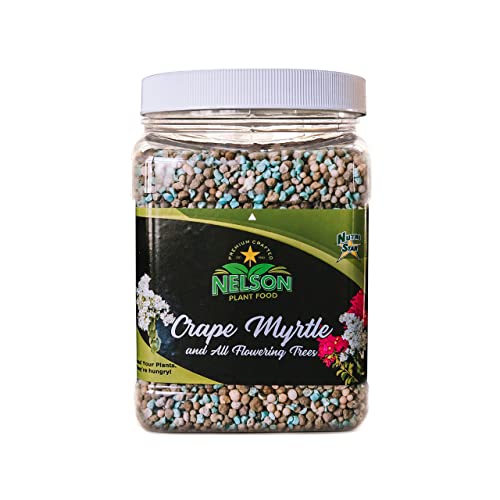
Nelson Plant Food’s NutriStar is one of the rare formulations designed specifically for crepe myrtles and other flowering trees. The 10-15-9 ratio delivers a phosphorus punch just before bloom season, while five different nitrogen sources provide a staggered release that prevents a sudden growth surge. Sulfur, iron, and manganese are included to fight chlorosis—a common problem in alkaline or clay-heavy soils.
User reports consistently mention visible results within two weeks of application, even on trees that had refused to bloom for multiple seasons. The granular format makes it easy to top-dress around the drip line or incorporate into potting media for container trees. A single 2-pound bag lightly feeds up to five small trees, making it a targeted investment rather than a bulk buy.
For anyone looking for a product that was literally tested on crepe myrtles, this is the most direct match.
Why it’s great
- Custom ratio (10-15-9) designed specifically for flowering trees like crepe myrtle
- Includes chelated iron, manganese, and sulfur for chlorosis prevention
- Staggered-release nitrogen feeds for up to 4 months
Good to know
- Small 2 lb. size may require multiple bags for a large landscape with many trees
- Some users feel the cost per ounce is higher than general-purpose alternatives
2. SimplyGro 8-8-8 Tree & Shrub Fertilizer Spikes (12 Spikes)
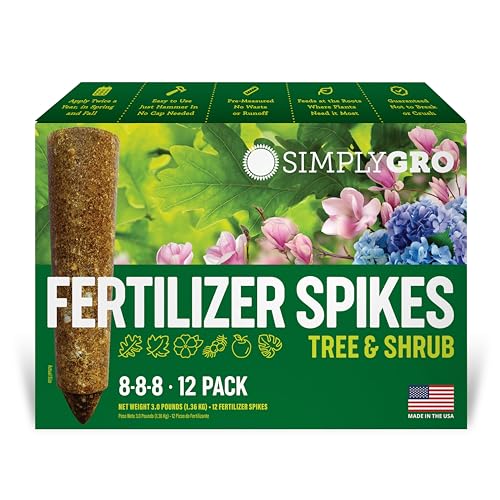
SimplyGro’s TruSpikes solve the most common user complaint about granular fertilizer: mess. These 5-inch spikes drive directly into the soil around the drip line, releasing a balanced 8-8-8 formula directly to the root zone for up to three months. The patented construction is rigid enough to hammer into hard clay without crumbling, and the lack of surface granules means no runoff into waterways.
One review specifically called out a crepe myrtle that showed new bloom growth within 3–4 weeks of spike insertion. The balanced NPK ratio makes these appropriate for general tree health rather than aggressive bloom forcing, which is ideal for mature crepe myrtles that already have good structure but need steady maintenance. With 12 spikes per box, you can treat multiple medium-sized trees in a single session.
The biggest advantage is the set-and-forget nature: apply twice a year (spring and fall) and you’re done. For gardeners who want a hands-off approach without sacrificing nutrition, this is the most convenient option in the group.
Why it’s great
- No measuring, no mixing, no surface mess
- Feeds continuously for up to 3 months per spike
- Rigid construction won’t break or crush during installation
Good to know
- Balanced 8-8-8 ratio is not bloom-specific, so may not push maximum flower density
- Less effective for small container trees where spike placement is tight
3. Carl Pool BR-61 Plant Food 9-58-8 (3 Lbs)
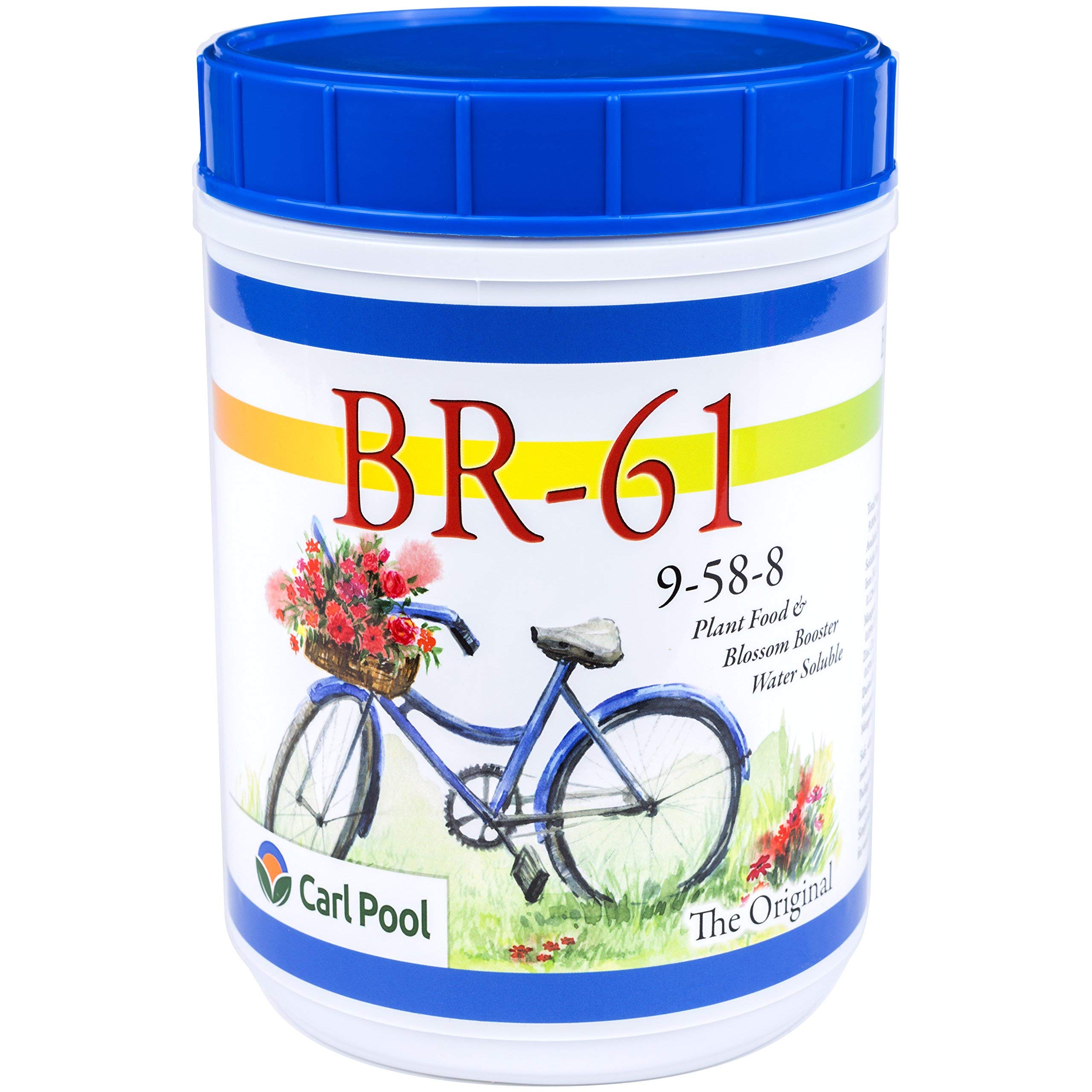
If your crepe myrtle is producing abundant leaves but only a handful of flowers, the issue is almost certainly a phosphorus shortage. Carl Pool’s BR-61 delivers a massive 58% phosphorus content—the middle number—which directly fuels bud formation. The 9-58-8 ratio is among the highest phosphorus concentrations you’ll find in a balanced garden fertilizer.
User reviews from plumeria and hibiscus growers confirm that this powder triggers aggressive blooming in plants that had plateaued. For crepe myrtles, a single early-spring application at the recommended rate can double the number of panicles compared to a standard 10-10-10 feed. The 3-pound bag is a generous size for the mid-range price, and it stores well if kept dry between uses.
The caveat is that high-phosphorus formulas require careful application. Over-application can lead to nutrient lockout, so follow the mixing guide precisely and avoid using this on seedlings or newly transplanted trees.
Why it’s great
- Extremely high phosphorus (58%) directly targets flower production
- Large 3 lb. bag offers strong value per feeding
- Effective on other flowering plants like plumeria and hibiscus
Good to know
- Requires careful measuring to avoid nutrient burn
- Not suitable for young or newly planted trees
4. Element Nutrients Flower Fuel 1-34-32 (250g)

Flower Fuel uses an ultra-low nitrogen (1%) and ultra-high phosphorus (34%) and potassium (32%) profile to push plants into an intense flowering phase. It’s a hydroponic-grade soluble powder, but it works just as well in soil when mixed as a drench. For crepe myrtles in containers, where root space limits nutrient uptake, this concentrated formula delivers a rapid, measurable bloom response.
The 250g jar treats 200 gallons of water, which means a single purchase can cover years of spot-feeding for a handful of trees. Users report seeing new blossoms within two weeks, particularly on stressed or reluctant plants. The key is to start with a weaker solution—the manufacturer recommends 1/4 teaspoon per gallon—to avoid burning sensitive roots.
This is a premium-tier product in terms of performance density, not package size. It’s best used as a supplement alongside a balanced base fertilizer rather than as a standalone feed, especially for in-ground trees that need broader nutrition.
Why it’s great
- Extremely concentrated: 250g treats 200 gallons of water
- Very high phosphorus and potassium drive rapid bloom formation
- Works in soil, coco, or hydroponic setups
Good to know
- Nearly zero nitrogen means it must be paired with a base fertilizer for full nutrition
- Mixing errors can cause leaf burn; starting with a weak solution is essential
5. FoxFarm Happy Frog Acid Loving Plants Fertilizer (4 lb.)

FoxFarm’s Happy Frog line is built for acid-loving plants, making it a natural fit for crepe myrtles that prefer a soil pH between 5.5 and 6.5. The slow-release granular formula includes mycorrhizal fungi and beneficial soil microbes that improve nutrient uptake and water absorption, which is especially helpful in sandy or depleted soils.
At 4 pounds, this is the heaviest bag in the group, offering the most feedings per purchase at a budget-friendly cost per feeding. Users report noticeable green-up within 10 days and sustained blooms throughout the growing season. The gentle formulation makes it safe for newly planted trees and sensitive container gardens.
The trade-off is that this fertilizer is not bloom-specific. Its NPK ratio is lower in phosphorus than the Carl Pool or NutriStar options, so it works best as a general soil conditioner that supports overall tree health rather than forcing a flower show. For trees already in good condition, it provides consistent, low-risk nutrition.
Why it’s great
- Large 4 lb. bag provides the most feedings per dollar
- Contains mycorrhizal fungi and soil microbes for root health
- Gentle, slow-release formula safe for young and container trees
Good to know
- Not a high-phosphorus bloom booster; better for general maintenance
- Some users find the organic smell stronger than synthetic formulas
FAQ
Why are the leaves on my crepe myrtle turning yellow even though I fertilized?
Can I use a general 10-10-10 lawn fertilizer on my crepe myrtle?
How often should I feed my crepe myrtle during the growing season?
Final Thoughts: The Verdict
For most users, the best crepe myrtle fertilizer winner is the NutriStar 10-15-9 because it is purpose-formulated for flowering trees, includes critical micronutrients for chlorosis control, and provides a slow-release feed that keeps blooms coming all summer. If you want a completely mess-free system, grab the SimplyGro 8-8-8 Spikes. And for reviving a stubborn tree that hasn’t bloomed in years, nothing beats the phosphorus density of the Carl Pool BR-61 9-58-8.

Mo Maruf
I created WellFizz to bridge the gap between vague wellness advice and actionable solutions. My mission is simple: to decode the research and give you practical tools you can actually use.
Beyond the data, I am a passionate traveler. I believe that stepping away from the screen to explore new environments is essential for mental clarity and physical vitality.