Our readers keep the lights on and my smoothie glass nicely filled. As an Amazon Associate, I earn from qualifying purchases.
Kneeling on a cold concrete floor while trying to reach a bolt that’s exactly three inches out of arm’s reach is a special kind of misery. A proper creeper seat eliminates that entire dynamic — letting you glide from wheel well to transmission pan without once standing up or sacrificing lower back comfort.
I’m Mohammad Maruf — the founder and writer behind WellFizz. After cross-referencing hundreds of verified owner experiences and dissecting the real-world load ratings, caster diameters, and foam densities that separate a long-term shop companion from a wobbly waste of garage space, I’ve built this guide around what actually matters when you sit down to work.
Whether you are a weekend DIYer or a pro turning wrenches eight hours a day, finding the best creeper seat means balancing rolling smoothness, height range, storage capacity, and maximum weight support for your specific body and workspace.
How To Choose The Best Creeper Seat
Shopping for a rolling shop stool goes beyond picking a color that matches the toolbox. The wrong choice means sore hips, wheels that jam, or a seat that’s too low to reach the engine bay. Focus on the four factors that reappear in every positive owner review and every complaint.
Weight Capacity and Frame Construction
The rating stamped on the box is only half the story. A seat that holds 400 pounds on paper can still wobble if the frame uses thin-walled tubing or the pneumatic cylinder lacks lateral bracing. Look for one-inch steel frame members and a wide base footprint — those two details stabilize the seat far more than a four-digit load claim. For larger users, prioritize models with documented real-world support over 300 pounds rather than theoretical maximums.
Caster Size and Surface Compatibility
Wheel diameter determines whether the seat glides over concrete joints, dropped bolts, and oily patches or comes to a dead stop. Three-inch casters work on smooth epoxy floors, but five-inch wheels roll effortlessly over rough broom-finished concrete and small debris. Material matters too: polyurethane resists oil absorption and won’t leave black marks, while hard plastic casters skid and wear fast. Locking casters are essential if you work on a sloped driveway or want stability when leaning to reach a tool.
Seat Comfort and Adjustability
The difference between a tolerable three-hour session and a miserable one often comes down to foam density and seat width. Thin padding compresses to the steel plate after thirty minutes. Look for at least three inches of high-density memory foam or firm polyurethane foam. Pneumatic height adjustment is smoother than pin-and-hole systems for fine-tuning the distance to the floor. A seat diameter of fourteen inches or wider distributes pressure better for larger body types.
Integrated Storage and Tray Design
A tool tray under the seat is only useful if it stays attached and holds its shape under the weight of a ratchet set. Metal trays or thick reinforced plastic trays survive daily abuse. Drawers add organization for sockets and wrenches, but check that they slide smoothly and close securely — loose drawers opening during movement dump your tools across the shop floor. Bonus features like can holders or magnetic strips add convenience, but never trade frame stability for extra storage slots.
Quick Comparison
On smaller screens, swipe sideways to see the full table.
| Model | Category | Best For | Key Spec | Amazon |
|---|---|---|---|---|
| Whiteside HRS | Premium | Pro-grade durability & stability | 3-inch oil-resistant rollers | Amazon |
| Powerbuilt 240299 | Premium | Maximum storage & 500-lb capacity | 1-inch steel frame members | Amazon |
| Omega-Lift 92450 | Premium | Built-in toolbox with 3 drawers | 450-lb capacity on 3″ casters | Amazon |
| Freeky Rock D10-R | Mid-Range | Ergonomic backrest & dual trays | 3.94-inch thick memory foam | Amazon |
| Traxion Monster 2-230 | Mid-Range | Rough-floor rolling with 5″ wheels | 5-inch synthetic rubber casters | Amazon |
| Pro-LifT C-2036DG | Budget | 2-in-1 creeper and seat versatility | 300-lb capacity, 6 swivel casters | Amazon |
| VEVOR Pneumatic Stool | Budget | Adjustable height on a tight budget | 16-22 inch pneumatic range | Amazon |
In‑Depth Reviews
1. Whiteside HRS Professional Mechanic’s Seat

The Whiteside HRS is built in Delaware, Ohio, and it shows in every weld and roller. The wide base offers a planted feel that cheaper circular bases cannot match — leaning sideways to grab a tool feels stable, not tippy. The three-inch oil-resistant casters roll smoothly over concrete seams and common shop debris, and they do not leave scuff marks on clean floors.
Tool storage comes via a 15 by 15-inch tray that includes a built-in magnetic strip for holding screws, sockets, and small parts during disassembly. This eliminates the tray sliding off or spilling when you roll across an expansion joint. The seat foam is dense and supportive without being rock hard, and multiple long-term owners report using the HRS for three to four hours straight without back pain.
Assembly takes about five minutes with basic tools, and ground clearance is just under four inches, keeping the center of gravity low. The design is intentionally simple — no pneumatic lever, no drawers, no gimmicks — which is exactly why seasoned pros trust it to last a decade or more in a working shop.
Why it’s great
- USA-made with heavy-duty steel frame that resists twisting
- Magnetic strip keeps small ferrous parts from rolling away
- Oil-resistant rollers glide over rough concrete without marking
Good to know
- Fixed height — no pneumatic or pin adjustment for seat level
- Seat cushion appearance may vary slightly from product photos
2. Powerbuilt Professional Detailers Roller Seat 240299

Powerbuilt calls this the Land Yacht of mechanic seats, and the one-inch steel frame members back that claim up. The 16-inch wide seat provides generous surface area for larger body types, and the foam is firm enough that it does not bottom out against the steel base. Two locking casters prevent rolling on sloped driveways — a feature many heavy-duty seats skip.
Storage is the standout here. Two full steel sliding drawers hold rags, detailing supplies, and hand tools securely, and the front tool tray combined with a can caddy that fits two aerosol cans keeps the workflow uninterrupted. Owners above 300 pounds report the seat feels solid and stable even during extended use, and the powder coat finish resists chipping from dropped tools.
Assembly requires about 45 minutes, but the hardware bags are labeled individually and the instructions are detailed enough for first-time builders. The three-inch casters roll well on smooth concrete but larger users may want to swap in sturdier aftermarket wheels if the shop floor is rough. The drawer slides are smooth out of the box but close with a solid sound rather than a soft stop.
Why it’s great
- Impressive 500-pound capacity on a stable steel frame
- Two locking casters prevent movement on sloped surfaces
- Integrated can caddy and dual drawers keep gear organized
Good to know
- Drawers close firmly rather than with a soft push
- Stock casters may struggle under full load on rough concrete
3. Omega-Lift 92450 Mechanic Stool with Toolbox

Omega-Lift designed the 92450 for mechanics who need a rolling seat and a small toolbox in one unit. The three ball-bearing slider drawers offer dedicated space for sockets, wrenches, and small tools, with both front and rear segmented trays for quick-access items. The vinyl-covered seat cushion is dense foam rather than cheap soft padding, so it holds up after hours of brake jobs and body work.
Four three-inch polyurethane casters roll 360 degrees without binding and resist oil absorption. The steel frame feels solid, and several owners have tested the capacity with heavy parts exceeding the 450-pound rating without visible flex. The seat height is fixed, but the overall dimension of 18.88 inches sits at a comfortable level for most truck and car work.
The plastic side trays have drawn some criticism for cracking under foot pressure, though the front tray is noticeably sturdier. Drawers are designed so they stay closed during movement but open smoothly with the ball-bearing slides. This seat is slightly taller than a traditional creeper, which helps when working on lifted vehicles or SUVs.
Why it’s great
- Three full ball-bearing drawers organize tools right under the seat
- Polyurethane casters roll smoothly without leaving marks
- Rigid steel frame handled near 450 pounds without wobble
Good to know
- Plastic side trays can crack under heavy foot pressure
- Drawers may slide open during movement if not securely closed
4. Freeky Rock D10-R Rolling Shop Stool with Backrest
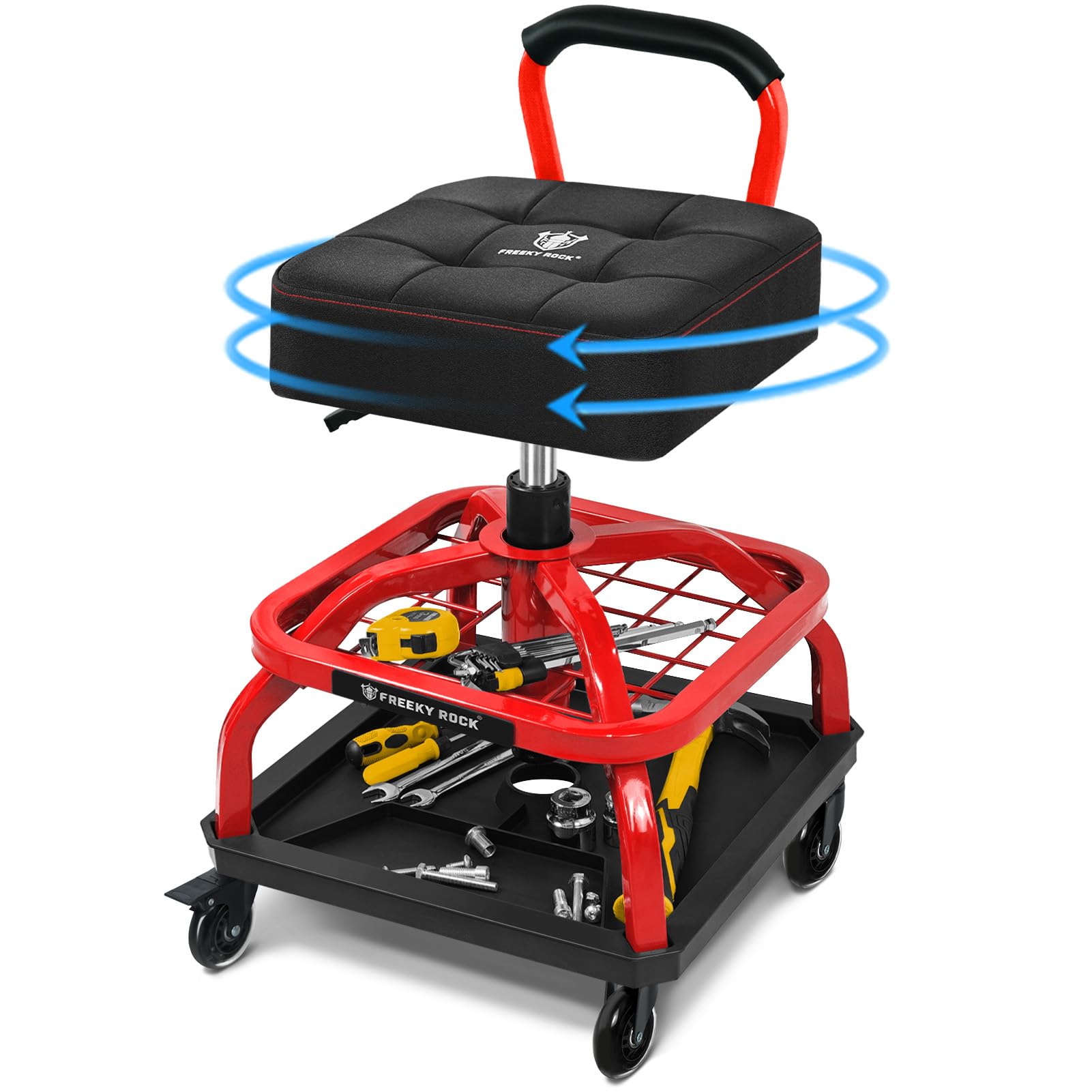
The most noticeable feature on the Freeky Rock D10-R is the seat cushion: 3.94 inches of memory foam on a 14.37-inch diameter platform. That thickness prevents the foam from compressing to the steel plate even during long detailing sessions. The removable backrest provides lumbar support that unclips when you need to spin around or reach behind the seat.
Height adjusts pneumatically from 19.68 to 25.19 inches, which covers everything from sliding under a bumper to sitting upright at a workbench. The dual-layer storage under the seat combines a metal mesh tray for heavy sockets and a plastic tray for smaller parts, keeping the workspace clean. Two of the five casters lock, and the 330-pound weight capacity covers the majority of home garage users.
Assembly takes under ten minutes, and the casters roll smoothly on both concrete and indoor flooring. The backrest handle is wrapped in resilient NBR material that stays grippy even with oily hands. Some users noted they wanted the seat to go lower than 19 inches for low-clearance work, but the pneumatic range works well for most automotive and woodworking tasks.
Why it’s great
- Nearly four inches of memory foam padding for all-day comfort
- Dual-layer tool storage with metal and plastic trays
- Removable padded backrest supports the lower back
Good to know
- Lowest seat height of 19.68 inches may be too high for tight under-car clearance
- Backrest handle position may feel too high for shorter users
5. Traxion Monster Rolling Mechanic Stool 2-230

Traxion built the Monster specifically to handle rough shop floors. The five-inch synthetic rubber casters are the largest found in this mid-range tier, which means they roll over concrete joints, dropped bolts, and even low-pile carpet without hesitation. The tractor-style seat is wide and padded with dense foam that supports up to 400 pounds without sagging.
The adjustment lever underneath the seat allows height changes from 18 to 24 inches through a pneumatic cylinder, and the reach is easy even while seated. The tool tray is made of thin plastic, which is functional but feels less premium compared to metal alternatives. Multiple owners have reported using this seat for over three years with nothing more than routine tightening of the casters.
Assembly requires only a T40 Torx bit and takes about ten minutes. One common note from customers is that the advertised maximum height of 24 inches is not achievable out of the box — the seat tops out closer to 17.5 inches. The manufacturer has sent replacement cylinders to customers who needed the full range. For most users working on cars and trucks, the actual height works perfectly.
Why it’s great
- Five-inch rubber casters float over rough concrete and debris
- Generous 400-pound capacity on a wide, stable base
- Simple pneumatic lever for height changes while seated
Good to know
- Maximum height may fall short of the 24-inch claim without a cylinder swap
- Tool tray is thin plastic rather than steel
6. Pro-LifT C-2036DG Black/Green 300 Lbs Mechanic Creeper

This Pro-LifT model stands out because it serves two roles: it works as a rolling seat for side-of-car tasks and flips into a full-length creeper for under-vehicle access. The retractable pin mechanism changes modes quickly, which saves time when you need to switch from brake work to exhaust repair. Six swivel casters provide easy maneuverability in both configurations.
The vinyl padded seat and headrest are comfortable enough for short to medium sessions, though the foam is thinner than dedicated seat-only models. Experienced owners recommend tightening the wheels periodically because the hardware can loosen during frequent mode changes. The 300-pound weight capacity covers most users, and the metal frame has not shown bending or cracking in long-term reviews.
Assembly takes about 20 minutes and requires simple hand tools. The green paint does scuff more easily than powder-coated finishes, but the functionality holds up. This is a strong option for hobbyists who want one tool that handles both sitting and lying-down work without buying two separate pieces of equipment.
Why it’s great
- Converts between seat and full creeper with a quick-pin mechanism
- Six swivel casters provide smooth movement in tight spaces
- Padded headrest adds neck support in creeper mode
Good to know
- Seat foam is thinner than dedicated rolling stools, less ideal for all-day sitting
- Wheels may loosen with repeated mode changes; periodic tightening needed
7. VEVOR Pneumatic Mechanic Stool 250 LBS

VEVOR brings pneumatically adjustable height into the entry-level bracket without cutting corners on the cylinder quality. The seat adjusts from 16 to 22 inches via a smooth pneumatic rod, which is rare at this tier. The steel tool tray resists impact from dropped tools and corrosion better than the plastic trays found on many budget competitors.
Five 2.5-inch 360-degree universal casters provide decent mobility on smooth garage floors, though the smaller diameter means they can hang up on larger debris or deep expansion joints. The wide padded seat is comfortable for light duty use, and the 250-pound weight capacity is sufficient for most home mechanics. The casters fasten with locknuts and thread glue, which prevents the loosening issues common in this price range.
Assembly requires only a Phillips screwdriver and takes under 15 minutes. The center of gravity stays stable during movement, and users report no tipping even when leaning to the side. The padding is thin compared to premium models — adding a gel seat cushion improves long-session comfort significantly. This is the right choice for a budget-conscious buyer who still wants pneumatic adjustability and a steel tray.
Why it’s great
- Smooth pneumatic height adjustment from 16 to 22 inches at a low entry point
- Steel tool tray withstands impact and resists corrosion
- Locknut and thread glue construction keeps casters tight
Good to know
- Seat padding is thin; a supplemental cushion helps for longer jobs
- 2.5-inch casters struggle on rough concrete or heavy debris
FAQ
What is the ideal seat height for working on a standard car?
Can a creeper seat replace a traditional rolling creeper?
How much weight should a creeper seat realistically support?
What size casters do I need for a rough garage floor?
Final Thoughts: The Verdict
For most users, the best creeper seat winner is the Whiteside HRS because it combines USA-made steel construction, a magnetic tool tray, and oil-resistant rollers in a stable, low-profile package that professional mechanics trust for years of daily abuse. If you need maximum onboard storage and a 500-pound capacity, grab the Powerbuilt 240299. And for a budget-friendly entry point with pneumatic height adjustment, nothing beats the VEVOR Pneumatic Stool — just add a gel cushion for longer sessions.

Mo Maruf
I created WellFizz to bridge the gap between vague wellness advice and actionable solutions. My mission is simple: to decode the research and give you practical tools you can actually use.
Beyond the data, I am a passionate traveler. I believe that stepping away from the screen to explore new environments is essential for mental clarity and physical vitality.