Our readers keep the lights on and my smoothie glass nicely filled. As an Amazon Associate, I earn from qualifying purchases.
Managing the visible white patches of vitiligo often feels like a lonely road of trial and error — trying formulas that promise results but deliver only temporary hydration. The real need isn’t concealment; it’s a targeted approach that supports your skin’s natural melanocyte function over the long term.
I’m Mohammad Maruf — the founder and writer behind WellFizz. After analyzing countless ingredient panels and clinical reports, I’ve filtered the market down to the formulations that actually address pigment pathways and skin barrier health.
Whether you prefer a fast-absorbing topical or a nutritional supplement to work from within, finding the right cream for vitiligo hinges on matching ingredients like Polypodium Leucotomos or L-Tyrosine to your specific needs and routine.
How To Choose The Best Cream For Vitiligo
Vitiligo is not just a cosmetic concern — it affects the immune system’s relationship with melanocytes, and not every “brightening” cream is built for pigment loss. Below are the specific factors to weigh before buying.
Active Ingredients: The Real Difference Makers
Look for ingredients like Polypodium Leucotomos (a fern extract known for its photoprotective and immunomodulatory properties), L-Tyrosine (an amino acid precursor to melanin), and key vitamins such as B12, Folic Acid, and Zinc. A cream that only moisturizes won’t repigment — the active compounds must be listed high on the ingredient label.
Format and Absorption
Topical creams, gels, and hydrogels each deliver actives differently. Gels tend to penetrate faster and are non-greasy, making them ideal for daytime use on the face. Creams with a richer base can work well for body areas where you need longer contact time, especially overnight.
Internal Support Matters
Many of the most effective protocols combine a topical cream with an oral supplement that provides L-Tyrosine, Copper, and Vitamin B12. If your chosen product line offers a capsule alongside the cream, the two may work synergistically to address pigment production from both outside and inside.
Quick Comparison
On smaller screens, swipe sideways to see the full table.
| Model | Category | Best For | Key Spec | Amazon |
|---|---|---|---|---|
| Vitiligo Cream for White Spots (4oz) – Aura Dermacare | Topical Cream | Daily repigmentation support | Polypodium Leucotomos | Amazon |
| ACM Laboratoire Vitix GEL Repigmentation 50ml | Topical Gel | Clinically proven gel routine | Non-greasy rapid absorption | Amazon |
| Viti-Nutrients Comprehensive Vitamins 120 Tablets | Oral Supplement | Internal nutrient support | L-Tyrosine + B12 + Folic Acid | Amazon |
| Vitiligo Capsules 60 Count – Aura Vitamins | Oral Supplement | Budget-friendly supplement | Vitamins C, E, Zinc | Amazon |
| Vitiskin Regulating Depigmentation Hydrogel | Hydrogel | Unique polymeric delivery | Polymeric hydrogel base | Amazon |
In‑Depth Reviews
1. Vitiligo Cream for White Spots (4oz) – Aura Dermacare
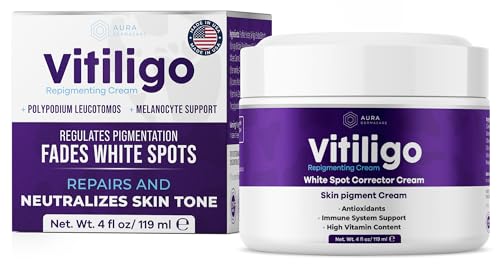
This cream stands out because it directly tackles repigmentation with Polypodium Leucotomos, a fern extract that supports melanocyte function while calming the immune response. The formula also includes antioxidants and vitamins that nourish the skin barrier, making it suitable for daily use on the face, hands, and arms.
Users report visible improvement after several weeks of consistent application, with multiple reviews noting that pigmentation returned slowly but steadily. The cream is dermatologist-formulated, paraben-free, and steroid-free, which reduces the risk of irritation on sensitive skin.
Its non-greasy, fast-absorbing texture means it layers well under sunscreen or moisturizer, so it doesn’t disrupt your existing skincare routine. The 4-ounce size offers a reasonable supply for long-term use.
Why it’s great
- Polypodium Leucotomos actively supports natural repigmentation
- Non-greasy, fast-absorbing, gentle enough for the face
- Dermatologist-formulated without parabens or steroids
Good to know
- Results require consistent daily application over weeks
- Not a standalone cure for severe or extensive vitiligo
2. ACM Laboratoire Vitix GEL Repigmentation 50ml

Vitix GEL from ACM Laboratoire is a medical-grade topical gel that has been studied in clinical trials for its repigmentation activity. The gel base allows the active ingredients to absorb quickly without leaving a residue, making it easy to apply under clothing or sunscreen.
Several long-term users report that it helped reverse pigment loss after years of trying other treatments, though the protocol requires discipline — applying the gel for at least eight hours per day, five days a week, with two rest days. Some users pair it with prescribed topical treatments for enhanced effectiveness.
It is well-tolerated with no reported side effects in most reviews, though a minority of users saw no change after two months of use. The non-greasy format is ideal for those who dislike heavy creams, especially during warmer weather.
Why it’s great
- Clinically studied gel formulation for repigmentation
- Rapidly absorbed, non-greasy, no harsh chemicals
- Positive long-term results reported by consistent users
Good to know
- Requires a strict daily protocol for many hours of wear
- Works best when combined with prescribed topical treatment
3. Viti-Nutrients Comprehensive Vitamins 120 Tablets

This oral supplement is designed specifically for people with vitiligo, providing L-Tyrosine, Vitamin B12, Folic Acid, Zinc, and Copper — nutrients that directly support melanin production and immune balance. Many users incorporate it as a daily companion to their topical treatment for a dual-action approach.
Reviews highlight that it can help stop the spread of white patches over time, and some users report that non-pigmented skin becomes less prone to sunburn after consistent use. The 120-tablet bottle lasts approximately two months, making it a straightforward addition to your morning routine.
While not a topical cream, its targeted nutrient profile fills gaps that many vitiligo patients have, especially when dietary intake is insufficient. Combined with a cream from this list, it creates a comprehensive protocol.
Why it’s great
- Contains L-Tyrosine, B12, Folic Acid, Zinc, and Copper
- Helps slow spread and supports repigmentation process
- Easy two-month supply per bottle
Good to know
- Works gradually; visible results can take several months
- Not a replacement for a topical treatment — best used together
4. Vitiligo Capsules 60 Count – Aura Vitamins

These capsules provide a budget-friendly blend of Vitamin C, Vitamin E, and Zinc — antioxidants that protect skin cells from oxidative stress, which is thought to contribute to depigmentation. They are manufactured in a GMP-certified facility and free from artificial additives.
User experiences are mixed: some saw noticeable reduction in white spots on the face, while others reported no effect. The formula is simpler than the more comprehensive Viti-Nutrients, lacking L-Tyrosine and Copper, which are more directly tied to melanin production.
For those wanting to dip their toes into oral supplementation for vitiligo without a large upfront cost, these capsules are a reasonable starting point. They are better suited as a general skin health support than a targeted pigment-regeneration product.
Why it’s great
- Budget-friendly entry point for oral supplementation
- GMP-certified with no artificial preservatives
- Antioxidant blend supports overall skin health
Good to know
- Lacks L-Tyrosine and Copper for direct pigmentation support
- Results vary significantly among users
5. Vitiskin Regulating Depigmentation Polymeric Hydrogel

Vitiskin uses a polymeric hydrogel base, which is an advanced delivery system designed to keep active ingredients in contact with the skin longer than a standard cream. The gel texture is lightweight and cooling, making it comfortable for warm climates or for use on large body areas.
Customer feedback is divided: some users report gradual repigmentation, while others saw little to no improvement after extended use. A few long-term buyers purchased multiple bottles hoping for results but eventually gave up. The product is recommended by some dermatologists, which adds credibility.
Its unique format may appeal to those who have tried traditional creams without success and are looking for a different delivery mechanism. However, given the mixed feedback, it is best approached with realistic expectations about the time frame for results.
Why it’s great
- Polymeric hydrogel ensures longer skin contact time
- Lightweight, cooling feel ideal for body application
- Recommended by some dermatologists
Good to know
- Mixed customer reviews on effectiveness
- Requires long-term commitment with no guarantee of results
FAQ
How long does it take to see results from a vitiligo cream?
Can I use a vitiligo cream together with a supplement?
Are vitiligo creams safe for sensitive skin?
Final Thoughts: The Verdict
For most users, the cream for vitiligo winner is the Vitiligo Cream for White Spots by Aura Dermacare because it combines Polypodium Leucotomos with a gentle, non-greasy base that is easy to use daily. If you prefer a clinically studied gel that penetrates rapidly, grab the ACM Laboratoire Vitix GEL. And for internal support that complements topical treatment, nothing beats the Viti-Nutrients Comprehensive Vitamins.

Mo Maruf
I created WellFizz to bridge the gap between vague wellness advice and actionable solutions. My mission is simple: to decode the research and give you practical tools you can actually use.
Beyond the data, I am a passionate traveler. I believe that stepping away from the screen to explore new environments is essential for mental clarity and physical vitality.