Our readers keep the lights on and my smoothie glass nicely filled. As an Amazon Associate, I earn from qualifying purchases.
A cement burn isn’t a simple scrape — it’s a chemical injury that keeps burning through tissue until the alkaline paste is neutralized. The wrong cream seals in the irritant; the right one hydrates, cools, and lets the wound breathe while the skin rebuilds underneath.
I’m Mohammad Maruf — the founder and writer behind WellFizz. I’ve spent hundreds of hours analyzing first-aid formulations, hydrogel science, and burn recovery protocols to separate the creams that actually work from those that just sit on the shelf.
Whether you’re a mason, a DIY patio layer, or a weekend gardener, knowing which formula delivers real relief matters. This guide cuts through the marketing to find the best cream for cement burns — the products that stop the chemical reaction, soothe the pain, and support clean healing without trapping contaminants.
How To Choose The Best Cream For Cement Burns
Choosing a cream for cement burns comes down to three factors: how it manages moisture, what ingredients it uses to fight infection, and whether it creates a barrier that helps or hurts the healing process. Get these right, and your skin recovers faster with less scarring.
Moisture Management — Hydrogel vs. Ointment
Cement burns are deep, dry, and prone to cracking. A thick ointment can seal the wound, trapping alkaline residue inside. Hydrogel does the opposite — it hydrates the burn without oil, creating a moist environment that draws out debris while letting the wound breathe. For cement burns, look for oil-free, water-based gel formulas.
Infection Protection Without Irritation
Traditional antibiotic ointments often sting on chemical burns and can delay healing by drying the tissue. Natural agents like tea tree oil and aloe vera provide broad antimicrobial coverage without the irritation. The best creams combine these with sterile, non-adherent dressings to protect the wound during changes.
Dressing Compatibility and Coverage
A cream only works if it stays on the wound. Thicker gels and ointments adhere better to irregular burn surfaces like knees, elbows, and fingers. If the burn covers a large area, choose a product that comes in a larger container or as part of a kit with sterile pads that stay in place without adhesive pulling on new skin.
Quick Comparison
On smaller screens, swipe sideways to see the full table.
| Model | Category | Best For | Key Spec | Amazon |
|---|---|---|---|---|
| BurnFix® 8-Pack | Premium Kit | Comprehensive coverage with hospital-grade dressings | 8 sterile 4×4 hydrogel pads with tea tree oil | Amazon |
| RHINO RESCUE Burn Kit | Emergency Kit | All-in-one burn kit for home or travel | 4 dressings + 8 gel packets + tools in one bag | Amazon |
| B & W Ointment | Thick Ointment | Deep-penetrating relief for small, stubborn burns | 4 oz. thick petroleum-free ointment | Amazon |
| Dimora Hydrogel | Hydrogel | Oil-free hydration for sensitive burn sites | 2 x 6 oz. water-based hydrogel tubes | Amazon |
| BurnFix® 4-Pack | Standard Pack | Affordable multiple-dressing option for small burns | 4 sterile 4×4 hydrogel dressings | Amazon |
In‑Depth Reviews
1. BurnFix® 8-Pack Hydrogel Dressing

The BurnFix 8-Pack delivers the most versatile burn care in this list. Each 4×4-inch sterile pad is saturated with a medical-grade hydrogel enriched with tea tree oil — a combination that cools on contact, fights infection, and keeps the wound moist without sticking to new skin. For cement burns that cover larger areas like forearms or knees, having eight individually sealed dressings means you can treat the burn immediately and change the dressing without losing the initial relief.
The foam backing prevents the gel from drying out, so the dressing stays effective for hours. Users consistently report that the non-stick surface makes removal painless — critical when the burn is still sensitive. The clear illustrated instructions make application straightforward even in an emergency, and the hospital-quality construction mirrors what ER nurses use for chemical burns. This is the kit you grab when the cement hits skin and you need immediate, professional-grade relief.
For burn care that covers multiple applications, provides genuine pain relief, and reduces scarring risk through proper moisture management, this 8-pack is the definitive choice. The only downside some users note is that the instructions could be clearer in non-English languages, but the visual guide compensates.
Why it’s great
- Eight individual sterile pads — enough for multiple burns or dressing changes
- Tea tree oil provides broad antimicrobial protection without stinging
- Non-stick foam design allows pain-free removal even on sensitive new skin
Good to know
- Each pad covers a 4×4 area; larger burns may need multiple pads at once
- Instructions are primarily visual; non-English text is minimal
2. RHINO RESCUE Burn Kit
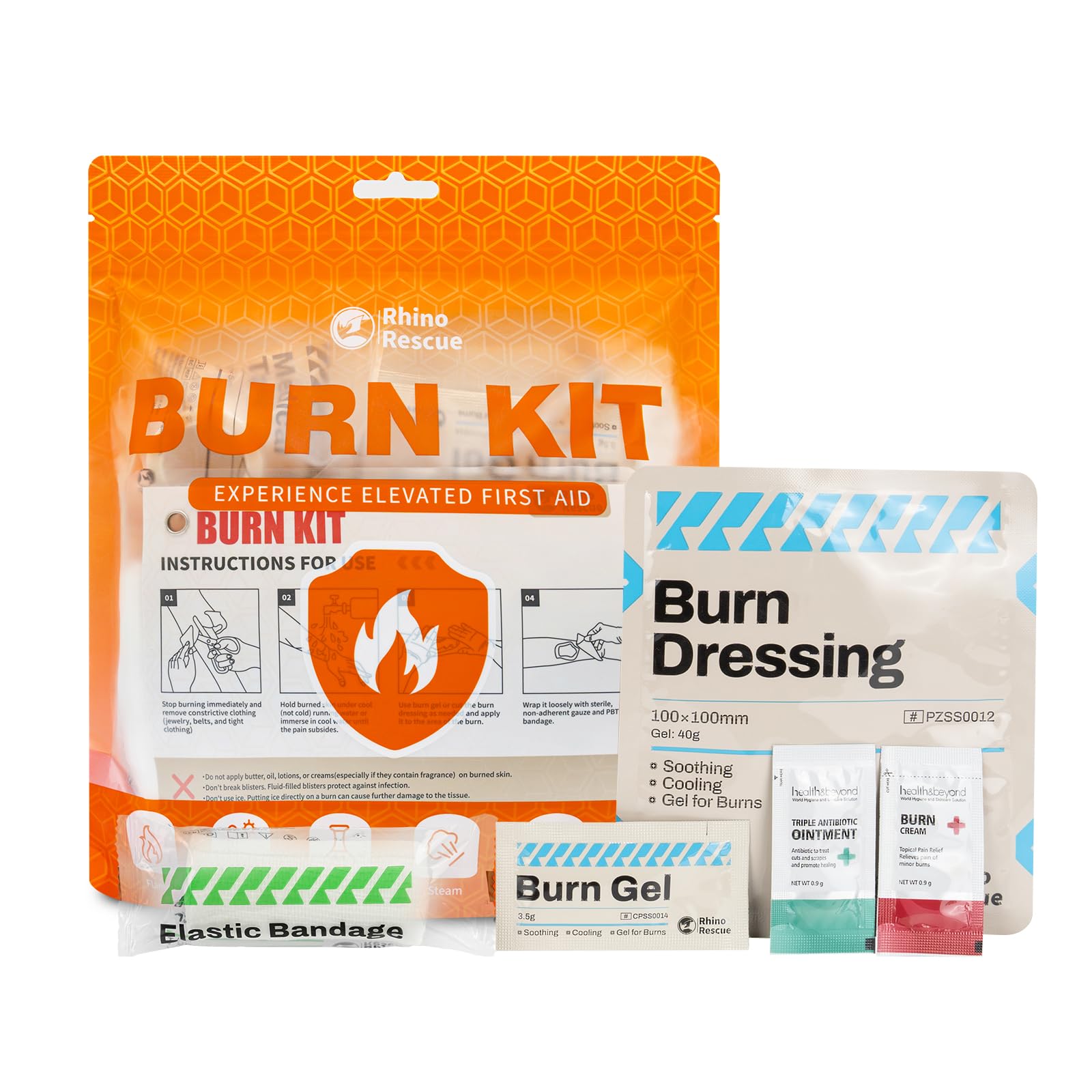
The RHINO RESCUE Burn Kit is designed for people who want everything in one bag — no hunting for scissors, gloves, or tape while someone is in pain. Inside the durable kit you get four 4×4-inch burn dressings, eight individual 3.5g gel packets, four non-adherent bandages, a PBT bandage, PE tape, bandage scissors, and a pair of nitrile gloves. For a cement burn on a job site or during a DIY project, having the complete set means you can clean, cool, dress, and secure the wound in under a minute.
The gel dressings are water-based and biodegradable, sterilized to prevent contamination on contact. Users consistently highlight how quickly the kit cools the burn and stops the chemical reaction from spreading to healthy tissue. The dressings work on any burn type — scalds, open flames, chemical, or electrical — making it a versatile addition to any first aid kit. The included user guide walks through each step so you don’t need prior training to provide effective care.
The only limitation is that the kit is best for initial treatment of 1-3 small burns rather than long-term wound management. For deeper cement burns that require multiple dressing changes over several days, you will need to supplement with extra supplies. But for emergency response and transport to medical care, this kit is hard to beat.
Why it’s great
- Complete kit includes dressings, gel packets, gloves, scissors, and tape
- Water-based biodegradable gel cools instantly without chemical residue
- Portable bag fits in a car glove box, tool bag, or camping pack
Good to know
- Best suited for initial emergency treatment, not long-term daily dressing changes
- For larger burns, you may need to buy additional dressings separately
3. B & W Burn and Wound Ointment

The B & W Ointment takes a different approach from the hydrogels on this list — it is a thick, petroleum-free ointment designed to stay on the wound without running. This makes it ideal for small, stubborn cement burns on hands, fingers, or knees where a gel might slide off. Users report that it provides noticeable pain relief and stays in place through movement, which is crucial for people who need to keep working after applying first aid.
Reviews consistently mention that it heals second-degree burns from hot tea or chemical exposure in 9 days or less, with reduced pain and itching during recovery. The thick consistency means a little goes a long way, so the 4 oz. container delivers solid value. It also absorbs well without leaving a greasy residue, and users appreciate that it has a pleasant scent compared to many burn treatments.
The main trade-off is that the thick ointment texture may not be suitable for large area burns on arms or legs, where a gel or dressing provides better coverage. Additionally, because it is an ointment rather than a gel, it is less ideal for wounds with heavy exudate — the ointment can trap moisture against the skin if the burn is still weeping. But for dry, localized chemical burns, it delivers dependable relief.
Why it’s great
- Very thick formula stays in place on hands, fingers, and knees
- Noticeable pain relief with a pleasant, natural scent
- Small amount covers the area well — good value from the 4 oz. container
Good to know
- Ointment texture not ideal for large burns or wounds with heavy exudate
- May require more frequent reapplication on areas that rub against clothing
4. Dimora Hydrogel First Aid Ointment

Dimora Hydrogel is the only oil-free, water-based cream in this lineup, making it the best choice for cement burns on sensitive areas like the face, neck, or private skin. The hydrogel formulation hydrates dry wound tissue without adding oil that can clog pores or irritate already damaged skin. It is also designed to conform to irregular wound contours — think cracked fingers, knuckles, or the gap between toes — areas where standard dressings often peel off.
Users with post-surgical wounds, blisters on heels, and even private-area comfort have reported that Dimora creates a long-lasting moist environment that soothes rather than stings. The 2-pack of 6 oz. tubes gives you a generous volume for treating multiple burns or for daily application over several days. Because it is oil-free, it does not stain clothes and washes off easily when you change the dressing.
The one catch is that Dimora is not ideal for wounds with a large amount of exudate — the gel will bulge and turn white as it absorbs, at which point it needs to be changed. It also specifies that infected wounds should be checked by a doctor before use. For clean, fresh cement burns on sensitive or hard-to-dress areas, it is the gentlest option available.
Why it’s great
- Oil-free water-based formula that won’t irritate sensitive burn sites
- Conforms to irregular contours like cracked fingers and joints
- Large 2-pack provides generous volume for daily dressing changes
Good to know
- Gel bulges and turns white when saturated — requires changing at that point
- Not suitable for wounds with heavy exudate or suspected infection
5. BurnFix® 4-Pack Hydrogel Dressing

The BurnFix 4-Pack is the entry-level version of the premium 8-pack, offering four sterile 4×4-inch hydrogel dressings at a more accessible price point. Each pad is soaked in the same tea tree oil and aloe vera formula that makes the larger pack so effective — it cools on contact, fights infection, and provides a moist healing environment that minimizes scarring. For someone who only needs to treat a single small cement burn and wants a few spare dressings, this is the smart choice.
Reviewers consistently note that it works well for minor burns, razor burns, and sunburns, and it makes an excellent addition to a bug-out bag or camping first aid kit. The dressings are easy to apply and remove without sticking, and the cooling sensation lasts for hours. Users who have compared it to other brands say it outperforms alternatives in terms of immediate pain relief.
The main limitation is that four dressings go quickly if you are treating a larger burn that requires dressing changes every 6-8 hours. The instructions are also noted as being in somewhat imperfect English, though the application process is simple enough to figure out visually. For small, contained cement burns that just need a few days of coverage, the 4-pack delivers solid performance without overbuying.
Why it’s great
- Same effective hydrogel and tea tree oil formula as the premium 8-pack
- Great value for treating a single small burn with spare dressings
- Compact packaging fits easily in a car kit, camping bag, or first aid drawer
Good to know
- Four dressings may not be enough for larger burns requiring frequent changes
- Instructions are not perfectly translated into English
FAQ
Can I use a regular first aid cream on a cement burn?
How often should I change a burn dressing for cement burns?
Can I use burn cream on a cement burn that already has blisters?
Final Thoughts: The Verdict
For most users, the best cream for cement burns winner is the BurnFix 8-Pack because it combines sterile hydrogel, tea tree oil, and hospital-grade dressings in a single ready-to-use package. If you want a complete emergency kit with tools included, grab the RHINO RESCUE Burn Kit. And for small, stubborn burns on hands or fingers where a thick formula stays put, nothing beats the B & W Ointment.

Mo Maruf
I created WellFizz to bridge the gap between vague wellness advice and actionable solutions. My mission is simple: to decode the research and give you practical tools you can actually use.
Beyond the data, I am a passionate traveler. I believe that stepping away from the screen to explore new environments is essential for mental clarity and physical vitality.