Our readers keep the lights on and my smoothie glass nicely filled. As an Amazon Associate, I earn from qualifying purchases.
When the grid goes down and your phone battery hits zero, a crank flashlight becomes your only dependable light source—no dead cells, no outlet required, just pure mechanical energy converted into illumination. Whether you are facing a hurricane season, a backcountry hike, or a simple power outage, understanding the crank-to-light efficiency, build quality, and multi-function capabilities of these devices separates a reliable emergency tool from a frustrating piece of plastic.
I’m Mohammad Maruf — the founder and writer behind WellFizz. I’ve spent hundreds of hours analyzing crank flashlight specifications, decoding the real-world efficiency of hand-crank generators, and cross-referencing actual user experiences to build this focused guide.
If you want a light source that never depends on disposable batteries and keeps working through extended emergencies, this guide to the best crank flashlight will walk you through the specific specs, power features, and trade-offs that actually matter.
How To Choose The Best Crank Flashlight
A crank flashlight is more than just a light—it’s a mechanical generator in your hand. The crank mechanism’s resistance, the gear train’s smoothness, and the internal battery’s capacity all determine whether you get 30 seconds of dim light from a minute of cranking or a solid 15 minutes of usable beam. Focus on three specific areas before buying.
Crank Efficiency and Gear Train Quality
The single most important spec is how many minutes of light you get per minute of cranking. Cheap units use poorly lubricated plastic gears that grind and break under moderate pressure, while well-designed models use metal-reinforced gears and balanced flywheels that deliver 10–15 minutes of flashlight runtime from 60 seconds of cranking. Test reviews for mentions of “smooth crank,” “easy turning,” and “consistent output” to identify units that won’t fail after a few cycles.
Internal Battery Chemistry and Capacity
Most crank flashlights include a rechargeable battery (typically NiMH or Li-ion) that stores the energy you generate. A 2000mAh Li-ion cell is common and can power a single LED for many hours or charge a phone in a pinch. Some budget models use older NiMH batteries that self-discharge faster, leaving you with a dead unit when you need it most. Look for units with removable 18650 Li-ion batteries for the best long-term reliability and replacement options.
Build Materials and Environmental Sealing
Drop a cheap crank flashlight on a concrete floor from waist height, and the casing often splits apart, sending gears flying. Durable models use thick ABS plastic or reinforced polymer housings with rubber overmolding on the grip. For outdoor use, an IPX4 waterproof rating (splash-proof) is the minimum acceptable standard—protected from rain and accidental submersion in puddles. If you plan to use the unit in wet conditions or rugged terrain, skip anything that feels hollow or creaks under hand pressure.
Quick Comparison
On smaller screens, swipe sideways to see the full table.
| Model | Category | Best For | Key Spec | Amazon |
|---|---|---|---|---|
| RunningSnail Emergency Radio | Radio + Light | Full emergency kit with weather alerts | 2000mAh Li-ion, AM/FM/NOAA | Amazon |
| ROCAM Hand Crank Flashlight | Radio + Light | High-lumen portable radio combo | 300 Lumens, 3000mAh, IPX4 | Amazon |
| PRUNUS J-369 Weather Radio | Radio + Light | Versatile AA battery emergency radio | 11100mWh, AA + crank + solar | Amazon |
| Oudain 4-Piece Solar Crank | Pure Crank Light | Multi-pack for kits and sharing | 50 Lumens, solar + crank, 86g | Amazon |
| Mudder 8-Pack Hand Crank | Pure Crank Light | Budget bulk for preparedness kits | 3 LEDs, NiMH, squeeze crank | Amazon |
In‑Depth Reviews
1. RunningSnail Emergency Hand Crank Radio With LED Flashlight

The RunningSnail delivers an exceptional balance of crank efficiency and multi-function utility at a mid-range price point. Its 2000mAh removable 18650 Li-ion battery stores enough energy for roughly 9–10 hours of radio playback or 15–17 hours of flashlight operation, and the hand crank generates about 3–5 minutes of radio or 45–60 minutes of flashlight per minute of cranking. The unit includes a dedicated NOAA weather band with automatic alert functionality, meaning it will notify you of incoming storms even when you are asleep.
Build quality is respectable for its class—the ABS/PC composite housing feels solid without being heavy, and the compact dimensions (5 x 1.8 x 2.4 inches) make it easy to stash in a bug-out bag or car glovebox. The flashlight uses a single 1W LED that cuts through darkness effectively for close- to mid-range tasks, and the bright red color aids visibility when you need to locate it quickly. Users consistently report clear AM/FM reception and a weather band that reliably picks up NOAA broadcasts in most suburban and rural areas.
The main practical limitation is the Micro USB charging port, which feels outdated compared to the USB-C found on newer units. Charging the internal battery via USB takes roughly four hours, and the solar panel is best treated as a trickle maintainer rather than a primary charging method. Despite these minor drawbacks, the RunningSnail offers a compelling mix of radio, power bank, and crank flashlight functions that justify its position as the top pick for most buyers.
Why it’s great
- Removable 18650 battery for easy replacement
- Reliable NOAA weather alert reception
- Excellent crank-to-light ratio (1 min crank = 45-60 min light)
Good to know
- Micro USB charging only, not USB-C
- Solar panel is very slow, mainly for battery maintenance
2. ROCAM Hand Crank Flashlight With NOAA Weather Radio
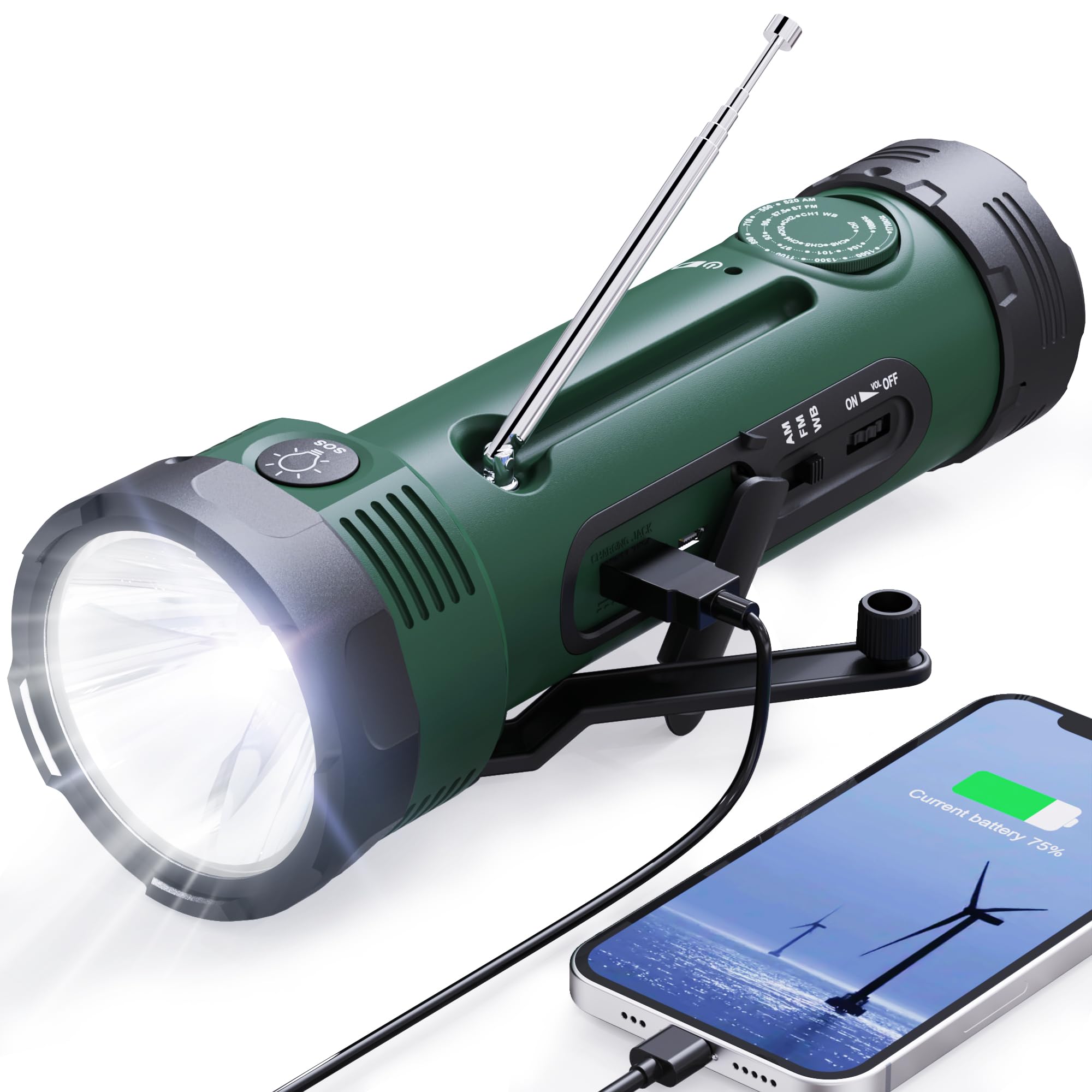
The ROCAM stands out by offering a genuine 300-lumen flashlight output—nearly six times brighter than many crank lights in its category—with a maximum beam distance of 656 feet. This makes it one of the few crank flashlights that can serve as a primary navigation light in total darkness, rather than just a backup glow. The unit combines this powerful LED with a built-in telescopic NOAA/AM/FM radio and a 3000mAh Lithium Polymer battery that can also serve as an emergency phone charger.
Weighing only 11.84 ounces and measuring 8.66 inches tall, the ROCAM is taller than pocket-sized options but remains easily packable. The IPX4 waterproof rating, along with dustproof and shockproof construction, gives it an edge for outdoor use in rain or dusty trail conditions. The 5 lighting modes—high, low, strobe, SOS, and a separate reading lamp—cover everything from close-up map reading to emergency signaling. The SOS siren is reported by users to be piercingly loud, making it effective for attracting attention in backcountry scenarios.
The hand crank charges the internal battery directly, and the solar panel acts as a secondary trickle charge source. One reviewer noted that the first use requires a full USB charge cycle to get the battery topped off, after which short crank sessions maintain the charge effectively. The radio reception is strong, with users reporting that it pulls in more stations than their car radio in the same location. For buyers who prioritize flashlight brightness and a robust environmental seal, the ROCAM delivers performance that justifies its premium tier.
Why it’s great
- True 300-lumen beam reaching over 600 feet
- IPX4 waterproof, dustproof, and shockproof build
- Five lighting modes including strobe and SOS
Good to know
- Requires initial full USB charge before first crank usage
- Solar panel is supplemental, not a primary charger
3. PRUNUS J-369 Emergency Weather Radio

The PRUNUS J-369 differentiates itself with a unique 3 x AA battery compartment that operates alongside the internal rechargeable battery. This is a critical feature for long-duration emergencies where you cannot recharge the internal Li-ion cell—you can simply swap in fresh alkaline or rechargeable AA batteries to keep the radio and reading lamp running. The radio packs a 11100mWh internal battery (equivalent to roughly 3000mAh at 3.7V), a DSP chip for clearer signal processing, and an extra-long telescopic antenna that pulls in weak stations reliably.
The flashlight function uses a dedicated LED bright enough to light a pathway, and a separate pop-out solar panel doubles as a reading lamp that covers a wider area. The SOS alarm emits a piercing tone with flashing lights, designed to alert search and rescue teams in backcountry situations. Users consistently praise the AA battery flexibility and note that the DSP-driven AM/FM/NOAA reception is noticeably clearer than cheaper alternatives. The unit stands 6.1 inches tall with a 3.7 x 1.7 inch footprint, fitting comfortably in a medium-sized pack.
The main trade-off is the plastic housing, which some users describe as feeling less robust than metal-shelled radios. It will hold up to normal use and drops from low height, but it is not built for heavy abuse. The solar panel, like most in this class, is slow and best used as a trickle top-off rather than a primary charging source. For preppers who want the peace of mind of multiple power source options—hand crank, solar, USB, and standard AA batteries—the PRUNUS offers the most flexibility at a mid-range price.
Why it’s great
- Operates on 3 AA batteries independently of internal cell
- DSP chip delivers superior AM/FM/NOAA reception clarity
- Versatile 5-way power: crank, solar, USB, Li-ion, AA
Good to know
- Plastic housing feels less premium than metal alternatives
- Solar panel is very slow; AA battery backup is the real value
4. Oudain 4-Piece Hand Crank Flashlight Solar Powered

The Oudain 4-pack is designed for buyers who need multiple crank flashlights to distribute across emergency kits, vehicles, or charitable donations. Each unit weighs only 86 grams (about 3 ounces) and measures 4.88 x 1.77 x 1.26 inches, making it one of the lightest and most pocketable crank lights available. The dual charging methods—solar panel on the front and a hand crank on the side—mean these lights never need disposable batteries, and the built-in carabiner clip attaches easily to backpack loops, tent zippers, or keychains.
Each light uses a standard LED that produces roughly 50 lumens—sufficient for close-range tasks like reading a map, navigating a tent, or finding your way to a bathroom during a power outage. The one-minute crank yields approximately 10–15 minutes of usable light, which is respectable for such a compact generator. User reports indicate that the lights have held up well to regular camping use over a year, including drops on rocks and brief water exposure, though they lack an official IP waterproof rating.
The beam is not designed for long-distance spotting—think of it as a reliable area light for immediate surroundings. The solar panel charging is slow, so relying on the crank for primary power is the realistic approach. For the price of a single premium unit, you get four functional crank lights that can be scattered across multiple emergency bags, making this an excellent value for families or group preparedness.
Why it’s great
- Ultra-light 86g per unit, easy to pocket or clip on a pack
- Four units included for multi-kit distribution
- Dual solar/crank charging with no batteries required
Good to know
- Beam is modest at roughly 50 lumens, not for distance
- No official IP waterproof rating despite user reports of durability
5. Mudder 8-Pack Hand Crank Flashlight 3 LED

The Mudder 8-pack is the entry-level option for buyers who need a large quantity of crank lights for preparedness kits, Operation Christmas Child boxes, or simple home backup. Each light uses a push-down squeeze crank mechanism—different from the rotary crank seen on most other units—that generates power through a vertical pressing motion. The unit houses three small LEDs that provide moderate brightness suitable for checking around a dark room, navigating a hallway, or providing light inside a tent or closet.
The design is intentionally simple: a non-slip rubber switch, a braided wrist loop, and a compact body that slips into any drawer or cup holder. Users report that these lights are particularly well-suited for children or elderly individuals because the squeeze action requires less fine motor coordination than a traditional rotary crank. The internal NiMH battery stores the cranked energy, and users note that a few squeezes produce 5–10 minutes of usable light. The multicolor variety pack (blue, green, red, orange, etc.) helps family members identify their own light quickly.
The main durability concern is that the ABS plastic casing can shatter if dropped on a hard surface from waist height—multiple user reviews confirm that a single drop on hardwood can separate the lens, case, and button. These lights are best left stationary in a drawer or deployed in low-risk environments where drops are unlikely. For the price, you get eight functional crank lights that will serve reliably in calm conditions, but they lack the robustness needed for rugged outdoor or emergency field use.
Why it’s great
- Eight lights per pack at a highly affordable per-unit cost
- Squeeze crank mechanism is easy for children and seniors
- No batteries needed; simple push-down operation
Good to know
- Plastic casing is fragile; can shatter from a single drop
- Light output is modest, adequate for close range only
FAQ
How long do I need to crank a hand crank flashlight for one hour of light?
Can a crank flashlight charge my smartphone in an emergency?
Are solar panels on crank flashlights actually useful?
Final Thoughts: The Verdict
For most users, the best crank flashlight winner is the RunningSnail Emergency Hand Crank Radio because it combines a smooth 1:45 crank-to-light ratio, reliable NOAA weather alerts, and a removable 18650 battery in a compact package that fits any emergency kit. If you prioritize maximum flashlight brightness and waterproof durability, grab the ROCAM Hand Crank Flashlight for its 300-lumen beam and IPX4-rated shell. And for building out multiple emergency kits on a budget, nothing beats the Oudain 4-Piece Solar Crank Pack for its lightweight, crank-to-light performance and four-unit value.

Mo Maruf
I created WellFizz to bridge the gap between vague wellness advice and actionable solutions. My mission is simple: to decode the research and give you practical tools you can actually use.
Beyond the data, I am a passionate traveler. I believe that stepping away from the screen to explore new environments is essential for mental clarity and physical vitality.