Our readers keep the lights on and my smoothie glass nicely filled. As an Amazon Associate, I earn from qualifying purchases.
The hunt for a craft kit for a preschooler is rarely about the final product. It is about buying thirty minutes where a pom-pom or a pipe cleaner replaces a screen, where little fingers learn to push, pull, and pinch their way toward fine motor control without a single worksheet. The problem is that many kits overshoot the age range, packing in components that frustrate more than they engage, or they undershoot, offering nothing but a single sticker sheet that is done in ninety seconds.
I’m Mohammad Maruf — the founder and writer behind WellFizz. After spending over a hundred hours analyzing the top-rated craft kits on the market, comparing component lists, reading through thousands of parent reviews, and cross-referencing material safety claims, I have built this guide around the kits that actually work for the 3-to-6-year-old set. Each pick here has survived the scrutiny of real-world mess, lost pieces, and repeated use.
Below you will find five projects that cover sewing, beading, hat decorating, paper assembly, and flower building, each chosen because they hit the right balance of independence and adult-help-needed. This is my definitive guide to the best craft kits for preschoolers, tested against the only metric that matters in this category: does a young child want to finish the project and start another one?
How To Choose The Best Craft Kits For Preschoolers
The preschool craft kit market is packed with boxes that look incredible on the shelf but fall apart the moment small hands dig in. The deciding factors are rarely listed in the bullet points. Here is what actually separates a kit that gets pulled out again from one that collects dust after a single use.
Material Safety and Certification
Preschoolers explore with their mouths as much as their hands. A kit that claims to be “non-toxic” is table stakes, but look for specific language about ASTM, CPSIA, or EN71 compliance. The safest kits list their testing standards clearly in the description or on the packaging. If a kit only says “safe” without naming a standard, consider it a yellow flag.
The Right Tool-to-Action Ratio
A 3-year-old cannot manage a sharp needle, a glue gun, or scissors that actually cut. The best kits use tools that feel real but are deliberately dulled or oversized — jumbo plastic needles, pre-punched holes, peel-and-stick adhesives. If the kit requires an adult to do 80 percent of the work, it is not a preschooler’s craft kit; it is a parent’s frustration kit.
Replay Value and Component Density
Single-project kits create a twenty-minute experience. Kits that offer multiple projects or interchangeable components — multiple bead colors to re-string, several sticker sheets to re-decorate, or a flower press that lets you build different bouquets — extend the value from one afternoon to weeks of rotating activity. Count the number of finished pieces the kit can produce, not the number of pieces in the box.
Quick Comparison
On smaller screens, swipe sideways to see the full table.
| Model | Category | Best For | Key Spec | Amazon |
|---|---|---|---|---|
| KRAFUN Unicorn Bunny Paper Craft Kit | Paper Craft | Maximum projects per box | 18 complete projects | Amazon |
| beefunni Flower Bouquet Craft Kit | Flower Craft | Independent play for 5+ | No glue or scissors needed | Amazon |
| EZCRA Unicorn Sewing Kit | Sewing Kit | First sewing experience | Jumbo plastic needles | Amazon |
| Melissa & Doug Butterfly Bead Kit | Beading Kit | Hand-eye coordination | 120 wooden beads | Amazon |
| Klever Kits Decorate Your Own Baseball Cap | Wearable Craft | Wearable finished product | 7 sheets of gem stickers | Amazon |
In‑Depth Reviews
1. KRAFUN My First Unicorn Bunny Paper Craft Kit

The KRAFUN kit hits the sweet spot that most preschool craft boxes miss: it gives the child something to actually build. Eighteen separate projects — unicorns, bunnies, fairies, and princesses — use paper bags, plates, rolls, and straws as construction materials rather than flat coloring sheets. The child transforms a plain paper roll into a standing unicorn or a plate into a fairy mask, which creates a physical object they can hold and play with afterward. That sense of real creation is rare in this price range.
Material quality stands out here. The paper stock is thick enough to survive being bent, folded, and re-folded by uncoordinated hands without tearing at the perforations. The included adhesive elements are peel-and-stick, which eliminates glue mess entirely. Parents report that children as young as three can follow the visual instructions with minimal help, though a few of the more intricate folds require an adult hand. The upright storage box keeps incomplete projects organized, so nothing gets lost between sessions.
The only real limitation is the theme; the kit is heavily girly in its color palette and motif choices. Children who do not connect with unicorn and princess imagery may lose interest quickly. For families who love the theme, however, this kit delivers an extraordinary amount of craft time per project — roughly twenty to thirty minutes per build, adding up to hours of screen-free engagement over several days.
Why it’s great
- Eighteen projects means weeks of rotating activity
- Thick paper stock resists toddler tearing during assembly
- Peel-and-stick adhesive removes the glue mess factor
Good to know
- Heavily unicorn-princess themed, not gender-neutral
- Some folds still require adult assistance for 3-year-olds
2. beefunni Flower Bouquet Craft Kit
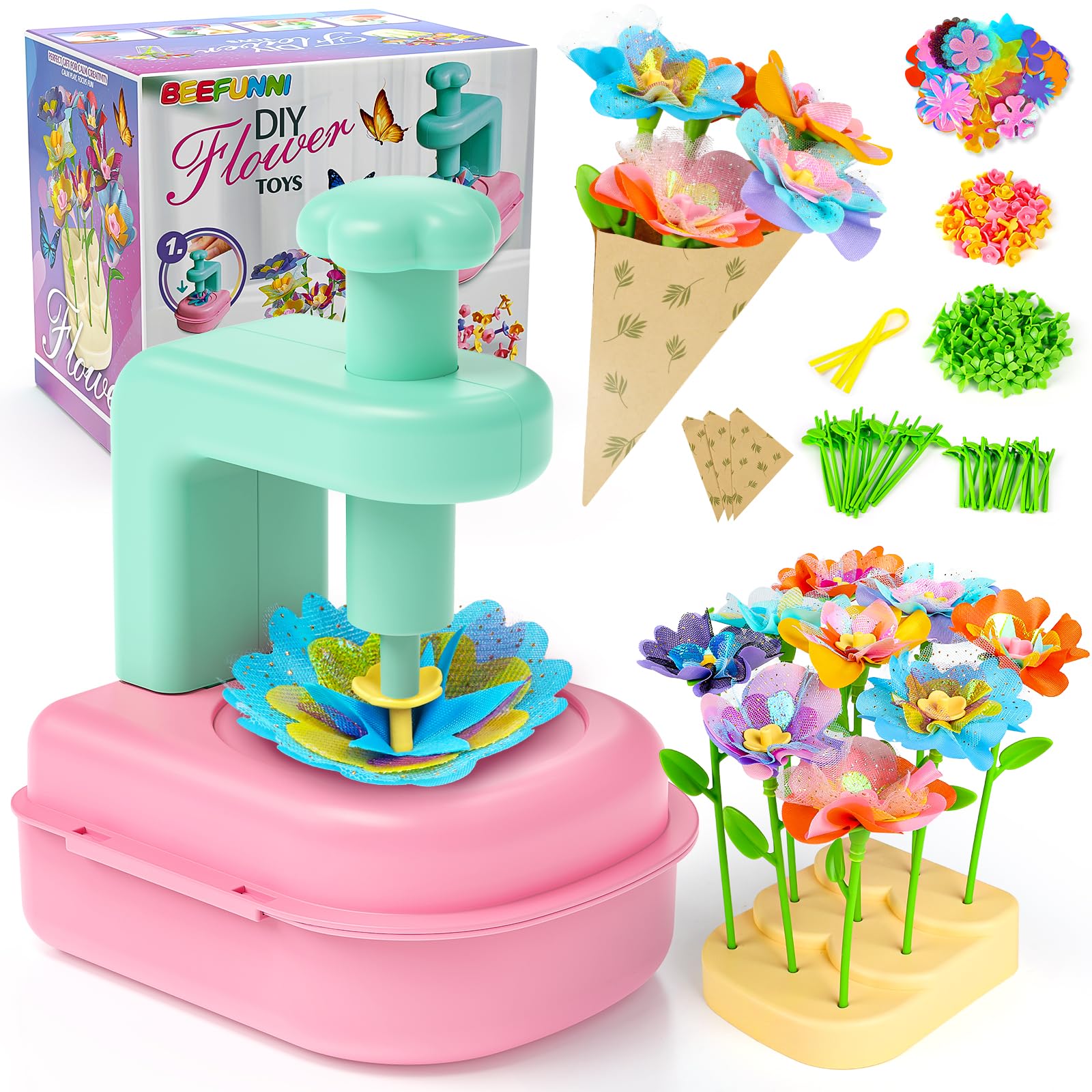
The beefunni kit rethinks what a preschooler can accomplish independently. Instead of drawing or gluing, the child uses a simple plastic press tool to snap petals onto flower centers, then attaches stems through a push-fit connection. No glue, no scissors, no drying time. A 5-year-old can sit down and produce a realistic-looking flower in about ninety seconds, which builds immediate confidence. The feedback loop from start to finished flower is fast enough to hold attention through multiple bouquets.
Component variety is impressive. The box includes petals in multiple colors, flower centers, receptacles, stems in two lengths, a display base, and actual bouquet wrapping paper with ribbons. Children can mix and match color combinations, vary the height by choosing different stem lengths, and then arrange the finished flowers on the base or wrap them as a gift. This modularity gives the kit strong replay value — a child can build, disassemble, and rebuild different arrangements rather than following a single rigid project.
The trade-off is that the flowers, while pretty, are not durable for rough play. The push-fit connections can pop apart if a child squeezes them too hard or tosses the bouquet across the room. For display and gift-giving purposes the construction holds fine, but this is not a toy meant to withstand the abuse a preschooler might dish out during imaginative play. The kit also skews toward the 5-to-8 age range; a very low 3-year-old may lack the finger strength to press the petals fully into place.
Why it’s great
- Completely glue-free and scissors-free assembly process
- Modular components allow endless bouquet rearrangement
- Finished flowers are display-worthy and gift-ready
Good to know
- Push-fit connections can detach during rough handling
- Requires more finger strength than a typical 3-year-old has
3. EZCRA Unicorn Sewing Kit

Teaching a preschooler to sew sounds like a recipe for poked fingers, but the EZCRA kit solves the safety problem with jumbo plastic needles that are blunt enough to be harmless yet sharp enough to pass through pre-punched holes in felt. The result is a genuine hand-sewing experience that a 4-year-old can manage without frustration. Four unicorn-themed projects — unicorn, butterfly, and related shapes — come with pre-cut felt pieces, so the child does not need to cut anything. They simply align, stitch, and then decorate with the included sticker sheets.
The dual activity of sewing plus sticker decorating is a smart design choice. The sewing portion demands focus and fine motor precision, while the sticker decorating that follows feels like a reward. Children who might give up on the repetitive in-and-out motion of sewing can switch to placing stickers, then return to the needle when they are ready. The instructions are step-by-step with clear visuals, and parents report that most 5- and 6-year-olds can work through the projects with only occasional guidance.
One limitation is that the felt pieces are relatively small. A child with larger hands or less refined pincer grip may struggle to hold the felt steady while pushing the needle through. The kit also produces plush ornaments rather than functional items, so the finished product is destined for display rather than play. For a first sewing experience that does not require sharp tools, however, this kit sets the standard for the category.
Why it’s great
- Jumbo plastic needles eliminate poking risk during sewing
- Pre-punched felt and pre-cut shapes remove prep work
- Sticker decorating provides a rewarding second activity layer
Good to know
- Small felt pieces can be tricky for less dexterous fingers to hold
- Finished products are ornaments, not toys meant for active play
4. Melissa & Doug Butterfly Bead Kit
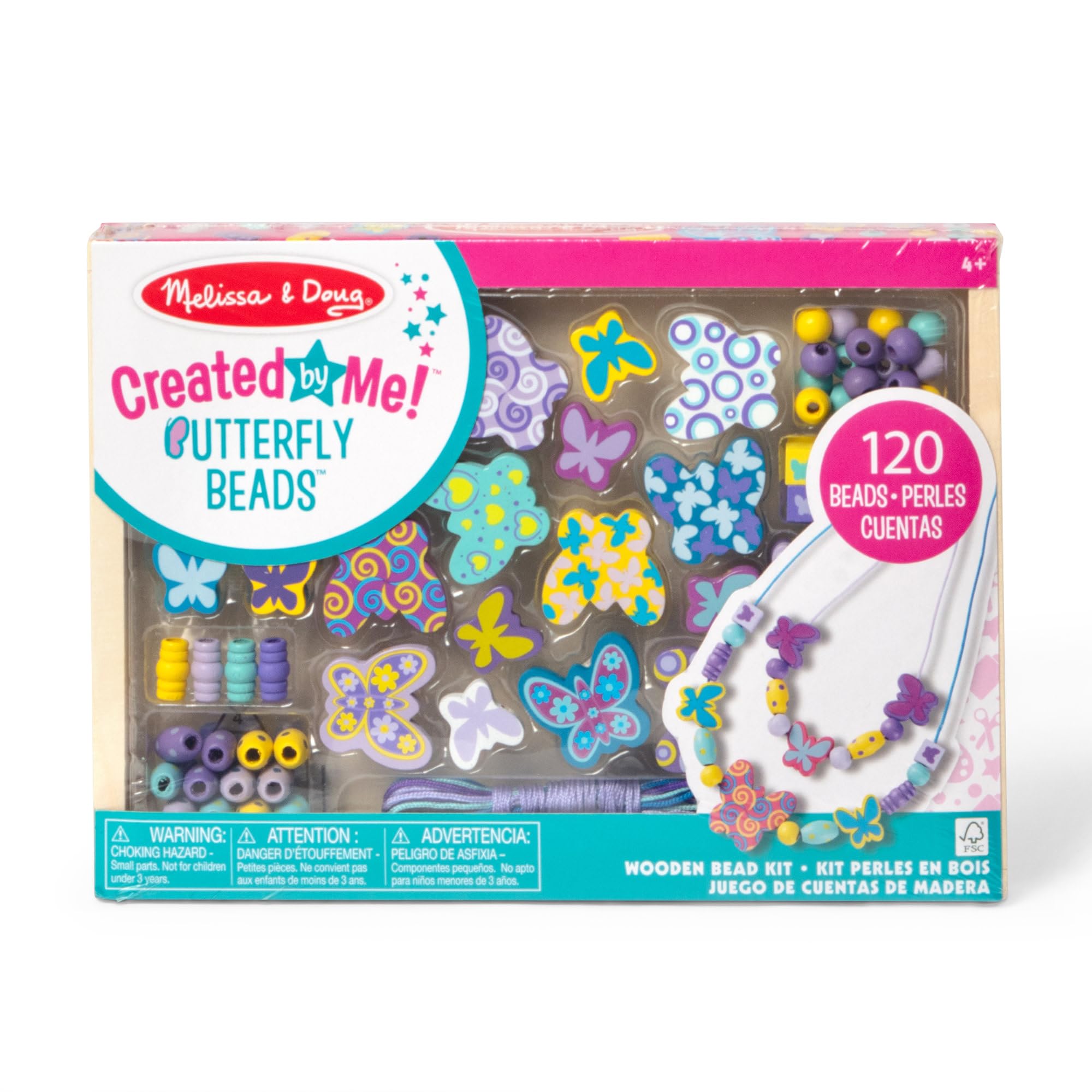
The Melissa & Doug bead kit is a no-surprises classic for a reason. One hundred twenty large wooden beads in butterfly and floral shapes come with five colored cords for stringing. The beads are chunky enough that a 3-year-old can grasp and thread them without choking risk, but varied enough in shape — circles, butterflies, flowers, cubes — to teach pattern recognition and sequencing. The wooden storage tray keeps everything contained, which matters when beads inevitably scatter.
The open-ended nature of this kit is its strongest feature. Unlike project-based craft kits that produce one specific result, this one allows the child to string any combination of beads in any order, creating necklaces, bracelets, or simply long chains. The same set can be used a dozen times with different patterns each session. Parents report that children return to it repeatedly, often mixing the beads with other toys for sorting games or pretend play.
The downside is that some beads arrive with rough edges around the drilled holes. Many reviewers note that while the beads are usable, the rough spots can begin to fray the stringing cords after repeated use. The five cords included are also relatively short; children who want to make long necklaces may run out of cord quickly. For a straightforward, no-gimmick beading experience that builds fine motor control and visual perception, however, this kit remains a reliable entry point.
Why it’s great
- Chunky wooden beads are perfectly sized for small preschool hands
- Open-ended stringing promotes pattern recognition and sequencing
- Wooden storage tray keeps the workspace organized
Good to know
- Some beads have rough interior holes that fray stringing cords
- Only five cords included, limiting long necklace projects
5. Klever Kits Decorate Your Own Baseball Cap

The Klever Kits hat decoration set solves one of the biggest problems with preschool crafts: what to do with the finished product. Instead of a paper creation that gets crumpled into a drawer or taped to the refrigerator and forgotten, this kit produces a wearable item the child can actually use. The pink baseball cap comes with seven sheets of adhesive gem stickers and three tubes of glitter glue, giving the child free rein to decorate the cap however they want. The adhesive gems stick on contact, so no drying time is needed for the jewel placements.
The appeal here is twofold. The creative process — selecting gems, arranging them in patterns, layering glitter glue details — engages a preschooler’s sense of design without requiring any technical skill. Then the finished hat becomes a practical accessory for outdoor play, making the child feel a genuine sense of accomplishment every time they wear it. Parents report that children often continue adding to the hat over multiple sessions, treating it as an evolving canvas rather than a one-and-done project.
The durability of the decorations is the main concern. Some reviewers note that individual gem stickers can peel off after a few wears, especially if the hat is tossed into a bag or worn in light rain. The glitter glue holds better once fully dry, but the adhesive stickers are the weaker link. The hat itself is well-constructed and fits most 5-to-7-year-olds comfortably, and the activity moves fast enough — about fifteen to twenty minutes for the initial decoration — that the short attention span of a younger preschooler is not a problem.
Why it’s great
- Creates a wearable finished product the child can use daily
- Adhesive gems and glitter glue require no drying or cutting
- Open-ended design encourages multiple decorating sessions
Good to know
- Gem stickers may peel off after repeated wear and washing
- Pink color theme is not gender-neutral
FAQ
At what age can a preschooler use a craft kit without constant adult supervision?
How do I know if the craft kit materials are truly non-toxic and safe for my child?
My child finishes craft projects in five minutes. What should I look for in a kit to extend the play time?
Are felt and paper craft kits messy or do they keep the mess contained?
Final Thoughts: The Verdict
For most families, the craft kits for preschoolers winner is the KRAFUN Unicorn Bunny Paper Craft Kit because its 18-project count and paper construction offer the most creative bang for the time invested, with materials sturdy enough to survive clumsy hands. If you want a glue-free independent play experience that lets a 5-year-old build and rebuild bouquets on their own, grab the beefunni Flower Bouquet Kit. And for a first sewing experience that does not involve sharp needles or parental dread, nothing beats the EZCRA Unicorn Sewing Kit.

Mo Maruf
I created WellFizz to bridge the gap between vague wellness advice and actionable solutions. My mission is simple: to decode the research and give you practical tools you can actually use.
Beyond the data, I am a passionate traveler. I believe that stepping away from the screen to explore new environments is essential for mental clarity and physical vitality.