Your desktop audio is the final frontier of your build. A great monitor and a fast GPU are useless if game footsteps are muddy, dialogue is hollow, or your favorite tracks lack punch. The difference between a cheap, noisy pair and well-engineered CPU speakers is the difference between hearing audio and feeling immersed in a soundstage.
I’m Mohammad Maruf — the founder and writer behind WellFizz. I’ve spent over 400 hours analyzing frequency response curves, driver materials, amplifier topologies, and real-user feedback across the entire spectrum of desktop speaker options to bring you a guide that cuts through the marketing noise.
Whether you need clear mids for video editing, a wide soundstage for competitive gaming, or room-filling bass for movies, this guide to the best cpu speakers will help you match your setup to a pair that delivers exactly what your ears need.
How To Choose The Best CPU Speakers
Selecting the right pair of speakers for your computer involves more than just picking the loudest option. You need to evaluate how they fit on your desk, how they connect to your audio interface, and how accurately they reproduce sound at nearfield listening distances.
Driver Configuration and Tweeter Type
The speaker driver is the heart of the sound. A 3-inch full-range driver can handle mids and some bass, but it will struggle with clarity compared to a two-way design that separates the tweeter from the woofer. Silk dome tweeters deliver smooth highs without harshness, while carbon fiber or metal tweeters provide more detail but can sound bright. For desktop use, a 0.75-inch silk dome tweeter paired with a 3- to 4-inch mid-bass driver offers the best balance for nearfield listening.
Active vs. Passive and Amplification
Active speakers have a built-in amplifier, so you plug them straight into your computer without needing a separate receiver. This is the most common and convenient choice for a desktop setup. Passive speakers require an external amplifier or AV receiver, which adds cost and desk space but allows for upgrades down the line. For most users, active speakers with at least 20 watts RMS per channel will provide sufficient clean volume for nearfield listening.
Connectivity and Input Options
Look at the back of the speaker to see what connections it offers. USB and 3.5mm AUX are the most universal for computers. Bluetooth 5.3 or higher adds the ability to stream from a phone or tablet. Balanced TRS inputs are important if you plan to use studio gear or audio interfaces. Having multiple inputs lets you switch between your PC, a gaming console, and a phone without constantly swapping cables.
Quick Comparison
On smaller screens, swipe sideways to see the full table.
| Model | Category | Best For | Key Spec | Amazon |
|---|---|---|---|---|
| Edifier MR3 | Premium | Hi-Res Monitoring | 52Hz-40kHz, 3.5″ driver | Amazon |
| Klipsch ProMedia 2.1 | Premium | Full-Range Gaming | 200W peak, 6.5″ sub | Amazon |
| Sony SS-CS5M2 | Premium | Hi-Fi Home Theater | 3-way, 5.12″ woofer | Amazon |
| Edifier R1280T | Mid-Range | General Listening | 42W, 4″ full-range unit | Amazon |
| Ortizan C7 | Budget | Music Production | 3.5″ carbon fiber + 0.75″ tweeter | Amazon |
| OHAYO 60W | Budget | Desktop Versatility | MDF enclosure, 30Wx2 | Amazon |
| IBALL·BOX D-ONE | Budget | Entry-Level Setup | 30W, 3″ driver + RGB | Amazon |
In‑Depth Reviews
1. Edifier MR3 Powered Studio Monitor Speakers

The Edifier MR3 brings a genuinely neutral frequency response to the desktop market, certified Hi-Res with a range extending from 52Hz to 40kHz. The 3.5-inch mid-low driver and 1-inch silk dome tweeter deliver a flat response that reveals subtle details in mixes and soundtracks without artificial coloration. The MDF cabinet reduces unwanted resonance, keeping the soundstage clean even when you push the volume.
Connectivity is the MR3’s strongest suit: balanced TRS inputs allow direct interfacing with audio interfaces, while RCA and AUX handle standard computer connections. The Edifier ConneX app offers three EQ modes — Music, Monitor, and Custom — plus a parametric EQ for fine-tuning. Bluetooth 5.4 with multi-point pairing lets you switch between your PC and phone seamlessly.
At 18 watts RMS per channel, the MR3 won’t shake a large room, but within nearfield range it provides precise, uncolored sound ideal for content creation, video editing, and critical listening. The headphone output is a welcome addition for late-night sessions. Build quality is excellent, and the Rose Gold trim option adds a premium visual touch.
Why it’s great
- Hi-Res Audio certified with flat 52Hz-40kHz response.
- Balanced TRS inputs for studio gear integration.
- App-based EQ with customizable parametric controls.
- Zero hiss and low distortion at all volume levels.
Good to know
- Limited low-end extension without a subwoofer.
- Bluetooth volume is not fully controllable from a paired device.
2. Klipsch ProMedia 2.1 THX Certified Computer Speaker System

The Klipsch ProMedia 2.1 is a legendary desktop audio system that has remained relevant for over two decades. The two-way satellites use Klipsch’s MicroTractrix horn technology, which controls sound dispersion and reproduces more detail per watt than conventional designs. The result is crystal-clear mids and highs that cut through the mix without harshness, even at high volumes.
The 6.5-inch side-firing, ported subwoofer delivers deep, tactile bass down to 35Hz. This is a 2.1 system that truly integrates the sub with the satellites, not just adding boom. The THX certification ensures the system meets rigid performance standards for dynamic range and distortion control. The control pod gives you separate volume and subwoofer level adjustments, letting you dial in the perfect balance for your room.
Setup is plug-and-play via a single 3.5mm input. The satellites are compact enough for most desks, and the subwoofer can be placed on the floor. Some users note a bright upper register and the lack of a power switch, but the overall sound quality, especially after a 20-hour burn-in, is remarkable for a system under two hundred dollars. For gaming and movies, this is the most immersive 2.1 option on the list.
Why it’s great
- THX certified for low distortion and high dynamic range.
- Horn-loaded tweeters provide exceptional clarity and soundstage.
- Separate subwoofer with 6.5-inch driver for deep bass.
- Proven longevity with many units lasting over a decade.
Good to know
- Satellite cones are exposed and can be easily damaged.
- No built-in power switch; always in standby.
3. Sony CS Speakers, SS-CS5M2 3-Way Bookshelf Speakers

The Sony SS-CS5M2 is a passive 3-way, 3-driver bookshelf speaker that requires an external amplifier or AV receiver. The 5.12-inch reinforced cellular cone woofer handles bass down to 53Hz, while a dedicated high-precision tweeter and wide-dispersion super tweeter reproduce mids and highs with remarkable detail. The 3-way design separates the frequency bands more effectively than a standard 2-way, reducing intermodulation distortion and creating a wider soundstage.
These speakers are built with a bass reflex enclosure that minimizes distortion at lower frequencies. The frequency response extends up to 50kHz, making them Hi-Res Audio compatible. They sound clear and open, with a slight brightness that can be tempered with careful amplifier matching. Vocals and jazz instruments are rendered with exceptional realism, and the soundstage extends well beyond the speaker boundaries when placed correctly.
Because they are passive, you will need a separate amplifier rated around 50 watts per channel at 6 ohms. The SS-CS5M2 pairs perfectly with Sony AV receivers but also works with quality mini amps for desktop use. The compact footprint fits on most desks, and the wood veneer finish looks premium. For users who want to build a high-fidelity system that can later expand to a full 5.1 surround setup, these speakers are an ideal starting point.
Why it’s great
- True 3-way design with separate super tweeter for high-frequency detail.
- 5.12-inch woofer delivers surprising low-end extension for the size.
- Bass reflex enclosure reduces port noise and distortion.
- Wide soundstage ideal for nearfield and midfield listening.
Good to know
- Requires an external amplifier or receiver (not powered).
- Rear port needs at least 6 inches of clearance from the wall.
4. Edifier R1280T Powered Bookshelf Speakers
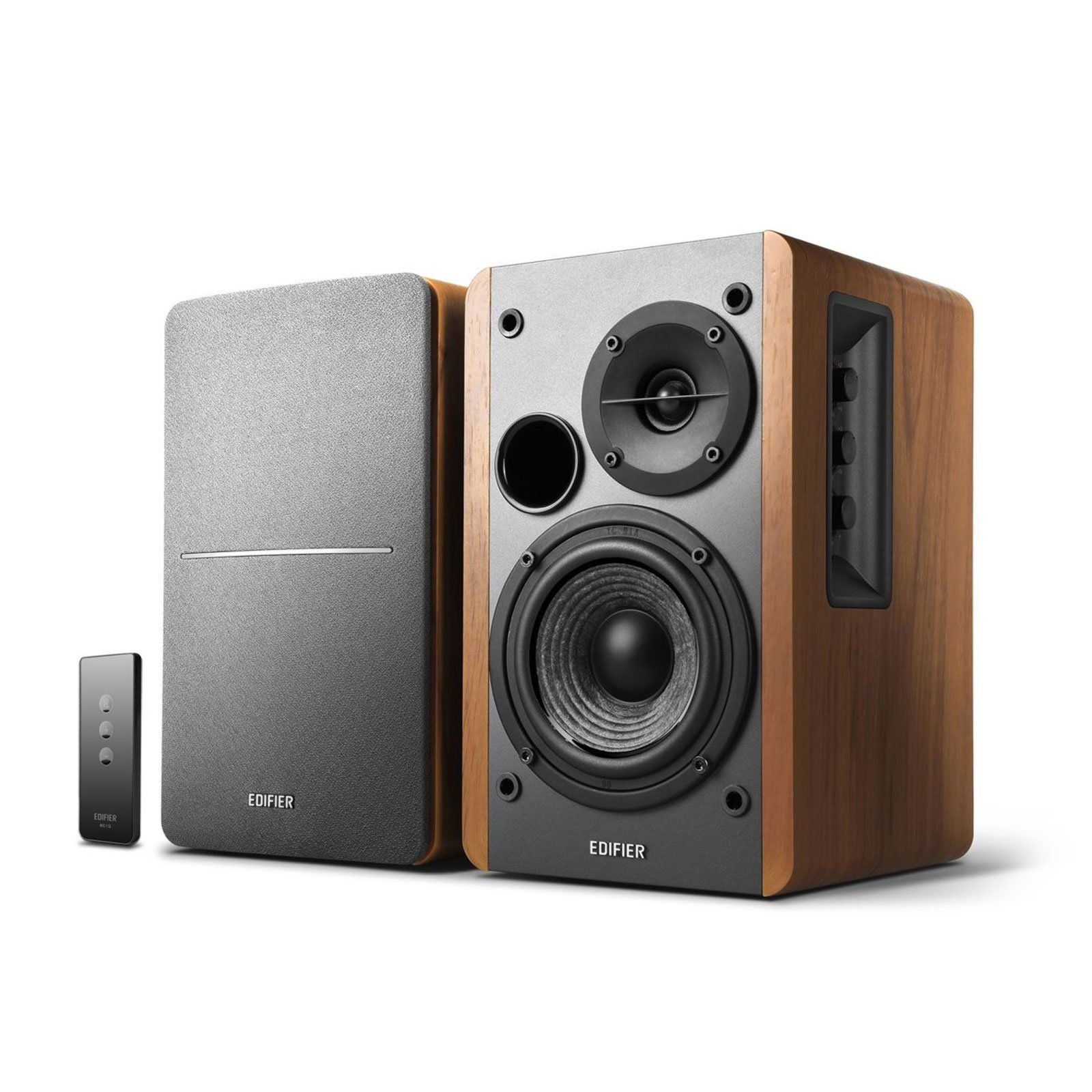
The Edifier R1280T is a timeless active bookshelf speaker that has set the standard for affordable desktop audio. The 13mm silk dome tweeter produces smooth, non-fatiguing highs, while the 4-inch full-range driver delivers warm mids and a satisfying low-end punch. The MDF wood enclosure with a wood-effect vinyl finish reduces cabinet resonance and looks elegant on any desk.
Dual AUX inputs allow you to connect two audio sources simultaneously — your PC and a turntable or game console — without plugging or unplugging cables. A remote control provides volume, bass, and treble adjustment from your listening position. The side-panel knobs offer tactile control over the EQ, letting you compensate for room acoustics or personal listening preferences.
At 42 watts RMS total, the R1280T fills a small to medium room with clean sound. There is no Bluetooth, so it is strictly a wired solution, but that also means zero latency for video editing or gaming. Some users note a coloration in the upper mids that can muddy complex mixes, but for casual music listening, movies, and general desktop use, these speakers offer unbeatable build quality and sound at this price tier.
Why it’s great
- Silk dome tweeter for smooth, detailed highs.
- Dual AUX inputs with independent source switching.
- Included remote control for volume and EQ adjustment.
- Solid MDF cabinet with premium wood finish.
Good to know
- No Bluetooth or wireless connectivity.
- Mids can sound slightly muddy on complex mixes.
5. Ortizan C7 Dual-Mode 2.0 Studio Monitors

The Ortizan C7 monitors pack a 3.5-inch carbon fiber mid-bass driver and a 0.75-inch silk dome tweeter into a compact bookshelf body. What sets them apart is the near-flat frequency response curve, achieved through extensive lab tuning and an electronic 2-way crossover. The 24-bit DAC captures USB audio directly, minimizing signal loss for cleaner conversion.
Connectivity is studio-grade: 6.35mm TRS balanced inputs allow connection to mixers and audio interfaces, while RCA and AUX handle consumer gear. A front-panel headphone output and volume knob with choppy increments are minor trade-offs for the versatility. Bluetooth 5.3 is included but adds slight compression artifacts compared to wired use.
The bass extends to around 45Hz, which is respectable for the driver size, but there is no deep sub-bass. The highs are detailed without being fatiguing, and the midrange is accurate for mixing. The build uses ABS with a metal front baffle, and the overall aesthetic is clean and professional. For entry-level music producers or gamers who want accurate audio, the C7 offers remarkable value.
Why it’s great
- Near-flat frequency response for accurate monitoring.
- Balanced TRS inputs for professional audio gear.
- 24-bit USB DAC for direct digital audio conversion.
- Compact design with multiple input options.
Good to know
- Volume knob has large, imprecise increments.
- Faint idle hiss audible in quiet environments.
6. OHAYO 60W Computer Speakers

The OHAYO 60W speakers use a premium MDF wooden enclosure to reduce box resonance, resulting in cleaner sound than plastic alternatives. The 0.75-inch carbon fiber silk dome tweeter and 3-inch carbon fiber full-range driver combine to produce clear highs and rich mid-bass. A rear bass port extends low-end depth, making the speakers sound larger than their footprint suggests.
Connectivity options are broad: Bluetooth 5.3, USB, AUX, and RCA inputs ensure compatibility with PCs, gaming consoles, turntables, and TVs. A front-panel volume knob also serves as the power switch, with separate treble and bass controls for precise tone shaping. The speakers are energy efficient, drawing less than 1 watt at full volume, which is unusual for an active set in this class.
The 30 watts per channel provides ample clean volume for a small to medium room. Bass is tight but not chest-thumping — the 3-inch drivers simply cannot move enough air for deep sub-bass. Sound staging is wide and clear, with good instrument separation. The all-black finish looks modern, and the compact size fits easily under a monitor. For a versatile, plug-and-play desktop set, the OHAYO delivers balanced performance.
Why it’s great
- MDF wooden enclosure reduces cabinet resonance.
- Carbon fiber drivers for low distortion and clear sound.
- Multiple input options including USB, RCA, and Bluetooth 5.3.
- Separate treble and bass tone controls.
Good to know
- Limited deep bass extension due to 3-inch drivers.
- 3.5mm AUX input can sound hollow compared to USB.
7. IBALL·BOX D-ONE Computer Speakers
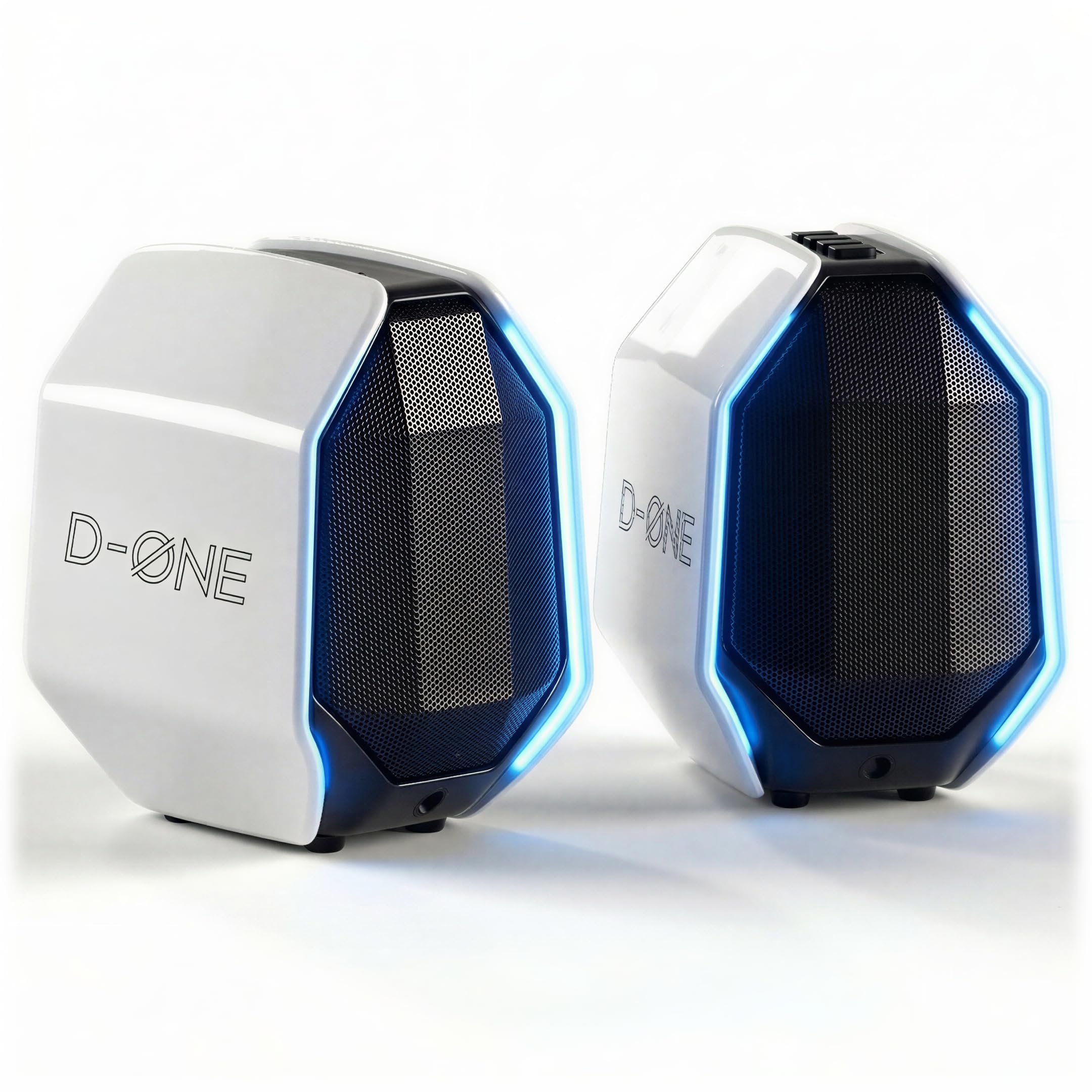
The IBALL·BOX D-ONE is a budget-friendly entry point into the world of desktop speakers, offering a 3-inch full-range driver paired with a rear bass diaphragm. The sound is surprisingly loud and clear for the size, with punchy lows that are rare in such a compact form factor. The triple EQ mode — Gaming, Music, and Bass Boost — lets you tailor the tonal balance without software.
The RGB lighting adds a breathing ambient glow that can match a gaming setup, though the color cannot be set to a static hue. Connectivity is modern: Bluetooth 5.3, USB-C, and 3.5mm AUX inputs ensure broad compatibility with PCs, consoles, and mobile devices. The AC power adapter delivers 30W of clean audio, and a compatible 15V/3A adapter can push the peak to 45W.
Build quality is acceptable for the price point, with a plastic enclosure that does not resonate excessively. The detachable cable routing helps with desk cable management. Some units have experienced power failures, but overall user satisfaction is high given the cost. For a beginner setting up their first desk audio rig, the D-ONE provides a satisfying audio upgrade without a large investment.
Why it’s great
- Surprisingly loud and punchy for the compact size.
- Triple EQ presets for gaming, music, and bass boost.
- Bluetooth 5.3 with USB-C and AUX connectivity.
- Breathing RGB lighting adds desk ambiance.
Good to know
- Plastic enclosure may not dampen resonance as well as wood.
- RGB lighting cannot be set to a static color.
FAQ
Do I need a subwoofer with my CPU speakers?
Can I connect studio monitors to my PC without an audio interface?
Final Thoughts: The Verdict
For most users, the best cpu speakers winner is the Klipsch ProMedia 2.1 because it combines a wide soundstage, THX-certified clarity, and a dedicated subwoofer that delivers tactile bass for both gaming and movies. If you want a flat response for music production and critical listening, grab the Edifier MR3. And for a budget-friendly build that still offers decent accuracy and versatile inputs, nothing beats the Ortizan C7.

Mo Maruf
I created WellFizz to bridge the gap between vague wellness advice and actionable solutions. My mission is simple: to decode the research and give you practical tools you can actually use.
Beyond the data, I am a passionate traveler. I believe that stepping away from the screen to explore new environments is essential for mental clarity and physical vitality.