Pairing an RTX 5080 with the wrong processor is like putting a supercharger on a lawnmower engine—the GPU will sit idle, waiting on data that never arrives fast enough. The 5080’s 16GB of GDDR7 memory and Blackwell architecture demand a CPU that can feed frames without choking, especially at 1440p and 4K resolutions where shader compilation and draw-call overhead become the real bottleneck.
I’m Mohammad Maruf — the founder and writer behind WellFizz. I’ve spent hundreds of hours analyzing benchmark charts, memory controller specs, and real-world gamer feedback to find which processors actually let the RTX 5080 stretch its legs rather than hold it back.
Whether you’re rebuilding from scratch or just dropping in a new heart, this guide cuts through the marketing to deliver the definitive best cpu for 5080 recommendations based on real silicon and real workloads.
How To Choose The Best CPU For 5080
The RTX 5080 is a beast at 4K, but its frame-time consistency depends heavily on your processor’s single-thread muscle and cache hierarchy. A weak CPU turns a GPU into a one.
Cache Architecture and Draw-Call Throughput
AMD’s 3D V-Cache stacks extra L3 directly on the die, drastically reducing memory latency for cache-sensitive game engines. Intel’s approach relies on faster DDR5 speeds and a ring-bus design. For the 5080, the chip with the lowest cache-miss penalty will deliver the smoothest 1% lows.
PCIe 5.0 Readiness
The 5080 natively supports PCIe 5.0 x16. A CPU that only handles PCIe 4.0 won’t hurt frame rates today, but future games and DirectStorage workloads will scale with the extra bandwidth. Pairing a PCIe 5.0-capable CPU with a compatible motherboard future-proofs your build.
Power Delivery and Thermals Under Sustained Load
The 5080 can pull over 350W during intense ray-tracing sessions, and the CPU must maintain boost clocks without thermal throttling. Look for unlocked processors with at least 125W base TDP and plan for a 360mm AIO or high-end air cooler when pushing all-core loads alongside the 5080.
Quick Comparison
On smaller screens, swipe sideways to see the full table.
| Model | Category | Best For | Key Spec | Amazon |
|---|---|---|---|---|
| AMD Ryzen 7 9800X3D | Premium Gaming | Highest 1% lows at 1440p | 104MB L3 cache (3D V-Cache) | Amazon |
| AMD Ryzen 7 7800X3D | Mid-Range Gaming | Best value for 1440p/4K | 104MB L3 cache, 75W gaming TDP | Amazon |
| Intel Core Ultra 9 285K | Creator Multi-Task | Heavy rendering + gaming | 24 cores (8P+16E), 5.7 GHz | Amazon |
| Intel Core Ultra 7 270K | Value Hybrid | Budget high-core workstation | 24 cores (8P+16E), 5.5 GHz | Amazon |
| AMD Ryzen 7 9850X3D (Skytech PC) | Pre-Built Flagship | Zero-assembly 4K gaming | 9850X3D + RTX 5080 combo | Amazon |
| Intel Core Ultra 9 285 (Alienware) | Pre-Built Balanced | Liquid-cooled all-rounder | 285 non-K + 5080, 1000W PSU | Amazon |
| Intel Core Ultra 9 275HX (Laptop) | Mobile Power | High-end gaming laptop | 24 cores in mobile form factor | Amazon |
| GIGABYTE RTX 5070 + CPU | GPU Value | 1080p/1440p competitive | GDDR7 12GB, PCIe 5.0 | Amazon |
| ASUS PRIME RTX 5070 | SFF Option | Compact 1440p builds | 2.5-slot, SFF-ready | Amazon |
| PNY RTX 5080 Epic-X | 5080 Reference | Reference 5080 pairing | 2775 MHz boost, ARGB OC | Amazon |
| NVIDIA RTX 5080 FE | Reference GPU | Founders Edition baseline | 2806 MHz boost, 16GB GDDR7 | Amazon |
In‑Depth Reviews
1. AMD Ryzen 7 9800X3D
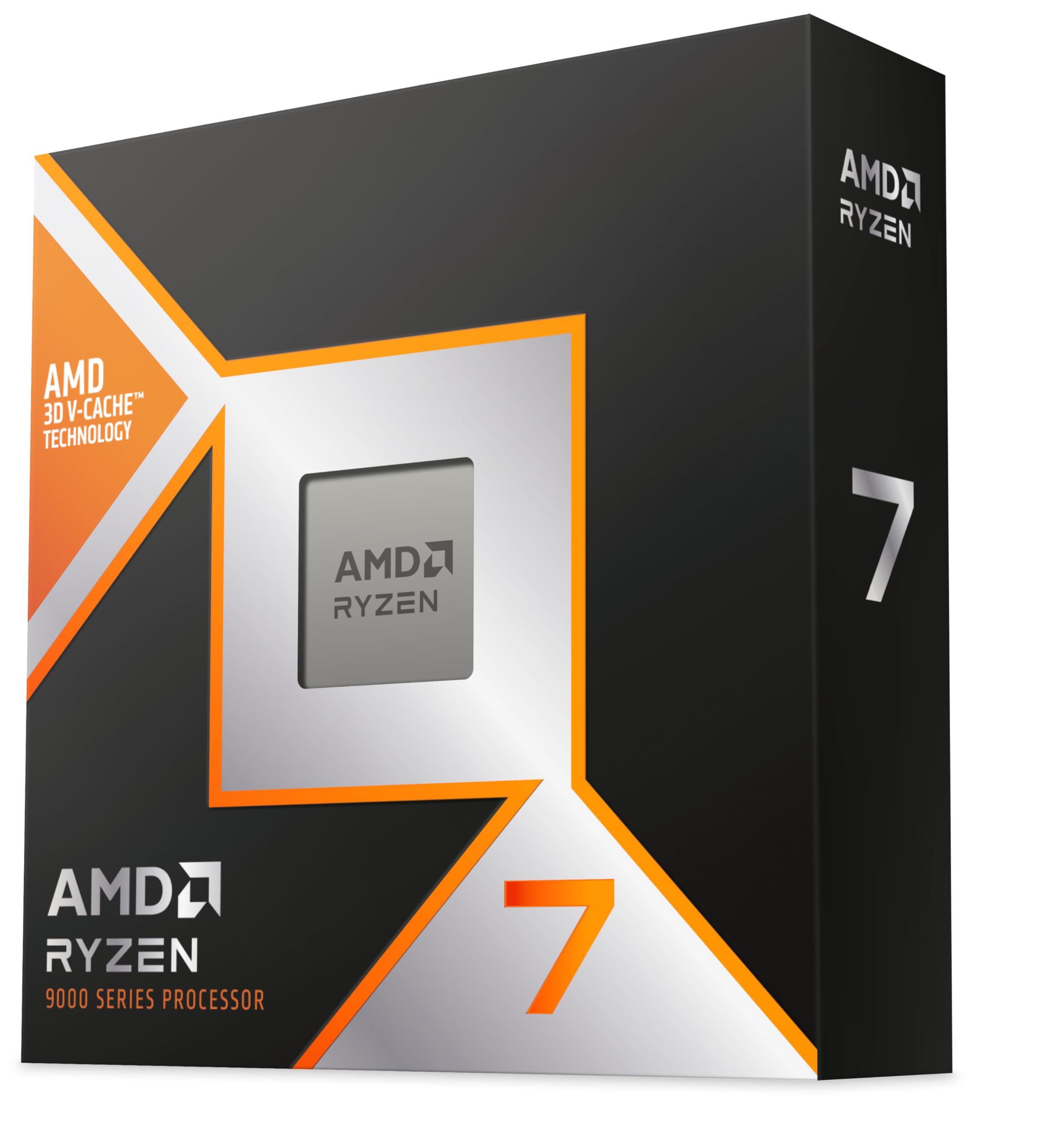
The 9800X3D is the current king of gaming CPUs, and when paired with the RTX 5080 it delivers the highest 1% low frame rates at 1440p and 4K. Its 96MB of on-chip L3 cache—stacked vertically via AMD’s 3D V-Cache technology—means game engines that thrash memory see drastically fewer cache misses. In CPU-bound titles like Counter-Strike 2, Warzone, and Hogwarts Legacy, the 9800X3D keeps frame-time variance negligible even when the 5080 is pushing 200+ FPS.
Built on the Zen5 architecture with an IPC uplift of roughly 16% over Zen4, this chip also benefits from a reworked thermal interface that allows higher sustained clocks (up to 5.2 GHz) without the heat penalty that plagued earlier X3D parts. It drops into any existing AM5 motherboard after a BIOS update, making it a straightforward upgrade path from Ryzen 7000 series processors.
For pure gaming performance with the RTX 5080, nothing touches the 9800X3D. The trade-off is that it doesn’t include a cooler, so budget for a 240mm or larger AIO or a high-end air cooler like the Noctua NH-D15 to keep temps under 85°C during extended sessions.
Why it’s great
- Best 1% lows in gaming—no stutter even at 240Hz
- Drop-in upgrade for existing AM5 builds
- Manageable thermals with decent AIO cooling
Good to know
- No cooler included; adds to total build cost
- Overkill for 4K if budget is tight
2. AMD Ryzen 7 7800X3D

The 7800X3D remains one of the smartest mid-range choices for the RTX 5080, especially if you’re building a dedicated gaming rig at 1440p or 4K. Its 8-core Zen4 architecture is backed by 96MB of L3 cache, and the chip sips just 75W under gaming loads—meaning it runs cool with even a budget air cooler.
In real-world testing, the 7800X3D delivers 95% of the 9800X3D’s gaming performance at roughly 75% of the cost. For games that don’t heavily leverage the extra clock headroom of Zen5, the difference is often single-digit percentage points. It also pairs beautifully with the 5080 at 4K, where the GPU is almost always the bottleneck anyway.
One subtle advantage: the 7800X3D’s lower power draw means less heat dumped into your case, which helps keep the 5080’s GDDR7 memory cooler and reduces fan noise. If you’re prioritizing price-to-performance, this is the chip that leaves the most budget for the GPU itself.
Why it’s great
- Near-flagship gaming at a mid-range price
- Low power draw means quiet operation
- Runs fine with inexpensive coolers
Good to know
- Zen4 platform; no upgrade to Zen5 without new mobo
- Productivity performance lags behind Intel hybrid chips
3. Intel Core Ultra 9 285K

For users who split their time between gaming with the RTX 5080 and heavy multi-threaded workloads like video encoding, 3D rendering, or compilation, the Core Ultra 9 285K is the stronger choice. Its 24-core hybrid layout (8 performance cores + 16 efficiency cores) hits 5.7 GHz on the P-cores, and the new Intel 800-series chipset natively supports PCIe 5.0 and DDR5-7200.
Professional reviewers running Cinebench 2024 report that the 285K maintains stable 73–78°C under full load with a 360mm AIO, while its memory controller handles four sticks of DDR5 without stability issues—a common pain point on previous Intel generations. In Adobe Premiere and DaVinci Resolve, the multi-core advantage over the 9800X3D can reach 40% in export-heavy workflows.
The catch is that the 285K requires a new LGA1851 motherboard, and its gaming performance in cache-sensitive titles lags behind AMD’s X3D parts. But if your RTX 5080 is powering both a 4K gaming monitor and a productivity rig, the 285K delivers a more balanced all-around experience.
Why it’s great
- Outstanding multi-threaded performance for creators
- Stable DDR5 memory controller
- Integrated graphics for troubleshooting
Good to know
- Requires LGA1851 motherboard (new platform)
- Gaming 1% lows trail AMD X3D chips
4. Intel Core Ultra 7 270K
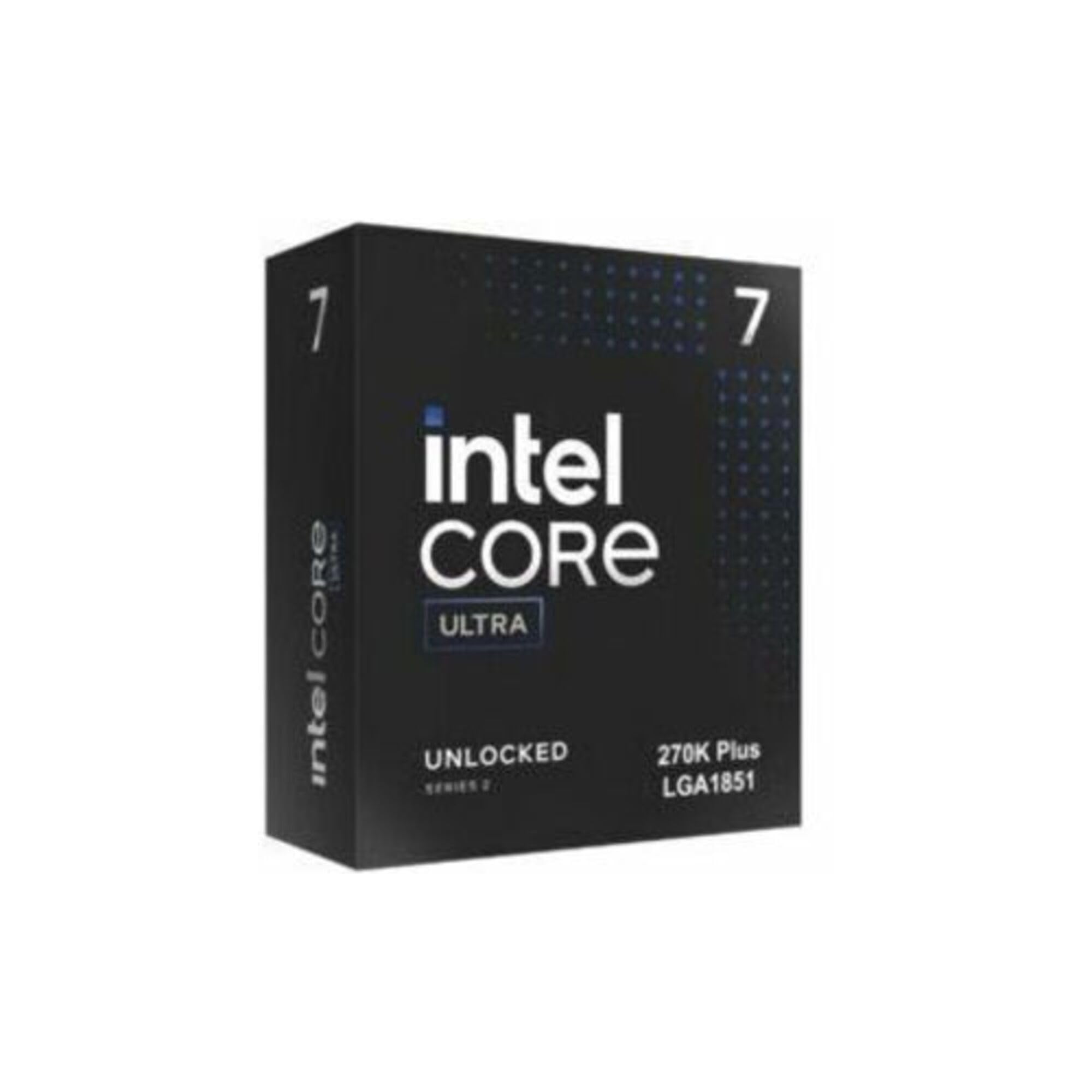
The Core Ultra 7 270K offers nearly the same core configuration as the 285K (8 P-cores + 16 E-cores) for roughly 40% less, making it the smart buy for builders who want Intel’s hybrid architecture without paying flagship premiums. Its 5.5 GHz boost clock is only 200 MHz shy of the 285K, and in gaming benchmarks the difference is often within the margin of error.
Where the 270K really shines is in multi-threaded productivity: with 24 threads, it keeps up with the 285K in most rendering and encoding tasks while consuming slightly less power. Users report stable 5.5 GHz all-core operation with a 360mm AIO, and the chip handles VR gaming with the RTX 5080 at 4K per eye without breaking a sweat.
The main drawback is that like all newer Intel chips, the 270K demands an LGA1851 motherboard and benefits from CUDIMM RAM to reach its rated DDR5 speeds. Still, for a hybrid-focused workflow that also games well, the 270K is a rare sweet spot in Intel’s lineup.
Why it’s great
- Flagship core count at mid-range price
- Strong performance in VR and multi-core tasks
- Better value than the 285K for most users
Good to know
- Requires LGA1851 motherboard
- Gaming 1% lows still behind 7800X3D
5. Skytech Gaming King 95 (Ryzen 7 9850X3D + RTX 5080)
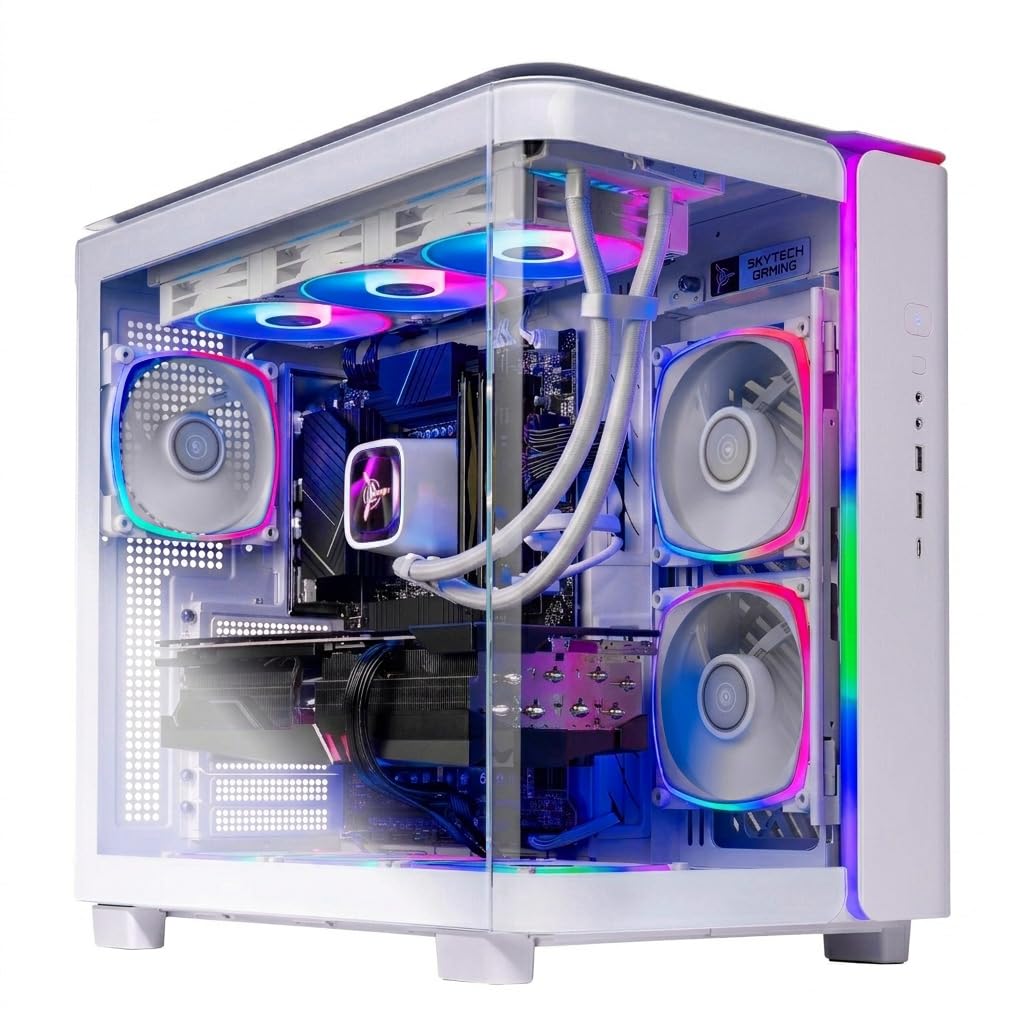
The Skytech King 95 bundles a Ryzen 7 9850X3D with the RTX 5080 in a pre-built configuration that targets no-compromise 4K gaming out of the box. The 9850X3D—a Zen5 X3D chip—inherits the massive L3 cache advantage while boosting to 5.6 GHz, and Skytech pairs it with 32GB of DDR5-6000 and a 360mm AIO for sustained thermal headroom.
Customer reports confirm the rig runs AAA titles at max settings 1440p with high frame rates, and the liquid cooling keeps both CPU and GPU temperature manageable under extended loads. The King 95 case offers good airflow and comes with magnetic dust filters, which is welcome given the 5080’s thermal output.
The value proposition is straightforward: you pay a premium over DIY but avoid the hassle of sourcing a hard-to-find 5080 at MSRP. The included keyboard and mouse are functional but basic, so plan to replace them if you’re serious about competitive gaming.
Why it’s great
- Top-tier CPU + GPU combo in one box
- 360mm AIO cooling keeps noise low
- Great cable management and build quality
Good to know
- Premium over DIY; not for builders
- Included peripherals are entry-level
6. Alienware Aurora ACT1250 (Intel Core Ultra 9 285 + RTX 5080)

The Alienware Aurora uses a locked Intel Core Ultra 9 285 (non-K) paired with the RTX 5080, a 1000W Platinum PSU, and 240mm liquid cooling. Because the 285 is factory-limited, it runs cool and quiet—important for a pre-built that targets mainstream buyers who don’t want to tinker with overclocking.
Performance is solid for 4K gaming: the 285’s 5.6 GHz boost and 76MB cache handle most titles without bottlenecking the 5080, and the 1000W PSU leaves plenty of headroom for future upgrades. Alienware’s Command Center software lets you switch between performance modes and control RGB lighting, though some users report bloatware concerns with Armory Crate equivalents.
The main risk is that the locked CPU and Dell-proprietary motherboard limit upgrade paths. Replacing the cooler or swapping the SSD is straightforward, but the CPU itself can’t be overclocked and the board likely won’t support future Intel chips without a full replacement.
Why it’s great
- Out-of-box stability; no tuning needed
- Quiet even under heavy gaming loads
- Generous PSU for future GPU upgrades
Good to know
- Locked CPU; no overclocking possible
- Proprietary motherboard limits upgrades
7. ASUS ROG Strix G16 (Intel Core Ultra 9 275HX + RTX 5080 Laptop GPU)

The ROG Strix G16 brings a desktop-class 24-core Intel Core Ultra 9 275HX paired with the RTX 5080 laptop GPU, making it one of the most powerful gaming laptops available. The 275HX features 8 P-cores clocked up to 5.4 GHz and 16 E-cores, providing enough multi-threaded grunt for streaming, rendering, and gaming simultaneously.
The 16-inch ROG Nebula display runs at 2560×1600 with a 240Hz refresh rate and a new anti-glare film that reduces reflections. In titles like Cyberpunk 2077, the RTX 5080 Laptop GPU pushes well over 100 FPS at the native resolution with DLSS 4 enabled, while the vapor chamber cooling keeps the chassis comfortable.
Some users report shipping defaults that cause crashes, but these are resolved by setting Nvidia’s dedicated GPU as the default in Control Panel and adjusting TDR timeout values. The keyboard is responsive, and the touchpad is generously sized, though the power brick is large and the fans can be noticeable under load.
Why it’s great
- Desktop-level CPU performance in a laptop
- 240Hz display with excellent color accuracy
- Upgradeable RAM and SSD
Good to know
- Requires driver tweaks for stability
- Loud fans under sustained load
8. GIGABYTE GeForce RTX 5070 WINDFORCE OC

While this is the RTX 5070 rather than the 5080, the WINDFORCE OC remains a relevant comparison point for builders considering a tier-down GPU to afford a better CPU. The 5070 delivers strong 1440p performance with 12GB of GDDR7, and its triple-fan cooling keeps temps under 75°C even during extended sessions.
Paired with a mid-range CPU like the 7800X3D, this card handles max settings at 1440p with competitive frame rates. The 5070 also supports PCIe 5.0, so it’s future-proofed for DirectStorage workloads. At 1440p, the 5070 is often the smarter buy than stretching to a 5080 if your monitor caps at 144Hz anyway.
The card is compact enough for most ATX cases and requires only a standard 16-pin power connector. It’s also quiet—users report it’s barely audible under load, making it a strong pick for builds where noise matters.
Why it’s great
- Excellent 1440p performance for the price
- Quiet triple-fan cooling
- PCIe 5.0 ready
Good to know
- Not a 5080; 12GB VRAM may limit future 4K
- No RGB for aesthetic builds
9. ASUS PRIME RTX 5070 SFF-Ready

The ASUS PRIME RTX 5070 is the go-to GPU for small-form-factor builds that pair with a compact CPU like the 7800X3D. At just 2.5 slots, it fits into ITX cases without sacrificing cooling performance, and its axial-tech fans move plenty of air even in restricted chassis.
The card features a dual BIOS switch that lets users toggle between quiet and performance modes—handy for SFF owners who want low noise during daily use and max performance for gaming. Benchmarks show the 5070 delivering 1440p gaming at over 100 FPS in most titles, and the 12GB GDDR7 buffer is sufficient for high-res texture packs.
One note: the card requires the new 16-pin power connector and ships with an adapter that uses two 8-pin leads. Ensure your power supply supports this before buying. For SFF builders who want 5080-like performance in a smaller envelope, this is the card to target.
Why it’s great
- SFF-ready design fits compact cases
- Dual BIOS for quiet or performance modes
- Clean black aesthetic for professional builds
Good to know
- Requires 16-pin power adapter
- 12GB VRAM is a ceiling for future 4K
10. PNY NVIDIA GeForce RTX 5080 Epic-X ARGB OC
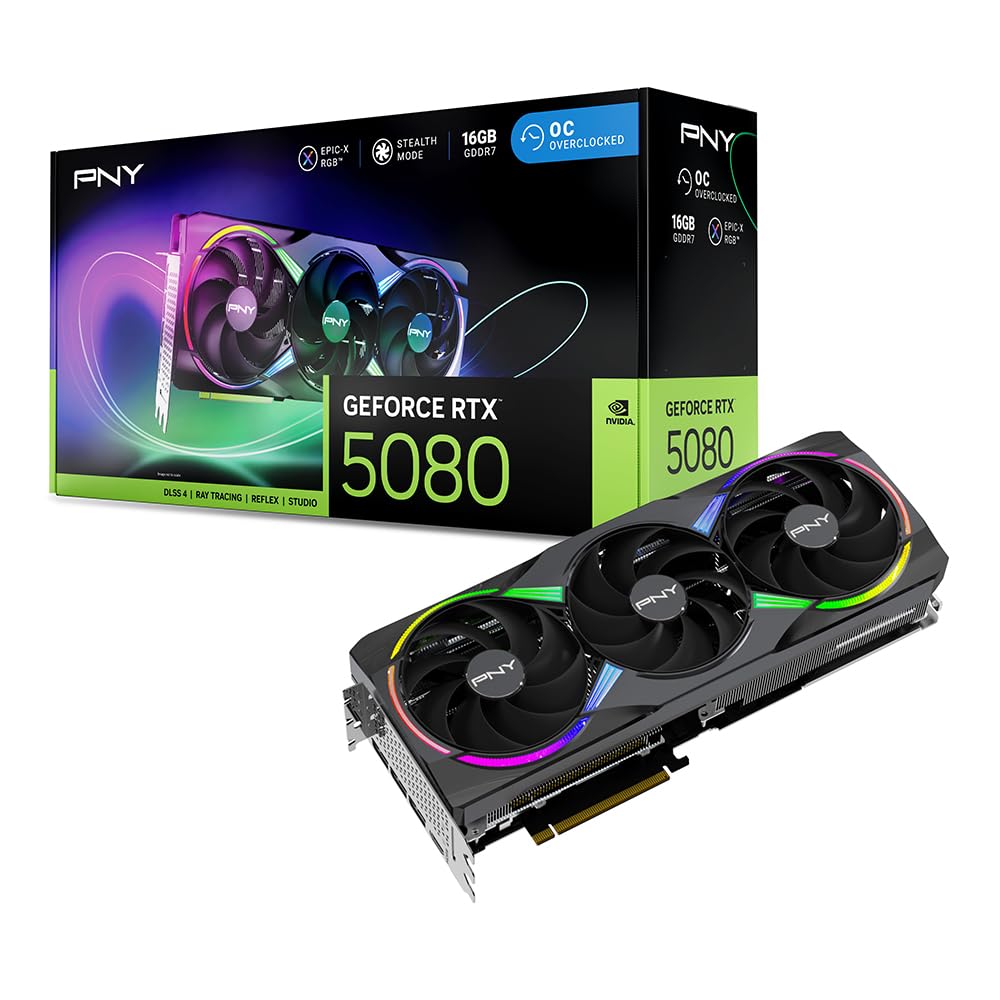
The PNY Epic-X is one of the first custom RTX 5080s to market, offering a 2775 MHz boost clock out of the box with ARGB lighting and a triple-fan cooler. It’s designed to be paired with a high-end CPU like the 9800X3D to unlock maximum ray-tracing and DLSS 4 performance.
The card includes an anti-sag bracket and a 3x 8-pin to 12VHPWR adapter, so it’s ready for installation in full-tower cases. In benchmarks, the Epic-X delivers roughly 30–40% more raster performance than the RTX 4080, with even larger gains in ray-traced titles thanks to Blackwell’s neural rendering improvements.
Some customers have reported receiving units that appear previously opened, leading to DOA scenarios. If you choose the Epic-X, inspect the seal immediately upon arrival and test within the return window. The Founders Edition remains a safer bet for reliability, but the PNY offers aggressive clock speeds for those willing to roll the dice.
Why it’s great
- High factory overclock with ARGB
- Includes support bracket and adapter
- Significant leap over RTX 4080
Good to know
- Quality control concerns; verify on arrival
- Large size requires spacious case
11. NVIDIA GeForce RTX 5080 Founders Edition

The Founders Edition is the baseline reference for the RTX 5080, and it’s the card against which all custom models are measured. Its dual-fan, 2-slot design is surprisingly compact for a 350W+ GPU, and it runs cooler and quieter than many triple-fan third-party cards thanks to NVIDIA’s optimized flow-through cooler.
At 2806 MHz boost, the FE matches or exceeds most custom cards without the bulk. Performance is stellar at 4K: users report 120–240+ FPS in competitive titles at max settings with ray tracing enabled, while the card stays under 70°C under load. The support bracket is unnecessary—the card is lightweight enough to rely on the PCIe slot alone.
The biggest downside is availability: the FE often sells above MSRP due to demand. If you can find one at a reasonable price, it’s the gold standard pairing with the 9800X3D for a no-compromise 4K gaming experience. Undervolting is popular with this card to further improve longevity without sacrificing performance.
Why it’s great
- Reference design; proven reliability
- Compact 2-slot form factor
- Runs cool and quiet under load
Good to know
- Often sold at premium over MSRP
- No overclocking headroom out of box
FAQ
Will a Ryzen 7 7800X3D bottleneck the RTX 5080 at 4K?
Do I need a PCIe 5.0 CPU for the RTX 5080 to work?
Why does 3D V-Cache matter for the RTX 5080?
Should I get the Intel Core Ultra 9 285K or the AMD Ryzen 9 9800X3D for a gaming/streaming PC?
Final Thoughts: The Verdict
For most users, the best cpu for 5080 winner is the AMD Ryzen 7 9800X3D because its 96MB 3D V-Cache delivers the smoothest 1% lows and highest average frame rates in the widest range of games. If you want a better balance between gaming and productivity, grab the Intel Core Ultra 9 285K for its 24-core hybrid architecture that excels in multi-threaded workloads. And for pure value at 4K, nothing beats the AMD Ryzen 7 7800X3D, which offers near-flagship gaming performance at a mid-range price while sipping power.

Mo Maruf
I created WellFizz to bridge the gap between vague wellness advice and actionable solutions. My mission is simple: to decode the research and give you practical tools you can actually use.
Beyond the data, I am a passionate traveler. I believe that stepping away from the screen to explore new environments is essential for mental clarity and physical vitality.