Our readers keep the lights on and my smoothie glass nicely filled. As an Amazon Associate, I earn from qualifying purchases.
Finding a CPU cooler that keeps your processor temperatures in check without turning your desktop into a wind tunnel is a balancing act between thermal conductivity, fan acoustics, and physical clearance inside the chassis. The right cooler extends component lifespan and maintains consistent clock speeds under sustained loads.
I’m Mohammad Maruf — the founder and writer behind WellFizz. This guide is the result of many hours spent analyzing thermal performance data, decibel ratings, fin density figures, and hundreds of verified buyer reports for each cooler discussed here.
The thermal solution you choose directly impacts system stability and noise levels. After comparing five top contenders across air and liquid designs, this deep dive into the best cpu coolers on the market will help you lock in the right decision for your build.
How To Choose The Best CPU Coolers
Selecting a CPU cooler requires a clear understanding of your processor’s thermal design power (TDP), the physical space inside your case, and your tolerance for fan noise. Ignoring any of these three factors leads to either throttling, a case that doesn’t close, or constant audible hum.
Air Coolers vs. AIO Liquid Coolers
Air coolers rely on a metal heatsink (aluminum fins with copper heat pipes) and one or more fans to pull heat away from the CPU. They have no pump, no coolant, and zero risk of leaks. Dual-tower designs like the Thermalright Phantom Spirit 120SE and Noctua NH-D15 G2 offer performance comparable to mid-range liquid coolers. AIO (All-In-One) liquid coolers use a pump, radiator, and pre-filled coolant to move heat to a remote surface where fans exhaust it. A 360mm AIO generally handles higher sustained TDPs than most air coolers but adds points of failure (pump, seals) and costs more.
Heat Pipe Count and Base Plate Design
For air coolers, the number of heat pipes (typically six to eight) and their diameter (6mm is standard) directly affect thermal transfer speed. Technologies like Thermalright’s AGHP (Anti-Gravity Heat Pipe) fourth-generation design minimize performance loss when the cooler is mounted horizontally or vertically. The base plate material — copper with nickel plating — ensures efficient heat absorption from the CPU’s integrated heat spreader.
Fan Noise, Bearings, and PWM Control
Noise levels, measured in dBA, are critical for a quiet workstation. Fans using S-FDB (Fluid Dynamic) bearings, such as those on the Thermalright and Noctua coolers, provide longer service life (up to 20,000 hours) and lower acoustic output than sleeve bearing fans. Pulse Width Modulation (PWM) control via the 4-pin header allows the motherboard to adjust fan speed dynamically, balancing cooling versus silence. A peak noise rating under 30 dBA is ideal for noise-sensitive environments.
Quick Comparison
On smaller screens, swipe sideways to see the full table.
| Model | Category | Best For | Key Spec | Amazon |
|---|---|---|---|---|
| Thermalright Phantom Spirit 120SE | Air | High-value quiet air cooling | 7 heat pipes & 66.17 CFM airflow | Amazon |
| be quiet! Pure Loop 2 FX 360mm | AIO 360mm | Quiet RGB AIO with refill port | 3x Light Wings fans & 34 dBA noise | Amazon |
| Corsair Nautilus 360 RS | AIO 360mm | Low-noise 20 dBA pump operation | 2100 RPM fans & convex cold plate | Amazon |
| Noctua NH-D15 G2 | Air | Ultimate air cooling for high TDP CPUs | 8 heat pipes & dual 140mm fans | Amazon |
| Lian Li GA II Trinity SL-INF 360mm | AIO 360mm | Premium aesthetics with LCD display | Fluid dynamic bearings & 35 dBA noise | Amazon |
In‑Depth Reviews
1. Thermalright Phantom Spirit 120SE

This dual-tower air cooler packs seven 6mm copper heat pipes with AGHP 4.0 technology, meaning its thermal transfer remains consistent whether mounted vertically or horizontally inside the chassis. The 120mm TL-C12B V2 PWM fans push 66.17 CFM at a maximum of 1500 RPM, producing just 25.6 dBA — quiet enough for a noise-sensitive workspace. With a 154mm total height, it fits comfortably in most mid-tower cases while clearing tall RAM modules by offsetting the front fin stack.
Verified buyers report idle temperatures in the low 40s°C and gaming loads around 50–60°C on chips like the Ryzen 7800X3D, while a heavily undervolted i7-12700K stays under 78°C in Cinebench. One user noted the stock fans developed audible noise after six months of 24/7 operation, but the overall consensus from over 1,000 reviews praises its price-to-performance ratio as exceptional. The included S-FDB bearings are rated for 20,000 hours, which translates to years of reliable service before any replacement consideration.
Some builders found that accessing M.2 slots becomes tighter after installation due to the cooler’s width, and the included mounting hardware for both Intel LGA1851/1700 and AMD AM5/AM4 sockets is clear but requires careful torque application. If your CPU’s TDP stays under 170W, this air cooler rivals the performance of a 280mm AIO while costing significantly less and eliminating any pump or leak risk.
Why it’s great
- Excellent thermal performance for the price, matching many mid-range AIOs
- Very quiet under normal and gaming loads (25.6 dBA peak)
- Broad socket compatibility including LGA1851 and AM5
Good to know
- Stock fan quality may degrade after extended continuous use
- Large footprint can obstruct top PCIe slot and M.2 access
- No RGB lighting for users wanting visual customization
2. be quiet! Pure Loop 2 FX 360mm

Be Quiet! designed this 360mm AIO with a doubly decoupled PWM pump that minimizes vibration transmission to the chassis, keeping operational noise low while the three Light Wings 120mm high-speed fans spin up to 1800 RPM. The included ARGB-PWM hub supports synchronization of up to six ARGB components and PWM fans, which simplifies cable management in builds that prioritize clean aesthetics. The 27mm thick radiator provides sufficient surface area for thermal dissipation on processors with TDPs up to the 14600K range.
Buyers report that the cooler handles an overclocked i7-9700K at 5 GHz without thermal throttling and keeps a Ryzen 5 7600X3D in the low 40s°C at idle. One user noted that the pump-on-line design makes routing the tubing somewhat awkward in compact cases like the NZXT S340 Elite, but the pre-filled coolant and included refill bottle (for topping up after the recommended two-year period) add longevity that few competing AIOs offer. The noise level at 34 dBA is present but described as a low hum rather than an aggressive whine.
Installation instructions are minimal, and the hub requires that at least one fan connect to the RPM header for proper BIOS speed control. The pump is audible to sensitive ears at close range, but the overall acoustic profile is far quieter than most budget AIOs. For users who want genuine long-term serviceability — the ability to refill coolant rather than replace the entire unit — this cooler stands apart in the mid-range AIO landscape.
Why it’s great
- Refillable coolant system extends product lifespan beyond typical AIOs
- Doubly decoupled pump reduces noise and vibration effectively
- ARGB-PWM hub simplifies cable routing and synchronization
Good to know
- Pump-on-line design can complicate tubing routing in smaller cases
- Instructions are sparse, especially regarding hub fan header requirements
- Pump noise is present, though low in volume
3. CORSAIR Nautilus 360 RS
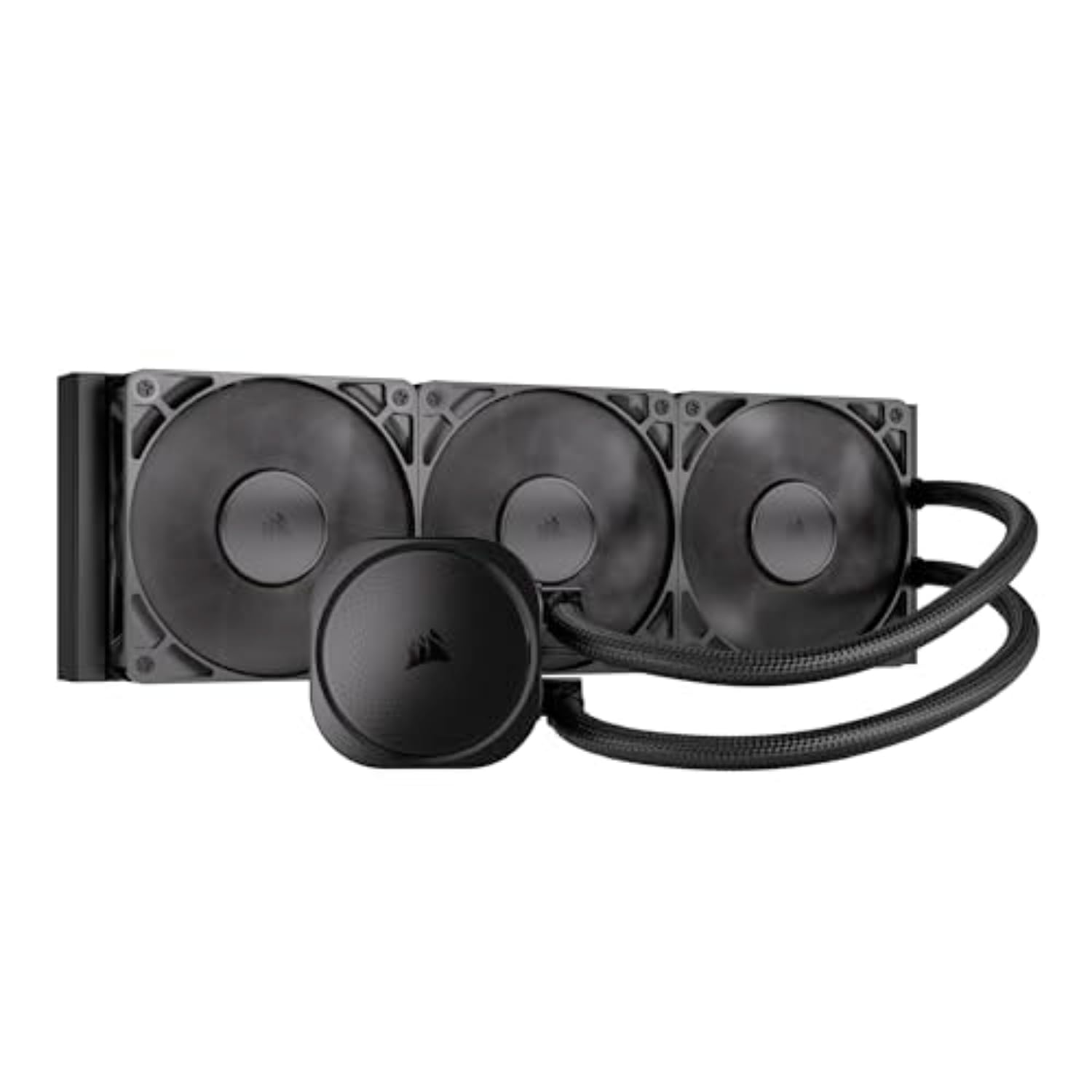
Corsair engineered this AIO with a convex cold plate that applies pressure to the center of the CPU’s integrated heat spreader, where the die concentrates most of its heat. The pre-applied thermal paste is laid in an optimized pattern to shorten installation time, and the pump itself generates only 20 dBA — nearly inaudible in a typical room environment. The RS120 fans use AirGuide technology with Magnetic Dome bearings, delivering high static pressure through the radiator fins at up to 2100 RPM while maintaining a published 36 dBA noise floor.
Testing on a Ryzen 9 9950X shows idle temperatures around 28°C, and under heavy Cinebench loads the CPU stays well below throttling thresholds. One verified user saw a 10°C drop after replacing the pre-applied paste with a high-end thermal compound, dropping gaming temps from 55°C to 45°C. The daisy-chainable fan cabling reduces the number of cables to a single 4-pin header, which is a major advantage for builders who value clean routing and minimal clutter behind the motherboard tray.
The unit includes a generic mounting kit for Intel LGA1851/1700 and AMD AM5/AM4, and the straightforward design means even a first-time AIO installer can complete the build without referencing a tutorial. Some users may want addressable RGB options (the RS fans lack lighting), but Corsair offers upgrade paths later. At a modest height of 1.06 inches for the radiator, this cooler fits in cases that lack generous top clearance — a detail many AIO specs overlook.
Why it’s great
- Extremely quiet pump operation at just 20 dBA
- Daisy-chainable fans reduce cable clutter significantly
- Convex cold plate maximizes contact over the CPU die hotspot
Good to know
- Pre-applied thermal paste is not top-tier; upgrading yields lower temps
- No ARGB lighting on the fans for builders wanting visual flair
- Fan noise at 36 dBA becomes audible under full load
4. Noctua NH-D15 G2

These fans use a speed-offset design for acoustic fine-tuning and PWM for automatic speed control, which keeps them near silent during idle while delivering maximum airflow under load. The offset lower fin stack provides 59mm of RAM clearance in single fan mode, solving a common clearance complaint from the previous generation.
Buyers report borderline absurd thermal performance: an Intel Core Ultra 9 285K stays at 80°C during AIDA64 stress testing, while a Core Ultra 7 265K never requires fans to ramp to full speed. One user noted that the cooler is 15% physically larger than the original NH-D15, requiring a full-size case with at least 6.61 inches of CPU cooler clearance. The SecuFirm2+ mounting system includes a Torx screwdriver and washers to reduce CPU warp on LGA1700 sockets, reflecting Noctua’s meticulous engineering.
The included NT-H2 thermal paste and the ability to passively cool a 250W processor without pump noise or leak risk makes this the definitive high-end air cooler. The only real drawback is the price point, which sits above many capable 240mm and even some 360mm AIOs. For users who prioritize absolute reliability and whisper-quiet operation over the novelty of liquid cooling, this cooler represents the plateau of what air cooling can achieve in a consumer desktop.
Why it’s great
- Exceptional thermal capacity handling CPUs over 250W TDP
- Ultra quiet operation at 24.8 dBA even under heavy load
- Six-year warranty and premium build quality with SecuFirm2+ mounting
Good to know
- Very large physical footprint requires a full-size case
- RAM clearance is limited to 32mm with both fans installed
- Premium price approaches the cost of many liquid cooling solutions
5. Lian Li GA II Trinity SL-INF 360mm

Lian Li’s Trinity SL-INF combines a 27mm thick radiator with a copper plate that has 13% larger fin spacing than typical AIOs, which helps prevent buildup of sediment over time. The tube diameter is 20% larger than standard, increasing water flow for faster heat dissipation. The pump cap features three interchangeable designs with dual individually controllable ARGB rings, and the 45-degree tubing connector rotates 360° for flexible routing. The 120mm fans are equipped with fluid dynamic bearings for stable, quiet operation at up to 3200 RPM pump speed.
Users report that the cooler keeps an i9-14900K at 80°C max under Cinebench with typical gaming loads in the 50–65°C range, and the daisy-chainable UNI Fan SL-INF fans simplify cabling to a single connection. The L-Connect 3 software, while visually polished, has drawn complaints for occasional bugs, high CPU usage, and stuttering in some configurations. One reviewer noted a loud pump at default speeds (requiring manual setting to 1690 RPM) and LCD flickering that required two RMA replacements within 8 months.
The 2.88-inch LCD screen can display real-time system metrics, custom images, or video clips, making this cooler a centerpiece for show builds. The cooling performance is genuinely top-tier, and when the software cooperates, the experience is excellent. The cost places it at the upper end of the AIO market, and the potential software and pump issues mean it demands a higher tolerance for troubleshooting than more mature platforms like Corsair or Noctua.
Why it’s great
- Excellent thermal performance with 360mm radiator and larger diameter tubing
- Customizable LCD screen and dual-ring ARGB for premium aesthetics
- Daisy-chainable fan cabling reduces build complexity
Good to know
- L-Connect 3 software has history of bugs and high CPU overhead
- Pump noise can be loud at default speed settings
- LCD reliability issues reported including flickering and burn-in
FAQ
Can a large air cooler like the NH-D15 G2 damage my motherboard through weight?
Is a 360mm AIO always better than a high-end air cooler?
How do I know if a cooler will fit inside my PC case?
Final Thoughts: The Verdict
For most users, the best cpu coolers winner is the Thermalright Phantom Spirit 120SE because it delivers near-premium air cooling performance at a price that undercuts every comparable solution while staying quiet and compatible with the latest sockets. If you want absolute silence with headroom for overclocking a 250W+ processor, grab the Noctua NH-D15 G2. And for a visually stunning liquid cooled build with an LCD screen and RGB fans, nothing beats the Lian Li GA II Trinity SL-INF 360mm.

Mo Maruf
I created WellFizz to bridge the gap between vague wellness advice and actionable solutions. My mission is simple: to decode the research and give you practical tools you can actually use.
Beyond the data, I am a passionate traveler. I believe that stepping away from the screen to explore new environments is essential for mental clarity and physical vitality.