Our readers keep the lights on and my smoothie glass nicely filled. As an Amazon Associate, I earn from qualifying purchases.
A backpacking trip should be about the trail, the sunrise, and the silence of the backcountry — not about gasping for air at 3 a.m. because your therapy machine had no power. The moment you strap a tent, a sleeping bag, and a medical device into a single pack, every ounce and every watt-hour counts. Finding a power solution that keeps your therapy running without breaking your back or your gear budget is the single hardest logistics problem for the outdoor CPAP user. This guide breaks down the battery packs, portable power stations, and dedicated medical backups that solve that exact challenge.
I’m Mohammad Maruf — the founder and writer behind WellFizz. I’ve spent hundreds of hours cross-referencing battery chemistries, DC voltage curves, and real-world runtimes from verified owners to find the gear that actually works when you’re miles from the nearest outlet.
Whether you’re thru-hiking the PCT or just car-camping for the weekend, this guide to the best cpap for backpacking focuses exclusively on power solutions that pair with your existing machine to deliver reliable, lightweight, and travel-friendly therapy off the grid.
How To Choose A CPAP Battery For Backpacking
Selecting the right power source for overnight therapy in the backcountry isn’t about grabbing the biggest battery on the shelf. You have to balance weight, capacity, voltage compatibility, and recharging speed — all while staying within airline limits if your hike involves a flight. Ignore one variable and you either carry dead weight or wake up without therapy.
Capacity vs. Portability — The Real Tradeoff
A 300Wh battery will run a ResMed AirSense 10 for two nights without humidity, but it also weighs over three pounds. A 95Wh unit like the Medistrom Pilot-24 Lite is a fraction of that weight and fits in your palm, but you will recharge it every single night. For ultralight backpacking, staying under 100Wh keeps you TSA-compliant and shaves a pound off your pack. For basecamp-style trips, the extra capacity of a larger LiFePO4 station makes sense.
Voltage and Cables — Don’t Assume Compatibility
CPAP machines run at specific DC voltages: most ResMed units operate at 24V, while Philips DreamStations use 12V or 19V. Not every battery pack outputs the right voltage natively. Some universal packs come with voltage selectors, while others require a separate converter cable. Buying a battery without checking your machine’s input voltage is the most common — and most frustrating — mistake backpackers make.
Pass-Through Charging Keeps You Flexible
A pack with pass-through charging lets you charge the battery while it simultaneously powers your machine. This is critical if you are at a trailhead café or in a car between campsites. Without it, you must choose between charging the battery and using the device — a logistical dead end for multi-day trips. Many dedicated CPAP batteries skip this feature, so check the specs carefully.
Battery Chemistry and Cycle Life
Lithium-ion (Li-Ion) batteries are lighter and more energy-dense, making them ideal for short, intense backpacking trips. Lithium iron phosphate (LiFePO4) packs are heavier but offer 2,000 to 3,000 charge cycles versus 500 for standard Li-Ion. If you plan to use the battery several nights a month for years, the heavier LiFePO4 chemistry pays for itself in longevity.
Quick Comparison
On smaller screens, swipe sideways to see the full table.
| Model | Category | Best For | Key Spec | Amazon |
|---|---|---|---|---|
| Zopec Explore Mini | Premium | Ultralight backpacking & air travel | 99.9Wh Li-Ion, 1.1 lb | Amazon |
| Zopec Explore 5700 | Premium | Multi-night trips without humidity | 5700mAh (approx 205Wh) | Amazon |
| Pilot Flex 98Wh | Premium | Dual-voltage travel with rugged case | 98Wh, 1.2 lb aluminum case | Amazon |
| EASYLONGER ES960 PRO | Mid-Range | Basecamp camping & RV use | 297.6Wh LiFePO4, 6.6 lb | Amazon |
| Medistrom Pilot 24 Lite Bundle | Premium | TSA-friendly travel with LED flashlight | 95Wh, 1.3 lb built-in USB | Amazon |
| Pilot-24 Lite | Premium | Air travel & lightweight overnight | 95Wh, 1.3 lb aluminum case | Amazon |
| EASYLONGER ES720 | Mid-Range | Car camping with multiple DC cables | 266.4Wh, 3.31 lb | Amazon |
| GRECELL EB1000 | Mid-Range | Powering multiple devices at camp | 999Wh LiFePO4, 17 lb | Amazon |
| Krisdonia 60000mAh | Budget | Emergency backup with AC outlet | 222Wh, 1.8 kg AC output | Amazon |
In‑Depth Reviews
1. Zopec Explore Mini

The Zopec Explore Mini weighs just over a pound and measures 6.5 x 3 x 1 inches, making it the smallest dedicated CPAP battery on the market. It uses Panasonic lithium-ion cells — the same chemistry used in Tesla vehicles — and its solid-state cooling eliminates the noisy fan found in most power stations. With 99.9Wh capacity, it stays under the FAA 100Wh limit, so you can carry it onto any flight without paperwork. A single USB-C 65W charger refills it in about 1.5 hours, which is significantly faster than the 3-8 hour recharge times of comparable units.
Patented auto-voltage technology means it adapts to 12V, 19V, or 24V devices without a selector switch — you simply plug in your machine. The battery supports ResMed AirMini, AirSense 10, AirSense 11, and AutoSet models out of the box. The included DC cable kit covers the main ResMed machines, and additional cables for DreamStation, Luna, and Transcend units are sold separately. Owners report the Mini powers an AirMini for nearly three full nights with humidity off, which is exceptional for a battery this size.
One limitation is the lack of a built-in AC inverter — you cannot plug a standard wall-wart CPAP into this unit. It is a pure DC device, so it requires your machine to have a DC input barrel plug. If your machine lacks DC input (rare but possible with older units), you will need an adapter. Some users also note the battery must be manually turned off after use to prevent parasitic drain, as there is no auto-shutoff feature. Despite these small quirks, the weight-to-runtime ratio is unmatched for serious backpackers.
Why it’s great
- Lightest dedicated CPAP battery at 1.1 pounds
- Auto-voltage technology works with 12V, 19V, and 24V machines
- Ultra-fast USB-C recharge in under 2 hours
- FAA/TSA compliant for carry-on air travel
Good to know
- No AC inverter built in — DC input only
- Requires manual shutoff to avoid standby drain
- Additional cable kits sold separately for non-ResMed machines
2. Zopec Explore 5700

The Zopec Explore 5700 is the larger sibling in the Zopec line, offering enough capacity to power most CPAP machines for up to three nights without humidification. It handles input voltages from 110V to 240V, making it genuinely universal for international backpacking trips where wall outlets vary by country. The battery uses standard lithium-ion cells and includes a car charger in the box — a nice bonus for road-to-trail transitions. At about 2.5 pounds, it is heavier than the Explore Mini but still packable for basecamp setups.
Compatibility covers ResMed, Philips Respironics, DeVilbiss, and most other major brands without requiring separate adapter cables. The unit outputs via a standard AC port and a DC barrel plug, so you can connect your machine’s native power brick directly. Owners consistently report 16 to 20 hours of runtime when running a ResMed AirMini without the humidifier or heated hose — enough for two to three full nights if your pressure setting stays below 12 cm H₂O. With humidifier use at low to medium levels, runtime drops to roughly eight hours, covering a single night.
Recharge time from 20% to full is about two hours with the included AC adapter, which is respectable for a pack of this capacity. Some users note that the battery cannot simultaneously charge a phone — it prioritizes the CPAP output, so leave a separate power bank for your devices. A few reviewers report that the three-night claim is optimistic at higher pressure settings (above 14 cm H₂O), so plan for two nights between charges if you run aggressive therapy. Overall, this is a strong choice for extended backcountry stays where weight is not the primary constraint.
Why it’s great
- Up to three nights of runtime on a single charge
- Universal 110-240V input for international travel
- Includes car charger for road trips
- Works with most major CPAP brands without adapters
Good to know
- Heavier than the Explore Mini at about 2.5 pounds
- Cannot charge a phone while powering the CPAP
- Runtime varies significantly with pressure settings above 12 cm H₂O
3. Pilot Flex 98Wh
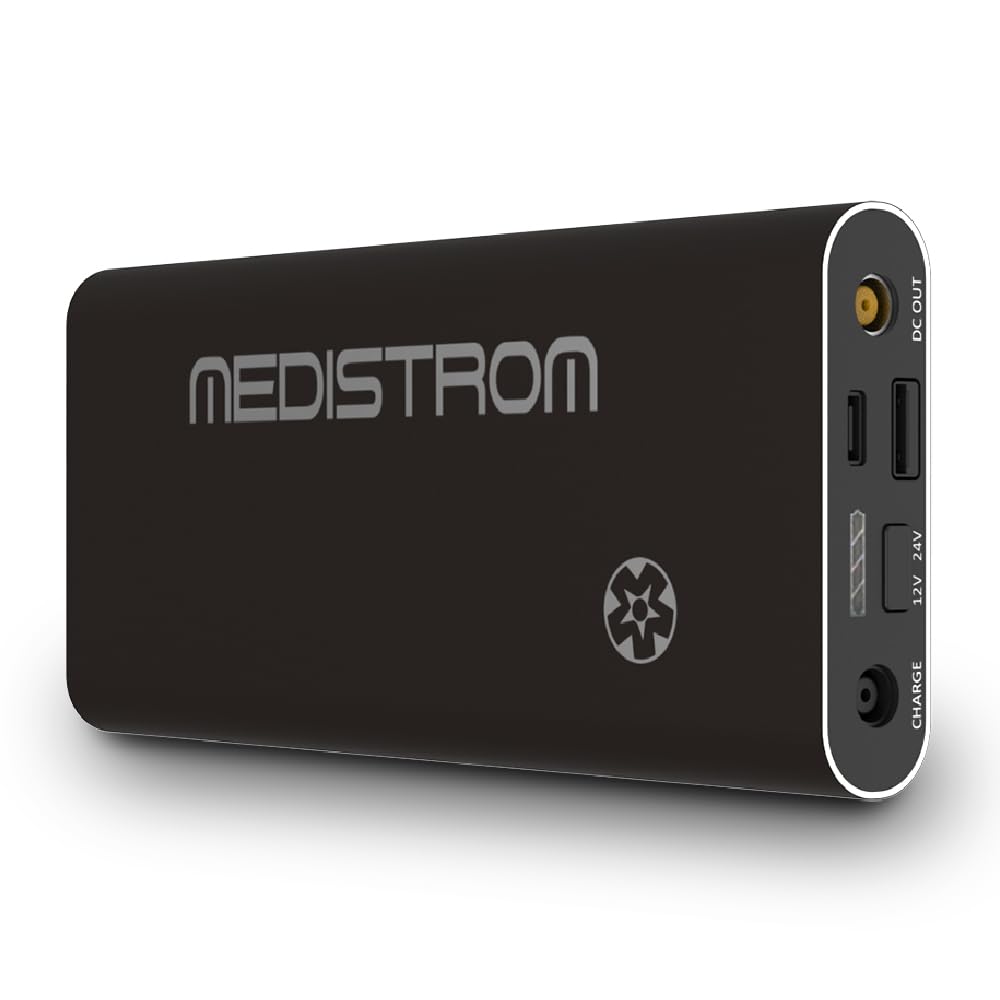
The Pilot Flex from Medistrom packs 98Wh into a machined aluminum case that measures just 6.57 x 2.95 x 0.79 inches — roughly the size of a large smartphone. At 1.2 pounds, it is only slightly heavier than the Zopec Explore Mini but adds dual-voltage output (12V and 24V) to support both ResMed and Philips DreamStation machines without extra cables. The USB-C fast charging port refills the battery in two to three hours, and the unit supports flowthrough operation, meaning it can act as an uninterrupted power supply during an outage without dropping therapy.
Inside the box you get two DC output cables: one for AirSense 11 and one for AirMini. Separate cables for AirSense 10, DreamStation 1 and 2, Luna, and other machines are available but sold individually. Owners report the Flex powers an AirMini for approximately 1.5 to 2 nights with humidity off — shorter than the Zopec Explore 5700 but inline with the 98Wh-class. For AirSense 11 users running without heated humidity, expect roughly eight hours, covering one full night with a small buffer.
The aluminum case provides excellent durability and feels premium in hand, but it also lacks any wireless charging pad or built-in flashlight found on cheaper competitors. The connectors require a firm push to lock in — some users reported intermittent contact if the cables were jostled during the night. The Flex comes with a two-year warranty, which is solid for this price tier. For backpackers who prioritize a slim, rugged form factor and need dual-voltage support, this is a top contender.
Why it’s great
- Ultra-slim aluminum case — fits in a jacket pocket
- Dual 12V/24V output supports ResMed and Philips machines
- Flowthrough operation for uninterrupted backup power
- USB-C fast recharge in 2-3 hours
Good to know
- Cables require firm insertion; can disconnect with jostling
- Single-night capacity for most machines with humidity
- Additional cables for non-ResMed machines cost extra
4. EASYLONGER ES960 PRO
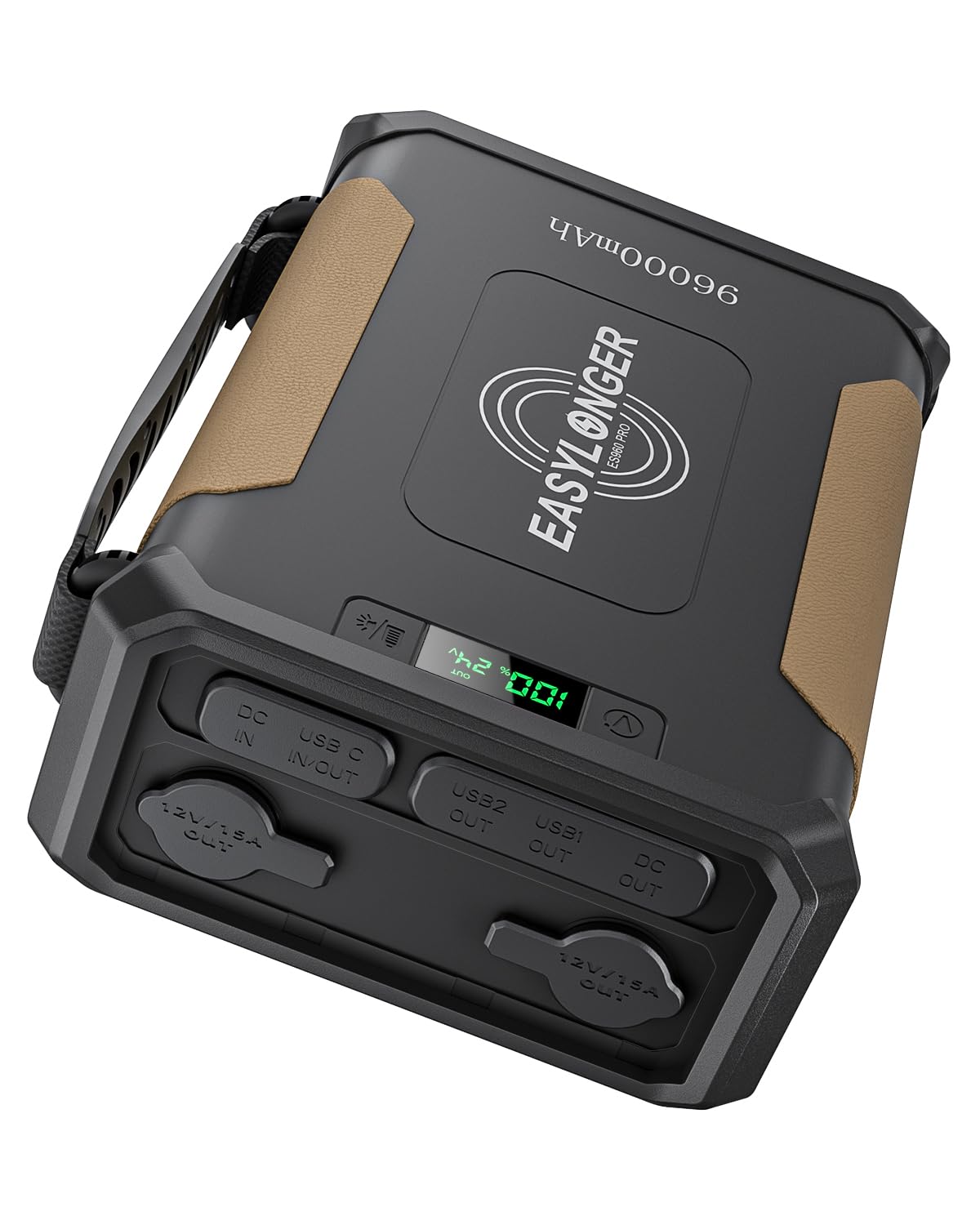
The EASYLONGER ES960 PRO shifts from lightweight trail use to serious basecamp and RV scenarios. Its 297.6Wh lithium iron phosphate (LiFePO4) battery is nearly three times the capacity of the Explorer Mini but also weighs 6.6 pounds — making it a poor choice for a backpack but an excellent companion for car camping, canoe camping, or van life. The LiFePO4 chemistry delivers over 3,000 charge cycles before noticeable degradation, so this battery will outlast your CPAP machine if treated well.
The unit includes four dedicated CPAP DC cables covering ResMed S9, AirSense 10/11, AirCurve 10/11, AirMini, and Philips DreamStation 1 and 2. A fifth adjustable DC port lets you set output voltage to 12V, 16.5V, 19V, or 24V for non-standard machines. Owners report running an AirSense 10 for two full nights with humidity off and still having 25% capacity remaining — or about one night with the heated humidifier at a medium setting. The 100W USB-C PD port also handles laptop charging, so you can consolidate devices.
Recharge via the included 72W wall adapter takes around five hours, or you can top it up with a 100W solar panel in four to five hours on a sunny day. The built-in white LED and SOS strobe are handy for camp setup. The main drawback is the bulk — at 8.86 x 6.2 x 3 inches, it takes up significant pack volume. It also exceeds the 160Wh airline limit, so it is strictly ground-travel only. If you drive to your trailhead and set up a basecamp, this is the most reliable multi-night option on the list.
Why it’s great
- Massive 297.6Wh capacity for 2+ nights of therapy
- LiFePO4 chemistry lasts 3000+ charge cycles
- Four dedicated CPAP cables included in the box
- Solar recharge capability for off-grid independence
Good to know
- Heavy at 6.6 pounds — not for backpacking
- Exceeds airline Wh limits for carry-on travel
- Large footprint takes up significant gear space
5. Medistrom Pilot 24 Lite Bundle

The Medistrom Pilot 24 Lite Bundle pairs the standard 95Wh battery with three packs of CPAP wipes — a small addition but genuinely useful for keeping your mask clean on the trail. The core battery unit is identical to the standalone Pilot-24 Lite: 1.3 pounds, a robust aluminum alloy case, and a 24V output designed primarily for ResMed machines. It also includes a USB-A port for charging a smartphone or tablet during the day, which is a welcome bonus when every outlet is miles away.
The battery packs a built-in LED flashlight with steady-on and SOS modes, so it doubles as an emergency light at camp. Owners report powering a ResMed AirMini for a full eight-hour night with the humidifier set to low, and up to 16 hours with heat and humidity off entirely. The charger recycles the battery from flat to full in approximately two to three hours using the included AC adapter. The bundle configuration typically costs the same as the battery alone, making the wipes essentially free.
One consistent complaint across user reviews is reliability over time — several owners report that after a year of regular use, the battery capacity degrades noticeably, dropping from a full night to under five hours. The unit also lacks pass-through charging, so you cannot charge the battery while it powers your CPAP. For occasional weekend trips, this is a minor inconvenience. For someone relying on this for multiple consecutive nights, the longevity concerns make the Zopec or Flex options more dependable over the long term.
Why it’s great
- Includes CPAP wipes for mask hygiene on the trail
- Built-in flashlight with SOS mode for camp use
- USB-A port charges phone or tablet alongside CPAP
- FAA-compliant at 95Wh for carry-on air travel
Good to know
- Capacity degrades noticeably after 12-18 months
- No pass-through charging — cannot charge and run simultaneously
- Only 24V output; not compatible with 12V DreamStation natively
6. Medistrom Pilot-24 Lite

The standalone Medistrom Pilot-24 Lite is the same core battery as the bundle version but without the accessory wipes. It holds 95Wh of capacity in a slim aluminum case that slips into any backpack side pocket. Weighing just 1.3 pounds, it is one of the lightest options available and remains fully TSA- and FAA-compliant for carry-on luggage. The battery recharges in two to three hours via its included AC adapter, which is fast enough to top off during a layover or lunch break at a trailhead café.
Compatibility out of the box covers ResMed AirMini and AirSense 10, with additional cables sold separately for AirSense 11, S9, DreamStation Go, Luna, and prismaSMART machines. The battery uses LG industrial-grade lithium-ion cells inside a machined aluminum housing, giving it a premium feel and solid drop resistance. Owners consistently report 10 to 16 hours of runtime on a ResMed AirMini with humidity off — more than enough for a single night plus buffer. With the humidifier engaged at a low setting, runtime drops to roughly seven to eight hours.
The critical weakness shared with the bundle version is reliability over extended ownership. Multiple reviews document the battery losing half its usable capacity within a year, dropping from a full eight-hour night to just three or four hours despite no change in machine settings. The unit also lacks pass-through charging and has no USB-C port, relying instead on a barrel-plug AC adapter that is easy to misplace. For backpackers who fly to a new trailhead every few months and need a light, disposable power solution, this makes sense. For long-term ownership, the Zopec Explore Mini offers better value at a similar weight.
Why it’s great
- Ultra-light at 1.3 pounds for backpack carry
- Premium aluminum alloy case with drop resistance
- FAA/TSA compliant with fast 2-3 hour recharge
- LG industrial-grade cells for reliable output
Good to know
- Capacity can degrade significantly after one year
- No USB-C port — uses proprietary barrel-plug charger
- No pass-through charging capability
7. EASYLONGER ES720

The EASYLONGER ES720 is a mid-range CPAP battery that comes with four different DC cables out of the box, covering ResMed S9, AirSense 10, AirCurve 10, AirMini, AirSense 11, AirCurve 11, Philips DreamStation, and DreamStation 2. This is the most inclusive cable set of any battery on this list — no additional purchases required unless you own a less common brand like Luna G3 (heated tube not supported) or a specialty machine. At 3.31 pounds and 266.4Wh, it splits the difference between the lightweight travel packs and the 6+ pound basecamp stations.
A 180W cigarette lighter socket and an adjustable DC port (12V/16.5V/20V/24V) let you power laptops, drones, car refrigerators, and other accessories beyond your CPAP. The built-in BMS protects against over-charge, over-discharge, short circuits, and thermal extremes, while pass-through charging lets you recharge the battery while it powers your therapy — a feature absent from the Medistrom units. Owners report the ES720 powers an AirSense 11 for roughly two dry nights (humidifier and heated tube off), or one night with humidity at a low setting.
Recharge options include the included 72W AC adapter (4-5 hours), a 60W USB-C PD charger (4.5-5.5 hours), a 100W solar panel (4-5 hours), or a car outlet adapter. The LED flashlight with SOS strobe is a nice bonus. The battery is not TSA-compliant for carry-on, as it exceeds 160Wh. Some users report that the cigarette lighter socket needs a voltage converter to power CPAP machines, which adds complexity if you plan to use that port. Overall, the ES720 offers the best cable diversity in this price bracket, making it ideal for households with multiple CPAP brands or for campers who also need to power laptops and cameras.
Why it’s great
- Four dedicated CPAP cables included for ResMed & Philips
- Pass-through charging allows simultaneous charge and use
- Adjustable DC port and 180W lighter socket for extra devices
- Multiple recharge methods including solar and car
Good to know
- Not TSA-compliant — cannot fly with it in carry-on
- Cigarette lighter port may require voltage converter for CPAP
- 3.31 pounds is too heavy for ultralight backpacking
8. GRECELL EB1000
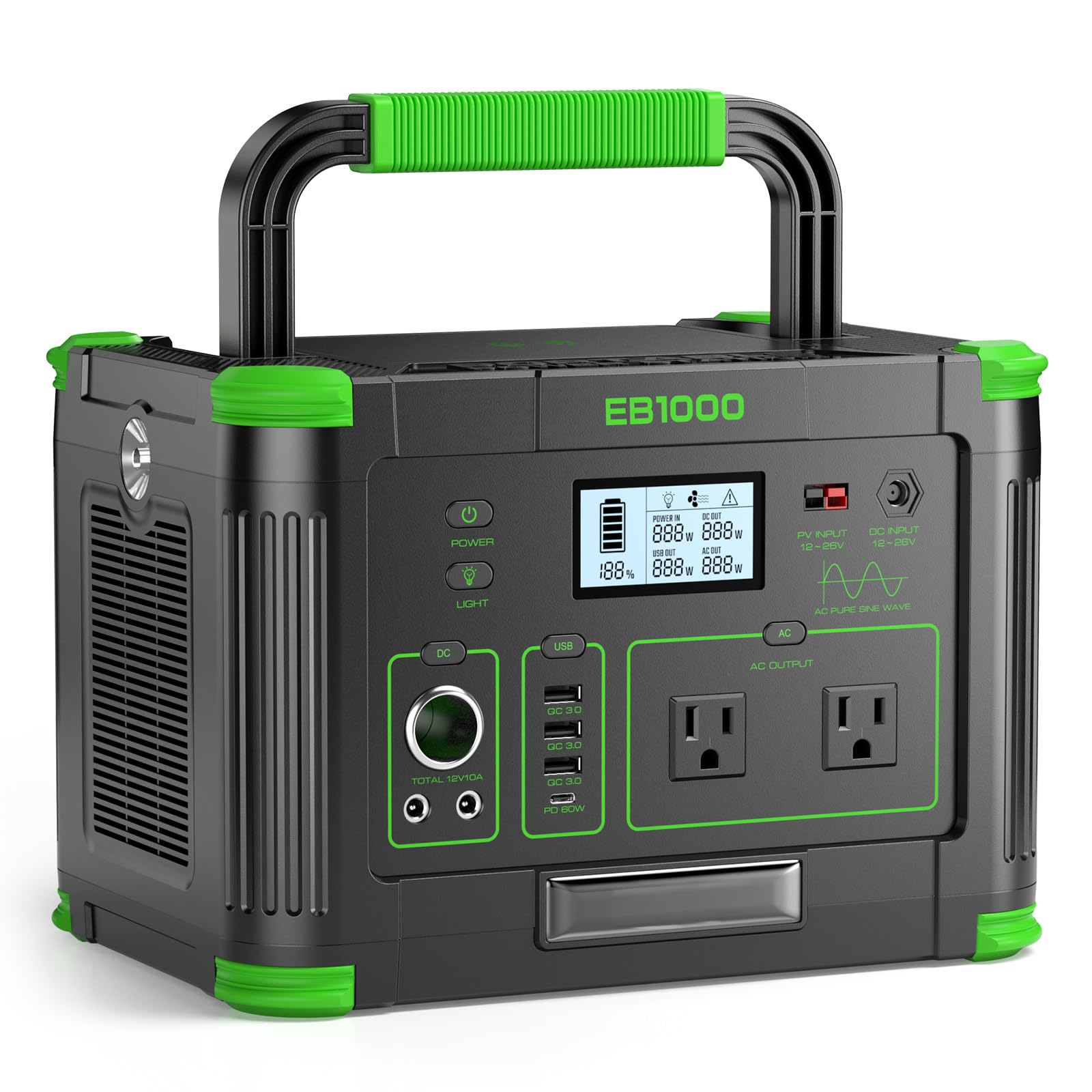
The GRECELL EB1000 is a full-size portable power station that happens to make an excellent basecamp CPAP power source. Its 999Wh lithium iron phosphate battery can run a ResMed AirSense 11 for five to seven nights without humidity, or three to four nights with the humidifier on low. The 1000W pure sine wave AC inverter ensures clean power for sensitive medical electronics — no risk of humming, weird DC whine, or device damage. At 17 pounds, this is strictly for car camping, RV setups, or stationary basecamps where you drive to your sleeping spot.
Ten output ports include two 110V AC outlets, a 60W USB-C PD port, three 18W USB-A QC 3.0 ports, a 10W wireless charging pad, a 12V car port, and two DC barrel outputs. This means you can power your CPAP, charge your phone, run a camera battery charger, and keep a laptop topped up all at the same time. The built-in MPPT solar controller supports up to 800W of solar input, so you can stay off-grid indefinitely with a portable panel. Pass-through charging works seamlessly — plug the station into a wall outlet or solar panel while it runs your machine.
The automotive-grade LiFePO4 cells are rated for over 2,000 charge cycles, making this the longest-lasting power solution on the list. The digital LCD provides real-time wattage draw, battery percentage, and estimated runtime, so you always know exactly how much power remains. The main drawbacks are the weight and the fact that you are paying for AC inverter capacity and extra ports you may not strictly need for CPAP use. But if your backpacking trip involves a vehicle to get there, this station eliminates all battery anxiety for you and your companions.
Why it’s great
- Massive 999Wh capacity for a week of therapy
- Pure sine wave AC output protects sensitive CPAP electronics
- 10 ports charge multiple devices simultaneously
- 2000+ cycle LiFePO4 battery lasts for years
Good to know
- 17 pounds — only suitable for car camping or basecamps
- Overkill if you only need to power a CPAP
- Larger than airline carry-on size limits
9. Krisdonia 60000mAh AC Power Bank

The Krisdonia 60000mAh power bank takes a different approach: rather than outputting DC voltage like a dedicated CPAP battery, it provides a 110V/130W AC outlet that your CPAP’s original wall-wart can plug directly into. This eliminates the need for any custom DC cables or voltage adapters — you simply plug your machine’s standard power brick into the AC port and set your therapy pressure as normal. The 222Wh capacity comes from lithium polymer cells inside a frosted aluminum case that feels more like a premium power bank than a medical device.
Beyond CPAP use, the Krisdonia serves as a general-purpose camping power station, with two 18W QC 3.0 USB-A ports and a 20W USB-C port for phones, tablets, and Nintendo Switch. The digital LED display shows remaining battery percentage, and pass-through charging allows you to charge the power bank while it simultaneously powers a device — useful when you have access to a wall outlet for a few hours between campsites. The unit recharges fully in about eight hours via its DC 19V/2A input.
User reviews are polarized: many owners praise the reliable AC output and compact form factor (8.66 x 5.91 x 1.57 inches), while a significant minority report intermittent output failures where the unit turns off unexpectedly despite showing 80-100% charge. The 130W AC limit means it cannot run CPAP machines with heated humidifiers at high power draw — you will need to disable humidity and heated hoses to stay under the ceiling. At 1.8 kilograms (approximately 4 pounds), it is heavier than the Medistrom options but lighter than the full-size power stations. For entry-level users who want a simple plug-and-play AC solution without learning about DC voltage matching, this is a functional starting point, but the reliability variance makes it hard to recommend for life-sustaining therapy.
Why it’s great
- Built-in 110V AC outlet accepts any CPAP wall adapter
- No custom DC cables needed — works with any machine
- Pass-through charging supports simultaneous charge and use
- Compact aluminum design with digital percentage display
Good to know
- Some units suffer intermittent AC output failure
- 130W AC limit forces humidifier and heated hose off
- Heavier than dedicated CPAP batteries at 4 pounds
- Eight-hour recharge time is slower than competitors
FAQ
How do I calculate how many watt-hours my CPAP needs per night?
Can I use a standard portable power station instead of a dedicated CPAP battery?
Why does my CPAP battery run time decrease when I use the humidifier or heated hose?
Are these CPAP batteries allowed on airplanes?
Final Thoughts: The Verdict
For most users, the best cpap for backpacking winner is the Zopec Explore Mini because it delivers a full night of power in the lightest, most compact package available — and its auto-voltage tech works with nearly any machine without extra cables or adapters. If you want multi-night capacity for basecamp setups where weight is less critical, grab the EASYLONGER ES960 PRO with its long-lasting LiFePO4 cells. And for car campers or van dwellers who need to power the whole camp, nothing beats the GRECELL EB1000 power station for sheer capacity and charging versatility.

Mo Maruf
I created WellFizz to bridge the gap between vague wellness advice and actionable solutions. My mission is simple: to decode the research and give you practical tools you can actually use.
Beyond the data, I am a passionate traveler. I believe that stepping away from the screen to explore new environments is essential for mental clarity and physical vitality.