Our readers keep the lights on and my smoothie glass nicely filled. As an Amazon Associate, I earn from qualifying purchases.
Whether you’re protecting livestock, managing a population, or filling a tag, the right sound is the difference between a blank stare and a closing coyote. The market is flooded with open reeds, closed reeds, and electronic units that all promise the same thing, but the real-world results depend on how well a call mimics a natural distress signal under field conditions.
I’m Mohammad Maruf — the founder and writer behind WellFizz. My research for this guide involved cross-referencing decibel ratings, reed materials, battery configurations, and user results across dozens of call types to determine which designs consistently perform when it matters most.
After analyzing material quality, sound output, and real-world calling success, I compiled this list of the best coyote call options for hunters who need proven results without the hype.
How To Choose The Best Coyote Call
A coyote call is not a one-size-fits-all piece of gear. The terrain, the season, the coyote’s pressure level, and your own hunting style all dictate whether you’re better off with a simple mouth call or a full remote-controlled electronic system. Understanding three key factors will help you match the call to the situation.
Reed Type and Sound Authenticity
An open reed call relies on your breath control and tongue placement to produce the sound. Closed reeds, by contrast, use a fixed internal reed that vibrates when air passes over it, giving you a consistent, loud note with less practice. For coyotes that have heard it all, the raspy, unpredictable tone of a well-played open reed can sound more realistic than the overly perfect digital note of an electronic call. If you hunt in high wind or open country, closed-reed calls often carry farther with less distortion.
Volume and Directional Control
Coyotes will commit to a sound from a quarter mile or more if the volume and direction are correct. A hand call naturally directs sound forward, but you can turn your head to shift the focus. Electronic calls with directional speakers let you project the sound exactly where you want it, which is critical when you’re trying to pull an animal across a field or away from a thicket. Units with volume control allow you to start loud to locate a coyote and then dial it down as it closes the distance.
Portability and Setup Speed
A mouth call fits in a shirt pocket and requires zero setup, making it ideal for walk-and-stop hunting or quick ambushes. Electronic units, even compact ones, require batteries, decoy attachments, and remote pairing. If you hunt on foot and move often, a simple hand call keeps your hands free and your setup time near zero. If you sit for long stands and need to vary sounds without alerting coyotes to your location, a remote-controlled unit with a decoy is the smarter play.
Quick Comparison
On smaller screens, swipe sideways to see the full table.
| Model | Category | Best For | Key Spec | Amazon |
|---|---|---|---|---|
| Icotec 320+ | Electronic | Long-range remote calling with decoy | 300-yard remote, 30 sounds, dual playback | Amazon |
| Cass Creek Mega Amp 20X | Electronic | Maximum volume directional calling | 120+ dB directional speaker | Amazon |
| Primos 372 The Third Degree | Closed-reed hand call | Close-range cottontail distress | Raspy closed-reed design, super-high pitch | Amazon |
| Woodhaven Ghost 3-Pack | Open-reed mouth call | Soft close-range finishing calls | Hand-stretched latex, square-cut top reed | Amazon |
| Western Rivers Mantis 50 | Electronic | Compact entry-level digital calling | Preloaded sounds, backlit LCD | Amazon |
| Faulk’s PR-3 Predator Set | Multi-call set | Versatile mouth calling on a budget | Jackrabbit, cottontail, squeaker | Amazon |
| Icotec AD400 Decoy | Electronic decoy | Add-on movement decoy for existing call | Speed dial, LED, quick-change toppers | Amazon |
In‑Depth Reviews
1. Icotec 320+ Predator Call/Decoy Combo

The Icotec 320+ is a premium electronic caller that pairs a powerful sound unit with an AD400 adjustable-speed decoy, giving you both audio and visual attraction in one package. The remote works reliably out to 300 yards, and the unit lets you play two sounds simultaneously — a feature that mimics a more chaotic distress scene and can trigger a coyote’s curiosity when single sounds fail. The crystal audio clarity is a clear step up from earlier Icotec models, and the 30 professional-grade calls cover coyote, fox, raccoon, and rabbit sequences.
Battery life is solid across all three components: the call runs on 4 AA cells, the decoy on another 4 AA, and the remote on a single A23. Backlit buttons on the remote make late-afternoon setups much easier, and the Bluetooth connectivity extends to 100 yards for app-based control. The decoy toppers swap quickly, and the speed dial lets you adjust motion intensity without a separate controller.
The only drawback is the initial setup: the app is not immediately intuitive, and pairing the remote with the call requires a quick read of the instructions. Some users also note that the remote’s on/off button protrudes enough to be accidentally activated in a pack, so removing the battery during storage is a good habit. For the hunter who wants one system that handles both sound and movement from a long distance, this is the most capable option available.
Why it’s great
- 300-yard remote range with dual-sound capability
- Includes AD400 decoy with interchangeable toppers
- Crystal-clear audio with 30 pro calls
- Backlit remote buttons for low-light use
Good to know
- App setup could be more straightforward
- Remote on/off button can activate accidentally in a pack
- Requires 9 total batteries (none included)
2. Cass Creek Mega Amp 20X Call

The Cass Creek Mega Amp 20X is built around one priority: raw volume. With a rated output exceeding 120 decibels, this handheld electronic caller can push sound across open fields and through moderate wind better than most units in its class. The directional megaphone-style design focuses the sound forward, which lets you aim the call at a specific area rather than broadcasting in all directions and alerting everything in the vicinity.
The unit comes preloaded with 20 authentic predator calls — coyote, fox, rabbit, and fawn distress sounds — that have been digitally remastered from analog recordings. The volume control is continuous, so you can start loud to locate a distant coyote and then dial it down as the animal closes the gap. The weather-resistant housing and hunter brown finish keep it functional in rain or snow without adding glare. Battery life is ample on 4 AA cells, and the belt clip keeps it accessible during long walks.
At maximum volume, the sound can distort slightly at close range, but from 100 yards it remains clear and realistic. The lack of a remote means you have to hold the call or place it on the ground, which may limit your ability to conceal your position. A few reviewers also noted that the sound selection, while effective, is smaller than what some premium units offer. If your priority is sheer sound pressure to cover massive terrain, this is the right tool.
Why it’s great
- Extremely loud 120+ dB output covers long distances
- Directional speaker focuses sound where you aim
- Continuous volume control from loud to whisper-quiet
- Weather-resistant and compact for carry
Good to know
- No remote control; must be operated at the unit
- Slight distortion at max volume up close
- Only 20 preloaded sounds
3. Primos Hunting 372 The Third Degree

The Primos 372 is a closed-reed predator call designed by Randy Anderson to produce a super-high-pitched, raspy cottontail distress sound that carries far and cuts through wind. Unlike open-reed calls that require precise breath and tongue control, this closed-reed design gives you a consistent, loud note with minimal effort, making it an excellent choice for hunters who want reliable volume without practicing for hours. The internal reed is not a standard insert — it is a unique system that produces a more aggressive, realistic rabbit sound.
The body is built from a hard plastic with a laminated wood mouthpiece, giving it a solid, durable feel that won’t crack in cold weather. Users report calling in coyotes within minutes of their first session, which speaks to the sound’s authenticity. You can vary the tone and urgency by controlling how much air you push through, so the call works for both distant locator sequences and more subtle close-range distress.
The main limitation is that the reed can lock up if you blow too hard — it produces no sound at all if you overpower it. Relaxing your breath and letting the reed do the work solves the issue, but it takes a few tries to find the sweet spot. A few long-term users also mention that the reed can rattle loose after heavy use, though this is not a widespread problem. For a simple, effective hand call that brings coyotes in, this is a top contender.
Why it’s great
- Extremely loud, wind-resistant closed-reed design
- Authentic raspy cottontail distress that coyotes respond to
- Adjustable tone and urgency with breath control
- Durable wood-and-plastic construction
Good to know
- Too much air pressure can lock the reed
- Internal reed may loosen with heavy use over time
4. Woodhaven Custom Calls Ghost 3-Pack
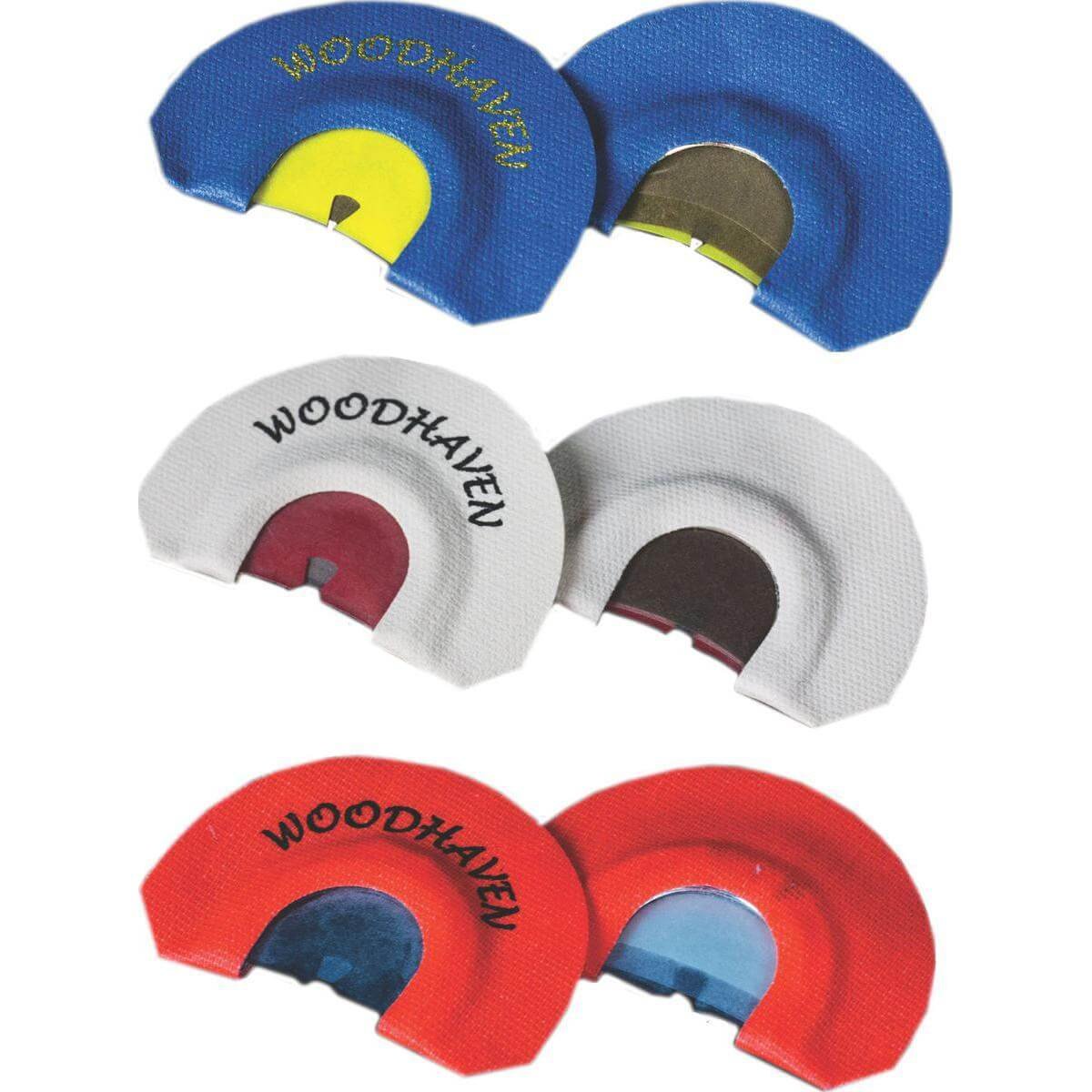
The Woodhaven Ghost 3-Pack is built for the mouth-call purist who wants a range of tones in a single purchase. This set includes three open-reed diaphragms: the Toxic Orange, Blue Demon, and Red Ghost. Each is handmade and hand-stretched, and each has a centered square cut in the top reed, allowing you to produce sharp cutts, cackles, and soft yelps depending on how much air you push and how you shape your mouth. The latex is thin and responsive, giving you fine control over pitch and volume.
These calls shine in the finishing stage — when a coyote has committed and is closing within 80 yards, and a loud electronic unit or aggressive hand call might spook it. The Ghost calls let you produce soft, realistic hen and distress sounds that keep an animal curious without alarming it. The pack gives you three different rasp levels, from the more aggressive Red Ghost to the higher-pitched Toxic Orange, so you can switch calls based on the animal’s reaction.
The trade-off is that open-reed mouth calls require practice. If you have never used a diaphragm call before, expect a learning curve to get clean notes without air leakage. Some users find Woodhaven calls stiffer and harder to blow than competing brands like Pinhoti, which may be a factor for hunters with less mouth-call experience. For the experienced caller who wants a compact, quiet finishing option, this pack delivers three distinct voices in a pocket-sized package.
Why it’s great
- Three distinct rasp levels in one pack
- Hand-stretched latex for precise tone control
- Excellent for soft close-range calling
- Compact and zero maintenance in the field
Good to know
- Steep learning curve for beginners
- Some users find them stiffer than competitor mouth calls
5. Western Rivers Mantis 50

The Western Rivers Mantis 50 is a compact electronic caller that slides easily into a pack or clips onto a belt, making it a solid entry-level option for hunters who want digital sound without the bulk of a full-size unit. It comes preloaded with the most popular predator sounds, including coyote howls, rabbit distress, and fawn bleats, and the backlit LCD screen makes navigation straightforward in low light. The rubberized grips on two pivoting legs let you stand the unit upright on a rock or log, freeing your hands for a weapon or binoculars.
The sound activation trigger button gives you on-demand control, and the random repeat timed option cycles through sounds automatically to keep the sequence unpredictable. Volume is surprisingly loud for such a small speaker — several users noted it was louder than expected — though there is no dedicated volume control, so you cannot easily dial it down when a coyote gets close. The unit runs on 4 AAA batteries, which are easy to find but not included in the package.
The main drawback is the lack of a remote. You have to be at the unit to start, stop, or change sounds, which can compromise your position if the coyote circles behind you. A few reviewers also describe the sound as slightly digital, which may be a factor for call-shy predators in high-pressure areas. For the price, it is a capable starter unit that lets you test electronic calling before committing to a more expensive system.
Why it’s great
- Compact, lightweight, and easy to pack
- Backlit LCD for visibility in darkness
- Random repeat timed option for hands-off sequences
- Good volume output for its small size
Good to know
- No volume control adjustment
- No remote; must operate at the unit
- Sound can be slightly digital on some calls
6. Faulk’s Game Calls PR-3 Predator Set

The Faulk’s PR-3 is a three-call set that includes a jackrabbit, a cottontail, and a squeaker, each tuned to imitate natural distress sounds. These are traditional wooden mouth calls that rely on your breath to produce the note, and they are made in the United States with a simple, no-frills design that has been on the market for years. The squeaker is consistently reviewed as the standout call in the set, with many users reporting that it attracted coyotes within minutes of the first sequence.
The calls are small and light at just 2.4 ounces for the whole set, so you can carry all three in a single pocket and rotate them based on what the coyotes seem to be responding to. The jackrabbit and cottontail calls produce a deeper, more guttural sound compared to the high-pitched squeaker, giving you some variety without needing to buy separate calls. The wood construction feels solid and warm in the hand, even in cold weather, and the calls require no batteries or electronics to maintain.
The main downside is that the jackrabbit and cottontail calls are less realistic than the squeaker, with some hunters saying they sound more like duck calls than true rabbit distress. This inconsistency means you may end up using only one of the three calls regularly. The set is budget-friendly and works well for the price, but serious hunters looking for precise, authentic tones across all three sounds may want to supplement with individual calls from other brands.
Why it’s great
- Three distinct sounds in one affordable set
- Squeaker call is highly effective and realistic
- Lightweight and pocket-portable
- Traditional wood construction, no batteries needed
Good to know
- Jackrabbit and cottontail calls sound less like rabbit distress
- Limited variety compared to electronic units
7. Icotec AD400 Electronic Predator Decoy

The Icotec AD400 is a dedicated electronic decoy designed to attach to Icotec’s GC300, GC320, GC350, and GC500 calls, adding visual motion to your audio setup. It includes a high-speed motor with a speed control dial, so you can adjust the movement from a slow, subtle twitch to a more frantic, attention-grabbing motion. The two quick-change toppers — shaped like different prey animals — let you customize the silhouette based on what you are calling, and the integrated LED light adds a subtle eye-glow effect at night.
The decoy is lightweight at under a pound and attaches securely to the call, creating a single unit that you can place on the ground and operate from a distance. The intermittent motion setting mimics the stop-and-start behavior of a real animal, which can be the difference between a coyote that hangs up at 150 yards and one that commits all the way to the setup. Many users report that the decoy alone has turned unresponsive coyotes into curious visitors, especially when paired with a cottontail distress sound.
The decoy does not work with the remotes used by some other Icotec models, so you may need to manually toggle it on and off depending on your caller setup. The LED light is quite bright and may need to be taped over if you want a more subtle glow. The spring-attached toppers can also detach if the decoy is bumped hard, though a small piece of tape solves that issue. For anyone already using an Icotec GC-series call, this decoy adds a potent visual layer that can tip the odds in your favor.
Why it’s great
- Adds lifelike motion to any compatible Icotec call
- Speed dial allows precise control over movement
- Interchangeable toppers and LED night light
- Lightweight and easy to attach
Good to know
- Does not work with all Icotec remotes
- LED light may be too bright without modification
- Toppers can detach if bumped; tape recommended for security
FAQ
What is the best type of call for a beginner coyote hunter?
How important is a remote control for an electronic coyote call?
Can you use a turkey mouth call for coyotes?
How many sounds should a good electronic coyote call have?
Final Thoughts: The Verdict
For most users, the best coyote call winner is the Icotec 320+ because it combines long-range remote control, crystal-clear audio, and an integrated motion decoy into a single system that can handle both distant locator calls and close-in finishing sequences. If you want maximum volume to cover huge open country, grab the Cass Creek Mega Amp 20X. And for a simple, pocket-sized hand call that brings coyotes in fast without batteries or electronics, nothing beats the Primos 372 The Third Degree.

Mo Maruf
I created WellFizz to bridge the gap between vague wellness advice and actionable solutions. My mission is simple: to decode the research and give you practical tools you can actually use.
Beyond the data, I am a passionate traveler. I believe that stepping away from the screen to explore new environments is essential for mental clarity and physical vitality.