Our readers keep the lights on and my smoothie glass nicely filled. As an Amazon Associate, I earn from qualifying purchases.
A cow fence that bends, sags, or breaks under the weight of a mature bovine is worse than no fence at all—it’s a constant promise of escape and repair. A serious cattle operation requires a structural barrier that stops an animal’s instinct to push against its boundaries.
I’m Mohammad Maruf — the founder and writer behind WellFizz. This guide is built on hours of analyzing galvanized wire gauges, knot-styles, zinc-coating thicknesses, and mesh transitions to find the specific fences that hold up to real pasture pressure.
Whether you need to contain beef cattle, protect a garden from deer, or establish a permanent perimeter, finding the truly best cow fence means matching the correct wire gauge and mesh profile to your specific herd’s behavior and terrain.
How To Choose The Best Cow Fence
Cattle are large, heavy, and inherently curious animals. Selecting a fence is less about looks and more about the measurable tensile strength and corrosion resistance of the materials. A fence that merely “looks like a fence” will fail when a 1,500-pound cow leans against it to reach grass on the other side.
Wire Gauge: The Backbone of Containment
The thickness of the wire, measured in gauge, is the single most important factor. A lower gauge number means thicker wire. For cattle, 14-gauge wire is the minimum standard, providing a good balance of strength and flexibility for most pastures. Thinner wire, like 16-gauge, is lighter and suitable for garden trellises or small-animal exclusion but will deform easily under the pressure of a cow’s head or body. Premium options often use 12.5-gauge, which offers exceptional resistance to bending and impact.
Galvanization Method: Hot-Dip vs. Electro
Rust is the silent killer of farm fencing. A “galvanized” label is not enough; you need to know the process. Hot-dip galvanizing (HDG) involves submerging the finished fence in molten zinc, creating a thick, durable coating that bonds to the steel. This method coats welds and joints fully, preventing the common problem of rust starting at the connection points. Electro-galvanizing uses a thinner zinc layer that can chip or wear away faster, especially in wet or saline environments. For a permanent, low-maintenance cow fence, always prioritize hot-dip galvanized wire.
Mesh Pattern and Graduated Openings
Woven wire fences with graduated mesh—where the openings are large at the top (around 8 inches) and taper down to small openings at the bottom (around 3.5 inches)—are ideal for cattle. This design serves a dual purpose: the large upper openings allow for better visibility and reduce wind load on the fence, while the tight lower gaps prevent calves from slipping through and block predators like coyotes or dogs from digging or crawling under. Fixed-knot construction is superior to welded mesh in this application because the intersections pivot slightly under stress instead of snapping.
Length, Height, and Volume
Measure your perimeter or paddock lines accurately. A fence that comes up 50 feet short forces a costly splice or an entirely new roll. Standard heights for cattle are 4 feet (48 inches), which is generally sufficient for mature beef breeds. For dairy cows or high-risk areas where deer pressure is also a concern, a 5-foot or even 6-foot fence provides an extra margin of security. Also consider the total running length of the roll; a 330-foot roll covers roughly 100 meters of fencing, which is a standard segment for many pasture divisions.
Quick Comparison
On smaller screens, swipe sideways to see the full table.
| Model | Category | Best For | Key Spec | Amazon |
|---|---|---|---|---|
| BEAST Fence (4ft x 104ft) | Field Fence | Perimeter & Heavy Impact | 12.5 Gauge Spring Steel | Amazon |
| Cattle Panel 14G (4ft x 328ft) | Woven Wire | Large Pasture Runs | 14 Gauge / 12 Gauge Borders | Amazon |
| HMOLIKH Cattle Fence (5ft x 164ft) | High Tensile | Tall Perimeter Security | 14 Gauge Galvanized Steel | Amazon |
| Zareba Charger (10 Mile AC) | Electric System | Adding a Psychological Barrier | 0.5 Joule / 10,500 Volts | Amazon |
| YESON Farm Fence (4ft x 164ft) | Field Fence | Cross-fencing & Sheep | 14 Gauge Alloy Steel | Amazon |
| Gardenova Field Fence (4ft x 164ft) | Anti-Weld | Budget Multi-Species Use | 14 Gauge High Carbon Steel | Amazon |
| Falanava Farm Fence (6ft x 100ft) | Field Fence | Gardens & Deer Deterrence | Hot Dipped Galvanized Wire | Amazon |
| Jotesnew Welded Wire (48in x 100ft) | PVC Coated | Residential Bounds & Poultry | 16 Gauge Vinyl Coated Steel | Amazon |
| Lansybel Welded Wire (36in x 100ft) | PVC Coated | Garden Borders (Light Duty) | 16 Gauge PVC Coated Metal | Amazon |
In‑Depth Reviews
1. BEAST 4ft x 104ft Galvanized Farm Fence
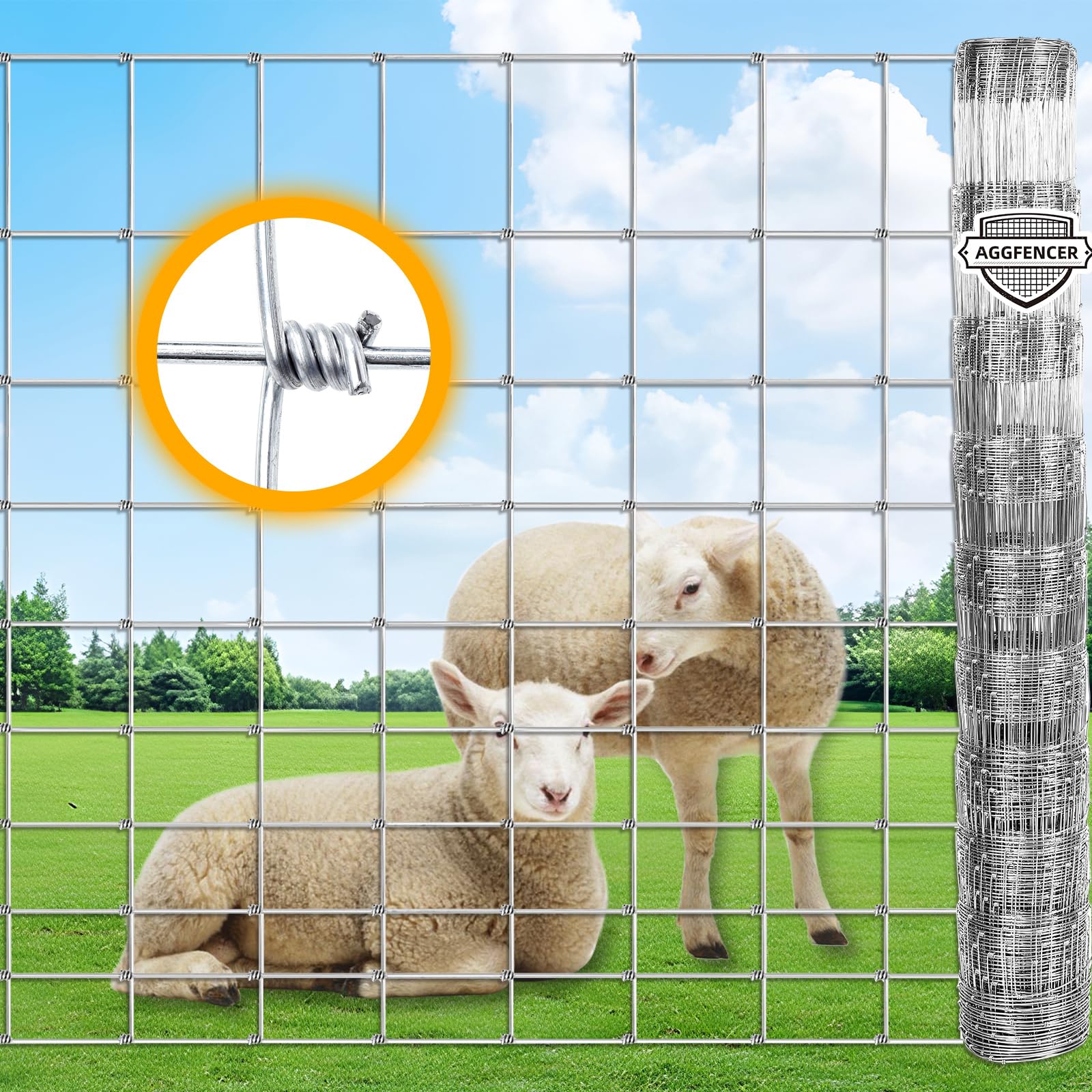
The BEAST fence stands apart because it uses 12.5-gauge spring-steel wire rather than the standard 14-gauge found in nearly all mid-range options. This thicker wire provides significantly higher resistance to bending when cattle lean or rub against it. The fixed-knot construction ensures that each intersection of vertical and horizontal wire locks in place, distributing impact stress across multiple strands instead of concentrating it at a single welded point. This fence is built for perimeter duty where escape pressure is constant.
Reviewers consistently note the extreme “spring back” of the wire, which makes tensioning challenging but guarantees a drum-tight final line. The galvanized coating is applied after welding, covering the joints entirely to prevent the common failure point of rust at knots. At 104 feet per roll, it offers a manageable length for a standard paddock side without the extreme weight of a 330-foot roll. The 4-foot height is optimal for adult cattle, while the loose top and tight bottom mesh design keeps calves contained.
Installation demands respect—reviewers recommend using a solid chain and bolt assembly for tensioning, as standard clipped pins can snap under the strain of this thick wire. Once stretched, the fence will likely outlast the user. It is not a lightweight option for temporary pens; this is a permanent, heavy-duty solution. The primary trade-off is its rigidity, which makes the final 20 feet of unrolling physically difficult without a helper or a mechanical puller.
Why it’s great
- Exceptional 12.5-gauge spring steel wire resists bending and impact from mature cattle.
- Post-weld hot-dip galvanizing covers all solder joints, eliminating early rust points.
- Fixed-knot design locks strands rigidly, preventing deformation under repeated pressure.
Good to know
- Extreme spring-back makes tensioning difficult; requires heavy-duty pulling equipment.
- Roll is only 104 feet long, which may require more splices for long perimeter lines.
- Very heavy and stiff material—unrolling the last portion is a two-person job.
2. ZESHANGUS Cattle Panel (4ft x 328ft)
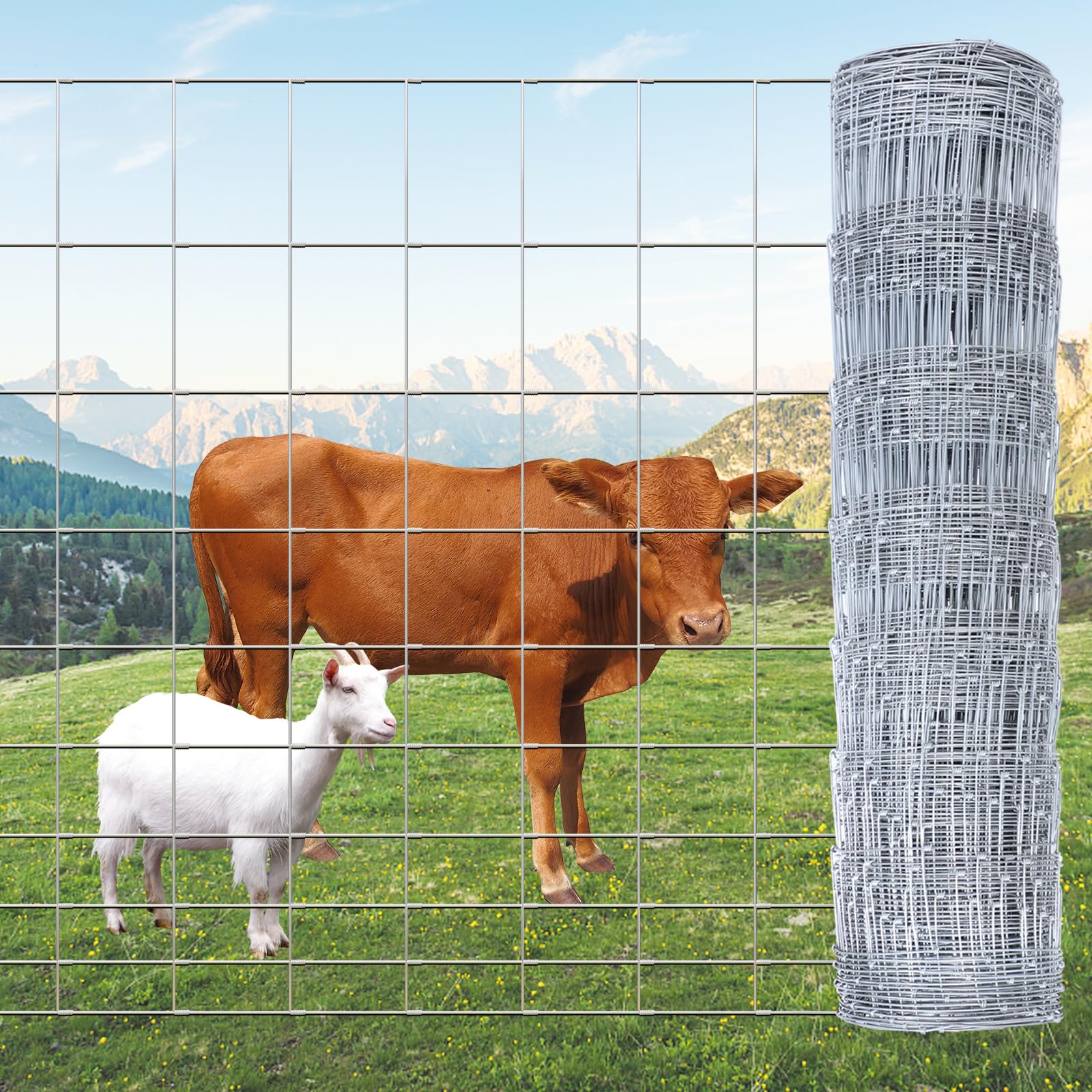
The ZESHANGUS cattle panel delivers an impressive 328 feet of continuous woven wire, making it the best option for running long pasture lines without frequent splices. The smart engineering choice here is the 12-gauge wire used for the top and bottom borders, while the main body uses 14-gauge steel. This reinforcement along the horizontal edges prevents the fence from sagging under its own weight or deforming when animals push against the boundary. The mesh transitions from 3.5-inch openings at the bottom to 8-inch openings at the top, effectively excluding piglets, small livestock, and predators while keeping the upper section lighter and more visible.
True woven construction, as opposed to welded mesh, provides critical flexibility. When a cow walks into this fence, the knots pivot rather than snapping, absorbing the shock and returning to shape. Reviewers confirm that the 14-gauge body is sufficient for medium-sized dogs and general livestock containment, though it is less rigid than 12.5-gauge options. The roll arrived well-packaged in many cases, though some reports mention bent sections from shipping, suggesting the packaging could be improved for very long rolls. At 4 feet tall, it is ideal for standard beef pastures.
Installation is a solo-possible task with the correct T-posts and stretchers, but a helper makes handling the 328-foot roll much safer. The wire is heavy enough to discourage casual pushing but light enough to cut with standard wire cutters. This fence is a strong mid-range choice for a rancher who needs to fence several acres on a budget without sacrificing the core durability of a woven design. The graduated mesh is particularly effective for mixed-species operations where goats, sheep, or pigs share pasture with cattle.
Why it’s great
- 328-foot length covers large pasture runs with minimal splices.
- Reinforced 12-gauge top and bottom borders resist sagging and deformation.
- Graduated mesh design (3.5” to 8”) excludes small animals while remaining visible.
Good to know
- Main body is 14-gauge; not as dent-proof as true 12.5-gauge alternatives.
- Shipping of very long rolls can result in bent sections if packaging is not reinforced.
- Requires significant physical effort to unroll and tension over uneven terrain.
3. HMOLIKH Cattle Fence (5ft x 164ft)
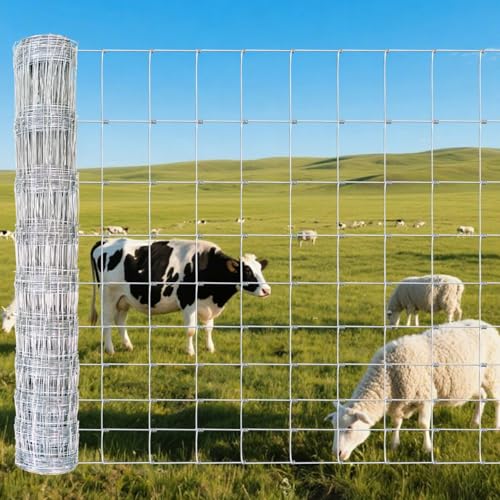
The HMOLIKH fence immediately signals premium ambition with its 5-foot height. This extra foot above the standard 4-foot barrier is a game-changer for dairy operations, Highland breeds, or properties with significant deer pressure, as it provides a visual and physical deterrent against jumping. The wire is constructed from high-tensile, galvanized steel that resists stretching and stays tight over long spans. The manufacturer specifically notes that the fence is “kinder to animals’ hides”—the smooth fixed-knot connections reduce abrasion on a cow’s neck and shoulders compared to sharp welded joints.
Reviewers compare this favorably to big-box store offerings, citing its superior rigidity and the thick PVC coating that adds weather resistance without making the wire brittle. The roll length of 164 feet is a practical sweet spot—long enough to make progress on a fence line but manageable enough for a two-person team to unroll without a dedicated spool holder. The mesh pattern is designed to prevent cattle from putting their heads through, which eliminates the common problem of cows getting stuck or damaging their horns. The galvanized coating is consistent and heavy, promising a 15-20 year lifespan in normal conditions.
While the price reflects its higher gauge and taller profile, the HMOLIKH is a clear step up from entry-level rolls. The main concession is that, like all woven wire, it requires proper tensioning and sturdy corner posts to reach its full potential. If you need to keep a bull contained or simply want a fence that requires zero resets season after season, this 5-foot option is a sound investment. It is not a product for a temporary garden plot—it is built for permanent, high-stakes animal containment.
Why it’s great
- 5-foot height provides extra security against jumping for deer, dairy, and large cattle.
- High-tensile galvanized wire resists stretching and maintains tension over long spans.
- Smooth fixed-knot design reduces hide damage compared to sharp welded intersections.
Good to know
- Premium price reflects the taller, heavier material; budget-conscious buyers may find it overkill.
- Requires strong, well-set corner posts to handle the increased tension from 5-foot height.
- Not suitable as a lightweight, temporary fence; it is a permanent installation product.
4. Zareba EAC10M-Z Electric Fence Charger (10 Mile)

The Zareba EAC10M-Z is not a physical fence, but it is arguably the most important component for augmenting any physical cow fence. This AC-powered energizer delivers a 0.5-joule pulse capable of charging up to 10 miles of fence line in ideal conditions and 1 mile in heavy weed contact. The low-impedance design is crucial—it forces voltage through vegetation that would normally ground out a weaker unit. When combined with a physical woven wire fence, this charger creates a psychological barrier that prevents cattle from even testing the fence, drastically reducing wear and tear on the physical structure.
Manufactured in the USA, the EAC10M-Z features a weather-resistant cabinet with internal moisture protection that allows year-round outdoor installation. The indicator light gives instant feedback on fence status, and the distinct ticking sound reassures operators that the unit is active. Reviewers report that a single shock from this unit trains animals immediately—dogs, horses, and cattle all learn the boundary within one encounter. The 0.5-joule output is sufficient for standard cattle but some users noted that small, fluffy animals like raccoons were not fully deterred at this power level, suggesting an upgrade to a 1-joule unit for predator exclusion.
Installation is straightforward: connect to a standard AC outlet, run a lead-out wire to the fence, and install at least one ground rod—though three ground rods are recommended for maximum voltage transfer. This charger is compatible with polywire, polytape, and high-tensile wire systems. It does not replace a physical fence for containment but instead makes a physical fence work harder and last longer. For anyone serious about keeping cattle in and predators out, adding this 0.5-joule charger to a woven wire perimeter is the standard of best practice.
Why it’s great
- Low-impedance design maintains fence voltage even when grass and weeds touch the wire.
- Moisture-resistant cabinet allows for year-round outdoor installation in most climates.
- Built-in indicator light and audible ticking provide clear operational status feedback.
Good to know
- 0.5-joule output may not be strong enough to deter thick-furred predators like raccoons.
- Requires access to a standard AC power outlet; not portable for remote pastures.
- Optimal performance requires at least three ground rods, which are sold separately.
5. YESON Farm Fence (4ft x 164ft)

The YESON farm fence hits the 14-gauge mark with a solid hot-dip galvanized finish that resists rust after months of exposure. It uses a twisted weave technique that locks vertical and horizontal wires together more firmly than basic welded mesh. The graduated mesh design is clearly intentional—large openings at the top for deer visibility and six-inch spaces at the bottom to block rabbits and chickens from crossing. At 164 feet per roll, it offers a practical length for cross-fencing a medium pasture or creating a secure boundary around a vegetable garden.
Customer feedback consistently praises its ease of installation. The wire cuts cleanly with standard bolt cutters and stretches reasonably well with a fence puller. Several reviewers note that after two months of outdoor exposure, there was zero rust on the surface, which confirms the hot-dip galvanized coating is applied consistently. The flexibility of the 14-gauge wire makes it workable for irregular terrain where a stiffer fence might not conform to dips and rises. It is also lightweight enough to be handled by a single person for short stretches, though a helper is recommended for the full 164-foot unrolling process.
However, the YESON is not an impact-resistant barrier. Pushy goats and large dogs can bend individual wires if they apply persistent pressure. One reviewer noted their goats manipulated the squares by rubbing their heads through them. This fence is best categorized as a high-quality visual and light physical barrier suitable for sheep, dogs, and as a secondary perimeter. For a main boundary containing aggressive bulls or heavy breeds, the 12.5-gauge options are more appropriate. It represents excellent value for the money when used for its intended purpose of general livestock management.
Why it’s great
- Hot-dip galvanized coating delivers zero rust performance even after extended wet exposure.
- Twisted weave technology locks wires firmly, preventing the joint slippage common in simpler weaves.
- Graduated mesh from top to bottom provides an effective barrier against deer and rabbits.
Good to know
- 14-gauge wire is not strong enough to withstand persistent pushing from determined goats or bulls.
- The wire’s flexibility, while useful, means it is not a rigid barrier for heavy-impact situations.
- Some reviewers found the roll very heavy to handle alone for the full 164-foot unrolling.
6. Gardenova Field Fence (4ft x 164ft)

The Gardenova fence shares the same price point as the YESON but uses a slightly different construction: “anti-weld” technology that prevents the edges from opening up under stress. This is achieved through a twisted knot system that maintains a strong connection without relying on weld points. The 14-gauge high-carbon steel wire provides good hardness and flexibility, making it suitable for terrains where the fence needs to curve gradually. The graduated mesh transitions from 2-inch gaps at the bottom to approximately 8-inch gaps at the top, providing a functional barrier for multiple species.
Reviewers report a mixed experience. Some found it effective as a deer fence for tree protection, noting it held up well after one year of use. Others, particularly those using it for active livestock like goats, found that the top rows of the mesh are too fragile and bend easily when animals rub their heads through the openings. The fence is also noted to be very heavy and difficult to unroll without a helper. Several users recommend using 7-foot stakes for support, suggesting the fence’s weight requires stronger-than-average posts to maintain a straight line.
This fence sits at a crossroads—it is affordable enough for a budget-conscious buyer but not durable enough for a permanent, high-stress livestock boundary. It is a better fit for a garden perimeter, orchard protection, or as a secondary cross-fence within a larger pasture system. The wire ends can be sharp, so gloves are essential during handling. If you simply need a fence to keep deer out of a food plot or to establish a visible property line, the Gardenova works well. For a primary cow fence where animals will test the barrier daily, look to the thicker gauge options earlier in this guide.
Why it’s great
- Anti-weld twisted construction prevents joints from popping open under lateral pressure.
- Graduated 2-inch to 8-inch mesh effectively excludes rabbits at the bottom and deer above.
- 14-gauge high-carbon steel offers a good balance of strength and affordability.
Good to know
- Top rows are fragile and bend easily under persistent rubbing from goats and pushy livestock.
- Very heavy roll; requires two people for safe unrolling and installation.
- Not suitable as a primary high-impact containment fence for adult cattle or bulls.
7. Falanava Farm Fence (6ft x 100ft)
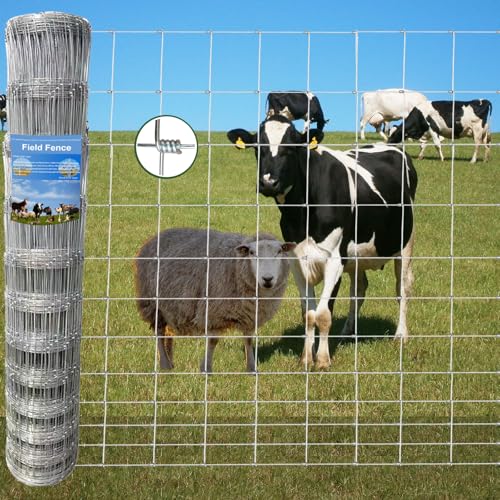
The Falanava farm fence offers a commanding 6-foot height, making it an outstanding solution for excluding deer from large gardens, orchards, or forestry plots. Its hot-dip galvanized coating provides corrosion resistance that is suited for wet climates and high-humidity environments. The woven mesh features a graduated opening design, with smaller gaps at the bottom to block rabbits and chickens and larger gaps at the top for weight savings and visibility. The twisted wire construction prevents the “popping” failure mode common in welded wire when animals apply impact pressure.
Early reviews on this fence are largely positive, with one reviewer buying multiple rolls for a large garden and experiencing zero intruders through the entire growing season. The welded connections are described as “light but sturdy,” with no drooping after installation. However, a significant warning comes from a reviewer who found the wire to be extremely weak—comparing it to aluminum foil and noting it is useless even as a garden trellis. This extreme divergence in opinions suggests potential quality control variations between batches or very specific applications where the wire’s tensile strength is tested differently.
Installation requires a good set of wire cutters, as the high-tensile steel is not easy to cut. The wire knots can also snag on each other during unrolling, requiring careful handling to avoid pinched fingers. The 6-foot height demands sturdy posts every 8 to 10 feet to prevent wind from bowing the top of the fence. This is not a product for containing aggressive, heavy livestock like bulls. Its primary value is as a tall, see-through barrier that stops deer from jumping into a protected area without the visual obstruction of a solid wall.
Why it’s great
- 6-foot height is ideal for deer exclusion, preventing them from jumping into gardens or orchards.
- Hot-dip galvanized coating provides strong corrosion resistance in wet and humid environments.
- Twisted wire construction prevents joints from popping under moderate animal impact.
Good to know
- Inconsistent reviews suggest potential quality control issues; some batches may be very weak.
- High-tensile wire is difficult to cut and can snag during unrolling, risking pinched fingers.
- Not suitable as a primary containment fence for strong, heavy livestock like bulls.
8. Jotesnew Welded Wire Fence (48in x 100ft)
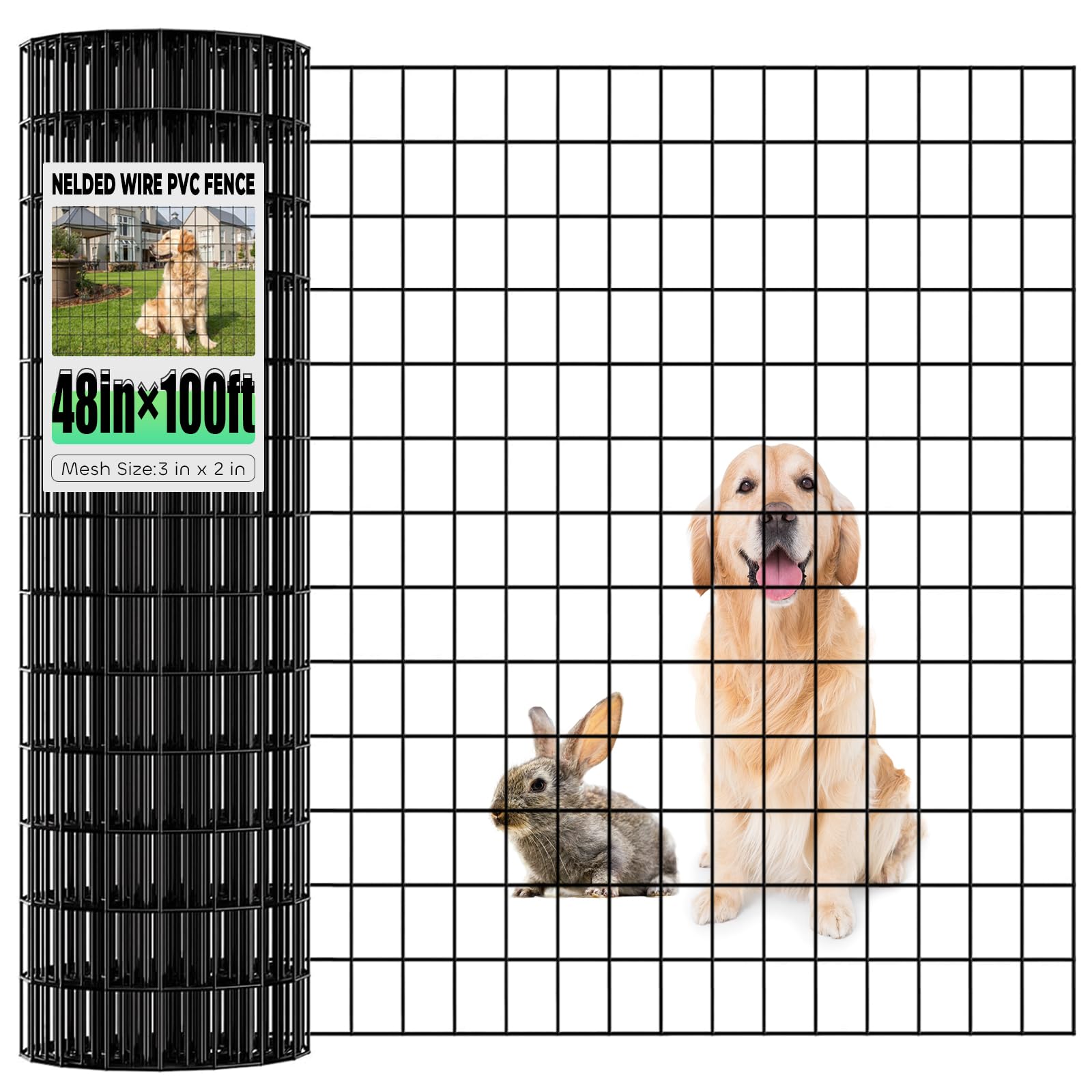
The Jotesnew welded wire fence is a clear step into residential-style fencing. It is constructed from 16-gauge galvanized steel wire that then receives a secondary black PVC vinyl coating. This dual-layer process maximizes rust resistance and gives a sleek, uniform appearance that blends well into yards and suburban garden settings. The 2-inch by 3-inch mesh size is small enough to contain chickens, rabbits, and small dogs while excluding snakes and chipmunks. At 48 inches tall and 100 feet long, it provides a substantial run for garden perimeter or poultry enclosure.
Buyers praise this fence for its ease of use. It unrolls easily, cuts with standard wire cutters, and the black vinyl coating does not leave the black gunk on hands reported with some cheaper PVC products. The wire is flexible enough to form circular tree cages or wrap around irregular garden beds, yet rigid enough to hold its shape when attached to stakes. One reviewer used 500 feet of this fencing to enclose a backyard for four dogs and found it effective, though they noted it feels “a little flimsy.” This is the key trade-off: 16-gauge wire is significantly weaker than 14-gauge livestock fencing.
This product is not appropriate as a primary cow fence. A 1,500-pound cow would easily push through this 16-gauge wire. Its best applications are as a garden border, a temporary poultry run, a decorative property line divider, or as an infill between wooden posts where aesthetics matter. The PVC coating adds a layer of weatherproofing but does not change the underlying tensile weakness. For anyone who needs a fence to keep small animals in or deer out of a small garden plot, the Jotesnew fence is an excellent choice. For cattle containment, it is simply the wrong tool for the job.
Why it’s great
- Double-coated galvanized steel and black PVC finish provide excellent rust and weather resistance.
- 2-inch by 3-inch mesh size is ideal for containing chickens, rabbits, cats, and small dogs.
- Lightweight and flexible design makes cutting, shaping, and installation simple for DIY projects.
Good to know
- 16-gauge wire is not strong enough to contain or deter cattle, goats, or large livestock.
- Black PVC coating can mark hands and clothing if handled roughly during installation.
- Some users report it feels flimsy; it is not a substitute for heavy woven livestock fencing.
9. Lansybel Welded Wire Fence (36in x 100ft)
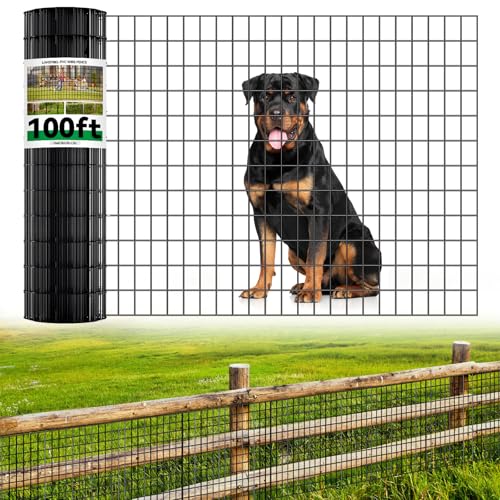
The Lansybel welded wire fence is a dedicated garden-grade product. At 36 inches tall, it is too short for cattle containment but perfectly sized for raised garden beds, chicken runs, and rabbit enclosures. The 16-gauge metal core is coated with a black vinyl layer that resists rust and weather damage, making it suitable for outdoor use in all seasons. The 2-inch by 3-inch mesh grid provides a secure barrier against groundhogs, squirrels, and medium-sized dogs while still allowing bees and beneficial insects to pass through.
Customer feedback highlights its aesthetic appeal. The black coating does not look like industrial farm fencing, which is a significant advantage for a front-yard garden or patio enclosure. One reviewer used three rolls to create a large dog enclosure with wooden posts and found the combination attractive and functional. The fence is easy to cut and bend, allowing for custom angles without specialized tools. However, the 16-gauge wire is not built for tensioning. Pulling it tight risks warping the mesh, which is why most installations stick to gentle tension or simple attachment to existing structures.
This product is not a cow fence. Its primary use cases are residential and light agricultural. It works well for closing gaps in existing fencing, creating a pet-safe area, protecting vegetable beds, or adding a decorative border to a property. The price point is competitive with big-box home improvement stores, and the convenience of having 100 feet delivered to your door is a clear advantage. For cattle ranchers reading this guide, skip to the BEAST or ZESHANGUS options. For suburban gardeners and small-scale poultry owners, the Lansybel is a perfectly serviceable, good-looking, and long-lasting solution.
Why it’s great
- 36-inch height is ideal for raised garden beds, chicken runs, and rabbit enclosures.
- PVC vinyl coating provides weather resistance and a clean, finished look that blends with landscapes.
- Easy to cut and bend, allowing for custom fence shapes and angles without complex tools.
Good to know
- 16-gauge wire is not strong enough to contain cattle, goats, or any large livestock.
- Low height (36 inches) is insufficient as a barrier for deer or jumping animals.
- Not designed for high-tension application; best used with gentle attachment to posts or frames.
FAQ
Can I use a 16-gauge PVC coated fence for cattle?
What is the best height for a cow fence?
Final Thoughts: The Verdict
For most users, the best cow fence winner is the BEAST 4ft x 104ft Farm Fence because its 12.5-gauge spring steel and fixed-knot construction offer unmatched impact resistance for a primary perimeter. If you want the longest coverage for your money, grab the ZESHANGUS Cattle Panel with its 328-foot run and reinforced borders. And for adding a psychological layer of protection to any physical fence, nothing beats the Zareba EAC10M-Z electric charger.

Mo Maruf
I created WellFizz to bridge the gap between vague wellness advice and actionable solutions. My mission is simple: to decode the research and give you practical tools you can actually use.
Beyond the data, I am a passionate traveler. I believe that stepping away from the screen to explore new environments is essential for mental clarity and physical vitality.