Our readers keep the lights on and my smoothie glass nicely filled. As an Amazon Associate, I earn from qualifying purchases.
A coverlock machine is the specialized tool that transforms the way you finish knit garments, producing professional, stretchable hems on t-shirts, leggings, and activewear that a standard sewing machine simply cannot replicate. Without it, sewists face frustrating issues like popped stitches, wavy edges, and seams that lack the flexibility needed for comfortable wear.
I’m Mohammad Maruf — the founder and writer behind WellFizz. I’ve spent hundreds of hours analyzing user reviews, dissecting technical specifications, and comparing threading systems and stitch quality across the most popular coverlock models on the market.
This guide ranks the top performers by their actual real-world usability and stitch reliability so you can confidently choose the best coverlock machine for your home sewing studio or small apparel business.
How To Choose The Best Coverlock Machine
Choosing the right coverlock machine means looking past brand names at the specific features that determine whether you’ll enjoy using it or dread re-threading it. The key factors are stitch type availability, threading ease, presser foot clearance for thick seams, and overall build quality.
Threading System: The Make-or-Break Feature
The single most common frustration across user reviews is difficult threading. Machines with color-coded guides, separate needle and looper threaders, and side-loading loopers dramatically reduce setup time. Look for models that offer a lower looper pretension release or a fully automatic threading system if you plan to switch thread colors frequently.
Stitch Versatility: Cover Stitch, Chain Stitch, and Combo Units
A dedicated coverlock machine typically offers 2-needle and 3-needle cover stitches plus a chain stitch. Combo machines add overlock capability but often sacrifice the ease of threading found in dedicated models. For pure hemming and neckline finishing on knits, a dedicated cover stitch machine with a narrow 2.8mm or wide 5.6mm stitch width option gives you professional results with fewer variables to manage.
Presser Foot Clearance and Fabric Handling
Coverlock machines are built for stretch fabrics, but not all handle thick seams equally. Machines with a presser foot lifter that raises an extra 2mm (like some Juki models) can easily feed over cross-seams on denim or fleece without jamming. If you sew multiple fabric weights, adjustable foot pressure is a must-have spec.
Quick Comparison
On smaller screens, swipe sideways to see the full table.
| Model | Category | Best For | Key Spec | Amazon |
|---|---|---|---|---|
| Juki MCS-1700QVP | Dedicated Cover Stitch | Professional knit finishing | Extra 2mm presser foot lift height | Amazon |
| Juki MCS-1600 | Dedicated Cover Stitch | Reliable tension on knits | 1,350 spm with color-coded guides | Amazon |
| Juki MCS-1500 | Dedicated Cover Stitch | Small footprint cover stitch | 3 needles, 3/4 thread stitch options | Amazon |
| Bernette B48 Funlock | Combo Serger/Coverstitch | Space-saving combo unit | 23 stitches in one machine | Amazon |
| Bernette B42 Funlock | Dedicated Cover Stitch | Beginner-friendly dedicated machine | LCD display for stitch adjustment | Amazon |
| Juki MO-2000QVP | Auto-Thread Overlocker | Automatic threading convenience | Electric air pump auto-threading | Amazon |
| Janome MyLock 634D | Overlock Serger | Beginner serging with bonus kit | Differential feed ratio 0.5 to 2.25 | Amazon |
| Singer 4432 Heavy Duty | Sewing Machine | Versatile home sewing | 60% stronger motor than standard | Amazon |
| Singer SE9180 | Sewing/Embroidery | Combined sewing & embroidery | 7-inch color touchscreen display | Amazon |
In‑Depth Reviews
1. Juki MCS-1700QVP Cover Stitch Machine

The Juki MCS-1700QVP is widely regarded by apparel sewists as the gold standard for dedicated cover stitch machines. Its standout engineering feature is the presser foot lifter that raises an extra 2mm, allowing you to casually glide over bulky cross-seams on denim jackets or multiple layers of fleece without the fabric catching or jamming.
Threading is straightforward for a coverlock machine, especially after watching a few tutorials. Users consistently report clean, professional-quality stitches straight out of the box with no skipped stitches or tension battles. The machine runs quiet and smooth at 1,350 stitches per minute, making it a pleasure to use for long hemming sessions.
Tension control is precise and predictable across a wide range of fabric weights from lightweight stretch satin to mid-weight knits. While the looper threading has a learning curve, the stitch quality and durability justify the initial patience. Some units have arrived with packing issues, so inspect the box carefully upon delivery.
Why it’s great
- Extra presser foot lift handles thick seams with ease
- Professional stitch quality from the first use
- Quiet and smooth motor for long sewing sessions
Good to know
- Looper threading takes practice to master
- Occasional packing and shipping quality control issues
2. Juki MCS-1600 Cover Stitch Machine

The Juki MCS-1600 is the iteration that improved upon the MCS-1500’s looper threading by switching to a side-loading design, significantly reducing the fussiness that frustrated earlier users. It delivers the same 1,350 stitches per minute and color-coded threading guides, making it much more approachable for someone moving from a standard sewing machine to a dedicated coverstitch.
Stitch quality on knits is exceptional, with users noting that skipped stitches are rare even over bulky seam intersections. The differential feed adjustment gives you control over fabric stretching during hemming, preventing the wavy edges that plague less capable machines. It handles lightweight jersey as well as heavier sweater knits without complaint.
Setup is intuitive with pre-threaded loops from the factory, though some users found the included documentation lacking for detailed threading steps. The machine is physically compact enough for a small sewing table while still offering a decent throat space for maneuvering garments. It’s a reliable daily driver for anyone serious about knit finishing.
Why it’s great
- Side-loading loopers are much less finicky than predecessor
- Differential feed prevents wavy hems on stretch fabrics
- Compact footprint suits smaller workspaces
Good to know
- Manual could be clearer for threading details
- Some units ship as the MCS-1500 instead of the 1600
3. Juki MCS-1500 Cover Stitch Machine
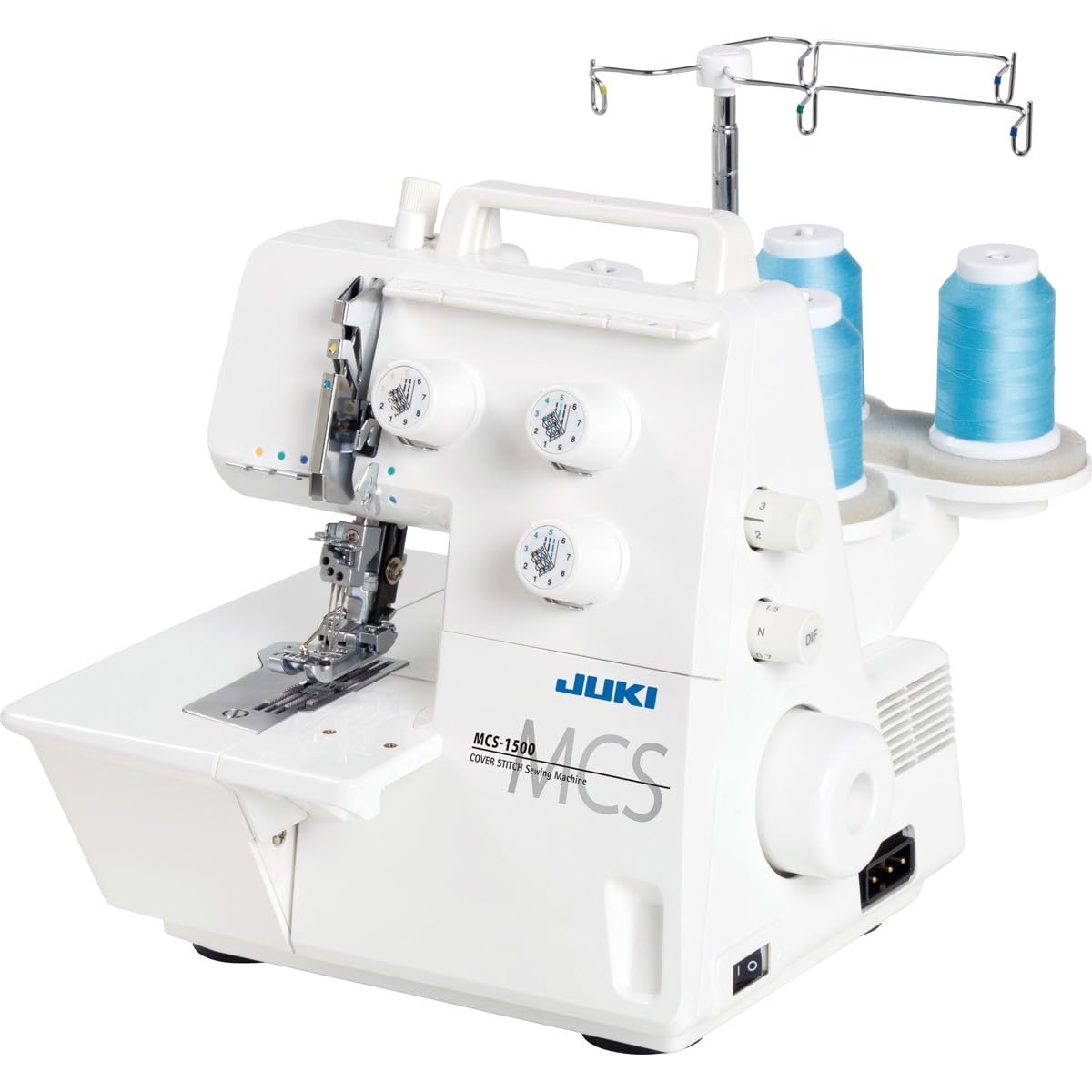
The Juki MCS-1500 is the entry point into Juki’s dedicated cover stitch lineup, offering the same core stitch engine as the higher models but with a left-mounted looper that demands patience during threading. Once you’ve mastered the threading sequence, it produces the same beautiful, skip-free 3-thread cover stitch and 4-thread chain stitch that Juki is known for.
Users praise its small footprint and relatively light weight, which makes it easy to store or move between sewing stations. The machine handles stretchy knits evenly, feeding them through without distortion, and the stitch quality holds up well even on demanding fabrics like spandex and rib knit. The 1,350 stitches per minute speed is adequate for both hobbyists and small production runs.
The main caveat is the threading difficulty for the left-mounted looper, which multiple reviewers found frustrating enough to return or replace with the MCS-1600. It also arrived pre-threaded, making it tricky to understand the correct path the first time you must re-thread. Overall it is a capable machine, but only recommended for sewists willing to watch online tutorials.
Why it’s great
- Pro-level stitch quality at a moderate price point
- Very compact and easy to store or transport
- Excellent warranty coverage for mechanical parts
Good to know
- Left-mounted looper is notoriously tricky to thread
- Tension can be finicky until you find the sweet spot
4. Bernette B48 Funlock Serger Coverstitch Machine
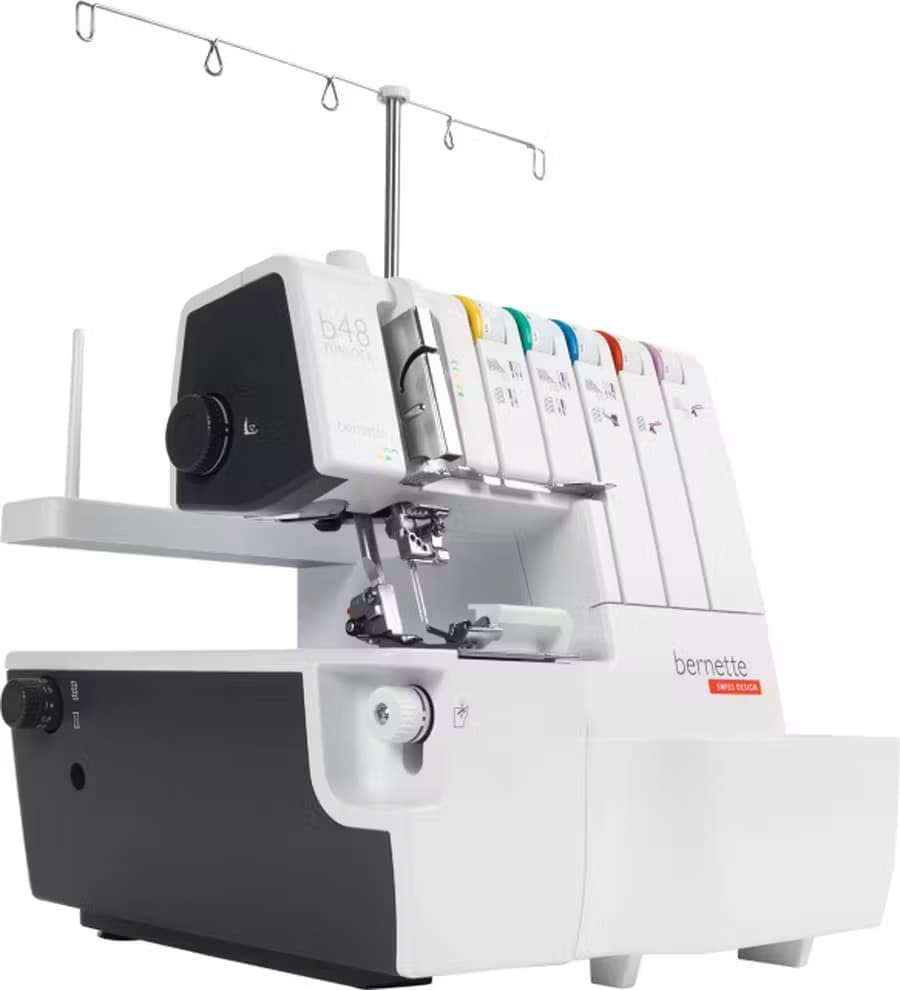
The Bernette B48 Funlock is a true combo machine that packs overlock, coverstitch, and chain stitch capabilities into a single, relatively compact unit. With 23 built-in stitches and a top speed of 1,300 stitches per minute, it is designed for the sewist who wants both serging and hemming functions without buying two machines.
Users consistently note that this machine is relatively quiet compared to other combo units, and the bright LED light is a welcome feature for detailed work. The coverstitch quality is good on knits, and the ability to switch between stitch types broadens the range of projects you can tackle. It includes an extension table for larger work.
The learning curve for threading and tension adjustment is steep, and the machine is not well-suited for absolute beginners. Some users reported missing needles or accessories in the package, and the presser foot clearance is limited compared to dedicated cover stitch machines. It is a strong choice for the intermediate sewist who values versatility over simplicity.
Why it’s great
- Versatile 3-in-1 functionality saves space and money
- Quieter operation than many comparable combos
- Bright LED work light and included extension table
Good to know
- Complex threading and tension setup for beginners
- Limited presser foot clearance for thick layers
5. Bernette B42 Funlock Coverstitch Machine

The Bernette B42 Funlock is a dedicated coverstitch machine that simplifies the process with a clear LCD display for adjusting stitch settings. It offers three cover stitches at 2.8mm and 5.6mm widths plus a chain stitch, covering the most common hemming and finishing needs for knit fabrics without overwhelming the user with options.
Reviewers highlight how smooth the machine runs on stretchy fabrics like satin and medium-weight knits, producing consistent stitches without skipped loops. The separate needle and looper threading system is well-designed with clear diagrams printed on the machine, making it one of the easier dedicated coverlocks to thread. The bright LED light and onboard tool storage are practical touches.
The main limitation is the low presser foot lift height, which prevents sewing over thick layers like double fleece or heavy denim seams. A few users found it completely unsuitable for their intended projects because of this. It is a fantastic machine for lightweight to medium-weight knit hems, but not for heavy-duty work.
Why it’s great
- Easy-to-read LCD display for quick adjustments
- Smooth, skip-free stitching on lightweight knits
- Helpful threading diagrams printed on the machine
Good to know
- Low presser foot clearance limits thick fabric use
- Not suitable for heavy fleece or denim projects
6. Juki MO-2000QVP Automatic Needle Overlocker

The Juki MO-2000QVP is a marvel of engineering that uses an electric air pump to automatically thread both the loopers and needles, reducing setup time to roughly 30 seconds. This is a game-changing feature for sewists who hate the chore of threading their serger and want to switch between thread colors or stitch types quickly.
The machine runs with notably reduced vibration and noise compared to other overlockers, and the LCD screen provides clear visual feedback on settings. It includes an integrated switch for 2 and 3 wire routing and offers magnificent curved seam capability thanks to the reduced gap between the knives and needles. Stitch quality is exceptional across knits and wovens.
The primary concern is warranty and support, as the product was originally intended for the French market. Some US buyers received units with US plugs and English manuals, but warranty service has been inconsistent, requiring shipping to Florida at the user’s expense. It is a premium investment best suited for dedicated sewists who prioritize convenience and are comfortable with potential service hurdles.
Why it’s great
- Electric air pump auto-threading is incredibly fast and convenient
- Very quiet operation with minimal vibration
- LCD display and excellent stitch quality
Good to know
- Warranty and support process can be uncertain for US buyers
- High price point for a specialized overlocker
7. Janome MyLock 634D Overlock Serger

The Janome MyLock 634D is a well-loved entry-level overlock serger that offers 2, 3, and 4 thread capabilities with a differential feed ratio adjustable from 0.5 to 2.25. It is not a dedicated coverstitch machine, but it is included here because many beginners use it as their first serger and it performs roll hems and basic edging on knits reliably.
Users find it easier to thread than expected, especially with the color-coded thread guides and lay-in tension dials. The machine sews fast at 1,300 stitches per minute and handles a variety of fabrics from lightweight sheers to medium-weight knits without issues. The included bonus kit adds value for new sewists exploring different techniques.
The main drawback is that some units are falsely advertised as having self-threading loopers, which they do not. Re-threading the entire machine after a thread break is a chore, and tension can be finicky for rolled hems. It is a solid, affordable starting point for learning overlock sewing, but its coverstitch capability is limited to basic rolled hems.
Why it’s great
- Differential feed gives good control over knit fabric edges
- Color-coded threading guides help beginners
- Great value with included accessory bonus kit
Good to know
- Not a dedicated coverstitch machine – no true cover hem
- Re-threading after a break is a full-machine process
8. Singer Heavy Duty 4432 Sewing Machine

The Singer Heavy Duty 4432 is a robust sewing machine, not a dedicated coverlock, but it earns a place in this conversation for sewists who need to handle thick fabrics like denim and canvas alongside their knit projects. Its high-performance motor delivers 60% more power than standard machines at 1,100 stitches per minute, easily punching through multiple layers.
With 32 built-in stitches offering 110 stitch applications, including a one-step buttonhole and stretch stitches, it provides versatility for garment construction, repairs, and quilting. Users report that it handles denim and leather up to 4oz without drag, while still being gentle enough for sheer fabrics. It runs quietly and stably with no jamming issues noted by experienced sewists.
The included accessory kit adds significant value, but the machine lacks the dedicated cover stitch and differential feed that make a true coverlock machine essential for professional knit hemming. It is a fantastic general-purpose machine, but you will need a separate coverlock for flawless stretch hems.
Why it’s great
- Powerful motor easily handles thick fabrics and multiple layers
- Versatile stitch selection for many project types
- Quiet, stable operation and durable build
Good to know
- No cover stitch capability for professional knit hems
- No differential feed for stretch fabric control
9. Singer SE9180 Sewing & Embroidery Machine

The Singer SE9180 is a sewing and embroidery combination machine with a large 7-inch color touchscreen, 250 built-in stitches, 150 embroidery designs, and WiFi connectivity for transferring designs. It is a creative powerhouse for sewists who want to add monogramming and decorative embroidery to their garments.
The machine converts between sewing and embroidery functions easily, and the touchscreen interface makes navigating stitch settings and design previews intuitive. Users who already love their Singer machines find this a worthy upgrade, and the included accessory kit is comprehensive. Embroidery speeds of 450 stitches per minute are adequate for detailed work.
However, it is not a coverlock machine. It produces sewing stitches and embroidery, not the stretchable cover stitch needed for professional knit hems. Some users reported serious thread breakage and alignment issues, and the machine lacks a dedicated cover stitch function. It is best suited for sewists who prioritize embroidery over hem finishing.
Why it’s great
- Large touchscreen and WiFi for easy design transfer
- Extensive embroidery design library included
- Versatile 2-in-1 sewing and embroidery functionality
Good to know
- No cover stitch or chain stitch for knit hemming
- Some reliability issues reported with thread breaks
FAQ
Can I use a cover stitch machine for regular sewing and zippers?
What is the difference between a cover stitch and an overlock stitch?
Is a dedicated cover stitch machine easier to use than a serger combo machine?
Why does my cover stitch machine skip stitches on thick seams?
Final Thoughts: The Verdict
For most users, the best coverlock machine winner is the Juki MCS-1700QVP because it combines professional stitch quality with the extra presser foot lift that solves the thick seam problem. If you want a side-loading looper for easier threading at a moderate price, grab the Juki MCS-1600. And for sewists who need a space-saving combo machine that does both overlock and cover stitch, nothing beats the Bernette B48 Funlock.

Mo Maruf
I created WellFizz to bridge the gap between vague wellness advice and actionable solutions. My mission is simple: to decode the research and give you practical tools you can actually use.
Beyond the data, I am a passionate traveler. I believe that stepping away from the screen to explore new environments is essential for mental clarity and physical vitality.