Our readers keep the lights on and my smoothie glass nicely filled. As an Amazon Associate, I earn from qualifying purchases.
Rust doesn’t sleep. Once oxidation takes hold on a frame rail, brake line, or engine bay component, the damage spreads beneath paint and coatings until structural integrity is compromised. A quality corrosion inhibitor for cars stops that process by forming a molecular or physical barrier that blocks moisture, oxygen, and road salt from reaching the metal surface.
I’m Mohammad Maruf — the founder and writer behind WellFizz. I spent countless hours analyzing chemical formulations, military specifications, flash points, film durability, and real-world customer test results across five dedicated corrosion inhibitors so you don’t have to guess which can actually delivers long-term protection.
Whether you need a spray-and-forget solution for daily drivers or a heavy-duty encapsulator for restored classics, this guide pinpoints the specific product that fits your exact scenario. You’re about to read the definitive review of the best corrosion inhibitor for cars.
How To Choose The Best Corrosion Inhibitor For Cars
Selecting a corrosion inhibitor isn’t just about picking the most expensive can on the shelf. You need to match the chemistry to your specific environment — salt-belt winters, coastal humidity, or dry garage storage all demand different formulation characteristics. Understanding a few core attributes will save you time and money.
Film Type: Waxy Encapsulator vs. Molecular Bonding
Waxy or resin-based inhibitors (like LPS 3 and CRC) leave a physical barrier that must stay intact to work. They are excellent for underbody frames and long-term storage because they self-heal if scratched. Molecular bonding inhibitors (like ACF-50 and CorrosionX) chemically attach to the metal substrate, offering creep and penetration into tight seams where brush-applied wax cannot reach. Choose waxy films for exposed chassis rails and molecular types for intricate engine components and electrical connections.
Dielectric Strength for Electronics
If you plan to spray near sensors, battery terminals, or wiring harnesses, the product must have a verified dielectric rating. CorrosionX, for example, is rated over 39,000 volts, meaning it safely coats circuits without causing shorts. Standard undercoating sprays or paint-on converters lack this property and can cause parasitic drain or connection failures if applied directly to terminals.
Application Method and Cleanup
Aerosol sprays offer convenience for tight cavities (door sills, frame boxes, engine crevices), but they generate overspray that stains driveways and garage floors. Brush-on liquids or paint-style converters provide thicker coverage on exposed panels but require 24-hour curing and adequate ventilation due to solvent fumes. Consider whether you need a spray wand attachment for deep frame rails or if a brush-and-roller approach fits your workspace.
Quick Comparison
On smaller screens, swipe sideways to see the full table.
| Model | Category | Best For | Key Spec | Amazon |
|---|---|---|---|---|
| ACF-50 Anti-Corrosion Lubricant | Aerosol Molecular | Electronics & engine bays | 13 fl oz; non-flammable; PTFE | Amazon |
| Meuvcol 2 in 1 Rust Converter | Brush-on Paint | Heavy rust conversion | 35 fl oz; waterproof film | Amazon |
| CorrosionX Rust Inhibitor | Aerosol Molecular | Marine & coastal use | 16 fl oz; >39kV dielectric | Amazon |
| LPS 3 Premier Rust Inhibitor | Aerosol Wax | Long-term storage | 11 fl oz; waxy self-healing | Amazon |
| CRC 06026 Heavy Duty Corrosion Inhibitor | Aerosol Wax | Underbody frame coating | 4 x 10 fl oz; waxy film | Amazon |
In‑Depth Reviews
1. ACF-50 Anti-Corrosion Lubricant Compound
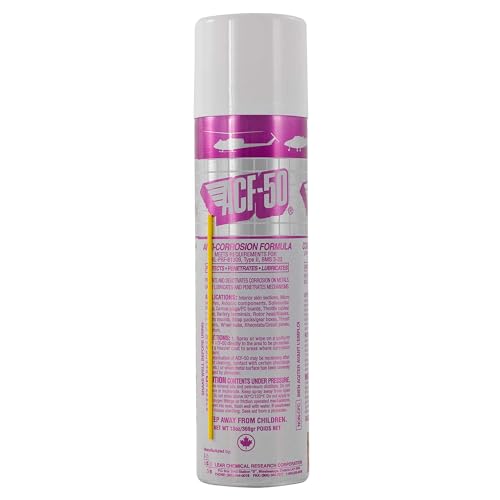
ACF-50 uses a PTFE-enhanced molecular bonding formula that creeps into microscopic surface pores, actively killing existing corrosion while preventing new oxidation. With a flash point of 79.4°C (175°F), it is classified as non-flammable — a rare safety advantage when spraying near hot engine components or battery terminals. The 13-ounce aerosol delivers a thin, clear film that does not attract dust or remain tacky, making it ideal for engine bays, alternators, starter motors, and wiring harnesses where a greasy residue would be problematic.
Real-world users report that a single annual application keeps trailers, motorcycles, and aircraft components rust-free through salt-heavy winters and coastal humidity. The product is also non-carcinogenic and virtually non-toxic, which matters when you are working in a closed garage. Multiple verified customers confirm it outperforms WD-40 specialty products by chemically bonding rather than simply displacing moisture.
The primary practical limitation is the aerosol nozzle, which some buyers received broken or detached from the can. Additionally, when applied directly to hot exhaust components, the compound can produce visible vapor until the carrier evaporates, so allow the engine to cool before spraying. For general automotive corrosion prevention with electronics-safe dielectric properties, ACF-50 is the benchmark.
Why it’s great
- Non-flammable formula safe near electronics and hot surfaces
- Penetrates and kills existing corrosion, not just surface prevention
- Leaves a dry, non-tacky film that resists dust buildup
Good to know
- Nozzle can detach or arrive broken from shipping
- Must ship ground due to aerosol restrictions
- Produces visible vapor if applied to hot metal
2. Meuvcol 2 in 1 Rust Converter & Metal Primer
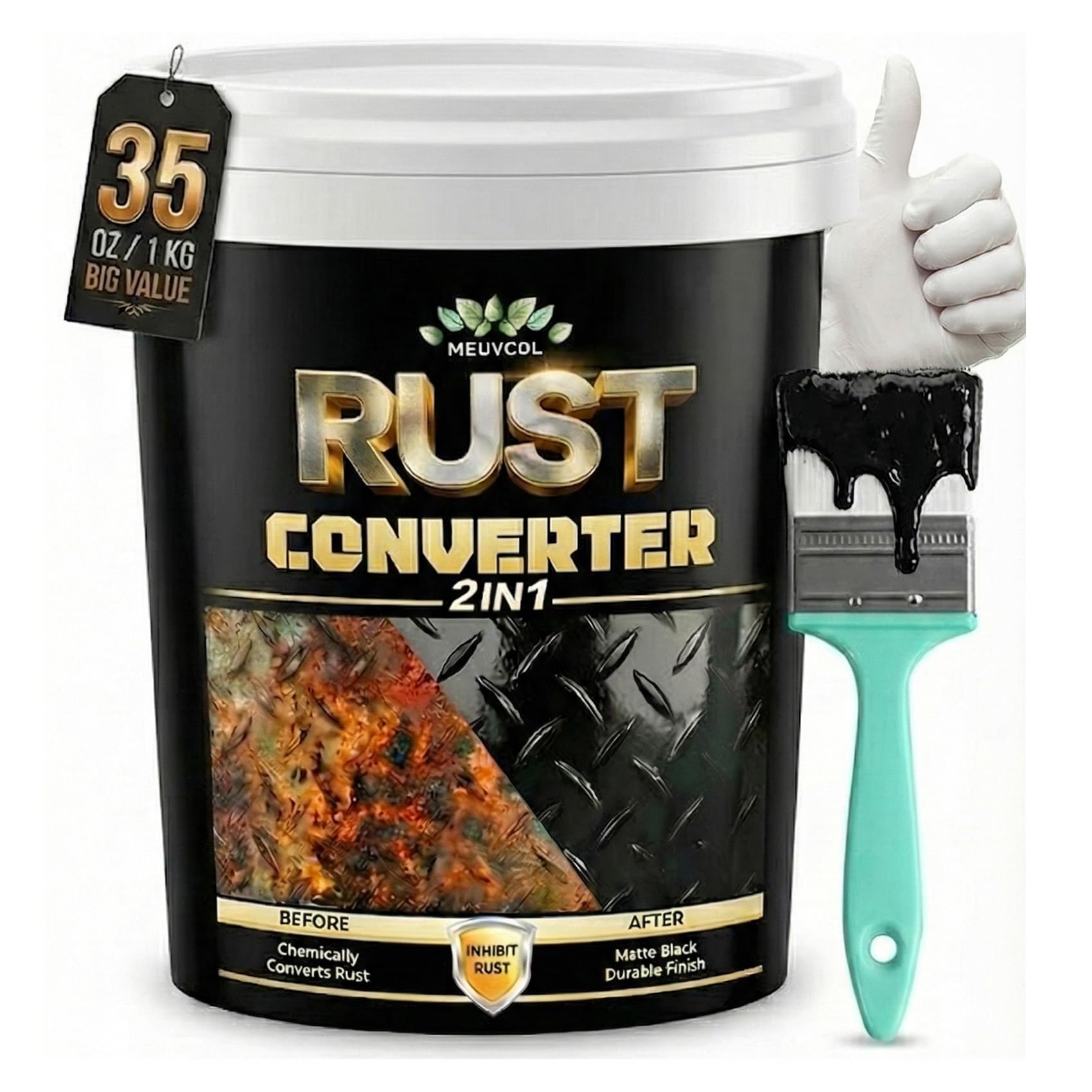
Meuvcol’s rust converter takes a fundamentally different approach from aerosol inhibitors: it is a brush-on liquid that chemically neutralizes iron oxide (rust) and simultaneously deposits a waterproof matte-black polymer film. The 35-ounce container includes a brush and gloves, which is generous compared to most paint-style converters that require separate applicator purchases. The formulation is designed for truck frames, trailer chassis, car underbellies, and farm equipment where you need a thick, durable encapsulation rather than a thin molecular layer.
Customer reviews consistently highlight the product’s ability to stop active rust in its tracks. One owner applied it to an RV underbelly and saw the rust convert to a stable black surface within hours. Another user treated a steel plate with heavy corrosion and reported that the coating remained intact through weeks of outdoor exposure. The finish is a flat, sleeker black that works well as a primer for topcoats, though some users caution that it behaves more like high-quality paint than a chemical converter — meaning longevity depends on proper surface prep and avoiding rock chips.
The main drawback is the strong solvent odor, which demands full ventilation or a respirator during application. The 24-hour drying time between coats also limits the product to projects where you can leave the vehicle stationary. For a one-step solution that converts existing rust into a protective barrier, Meuvcol delivers reliable coverage at a low per-ounce cost.
Why it’s great
- Includes brush and gloves for immediate application
- Creates a thick, waterproof matte finish that stops rust
- High coverage at 35 oz per container
Good to know
- Strong solvent fumes require ventilated workspace
- Requires 24 hours curing time between coats
- Finish may chip if exposed to constant rock impact
3. CorrosionX Rust Inhibitor

CorrosionX is the only inhibitor on this list qualified under a U.S. Navy Advanced Corrosion Preventive Compound military specification (MIL-SPEC). The 16-ounce aerosol dispenses an oil-based lubricant that molecularly bonds to metal while resisting pressure wash-off and salt spray. Its dielectric rating exceeds 39,000 volts, making it the safest choice for direct application to battery terminals, sensors, fuse boxes, and exposed wiring without risking short circuits.
Verified buyers with boats, off-road vehicles, and coastal equipment report that CorrosionX’s self-healing film recovers from minor scratches and abrasions, maintaining protection longer than standard spray-on waxes. It also functions as a penetrant for frozen bolts and seized hardware, combining anti-corrosion with freeing stuck parts in one step. One long-term user applied it to a motorcycle’s electrical connections and chain, noting that the film endured multiple rainstorms without washing off or attracting grit.
The flip side is that the oil-based carrier leaves a slightly slick residue that may transfer to hands or clothes if you touch treated areas afterward. Overspray on painted surfaces can also mar the finish if not wiped promptly, so masking tape is recommended. For marine-level humidity and electronics-heavy vehicles, CorrosionX sets the standard.
Why it’s great
- U.S. Navy qualified for advanced corrosion prevention
- Extremely high dielectric strength for safe electronics use
- Self-healing film repairs minor scratches automatically
Good to know
- Leaves oily residue that can transfer to surfaces
- Overspray may stain paint if not wiped immediately
- Higher price per ounce than some wax-based competitors
4. LPS 3 Premier Rust Inhibitor
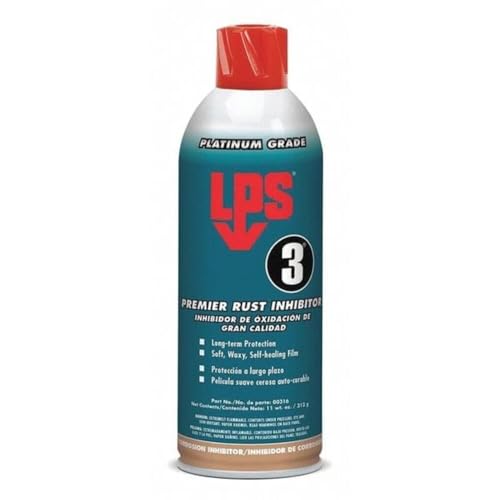
LPS 3 leaves a thick, waxy, hazy-brown film that dries to a self-healing coating ideal for long-term storage of firearms, automotive parts, and tools. The wax layer is sacrificial — it takes the abuse of moisture and oxygen so the underlying metal does not. An aerospace engineer and gun collector who reviewed the product subjected a cut barrel section to two weeks of Midwest summer humidity: the untreated half rusted heavily, while the LPS 3-treated side remained pristine. That real-world torture test validates the product’s claim as a preservation-grade inhibitor.
Automotive users apply LPS 3 inside door cavities, along brake lines, and on frame sections exposed to road salt. The film is thick enough to survive pressure washing in some cases, and it can be removed with soap and water when you need to repaint or weld the area. A customer in a heavy snow region reported that annual application inside his car’s door drain holes added years of life to the panels.
The waxy consistency becomes noticeably thicker in cold temperatures, making spray application more difficult during winter months. Additionally, heavy application on moving parts like hinges or throttle linkages can gum them up, so a thin, wiped coat is recommended for anything that slides. For classic car owners and off-season storage, LPS 3 is the gold standard.
Why it’s great
- Forms a thick, sacrificial wax barrier that self-heals
- Proven performance in extreme outdoor exposure tests
- Removable with soap for future painting or welding
Good to know
- Thickens in cold weather, reducing sprayability
- Can gum up moving parts if applied too heavily
- Hazy brown finish not cosmetically appealing for visible areas
5. CRC 06026 Heavy Duty Corrosion Inhibitor

CRC’s 06026 comes in a 4-pack of 10-ounce aerosols, making it the most cost-effective way to cover an entire vehicle underbody. The spray deposits a yellow waxy film that cures to a hard, nearly invisible layer — similar to classic Waxoyl or Cosmoline formulations. The 20W viscosity rating means it flows evenly through a spray wand or straw attachment without clogging, which is critical for reaching inside frame rails and boxed sections.
Real-world data from a Jeep Wrangler owner who applied two coats (four cans total) to a new underbody showed zero visible rust after three years of beach driving, pressure washing, and saltwater exposure. That durability rivals more expensive specialty undercoatings. Another user with a 2004 and 2022 Chevy Colorado reported fabricating an extended wand from a FluidFilm nozzle and copper wire to access deep frame cavities, confirming the product’s versatility for DIY rustproofing.
The trade-off is that the wax layer is prone to chipping in areas with constant rock or debris impact — users recommend combining CRC with a softer, more adherent inhibitor like FluidFilm on suspension components. Some cans also leaked from the spray nozzle during shipping, so inspect the seals on arrival. For full-frame undercoating projects where budget matters, CRC delivers impressive coverage per dollar.
Why it’s great
- Excellent value with 4-pack for full vehicle undercoating
- Dries to a hard, self-healing invisible wax layer
- Compatible with spray wand extensions for deep frame cavities
Good to know
- Wax layer may chip under heavy rock impact
- Some cans arrive with leaking spray nozzles
- Strong solvent odor during application requires ventilation
FAQ
Can I use an aerosol corrosion inhibitor on my car’s oxygen sensors?
How often should I reapply a corrosion inhibitor in a salt-belt climate?
Is it safe to spray corrosion inhibitor on a hot engine block?
Final Thoughts: The Verdict
For most users, the best corrosion inhibitor for cars winner is the ACF-50 because it combines electronics-safe non-flammability with deep molecular penetration and proven annual protection against road salt and humidity. If you want a dielectric marine-grade formula for coastal vehicles and sensitive electronics, grab the CorrosionX. And for budget-friendly full-frame undercoating that dries to a hard invisible shell, nothing beats the CRC 06026 4-pack.

Mo Maruf
I created WellFizz to bridge the gap between vague wellness advice and actionable solutions. My mission is simple: to decode the research and give you practical tools you can actually use.
Beyond the data, I am a passionate traveler. I believe that stepping away from the screen to explore new environments is essential for mental clarity and physical vitality.