Our readers keep the lights on and my smoothie glass nicely filled. As an Amazon Associate, I earn from qualifying purchases.
Specs are compiled from manufacturer listings and verified buyer reviews and can change over time — please confirm the key details on the product page before buying.
The cord is your biggest enemy on a sander — it snags on edges, drags across your workpiece, and keeps you tethered to an outlet you may not have. A cordless sander removes that hassle entirely, but the real question is which one actually removes material fast enough without draining its battery in ten minutes. This guide flags the three specs buyers overlook (run time, pad size, and orbit speed) and names the one model that balances them best for most jobs.
I’m Mohammad Maruf — the founder and writer behind WellFizz. This guide is built by comparing the manufacturers’ published specifications and the patterns across verified customer reviews, so you get each pick’s real strengths and trade-offs instead of marketing spin.
You need a machine that does not bog down under pressure and keeps cutting long enough to finish a project. Here is the best cordless sander lineup, ranked by real-world trade-offs that matter to a homeowner or pro on a job site.
Our Picks at a Glance


How To Choose The Best Cordless Sander
Three numbers decide whether a cordless sander fits your work: orbit speed, pad size, and battery compatibility. Orbit speed (measured in OPM or RPM) controls how fast the sander removes material — higher numbers strip paint and smooth rough wood quickly, but may leave visible swirl marks if the orbit is not random. Pad size determines reach and precision; a 5‑inch pad covers large flat surfaces fast, while a mouse‑sized tip gets into corners and tight spots. Battery compatibility is the hidden trap — most tools are sold as “bare tools” (no battery included), so you need to own the same brand’s battery system already or factor in the cost of a starter kit.
Random Orbit vs. 1/4 Sheet vs. Mouse
A random‑orbit sander spins the pad in an elliptical motion, which leaves a swirl‑free finish and removes material steadily. It is the most versatile shape for woodworking, paint removal, and drywall finishing. A 1/4‑sheet sander (like the RYOBI PCL401B) vibrates in a straight back‑and‑forth pattern — it is cheaper and uses standard precut sheets, but it can leave visible scratch marks if you are not careful. A mouse sander (like the BLACK+DECKER BDCMS20B) is a triangular pad designed for tight corners and detailed work, but its small surface area makes it slow on large panels. Choose the shape that matches your typical workpiece.
Brushless vs. Brushed Motor
A brushless motor (found on the BOSCH GEX18V-5N and DEWALT DCW210P1) uses electronics to deliver power, which gives longer runtime, less heat buildup, and more torque at low speeds compared to a brushed motor. A brushed motor is cheaper to manufacture but wears out faster and runs less efficiently. For a tool you will use on multiple projects, the brushless premium is usually worth it — the savings come from fewer battery swaps and longer tool life.
Dust Collection: Bag vs. Vacuum Port
Onboard dust bags keep the work area reasonably clean for short jobs, but they fill up fast — buyers with the BLACK+DECKER mouse sander say the bag needs emptying every five to ten minutes. A dedicated vacuum port (like the Metabo HPT SV1813DAQ4 includes a 1‑3/8‑inch dust port and adapter) lets you attach a shop vac directly, which captures nearly all the dust and keeps the sanding pad from clogging. If you sand indoors or inside a workshop, prioritize a model with a well‑fitting vacuum adapter.
Quick Comparison
| Model | Best For | Pad Size | Max Orbit Speed | Weight | Amazon |
|---|---|---|---|---|---|
| RYOBI RROS18-0★ Best Overall | Affordable 5‑inch orbit on a budget | 5 in. | 10,000 RPM | 2.6 lb | Amazon |
| Metabo HPT SV1813DAQ4Also Great | Pro‑grade control & dust collection | 5 in. | 11,000 OPM | 2.6 lb | Amazon |
| DEWALT DCW210P1 | Kit with battery & instant‑stop brake | 5 in. | 12,000 OPM | 5.6 lb (kit) | Amazon |
| BOSCH GEX18V-5N | Lightweight vibration‑free finish | 5 in. | 10,000 RPM | 2.4 lb | Amazon |
| BLACK+DECKER BDCMS20B | Detail work in corners & trim | Mouse | — | 2.1 lb | Amazon |
| RYOBI PCL401B | Fast sheet‑sanding for flat surfaces | 1/4 sheet | 14,000 OPM | 3.24 lb | Amazon |
In‑Depth Reviews
1. RYOBI 18V Cordless 5 in. Random Orbit Sander
Our pick — over 4.5★ from 800+ verified ratings; the strongest balance of quality and price.
A 5‑inch random‑orbit sander that undercuts the price of most competitors by a full notch, but asks you to buy into the RYOBI 18V battery system separately.
The hook‑and‑loop pad makes paper changes easy, and at 2.6 pounds it is lighter than the RYOBI sheet sander. Owners mention it works great and the pad swaps are simple, but one owner reports the on/off switch is hard to operate because a stiff plastic dust cover sits between your finger and the actual switch, making quick shutdowns awkward.
The real limitation is runtime: a verified buyer notes the sander “runs only about 20 minutes on battery before you need to swap out batteries.” That is significantly shorter than the 30‑40 minutes users report on the BLACK+DECKER mouse sander, and it means you will need a second battery on the charger to avoid downtime. The rotary motion also feels passive — one reviewer says the pad can stall entirely if you press too hard, which suggests the motor lacks the torque of the Metabo or DEWALT models. Keep this pick for light, intermittent work on small projects where the low entry price matters more than continuous runtime.
The appeal
- Budget‑friendly 5‑inch random‑orbit size at a price that undercuts most competitors
- 2.6 pounds is light enough for one‑handed use on horizontal surfaces
- Compatible with the broad RYOBI ONE+ 18V battery family
The catches
- Only about 20 minutes of runtime per charge — you will need two batteries for any real job
- Pad can stall under moderate pressure — not suitable for heavy material removal
- On/off switch is stiff behind a plastic dust cover, making quick stops difficult
Who it fits: If you already own RYOBI ONE+ batteries and need a cheap 5‑inch orbital for quick touch‑ups and light sanding between finishing coats. The low entry price is hard to argue with.
Who should skip it: Anyone sanding paint, thick varnish, or large surfaces — the 20‑minute runtime and stall‑prone motor will frustrate you. Step up to the Metabo HPT or DEWALT for real work.
2. Metabo HPT 18V Cordless 5-Inch Random Orbital Sander (SV1813DAQ4)
Six speeds, an electric brake, and the best dust collection in its class for the same weight as most 2.6‑pound bare tools.
You can dial down to 7,000 OPM (orbits per minute — how fast the pad moves back and forth) for a slow fine finish on softwood, or crank it up to 11,000 OPM to strip paint fast. The electric brake stops the pad instantly when you shut it off, so you don’t gouge the surface during the coast‑down that cheaper sanders suffer. Buyers report the dust bag captures nearly all sawdust, but one owner mentioned the lower OPM range (7k‑11k instead of an expected 9k‑13k) actually helps prevent over‑removal on softwoods. The included dust‑port adapters (1‑3/8‑inch, 1‑1/2‑inch, and 1‑3/4‑inch) mean you can hook it to most shop vac hoses without a trip to the hardware store.
At 2.6 pounds it is the same weight as the ONEAND sander, but it runs on Metabo HPT’s MultiVolt battery system — you can slap on a standard 18V pack for light work or an 8.0Ah 36V battery for extended runtime. The trade‑off: one reviewer found the sander tends to tilt when using the large 8Ah battery, and the switch requires more effort to operate than some competitors. Still, with a 5‑year tool warranty and the versatility of six speeds, it is the one I’d pick if you need pro‑grade results at home.
What raises it above
- Electric brake stops pad instantly — no surface gouging on shutdown
- Six speed settings match the orbital rate to the material (softwood vs. metal)
- Three vacuum adapters included, so you connect to most shop vacs without an extra purchase
Where it gives ground
- OPM range (7k‑11k) runs lower than some competitors — deliberate, but noticeable if you are used to 12k+ sanders
- Can tilt under a heavy 8Ah battery — lighter packs feel more balanced
- Power switch takes a firm press, which some buyers find awkward
Match the tool to the job: Reach for this if you sand a variety of materials (metal, hardwood, softwood) and want pro dust collection without a shop vac always attached. The six speeds and electric brake justify the premium.
When to keep scrolling: If you are invested in a different battery ecosystem (DEWALT, Ryobi, Bosch) the bare‑tool savings vanish once you add a charger and battery you do not already own.
3. DEWALT 20V MAX Random Orbital Sander Kit (DCW210P1)
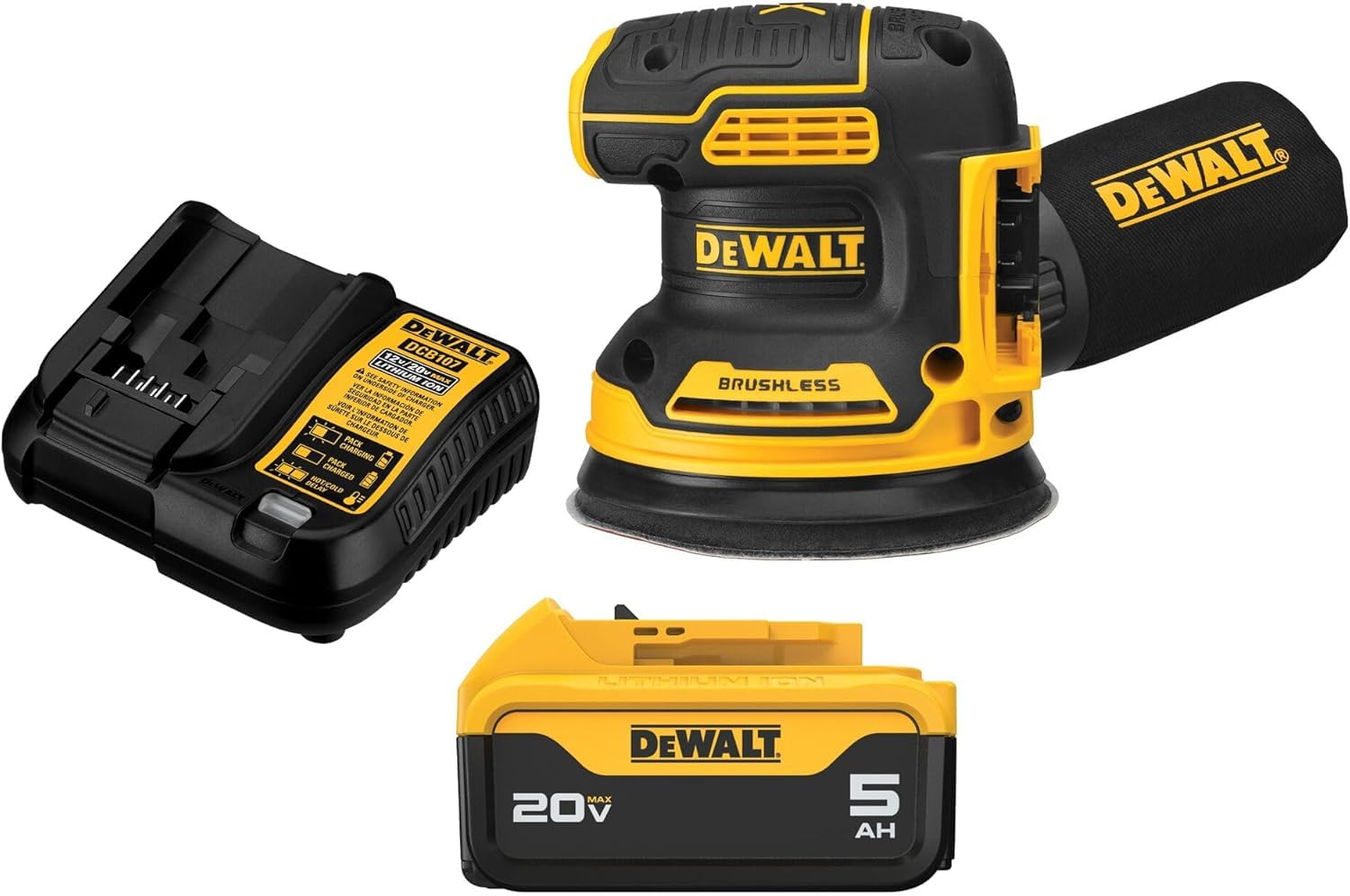
A brushless kit that drops an instant‑stop brake and variable speed into one package with a 5.0Ah battery, so you are ready to sand from the first trigger pull.
DEWALT gives you 8,000 to 12,000 OPM in a single dial, which tops the Metabo HPT by 1,000 OPM at the high end — and that extra speed helps when you are flattening epoxy or stripping thick paint. The brushless motor (a motor that uses electronics instead of physical brushes to deliver power) keeps runtime efficient, and the electric brake stops the pad the moment you release the trigger, while many other sanders coast for 10‑15 seconds. Buyers call it “a joy to use” for fine work on tabletops and chess boards, and note that it works well with both fine and coarse grits without bogging down.
The kit includes the sander, a 5.0Ah battery, charger, and a dust bag — making it the only pick on this list that arrives complete from the start. The catch is weight: at 5.6 pounds for the full kit (with battery and charger), it is more than double the bare weight of the Bosch or Metabo HPT. The low‑profile height of 12.8 inches helps you get close to the work surface, but you will feel the extra heft during a long sanding session. The dust‑sealed switch is a nice touch — it keeps fine particles out of the trigger mechanism, so the tool lasts longer in drywall or wood dust.
Why it stands out
- Comes with battery and charger — no extra purchase needed to start sanding today
- Electric brake stops instantly, unlike the 10‑15 second coast on cheaper models
- Dust‑sealed switch protects the trigger from sanding debris
The honest trade‑offs
- 5.6‑pound kit weight is noticeably heavier than bare‑tool competitors — fatigue builds faster on overhead work
- Only one dust bag included; the vacuum port requires a separate adapter (DWV9000) for 1‑1/4‑inch hoses
Who should grab this: If you are new to the DEWALT 20V system or want a single‑box solution with an instant‑stop brake that spares you from swirl marks on coast‑down. The kit convenience is a real timesaver.
Who might pass: Buyers who already own a strong battery system from another brand — the weight penalty and the cost of an extra battery system may not be worth it for occasional use.
4. BOSCH GEX18V-5N 18V Brushless 5 Inch Cordless Random Orbit Sander

At 2.4 pounds and barely 8.8 inches long, this Bosch feels more like a heavy electric scraper than a full‑size orbital — and that is good for your forearm.
The close‑to‑the‑workpiece design (the pad sits very near your hand) gives you precise control in tight spots like cabinet interiors or between studs, and the soft‑start technology (a circuit that ramps up the motor instead of jerking it to full speed) prevents the sander from skating across your workpiece when you pull the trigger. The palm‑grip shape is equally comfortable for left‑ and right‑handed use, and the cast‑zinc dust chute actually pulls heat away from the motor — a clever bit of engineering that keeps the tool cooler during long passes. Reviewers praise the low vibration and quiet operation, noting it is “far smoother than Dewalt or Porter Cable” sanders.
One downside: the battery sits centered above the disc rather than at the back of the handle, so you have to pull up slightly to keep the pad flat, which adds fatigue on extended jobs. The maximum speed is 10,000 RPM — that is lower than the DEWALT’s 12,000 OPM top end, so you may feel the pace is slower for aggressive stock removal. Still, for the price, the 2.4‑pound weight and excellent ergonomics make it the best choice if you sand furniture, drywall patches, or anything that requires steady, controlled passes.
What you will appreciate
- Extremely light at 2.4 pounds — reduces arm fatigue on long, repetitive sanding
- Soft‑start prevents gouging when you trigger the sander on a delicate surface
- Cast‑zinc dust chute doubles as a heat sink, keeping the motor cooler under load
What could be better
- Centered battery forces an upward pull to keep the pad flat — an ergonomic miss
- 10,000 RPM top speed is conservative; it is not a fast paint stripper
- No battery charge indicator on the tool itself — you have to check the battery pack
Best suited for: Finish carpenters and DIYers who sand furniture, trim, and drywall — the 2.4‑pound weight and soft‑start let you work precise edges without fishtailing.
Not the pick if: You need raw speed to strip paint or level thick epoxy. The 10,000 RPM ceiling is deliberate for control, but it is not a heavy‑removal machine.
5. BLACK+DECKER 20V MAX* Mouse Sander, Tool Only (BDCMS20B)

A tiny 2.1‑pound mouse sander built for corners, trim, and any spot where a 5‑inch pad is too big to fit.
The triangular pad reaches into tight 90‑degree corners that no round or square sander can touch, and the included detail finger attachment (a narrow pointed tip) lets you creep into even narrower gaps like window‑frame grooves or between raised panel doors. The hook‑and‑loop system makes paper changes as simple as peeling off the old sheet and pressing on a new one — no clamps, no alignment. At 2.1 pounds compared to the RYOBI sheet sander’s 3.24 pounds, the weight difference makes a big difference when sanding overhead or on a ladder. Customers note battery life around 30‑40 minutes continuous and about one hour of intermittent use, which is better than the 20 minutes of the RYOBI RROS18-0 and reasonable for touch‑up work.
The dust bag works but fills fast — reviewers point out you need to empty it every five to ten minutes, and the bag is not for metal dust (sparks could be a hazard). BLACK+DECKER’s own sanding pads are expensive, so several buyers recommend Lot Fancy 12‑hole pads at roughly for 50 sheets as a cheaper alternative. The vacuum port works well, but you need pads with exactly 12 holes for proper suction. This is not a machine for stripping a deck or flattening a tabletop — it is a detailer’s companion for finishing work where big sanders cannot reach.
Where it shines
- Lightest pick at 2.1 pounds — ideal for overhead and ladder work
- Detail finger attachment reaches into grooves and tight corners a round pad cannot touch
- Battery lasts 30‑40 minutes continuous, compared to about 20 minutes for the RYOBI RROS18-0
Where it falls short
- Small triangular pad is painfully slow on flat, wide surfaces — not a primary sander
- Dust bag needs emptying every 5‑10 minutes during continuous use
- Replacement pads (must have 12 holes) are brand‑specific and more expensive than standard sheet pads
Reach for this when: You need to sand inside a cabinet, between stair balusters, or along window trim where a 5‑inch pad is too wide. The 2.1‑pound weight and detail tip make it the right tool for those tight spots.
Look elsewhere for: Any job that involves sanding a flat surface larger than a foot square. The mouse pad will take forever. Get a 5‑inch random‑orbit sander for the main event and use this mouse as a secondary tool.
6. RYOBI ONE+ 18V Cordless 1/4 Sheet Sander (PCL401B)

A 1/4‑sheet sander that pushes 14,000 OPM, compared to 10,000 RPM for the RYOBI RROS18-0, making it the fastest stock‑removal machine in this lineup.
That 14,000 OPM rating is the highest orbit speed among every sander here, beating the DEWALT by 2,000 OPM and the Bosch by 4,000 RPM, so it strips paint and smooths rough wood faster than any random‑orbit model on this list — at least for flat surfaces. The new paper clamp system lets you swap sheets without fumbling with spring clips, and the on‑board dust collection port is compatible with a standard shop vac, so you can keep the workspace clean. Shoppers say it works great for patching cracks and nail holes before painting, and the compact 6.26‑inch length means you can get into corners that a 5‑inch orbital might not fit.
The catch is weight and dust‑bag retention. At 3.24 pounds, it is the heaviest bare tool here — 1.14 pounds heavier than the BLACK+DECKER mouse sander at 2.1 pounds. Multiple buyers report the dust catcher slides on but has no lock, so it falls off if you bump it against a workbench or a wall. The sheet‑sanding format also leaves visible scratch marks if you are not careful—you need to move the sander with the grain and change grits progressively, unlike a random‑orbit that hides the marks by design. It is a great tool if you already own RYOBI ONE+ batteries and need a fast sheet sander for flat prep work, but the dust‑cup flaw is frustrating enough that several buyers mention it.
What makes it fast
- 14,000 OPM top speed strips material faster than any other sander listed here
- Improved paper clamp system simplifies sheet changes compared to older RYOBI models
- Vacuum‑port compatible, so you can attach a shop vac for near‑dustless sanding
The honest friction points
- 3.24 pounds is the heaviest bare tool here — fatigue builds faster, especially on vertical work
- Dust catcher has no locking mechanism, so it pops off when you bump the tool
- Sheet‑sanding pattern leaves visible scratches if you do not follow the grain perfectly — not as simple to use as random‑orbit
The 14,000 OPM is genuinely fast.
Consider skipping: If your projects involve curves, edges, or fine finish work — the sheet format and the unreliable dust cup will annoy you. A random‑orbit sander is more versatile for mixed jobs.
Understanding the Specs
OPM vs. RPM (Orbits Per Minute vs. Rotations Per Minute)
Both measure the same thing — how fast the pad moves — but the terms differ by manufacturer. OPM (orbits per minute) describes the back‑and‑forth or elliptical motion of a sheet or random‑orbit sander, while RPM (revolutions per minute) describes the spinning speed of a random‑orbit pad. In practice, a higher number means faster material removal: 14,000 OPM on the RYOBI sheet sander strips paint noticeably faster than 10,000 RPM on the Bosch. For random‑orbit sanders, you also want the orbit diameter (usually 3/32‑inch or 1/8‑inch) — a larger orbit removes more material per pass, so a 1/8‑inch orbit at 10,000 RPM may cut faster than a 3/32‑inch orbit at 12,000 RPM. The buyer should look for the orbit diameter in the details if possible.
Bare Tool vs. Kit
A “bare tool” or “tool only” means you get the sander and nothing else — no battery, no charger. You must own the same brand’s batteries already or buy them separately, which adds ‑ to your total depending on the brand. A “kit” includes the sander, a battery, a charger, and often a bag or accessories — like the DEWALT DCW210P1 kit includes a 5.0Ah battery and charger. For a first‑time buyer, a kit is almost always a better deal because the cost of a single battery alone is often half the price of the entire kit. If you already own several batteries from one brand (for example, three RYOBI 18V packs), then buying the bare tool saves you money without leaving you stranded mid‑project.
FAQ
Can I use a cordless sander to remove paint from a deck?
Do all 5‑inch sanding discs fit every 5‑inch sander?
How long does a cordless sander battery last on a single charge?
What is the difference between a random‑orbit sander and a 1/4‑sheet sander?
Will a 20V battery from one brand work on another brand’s sander?
Is a brushless motor really worth the extra money on a sander?
Can I use a cordless sander on drywall without making a huge mess?
What does “variable speed” mean on a sander?
How do I know which sanding grit to start with?
Can I use a random‑orbit sander to polish metal?
Final Thoughts: The Verdict
Across the board, the cordless sander winner is the Metabo HPT SV1813DAQ4 because it gives you six speed settings, an electric brake, and pro‑grade dust collection at a weight (2.6 pounds) that does not wear you out, covering the widest range of materials and jobs. If you want a complete kit with a battery included and an instant‑stop brake, grab the DEWALT DCW210P1. And for detail work in tight corners where nothing else fits, the standout is the BLACK+DECKER BDCMS20B at 2.1 pounds with its finger attachment.
How We Picked
We do not accept paid placement. Every pick is matched to a real buyer and a real use-case; we do not hands-on test units.
Sources & Methodology
Specifications: manufacturer listings and product documentation. Review insights: verified customer reviews, as of July 2026. Pricing: not shown on this page (it changes often); check the current price via the retailer link.
As an Amazon Associate, WellFizz earns from qualifying purchases. This does not affect which products we feature.
Related Guides

Mo Maruf
I created WellFizz to bridge the gap between vague wellness advice and actionable solutions. My mission is simple: to decode the research and give you practical tools you can actually use.
Beyond the data, I am a passionate traveler. I believe that stepping away from the screen to explore new environments is essential for mental clarity and physical vitality.