Our readers keep the lights on and my smoothie glass nicely filled. As an Amazon Associate, I earn from qualifying purchases.
Specs are compiled from manufacturer listings and verified buyer reviews and can change over time — please confirm the key details on the product page before buying.
You reach for a cordless planer when a door sticks, a shelf board is a hair too thick, or you need to true an edge without dragging a cord across the job site. The hard part is finding one that cuts cleanly without draining three batteries in five minutes — so you finish the job instead of swapping packs. These seven picks are sorted by who they actually suit, from fast compact trimmers to heavy-duty stock removers.
I am Mohammad Maruf, the founder behind WellFizz. This guide compares manufacturers’ published specs and patterns from verified customer reviews, so you get each pick’s real strengths and trade-offs.
Whether you trim door edges, prep lumber for joinery, or square rough stock, the right tool saves time. This round-up of the best cordless planer options breaks down the real-world trade-offs in speed, weight, cut width, and battery compatibility so you buy once and buy right.
Quick Picks
- MtiolHig 30000 CPM Cordless Handheld Planer (DeWalt 20V) — Budget Champion
- TengXcel Electric Hand Planer for DeWalt 20V MAX — Top Performer
- TengXcel Cordless Planer for Milwaukee 18V MAX — Fast Passes
- Milwaukee M12 BRUSHLESS 2 Planer (2524-20) — Compact Finisher
- DEWALT DCP580B 20V MAX Brushless Planer + DW6655 Blades — Pro Workhorse
- Bosch PLH181B 18V 3-1/4 In. Planer (Bare Tool) — Fence Master
- Makita DKP181Z 18V LXT Brushless Cordless Planer — Deep Stock
How To Choose The Best Cordless Planer
Picking a cordless planer depends on matching the tool’s speed, cut width, and weight to the kind of work you do most often. A few specs separate the tools that feel easy from those that fight you all day.
Motor type and speed (RPM)
A brushless motor (a motor that uses electronic controls instead of physical carbon brushes) is the standard for modern cordless planers — it delivers more torque from every battery charge and lasts longer without maintenance. But the number that tells you how fast the blades spin, measured in rotations per minute (RPM), decides the quality of the cut. Higher RPM means the blade hits the wood more times per second, which leaves a smoother surface. Budget options tend to sit around 15,000 RPM. Faster models push past 30,000 cuts per minute for a glassier finish with less sanding.
Cut width and depth
Most cordless planers cut a 3.25-inch (82mm) swath in one pass. A few wider models reach 3.83 inches, letting you flatten a 2×4 in fewer passes. The maximum depth of cut — how much wood the blade shaves off per pass — usually ranges from 0.06 inches up to 0.08 inches (about 2mm). A deeper cut removes material faster but demands more from the motor and the battery. For fine trimming, you want a depth knob that lets you dial in adjustments as small as 0.01mm.
Weight and balance
A planer that feels nose-heavy or weighs over 6 pounds will fatigue your arm during overhead work or extended sessions. Compact models hover around 4.4 to 5 pounds and are much easier to control for door scribing and panel trimming. Heavier builds between 6 and 7 pounds often come with more sturdy motors and wider cuts, making them better suited for benchtop stock removal where you set the workpiece down.
Battery platform
Every cordless planer fits one specific brand’s battery system — Milwaukee 18V or M12, DeWalt 20V MAX, Bosch 18V, or Makita 18V LXT. If you already own several batteries from one brand, that is the most cost-effective path because you buy the tool alone and skip the expensive battery-plus-charger kit. Starting fresh means picking a platform with a strong lineup of other tools you might want later.
Quick Comparison
| Model | Best For | Max RPM | Cut Width | Weight | Amazon |
|---|---|---|---|---|---|
| MtiolHig 30000 CPM Planer | Budget DIY on DeWalt batteries | 15000 RPM | 3.25 Inches | — | Amazon |
| TengXcel 30000 CPM (DeWalt) | High-speed stock removal | 30000 RPM | 3.25 Inches | 2.6 kg | Amazon |
| TengXcel 30000 CPM (Milwaukee 18V) | High-speed stock removal | 30000 RPM | 3.25 Inches | 2.61 kg | Amazon |
| Milwaukee M12 BRUSHLESS 2 Planer | Compact trimming and scribing | 14500 RPM | 3.83 Inches | 4.41 lbs | Amazon |
| DEWALT DCP580B + DW6655 Blades | Pro-grade speed and durability | 15000 RPM | — | — | Amazon |
| Bosch PLH181B 18V Planer | Fence-guided accuracy | — | 3.25 Inches | 6.1 Pounds | Amazon |
| Makita DKP181Z LXT Brushless | Deepest single-pass cut | — | 82mm | 2.9 kg | Amazon |
In‑Depth Reviews
1. MtiolHig 30000 CPM Cordless Handheld Planer (DeWalt 20V)
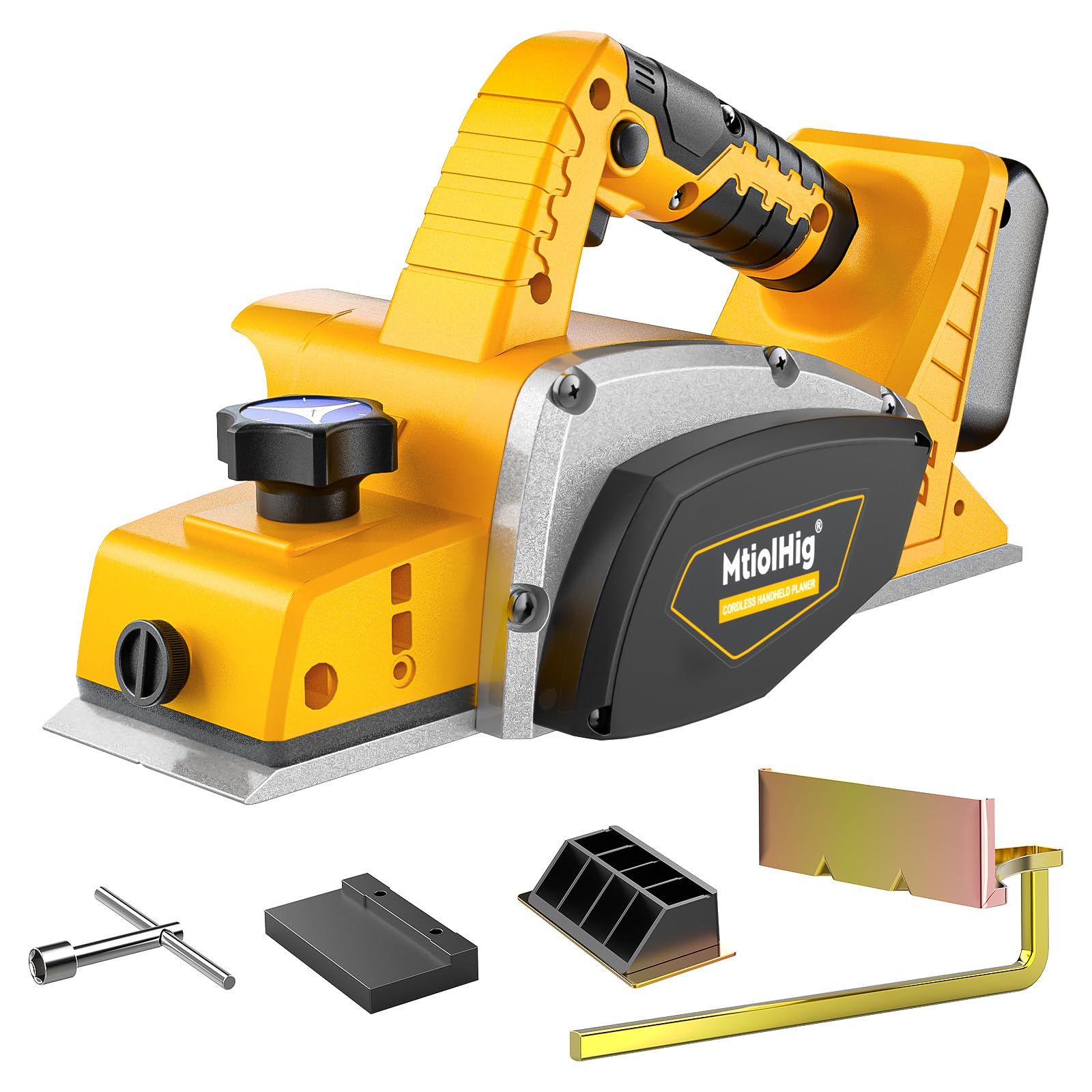
A no-frills entry point that lets DeWalt 20V owners plane without the brand tax.
This planer spins at 15,000 RPM with a 3.25-inch cutting width and a maximum depth of 2mm — numbers that put it in the middle of the pack for speed but right at the budget floor for price. It uses a brushless motor, so you get decent runtime from a single DeWalt 20V battery even though the tool runs at a lower RPM than the 30,000 CPM competitors.
Buyers report it has “decent power” but note that “heavy use drains battery fast” and the “adjustment knob moves on heavy cuts.” It also has a dual-switch safety feature that requires pressing both the on/off switch and a safety switch simultaneously, so accidental startups are unlikely. The included parallel guide and T-handle wrench add value, but the shoe alignment can leave cuts slightly uneven under heavy passes — a common compromise at this price point.
Unlike the 30,000-RPM TengXcel models below, this planer runs at half the blade speed, which means you will need lighter passes for a smooth finish. It also has a narrower cut width (3.25 inches vs the 3.83 inches on the Milwaukee M12) but weighs less and fits a more common 20V battery platform.
High-speed cordless planer
- Very fine 0.01mm depth adjustment for precise trimming
- Dual-switch safety prevents accidental startups
- Compact and quiet compared to heavier models
Battery sold separately
- Lower RPM means more passes needed for a smooth surface
- Adjustment knob shifts during aggressive cutting
- Cuts can be uneven under full-depth passes
Best for speed: DIYers who already own DeWalt 20V batteries and need a bare-bones planer for light jobs like trimming shelves or squaring scrap wood.
Not for beginners: Flattening wide boards or working through thick stock regularly — the lower RPM and narrow cut will slow you down.
2. TengXcel Electric Hand Planer for DeWalt 20V MAX
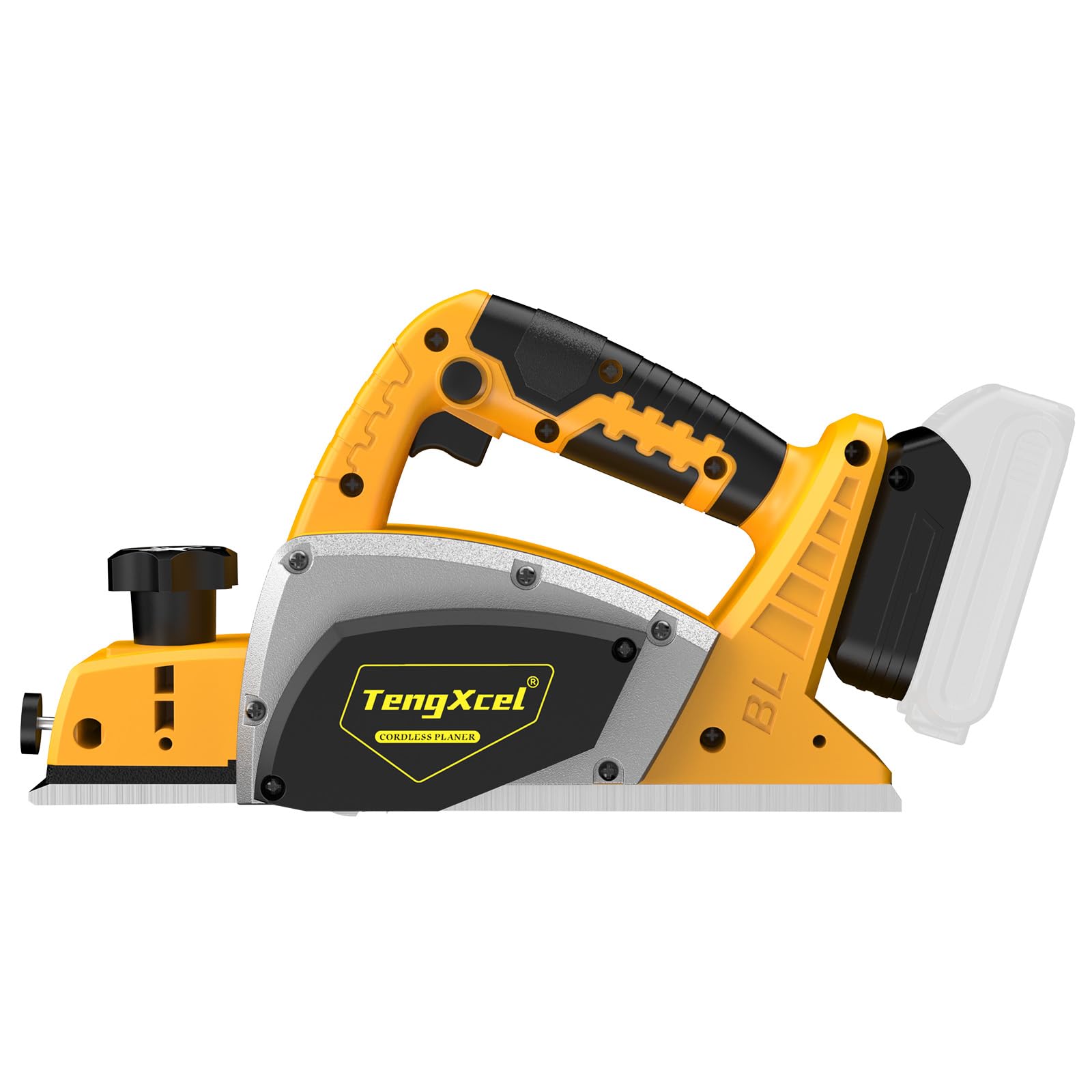
Double the blade speed of budget options means stock removal in half the passes.
This planer hits 30,000 CPM (cuts per minute — the same as RPM) from its brushless motor, which is double the 15,000 RPM of the MtiolHig above and translates to a noticeably smoother finish with each pass. The 3.25-inch cut width and 2mm depth are standard for the category, but the real difference is the precision-matched front and rear shoe — the two base plates that must sit perfectly flat relative to each other. When they are off by even a hair, every board gets a slight dip at the start of the cut. Reviews confirm the shoe alignment is spot-on here.
The front shoe also features a V-groove guide, a small V-shaped notch that you can ride along the edge of a board to quickly chamfer or square the corner without freehand guessing. One buyer wrote that “taking off layers at a time was quick and easy.” The dedicated safety switch prevents accidental startups, and the 2.6 kg weight keeps it manageable for one-handed work. A common complaint is the oddly shaped dust port that does not accept a standard shop-vac adapter — several owners wished it was round instead of kidney-shaped.
Compared to the 15,000-RPM MtiolHig, you get twice the blade speed for roughly the same cost, which makes this the better value if your DeWalt batteries are already in hand. It lacks the wider 3.83-inch cut of the Milwaukee M12, but for 3.25-inch work it is tough to top at this price.
Compatible with DeWalt
- 30,000 CPM brushless motor leaves a glassy finish
- Precision-aligned shoes for flat cuts without dips
- V-groove guide for quick edge chamfering
Limited blade options
- Non-standard dust-port shape makes vac attachment difficult
- Bare tool only — no battery or charger included
Choose for compatibility: You already own DeWalt 20V or 60V Flex batteries and want the fastest blade speed available at a mid-range price.
Weak on hardwoods: You need a wider cut than 3.25 inches — the Milwaukee M12 below covers 0.58 inches more per pass.
3. TengXcel Cordless Planer for Milwaukee 18V MAX
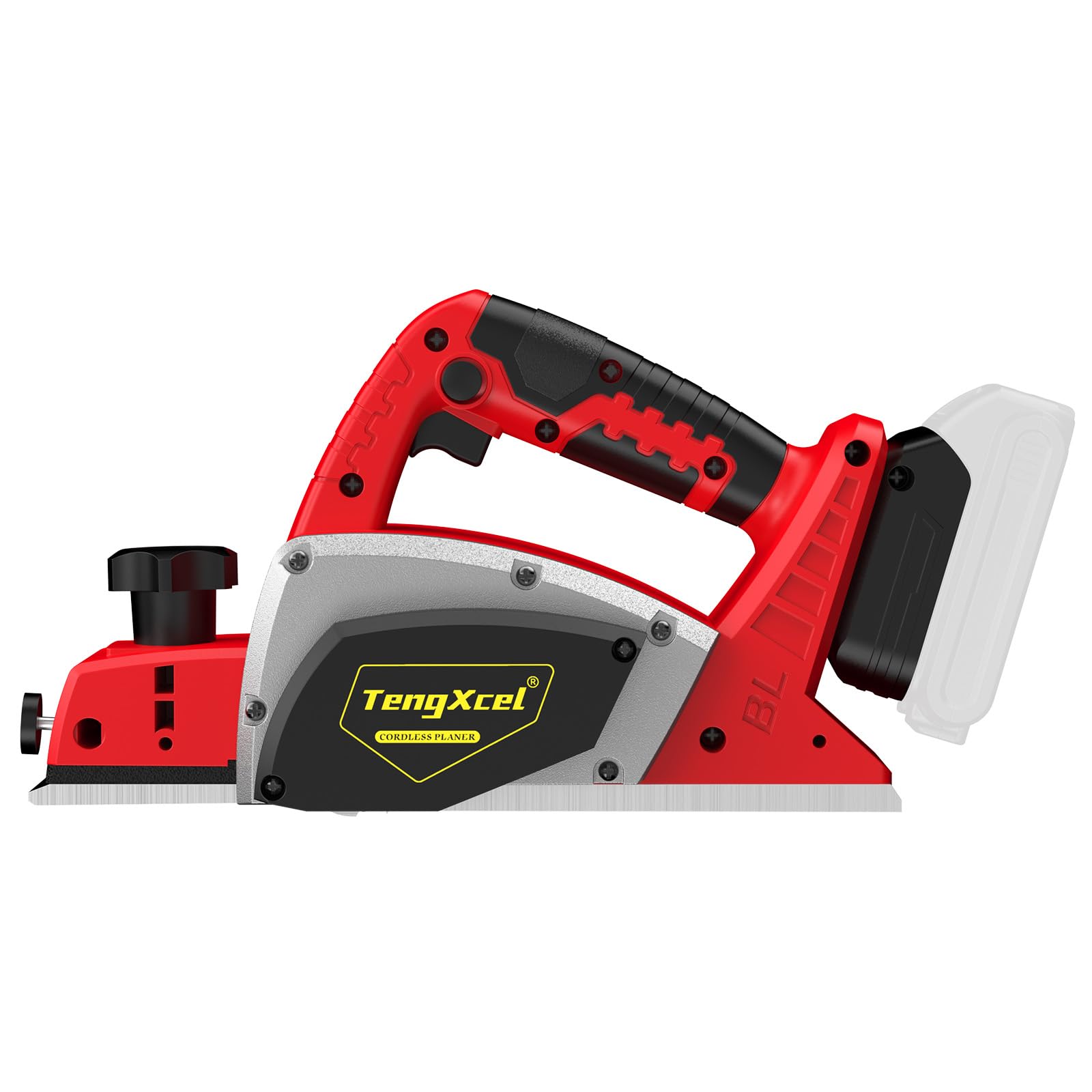
The same high-speed motor as the DeWalt version, tuned for the red battery family.
This is mechanically identical to the TengXcel DeWalt version above — a brushless motor spinning at 30,000 CPM, a 3.25-inch cut width, a 2mm max depth, and precision-matched shoes — but built to accept Milwaukee 18V batteries instead of DeWalt packs. That makes it the go-to pick if your toolbox is already stocked with red batteries and you do not want to pay Milwaukee’s premium for a branded planer. The weight comes in at 2.61 kilograms, almost the same 2.6 kg as the DeWalt flavor.
Buyers confirm it works well with Milwaukee 18V batteries. One reviewer noted, “Taking off layers at a time was quick and easy,” matching the experience of the DeWalt version. The same V-groove guide lives in the front shoe for easy edge work, and the safety switch setup is the same. Like its yellow counterpart, the dust port is a weird kidney shape that does not easily attach to a shop vac, though one owner mentioned 3D printing their own adapter.
At 30,000 CPM this planer cuts more than 2x faster than the 14,500-RPM Milwaukee M12 planer, which means fewer passes for the same depth. The trade-off is weight: the M12 comes in at 4.41 pounds (roughly 2 kg), making the TengXcel heavier by about 0.6 kg despite being less compact.
Fits Milwaukee system
- 30,000 CPM brushless motor for fast stock removal
- Fits existing Milwaukee 18V batteries without adapters
- V-groove guide for edge squaring
Heavy for one hand
- Non-standard dust port shape
- Heavier than the Milwaukee M12 planer by about 0.6 kg
Best for Milwaukee users: Milwaukee 18V users who want high-speed planing without paying for a branded Milwaukee model.
Not for tight spaces: Anyone who prioritizes a compact trimmer over raw speed — the M12 is smaller and lighter.
4. Milwaukee M12 BRUSHLESS 2 Planer (2524-20)
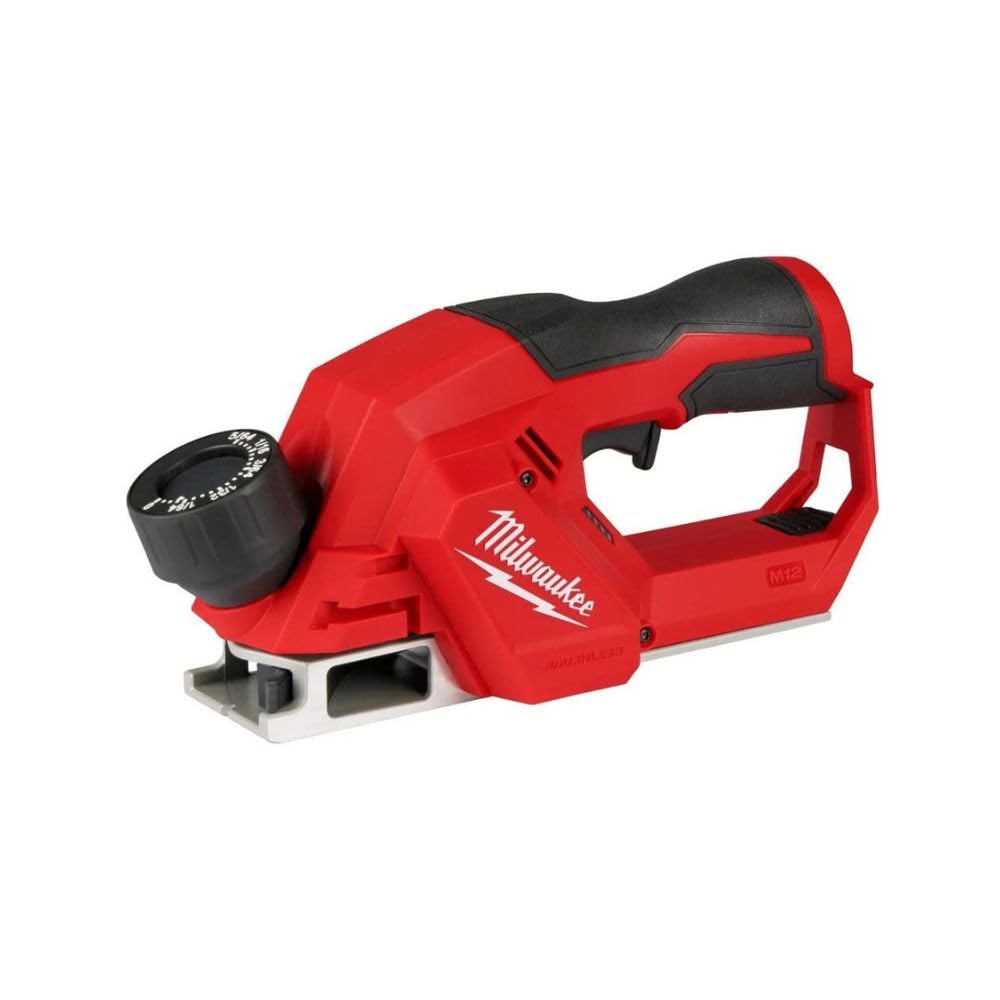
The lightest, widest-cut planer here — built for doors, panels, and one-handed scribing.
A 50-year carpenter (verified) said it is “very compact and about 5 lbs,” noting it is perfect for “scribing panels or planing doors” compared to his heavier DeWalt. The cutting depth is 0.08 inches (about 2mm), the same as most competitors, but the wider shoe means you flatten a 2×4 in three passes instead of four.
The M12 platform runs at a maximum rotational speed of 14,500 RPM — significantly slower than the 30,000 CPM TengXcel models — but the trade-off is a tool that feels like an extension of your hand rather than a wrestle. Owners mention it is “silky smooth” and the “adjustment knob, onboard tool holder and spare blades” make it easy to fine-tune on the fly. Dust extraction is described as “very good,” and the metal construction feels premium despite the compact size.
It is 4.41 pounds versus the 2.61 kg (about 5.75 lbs) of the TengXcel for Milwaukee 18V, so you save over a pound while gaining a wider cut. The catch is the lower RPM — you trade raw blade speed for lighter weight and a broader pass, which favors finish work over bulk material removal.
Compact M12 design
- Widest cut of any pick here at 3.83 inches
- Lightest planer at 4.41 pounds for fatigue-free overhead work
- Onboard tool holder and spare blade storage
Small cutting width
- 14,500 RPM is roughly half the blade speed of 30,000-CPM models
- M12 battery platform — not compatible with Milwaukee 18V packs
Reach for portability: You plane doors, scribe panels, or trim sheet goods — the light weight and wide cut make these jobs faster and less tiring.
Skip for large jobs: You need to hog off material from rough lumber quickly; the lower RPM means slower stock removal than the TengXcel options.
5. DEWALT DCP580B 20V MAX Brushless Planer + DW6655 Blades

A year-in, year-out planer from a brand that trades on consistency, not gimmicks.
The DCP580B is a brushless planer that delivers 32,000 cuts per minute — slightly faster than the 30,000 CPM TengXcel models and more than double the 14,500 RPM of the Milwaukee M12. The motor is designed for power and runtime simultaneously, which means fewer battery swaps when you are working through a stack of boards. The included DW6655 blades are resharpenable for longer life, and the quick-set knife mechanism makes blade changes faster than the screw-and-shim setups on cheaper planers.
One long-term user said, “Have been using this tool for about a year and it is a pleasure to use,” which lines up with the typical DeWalt reputation for holding up to daily job-site abuse. A few buyers noted that the tool feels “a bit heavier than I thought” and that the included DW6655 blades did not fit the DCP580B — the correct blade is DW6654, so check compatibility before ordering. The cutting depth maxes out at 0.08 inches.
Versus the Bosch PLH181B below, the DeWalt runs at a higher rated speed (32,000 vs not-disclosed CPM) and uses a brushless motor instead of a four-pole motor (a motor with four magnetic coils). Both are premium-tier tools, but the DeWalt leans toward high-speed material removal while the Bosch prioritizes precision fence-guided cuts.
Brushless with extra blades
- 32,000 cuts per minute for fast, smooth stock removal
- Resharpenable blades extend usable life
- Brushless motor for better runtime and durability
No case included
- Some units ship with wrong blades (DW6655 vs correct DW6654)
- Heavier than expected for a compact planer
Choose for value: You want a pro-grade DeWalt planer with a proven track record and do not mind double-checking the blade SKU at purchase.
Consider another if quiet need: You want a tool that ships ready-to-plane without potential blade compatibility issues.
6. Bosch PLH181B 18V 3-1/4 In. Planer (Bare Tool)

A four-pole motor and an edge-guide fence that reward precision cuts over raw speed.
The Bosch PLH181B takes a different approach — instead of a brushless motor, it uses a high-performance four-pole motor (a motor with four magnetic coils for strong torque) that the brand claims provides “fast stock removal and a smooth finish.” The cutting depth is shallower than most at 0.06 inches (about 1.5mm), which is fine for fine trimming but means more passes for heavy material removal. The ratcheting depth knob lets you set increments from 0 to 1/16 inch within one full rotation, eliminating the need to re-zero the depth each time you adjust.
The included WoodRazor micrograin carbide blade is designed to resist fractures from nail and staple strikes — a genuine advantage if you plane reclaimed lumber or doors with hidden fasteners. The aluminum front and rear shoes are machined after assembly, which ensures the base stays flat. At 6.1 pounds it is the heaviest planer here, so overhead work will fatigue your arm faster.
Versus the DeWalt DCP580B, the Bosch is 6.1 lbs (heavier by at least a pound), has a shallower max depth of 0.06 inches versus 0.08 inches, and uses a four-pole motor instead of brushless. The trade-off is the carbide blade that survives nail strikes better than standard steel, plus Bosch’s five-year limited warranty on the tool.
Ergonomic Bosch build
- Micrograin carbide blade resists fracturing from nail strikes
- Ratchet depth knob does not need re-zeroing between adjustments
- Aluminum shoes machined post-assembly for flatness
Bare tool only
- Heaviest planer at 6.1 pounds
- Shallower cut depth means more passes for material removal
- Bare tool — no battery or charger included
Suits for comfort: You regularly plane old doors or lumber with hidden nails — the carbide blade handles accidental strikes better than any other pick.
Not for budget buyers: You need to remove deep stock quickly; the shallow cut and heavy weight work against speed.
7. Makita DKP181Z 18V LXT Brushless Cordless Planer
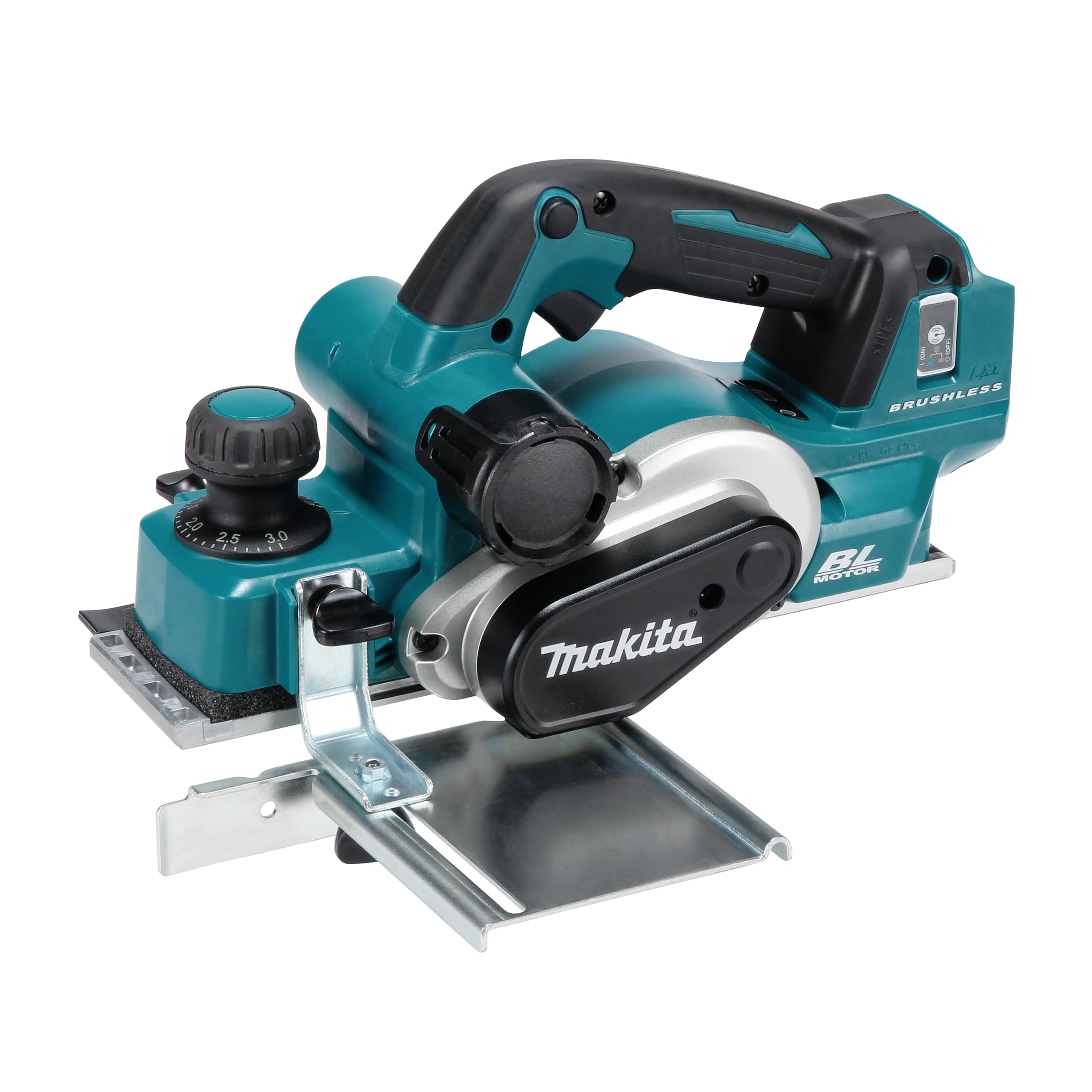
The only planer here that chews off 3mm per pass — best for hogging thick stock fast.
Every other planer on this list stops at a maximum 2mm cut depth (0.08 inches), but the Makita DKP181Z cuts up to 3mm (roughly 1/8 inch) per pass. That is a 50% deeper single pass than anything else here, which means you can flatten a rough board in fewer strokes. The brushless motor and 82mm (about 3.23-inch) cutting width are standard for the category, but the aluminum base material and 2.9 kg weight (roughly 6.4 pounds) put it in the heavier, more sturdy tier alongside the Bosch.
Reviews from international buyers consistently praise “Premium Makita quality,” and one owner who has used it since 2020 says “best planer ever. Sounds cool too.” The DKP181Z runs on Makita’s 18V LXT platform — the same battery system that powers hundreds of other Makita tools — so if you are already invested in that ecosystem, this is a natural addition. The style name in the data reads “Akku-Hobel,” which is German for battery planer, confirming this is a global-market tool.
Compared to the Bosch PLH181B, the Makita cuts deeper (3mm versus 0.06 inches), runs brushless versus a four-pole motor, and weighs 2.9 kg versus 6.1 pounds (light enough to make a difference). The deeper cut makes it better for rough dimensioning, but the heavier feel means it is less suited for one-handed trim work on a door that is already hung.
Lightweight Makita design
- Deepest cut of any pick at 3mm per pass
- Brushless motor for longer runtime and torque
- Fits Makita 18V LXT battery ecosystem
No blade guard
- Heavier than the Milwaukee M12 at 2.9 kg
- Premium price reflects Makita brand and build quality
Grab for long use: You need to true up rough lumber quickly — the extra millimetre per pass cuts your work time by roughly a third versus 2mm planers.
Think twice for safety: You mostly trim doors or scribe panels; the weight and depth are overkill for fine finish work.
Understanding the Specs
Rotations Per Minute (RPM)
This tells you how many times the blade drum spins in one minute. Higher RPM means the blade hits the wood surface more times per second, which produces a smoother finish with less tear-out. Budget options run around 15,000 RPM. High-speed models hit 30,000 RPM or higher — those leave a surface that often needs little to no sanding. Planers marketed as “CPM” (cuts per minute) refer to the same thing: the number of blade passes over the workpiece per minute.
Cut Width and Cut Depth
Cut width is the swath of wood the planer removes in a single pass. Most cordless planers cut 3.25 inches (82mm), which means it takes two passes to flatten a 2×4. A wider cut like 3.83 inches covers more ground per pass but usually requires a larger motor housing. Cut depth is how much material the blade shaves off in one pass — typically 2mm (0.08 inches). A deeper cut, like the 3mm on the Makita DKP181Z, removes material faster but puts more strain on the motor and battery.
Shoe Alignment
The front and rear shoes — the flat metal plates that ride on the wood surface — must be perfectly level with each other. If they are misaligned by even a fraction of a millimetre, the planer will start each cut with a subtle dip, creating a wavy surface that requires extra sanding. Higher-end planers machine both shoes after assembly to guarantee flatness. Budget models may need a quick check at home with a straightedge.
V-Groove Guide
A small V-shaped notch cut into the front shoe. You align this notch with the edge of a board to make quick chamfers or to square up a corner without measuring. It is a simple detail but a genuinely useful one for trim work and joinery prep — you will find it on most modern planers from mid-range up.
FAQ
Can I use a cordless planer on a door that is already hung?
Will a cordless planer fit my existing batteries?
How deep can a cordless planer cut in one pass?
What does “brushless motor” mean on a planer?
Why does my planer leave a groove or dip at the start of the cut?
How often do planer blades need replacing?
Can I use a cordless planer for rough lumber from the sawmill?
What is the difference between 30,000 CPM and 15,000 RPM on a planer?
Why is the dust port on my planer an odd shape?
Is a heavier planer better for stock removal?
Final Thoughts: The Verdict
Across the board, the cordless planer winner is the TengXcel 30000 CPM for DeWalt 20V because it delivers pro-level blade speed at a mid-range price, leaving a smooth finish in fewer passes. If you want the lightest, most compact trimmer for doors and panels, grab the Milwaukee M12 BRUSHLESS 2 Planer — its 4.41-pound weight and 3.83-inch cut make scribing and one-handed work genuinely easier. And for rough lumber that needs deep passes fast, the Makita DKP181Z with its 3mm cut depth stands alone — half again as deep as every other pick here.
How We Picked
We do not accept paid placement. Every pick is matched to a real buyer and a real use-case; we do not hands-on test units.
Sources & Methodology
Specifications: manufacturer listings and product documentation. Review insights: verified customer reviews, as of July 2026. Pricing: not shown on this page (it changes often); check the current price via the retailer link.
As an Amazon Associate, WellFizz earns from qualifying purchases. This does not affect which products we feature.

Mo Maruf
I created WellFizz to bridge the gap between vague wellness advice and actionable solutions. My mission is simple: to decode the research and give you practical tools you can actually use.
Beyond the data, I am a passionate traveler. I believe that stepping away from the screen to explore new environments is essential for mental clarity and physical vitality.