Our readers keep the lights on and my smoothie glass nicely filled. As an Amazon Associate, I earn from qualifying purchases.
Finding a cordless phone that actually delivers clear, powerful audio for someone with hearing loss can feel impossible. Standard handsets often produce thin, weak sound that forces you to ask callers to repeat themselves, turning simple conversations into exhausting work.
I’m Mohammad Maruf — the founder and writer behind WellFizz. This guide moves beyond marketing specs to analyze the real-world performance of specialized cordless phones with critical features like decibel-rated amplification, tone control, and T-coil compatibility for hearing aid users.
After evaluating dozens of options, these stand out for their volume-boosting technology, oversized buttons, and visual ringers. This is the definitive guide to the best cordless phone for hard of hearing users in the market today.
How To Choose The Best Cordless Phone For Hard Of Hearing
Buying a phone for hearing loss is not like buying a standard cordless phone. The two most important specs you need to check are the decibel boost level and whether the phone offers a T-coil mode for hearing aids. Without these two features, the phone is likely useless for someone with significant hearing loss.
Decibel Boost and Tone Control
The boost rating tells you how much the phone can amplify incoming voice volume. Entry-level models offer around 30dB, which works well for mild hearing loss. Premium models push that to 40dB or even 50dB. But raw volume is only part of the equation. Tone controls let you shift the audio frequency, reducing background hiss or boosting specific voice ranges, which helps with speech clarity far more than a simple volume knob.
Hearing Aid Compatibility and T-Coil
If the user wears hearing aids, look for a phone that is explicitly TIA-1083 compliant and includes a T-coil setting on the handset. This eliminates the high-pitched interference and buzzing that normal phones can create inside hearing aid receivers. Without T-coil compatibility, the audio can sound distant, tinny, or distorted even at high volume.
Extra-Loud Ringer and Visual Alerts
Many hearing-impaired users can hear a caller fine once the handset is against the ear but cannot hear the phone ring across a room. A ringer rated at 90dB or higher solves this, while a bright flashing LED visual ringer on the handset and base provides a silent alert. Premium models combine both, ensuring no call is missed even when the user is in another room or watching television.
Quick Comparison
On smaller screens, swipe sideways to see the full table.
| Model | Category | Best For | Key Spec | Amazon |
|---|---|---|---|---|
| Panasonic KX-TGD892S | Premium | Bluetooth hearing aid pairing | Bluetooth audio streaming | Amazon |
| VTech SN5127+SN5107 Bundle | Premium | Maximum loud volume | 50dB audio booster | Amazon |
| Panasonic KX-TGM430 Handset | Mid-Range | T-coil hearing aid compatibility | 40dB volume boost | Amazon |
| Clarity D714 (53714) | Mid-Range | Adjustable tone control | 40dB sound amplification | Amazon |
| Clarity D712 | Mid-Range | Large button simplicity | 30dB sound boost | Amazon |
| AT&T BL102-2 | Value | Robocall blocking | Audio Assist feature | Amazon |
| AT&T EL51203 | Value | Budget-friendly 2-handset set | Full-duplex speakerphone | Amazon |
In‑Depth Reviews
1. Panasonic KX-TGD892S

The Panasonic KX-TGD892S is the most future-proof option on this list because it pairs directly with Bluetooth hearing aids and wireless headphones. Users can stream landline calls directly into their hearing aids, bypassing the handset speaker entirely. This is a game-changer for anyone who struggles with phone placement or hearing aid microphone feedback.
The landline supports a full-duplex speakerphone, a 17-minute digital answering machine, and advanced call blocking that can stop robocalls before they even ring. The talking caller ID announces the caller in English or Spanish, so you can screen calls without reading a tiny screen.
Bluetooth connectivity supports up to four devices, including earbuds like AirPods, and works with common hearing aid models from Phonak and Kirkland. The only catch is that pairing can occasionally drop when the hearing aids are turned off or the user leaves the house, requiring manual reconnection.
Why it’s great
- Streams calls directly to Bluetooth hearing aids and earbuds
- Robust smart call blocking with 1,000-number capacity
- Long battery life — up to 10 hours talk time
Good to know
- Pairing can be lost when hearing aids power off or leave range
- No 3.5mm audio jack for corded headsets
2. VTech SN5127+SN5107 Bundle
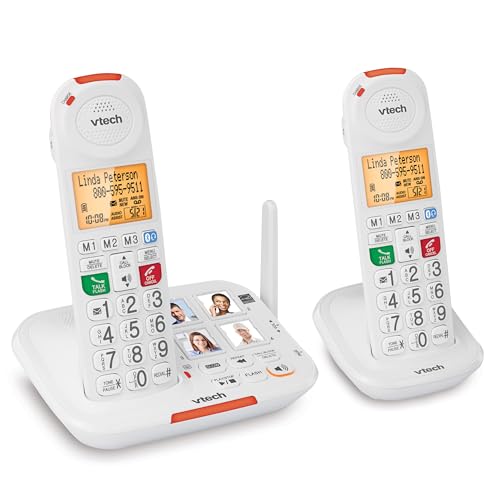
The VTech SN5127 plus SN5107 bundle delivers the highest audio boost in this lineup: 50dB of temporary amplification alongside a 90dB ringer that cuts through background noise in any room. The oversized buttons feature high-contrast colors designed for users with low vision, and the photo speed-dial keys allow four frequently dialed numbers to be programmed with a custom picture for easy identification.
The digital answering system supports 22 minutes of recording time with a slow-message playback option, which is helpful when trying to understand a rapid speaker. The bundle includes two handsets, so one can live in the kitchen and the other in a bedroom without needing separate base stations.
Some users report that the handset interface is not the most intuitive for seniors, especially when setting up the speed-dial directory. On maximum volume, a few units produce noticeable audio feedback, which can be disorienting for hearing aid wearers.
Why it’s great
- Industry-leading 50dB volume boost for severe hearing loss
- 90dB ringer and bright blinking visual alert for missed calls
- Photo speed-dial simplifies calling loved ones
Good to know
- Interface can be confusing for seniors to navigate initially
- Audio feedback may occur at maximum volume levels
3. Panasonic KX-TGMA44B (KX-TGM430 Series)

This is a single accessory handset designed for the Panasonic KX-TGM430B base system, but it deserves its own spotlight because of its exceptional T-coil performance. The KX-TGMA44B is TIA-1083 compliant, meaning it produces virtually no electromagnetic interference for hearing aid users with T-coil enabled devices — a critical feature that many competing phones overlook.
The handset includes a 40dB volume booster, six distinct tone settings to fine-tune voice clarity, and a bright red LED visual ringer on both the handset and the base unit. The white backlit LCD is large and high-contrast, making caller ID information readable from across the room.
Keep in mind that this is not a standalone phone. You need the KX-TGM430B base station to use it. Once paired, however, it offers the cleanest, most interference-free audio for hearing aid users on this list.
Why it’s great
- TIA-1083 compliant — minimal interference with T-coil hearing aids
- Six tone settings let you customize the audio profile
- Oversized lighted keypad and white backlit display
Good to know
- Requires compatible Panasonic base station (KX-TGM430B)
- Speakerphone volume drops when boost is not activated
4. Clarity D714 (53714)

The Clarity D714 is a dedicated amplified cordless phone built by a brand that specializes exclusively in hearing-assistive technology. It delivers a clean 40dB boost and goes a step further with adjustable tone control — four distinct settings that let you emphasize high or low frequencies based on your specific hearing profile. This is invaluable for users whose hearing loss is not flat across all frequencies.
The phone includes a digital answering machine, a headset jack for wired neckloops or amplified headsets, and a large directory for storing contacts. The white handset with high-contrast buttons makes dialing easy even in dim light, and the belt clip adds portability around the house.
Several users point out that the Answer and End buttons lack sufficient color contrast, making them hard to locate quickly. The ringer volume can also feel underwhelming for those whose primary challenge is hearing the phone ring from another room.
Why it’s great
- Four adjustable tone settings fine-tune voice frequencies
- Included headset jack expands connectivity options
- DECT 6.0 ensures interference-free operation
Good to know
- Answer and End buttons can be hard to see in low light
- Ringer volume may not be loud enough for some users
5. Clarity D712
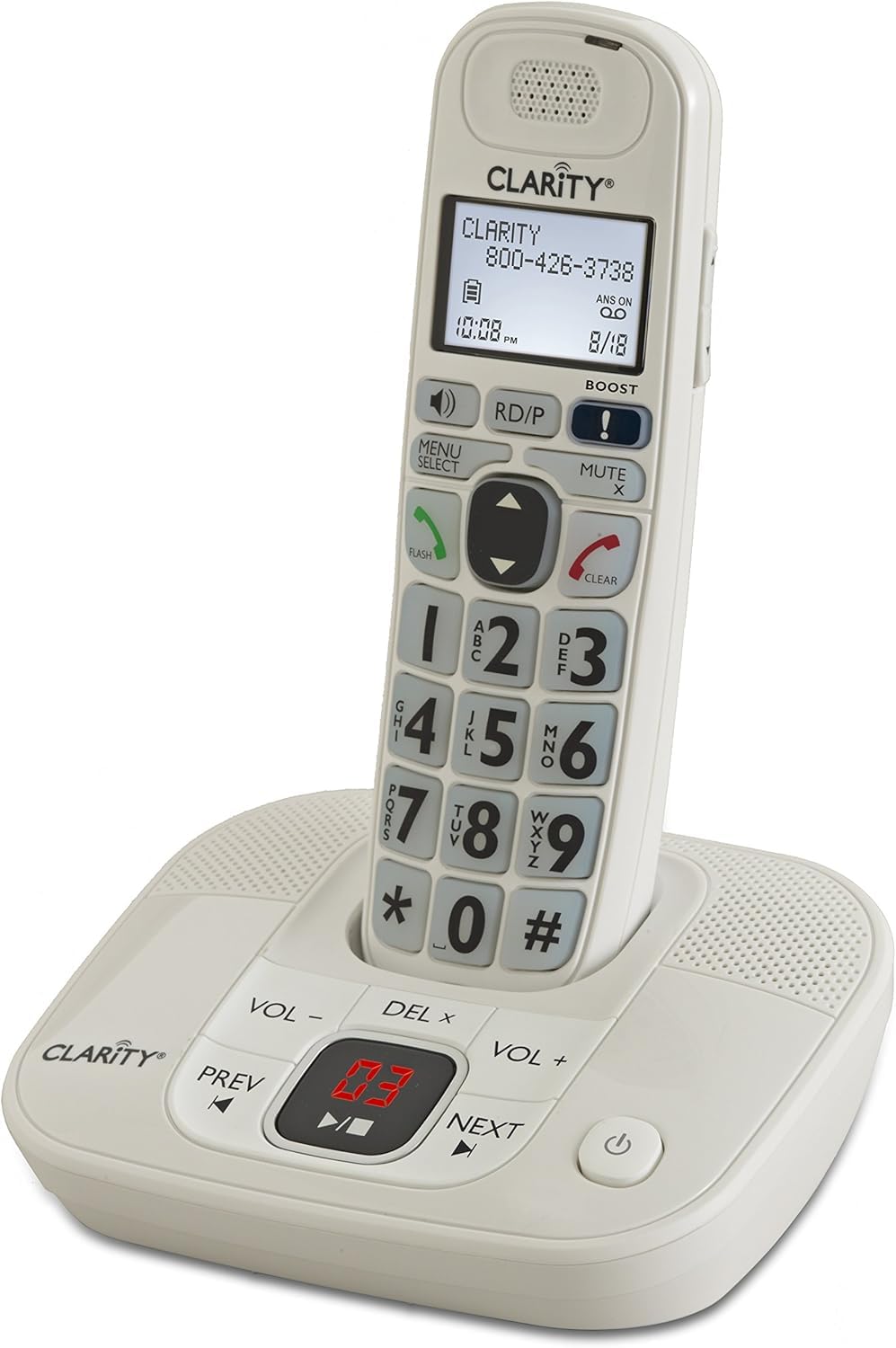
The Clarity D712 is purpose-built for seniors with both hearing and vision challenges. The handset features oversized white buttons with black numbering — the highest-contrast keypad in this comparison — and a large LCD display with bright backlighting. The 30dB boost is enough for moderate hearing loss without being overwhelming.
It includes a digital answering machine, T-coil compatibility for hearing aids, and an extra-loud speakerphone that works well in quiet environments. The bright LED visual ringer on the base flashes when a call comes in, and the “find” button helps locate a misplaced handset around the house.
The speed-dial system requires holding a numeric keypad for 3 to 5 seconds, which some users with arthritis or reduced hand dexterity find difficult. The boost feature also resets after each call, meaning the user must press the boost button every time they answer.
Why it’s great
- Oversized high-contrast buttons ideal for low vision
- T-coil compatible for clear hearing aid use
- 30% longer battery life compared to standard phones
Good to know
- Speed-dial activation is difficult for users with arthritis
- Boost resets each call — must be reactivated manually
6. AT&T BL102-2
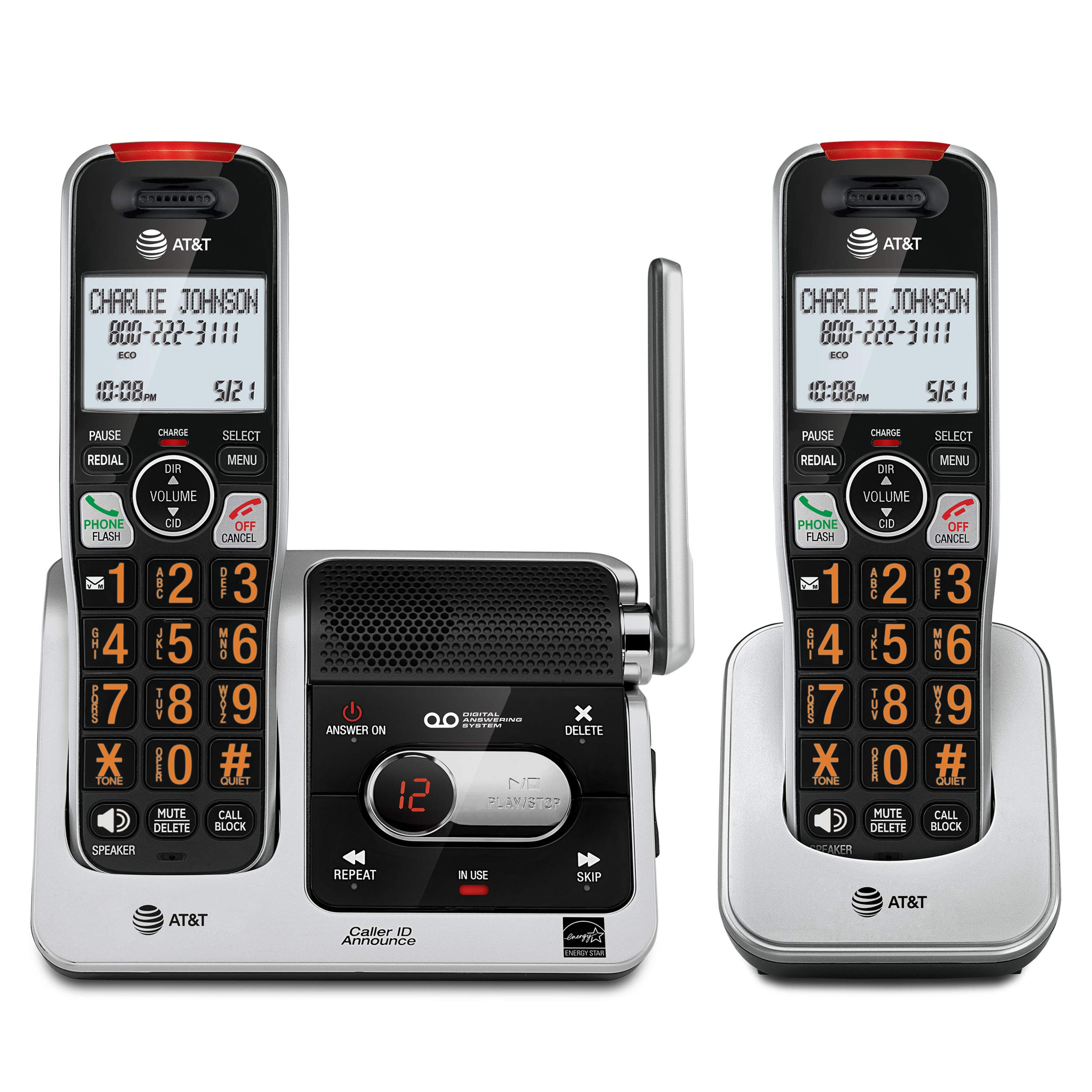
The AT&T BL102-2 is a strong mid-range option that focuses on call management and clarity. Its Audio Assist feature enhances sound quality and boosts incoming voice volume, making it a useful daily driver for those with mild to moderate hearing loss. The smart call blocker automatically stops robocalls before they ring, and the 1,000-number directory is one of the largest on this list.
It features a 2-inch high-contrast screen with enlarged font, a full-duplex speakerphone, and a 22-minute digital answering machine. The handset also announces the name of the caller, allowing you to decide whether to pick up without reading a screen.
The build quality leans toward lightweight plastic, which feels less solid than the Clarity or Panasonic options. The Audio Assist boost is not as powerful as dedicated amplified phones, so users with severe hearing loss will likely need a higher-output model.
Why it’s great
- Excellent robocall blocking — eliminates 98% of nuisance calls
- Audio Assist enhances clarity during conversations
- Large 2-inch screen with easy-to-read caller ID
Good to know
- Build uses lighter plastic compared to premium competitors
- Audio boost not strong enough for severe hearing loss
7. AT&T EL51203

The AT&T EL51203 is the most affordable two-handset system in this guide, offering a lighted keypad, full-duplex speakerphone, and DECT 6.0 clarity at a very accessible price point. The handsets feature an extra-large backlit display and illuminated buttons that make dialing easy in low light, making it a practical choice for users who prioritize visibility over audio power.
The intercom lets you page between handsets, which is useful for larger homes, and the ECO mode extends battery life by reducing transmission power when near the base. The call volume is clear and adequate for normal hearing, but there is no dedicated audio boost feature for hearing loss.
This phone lacks an answering machine and does not offer T-coil compatibility or specialized amplification. It works well as a secondary phone for a home with mixed hearing needs, but it is not a primary solution for someone with diagnosed hearing impairment.
Why it’s great
- Budget-friendly two-handset system for whole-home coverage
- Large backlit keys and display for easy use in the dark
- Full-duplex speakerphone on both handsets
Good to know
- No dedicated volume boost for hearing loss
- Does not include an answering machine
FAQ
How many decibels of boost do I need for severe hearing loss?
Can I use a cordless amplified phone with my hearing aids without interference?
What is the difference between a visual ringer and a loud ringer?
Final Thoughts: The Verdict
For most users, the best cordless phone for hard of hearing is the Panasonic KX-TGD892S because it pairs directly with Bluetooth hearing aids and earbuds, routing landline calls straight into the user’s ears without interference or feedback. If you need maximum raw volume for severe hearing loss, grab the VTech SN5127+SN5107. And for hearing aid users who want zero interference at a mid-range price, nothing beats the Panasonic KX-TGMA44B accessory handset.

Mo Maruf
I created WellFizz to bridge the gap between vague wellness advice and actionable solutions. My mission is simple: to decode the research and give you practical tools you can actually use.
Beyond the data, I am a passionate traveler. I believe that stepping away from the screen to explore new environments is essential for mental clarity and physical vitality.