Our readers keep the lights on and my smoothie glass nicely filled. As an Amazon Associate, I earn from qualifying purchases.
Specs are compiled from manufacturer listings and verified buyer reviews and can change over time — please confirm the key details on the product page before buying.
Painting cabinets is a fast way to refresh a kitchen, but dragging a hose around or wrestling with a roller on every door front is a waste of a weekend. A cordless paint sprayer for cabinets solves that — you move freely around the project, lay down an even coat without brush strokes, and finish the job in hours instead of days. The trick is picking a model that actually atomizes the paint fine enough for a smooth cabinet surface, not one that spits and leaves orange peel.
I’m Mohammad Maruf — the founder and writer behind WellFizz. This guide is built by comparing the manufacturers’ published specifications and the patterns across verified customer reviews, so you get each pick’s real strengths and trade-offs instead of marketing spin.
You need a sprayer that balances battery runtime, nozzle precision, and cleanup ease for cabinet-grade work. That is exactly what this breakdown of the top cordless paint sprayer for cabinets models covers — so you walk away knowing which one fits your next project.
Our Picks at a Glance

How To Choose The Best Cordless Paint Sprayer For Cabinets
Cabinet painting demands a finer finish than a fence or a wall. A sprayer that works great for exterior siding can leave a cabinet door looking rough. Here are the three specs that matter most when you are shopping for cabinet work.
Motor Type and Speed
A brushless motor runs cooler and lasts longer than a brushed one, and it usually spins faster. Higher RPM (revolutions per minute — how many times the motor spins in a minute) means the paint gets broken into finer droplets before it hits the surface — that translates to a smoother finish with less orange-peel texture (a bumpy look like the skin of an orange). For cabinets, look for motors that push past 30,000 RPM.
Nozzle Flexibility
Cabinet doors and drawers are flat, detailed surfaces. You want a sprayer that accepts multiple nozzle sizes — a smaller nozzle (around 1.0 mm to 1.5 mm) for thin stains or primers on fine woodwork, and a slightly larger one (1.8 mm or 2.0 mm) for thicker latex paints. Interchangeable nozzles let you switch between tasks without buying a second tool.
Battery System and Runtime
A full set of kitchen cabinets can take an hour or more of continuous spraying. A 20V battery with at least 2.0Ah (amp-hours — a measure of how much charge the battery holds) gives you a reasonable window, but having a second battery on hand (or a model that shares batteries with other tools) keeps you from running dry mid-door. Some sprayers list their runtime in minutes, others in square footage — compare those numbers to your project size.
Quick Comparison
| Model | Best For | Motor Speed | Tank Volume | Weight | Amazon |
|---|---|---|---|---|---|
| Wagner FLEXiO 3550★ Best Overall | Premium all-round finish | Variable speed (5 settings) | — | 9.09 lbs | Amazon |
| Graco Ultra Cordless AirlessPro Grade | Pro-grade cabinet work | Variable speed | — | — | Amazon |
| Bosch AdvancedSpray 18V-500 | Fine finish with German engineering | Variable via EasySelect | 500 ml | 2.4 lbs | Amazon |
| WORX Nitro WX020L | Versatile kit with battery included | Variable speed control | 1000 ml | — | Amazon |
| Tilswall Shark700 | High-speed brushless power | 90000 RPM | 1300 ml | — | Amazon |
| PULENDY DL05S | Budget kit with large container | — | 1400 ml | — | Amazon |
| Litheli 20V | Ultra-light entry-level sprayer | 36000 RPM | 1000 ml | 3.5 lbs | Amazon |
In‑Depth Reviews
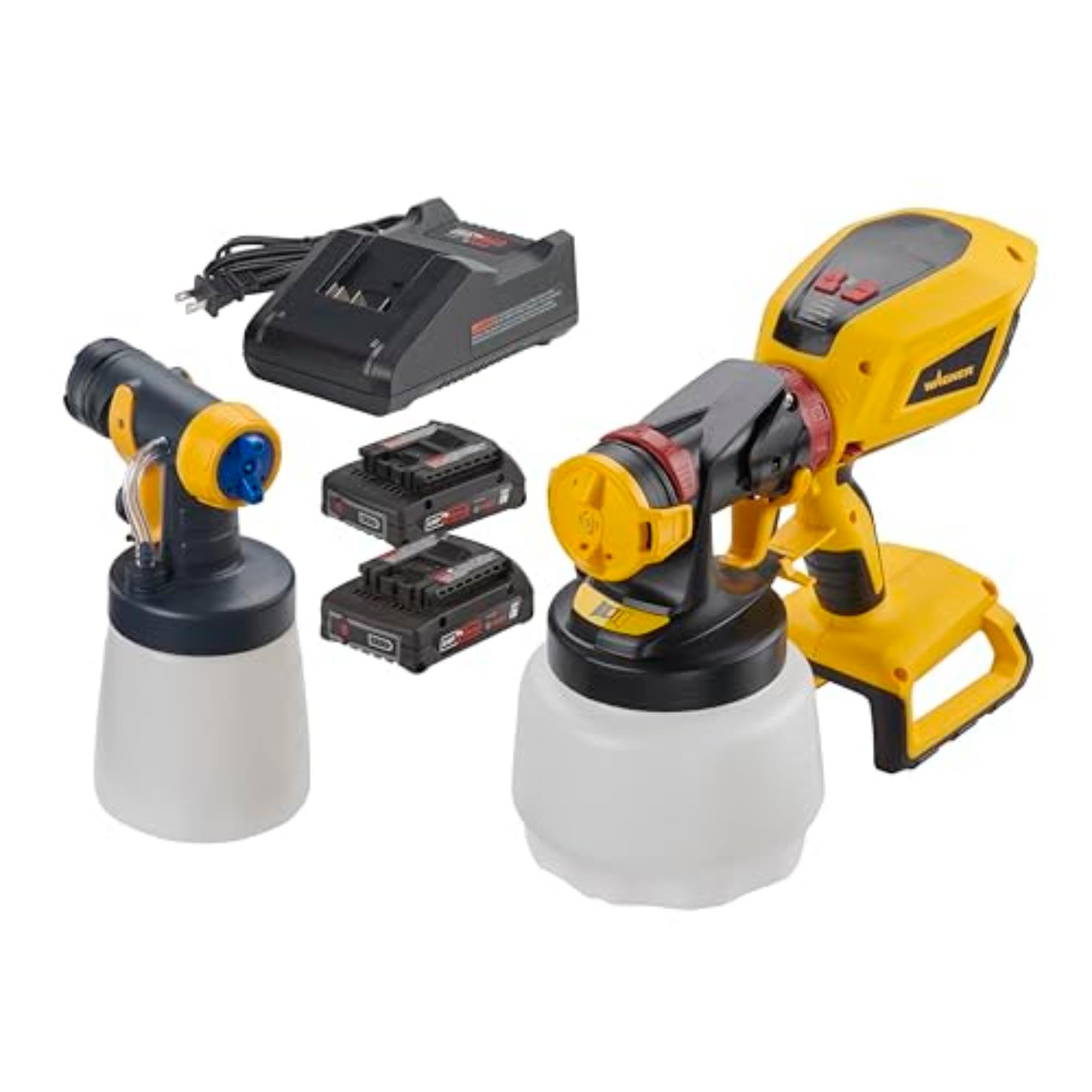
1. Wagner Spraytech FLEXiO 3550 18V Cordless Handheld HVLP Paint Sprayer
Our pick — over 4★ from 2,500+ verified ratings; the strongest balance of quality and price.
The only sprayer that ships with a dedicated fine-finish nozzle for cabinet doors right from the start.
Wagner designed this one for people who want a single tool that handles both a wall and a cabinet. The Detail Finish Nozzle focuses the spray pattern into a narrow, controlled mist that lays flat on cabinet fronts without blowing paint into the corners. You switch to the iSpray nozzle when you move to bigger surfaces like walls or siding.
The cordless freedom comes from two included 18V 2Ah lithium-ion batteries. Wagner says one charge gives you about 7 minutes of painting time (roughly 128 sq ft) or 20 minutes of staining (around 240 sq ft) — enough to clear a small set of kitchen cabinets on a single battery if you work efficiently. The five speed power settings let you dial back the flow for thin stains or crank it up for thick latex.
Buyers report that the finish quality on cabinets is noticeably better than with the company’s older corded models, and that the adjustable spray width (horizontal or vertical) helps match the grain direction of the wood. At 9.09 lbs, it is the heaviest pick here — you will want to keep a hand under the cup during longer sessions, but the two-battery system and the purpose-built nozzle make that tradeoff worth it for serious cabinet work.
Cabinet-Ready Design
- Dedicated Detail Finish Nozzle for fine work on doors and trim
- Two batteries included so you never stop mid-project
- Five speed settings let you match flow to paint thickness
The Weight Trade
- At 9.09 lbs, noticeably heavier than most competitors — fatiguing for one-handed overarm work
- Bulky profile makes it harder to reach into tight cabinet interiors
Why this over others: It is the most complete package for first-time cabinet sprayers — the dedicated nozzle and two batteries mean you do not buy anything extra. A pro skipping it for the Graco gets a commercial-grade airless pump, but the Graco costs substantially more and does not include a battery system.
2. Graco Ultra Cordless Airless Handheld Paint Sprayer 17M363
The airless pump that sprays unthinned paint directly onto cabinets with zero setup fuss.
Graco builds professional finishing tools, and the Ultra Cordless is their handheld entry that does not compromise on pump power. It uses a Triax Triple Piston Pump with ProConnect — that is a three-piston system that pushes paint straight from the cup to the tip at pressures up to 2000 PSI (pounds per square inch, a measure of force). The big advantage for cabinets: you do not need to thin the paint. Most HVLP (High Volume Low Pressure) sprayers force you to add water or solvent so the paint flows. The Graco airless design handles full-viscosity latex as-is, saving prep time and keeping the color consistent.
The sprayer runs on the DEWALT XR Lithium Ion battery platform, so if you already own DEWALT 20V tools, you share batteries across the lineup. It uses RAC X FFLP Spray Tips, which are the same tips pros use on Graco’s big rigs — you get a fine finish tip for cabinets and trim. Owners mention that the finish rivals a professional spray booth, with zero orange peel when you use the correct tip size.
The catch is the investment and the learning curve. This is the most expensive handheld cordless sprayer on the market, and airless spraying requires a different technique than HVLP — you need to move faster and keep a consistent distance. But for a cabinet refinisher or a serious DIYer who wants the best possible factory-like finish without thinning, the Graco is the benchmark.
Pro-Grade Finish
- Sprays unthinned latex — no mixing, no viscosity cup, just pour and spray
- Triax piston pump matches the reliability of Graco’s full-size rigs
- Fully repairable; individual parts available if anything wears out
The Upfront Cost
- Premium price that only makes sense for serious cabinet work or repeated use
- Airless technique takes practice — first-time users may get runs before they find the right speed
Best for: the experienced finisher who paints cabinets regularly and wants the durability and finish quality of a commercial sprayer in a cordless handheld format. A weekend DIYer painting a single kitchen will likely find the learning curve and cost hard to justify — the Wagner delivers a very good finish with a much simpler technique.
3. Bosch AdvancedSpray 18V-500 Cordless Paint Gun

The two-air-cap system that tunes the spray from a fine finish to fast coverage with one switch.
Bosch sends this sprayer with two different air caps (the part at the front that shapes the spray pattern). One is tune for a “super finish” — that is the cap you use on cabinet doors and trim where every droplet matters. The other cap pushes higher volume for faster work on larger flat surfaces. Switching between them changes the spray performance without you having to mess with flow settings or guesswork.
The EasySelect function on the body gives you intuitive control over paint flow and air volume — Bosch designed the dial so you feel the click between settings rather than staring at numbers. It sprays lacquers, varnishes, and latex paints up to about 3m² per minute, which translates well for cabinet face frames and door fronts. The included 4Ah battery and charger mean you have a full power system in the box, and the 500 ml buckets (two included) are easy to refill without spilling.
At only 2.4 lbs (the weight of the gun itself), it is far lighter than the Wagner. Buyers mention that the compact body makes it easy to hold steady along a cabinet door edge without arm fatigue. The trade-off is a smaller container — 500 ml versus the 1000 ml or 1400 ml options elsewhere — meaning more frequent refills on a full kitchen run. For the quality of finish you get on cabinets, most owners say the extra refill stops are worth the trade.
Cabinet-Quality Control
- Dedicated fine-spray air cap delivers a smooth, even coat on wood surfaces
- Ultra-light at 2.4 lbs — easy to hold steady for long cabinet runs
- Powerful carbon-free motor runs through a full charge with consistent output
Smaller Cup
- 500 ml container means you refill every few doors on a large kitchen project
- Paint cup design can be tricky to clean if paint dries in the threads
Grab it for: lacquers, varnishes, and thin paints on detailed cabinet work where you want the finest possible finish without fighting a heavy tool. Skip it for thick latex on large cabinet sets — the small cup and lower motor speed compared to the Tilswall make it slower, so the WORX or Tilswall will finish faster, though with a slightly less refined spray.
4. WORX Nitro 20V Cordless Paint Sprayer WX020L
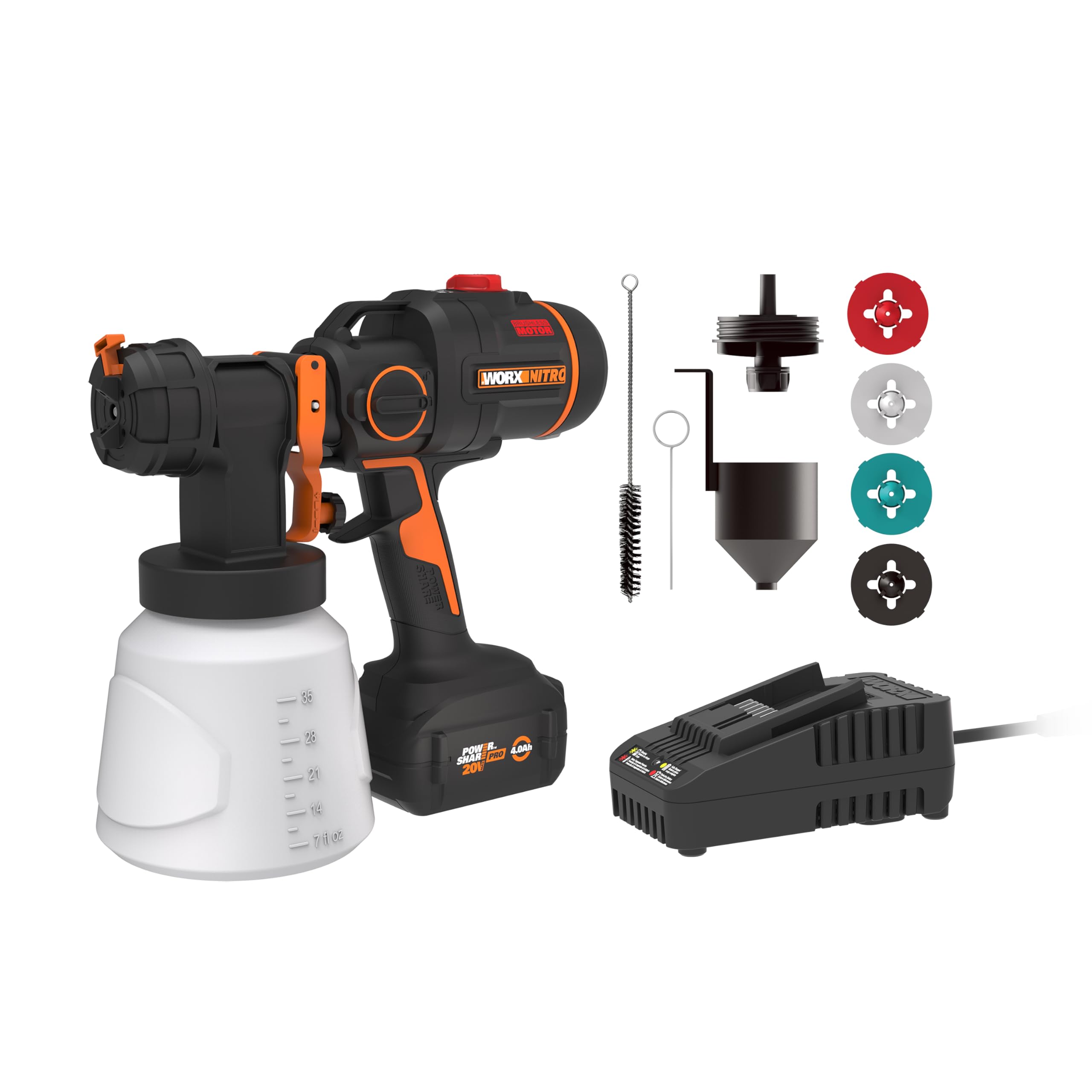
A complete kit with four nozzle sizes and a 4.0Ah battery that shares power with 75+ other WORX tools.
WORX built the Nitro line to compete head-on with premium brands, and the WX020L shows that ambition. The sprayer comes with four nozzles — 1.5mm, 1.8mm, 2.2mm, and 2.6mm — covering everything from thin stain on cabinet doors to thick latex on walls. The 1.5mm and 1.8mm nozzles are your go-tos for cabinets, giving you a fine mist that lays smooth without pitting.
The 1000 ml container is a balance for cabinet work — large enough to spray several doors before refilling, but not so huge that the sprayer feels front-heavy. The speed control dial lets you adjust the paint flow evenly, which helps minimize overspray (the mist that drifts past your workpiece and settles on the floor). Customers note that the included garden hose adapter for cleaning is a genuine time-saver — you connect a standard hose, run water through the system, and the sprayer flushes clean in under a minute.
Unlike the Wagner, the WORX does not include a dedicated fine-finish nozzle in the same sense — you rely on the smallest included tip. The 4.0Ah battery gives longer runtime than the Wagner’s two 2.0Ah batteries combined, and since it belongs to the Power Share ecosystem, you can use it across WORX lawn and garden tools too.
Complete Kit Philosophy
- Four nozzle sizes give you fine control from cabinet stain to house latex
- Garden-hose hookup makes cleanup fast — no disassembling every part
- Battery and charger included; share power with the whole WORX lineup
Finish Finesse
- Lacks a purpose-built fine-finish nozzle like the Wagner — you rely on the smallest generic tip
- Motor does not reach the high RPM of brushless competitors, so thick paint requires more thinning
Best value for: the DIYer who wants a single affordable kit that paints cabinets and everything else around the house, with a battery system that grows into other tools. Not ideal if you are exclusively painting cabinets and want the most precise fine-finish nozzle — the Wagner or Bosch has a dedicated edge that the WORX cannot match with its standard tips.
5. Tilswall Brushless Cordless Paint Sprayer Shark700
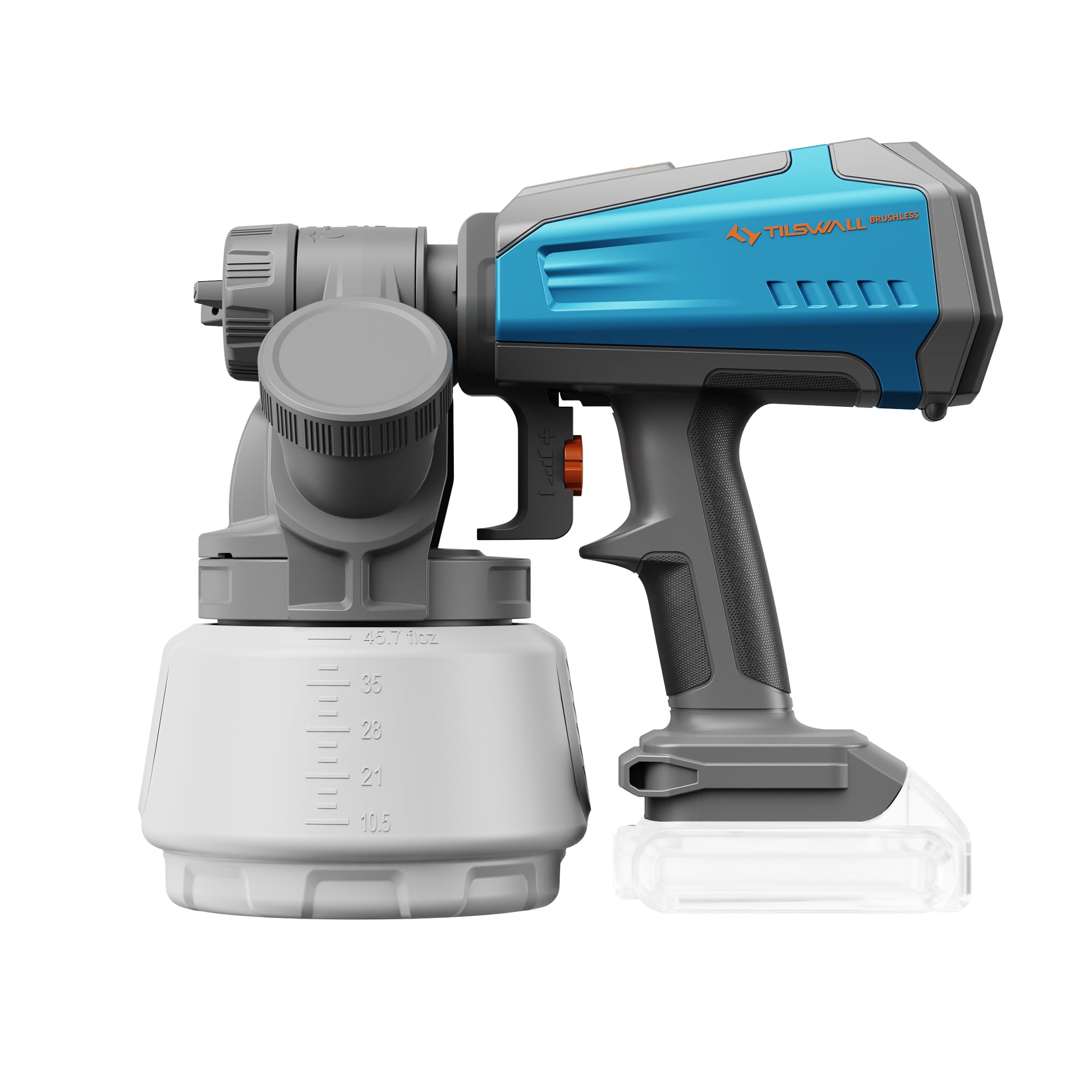
The brushless motor screaming at 90000 RPM — versus the Litheli’s 36000 RPM — for a mist so fine it barely lands on the surface.
Tilswall’s Shark700 runs a brushless motor that hits 90000 RPM, which is drastically higher than the 36000 RPM you get from the Litheli. That RPM gives you exceptionally fine atomization — the paint breaks into tiny droplets that dry evenly on cabinet doors without drips or heavy buildup. It is the kind of finish you expect from a professional HVLP turbine, but in a cordless body that runs on compatible DEWALT 20V batteries (not included).
The 1300 ml tank volume is 1300 ml versus the WORX’s 1000 ml, so you spray more doors between refills. The side-fill system is the standout practical feature — you pour new paint in from the side without unscrewing the whole container. That means less mess and faster turnaround when you switch colors or run low mid-door. The variable flow control goes from 0 to 900 ml/min, giving you fine control on detailed cabinet face frames.
Reviewers point out that the start-up delay (a built-in safety feature) takes a moment to get used to — you pull the trigger halfway for two seconds before the motor engages fully. The company advises thinning paint to the right viscosity using the included cup, and cleaning within 15 minutes of use to prevent clogs. For the price, the motor performance and container capacity punch well above the budget tier.
Motor Muscle
- 90000 RPM brushless motor delivers the finest atomization in this price range
- Side-fill design lets you add paint mid-job without making a mess
- Huge 1300 ml container reduces refill stops compared to the WORX and Bosch
Battery Not Included
- No battery in the box — you need a compatible DEWALT 20V battery to use it
- Protective start-up delay can frustrate new users who expect instant spraying
Pick this if: you already own DEWALT 20V batteries and want the most powerful brushless motor for ultrafine cabinet finishes without paying for a complete battery system. Avoid it if you do not own DEWALT batteries and do not want to buy them separately — the total cost with a battery edges close to the Bosch.
6. PULENDY Cordless Paint Sprayer DL05S
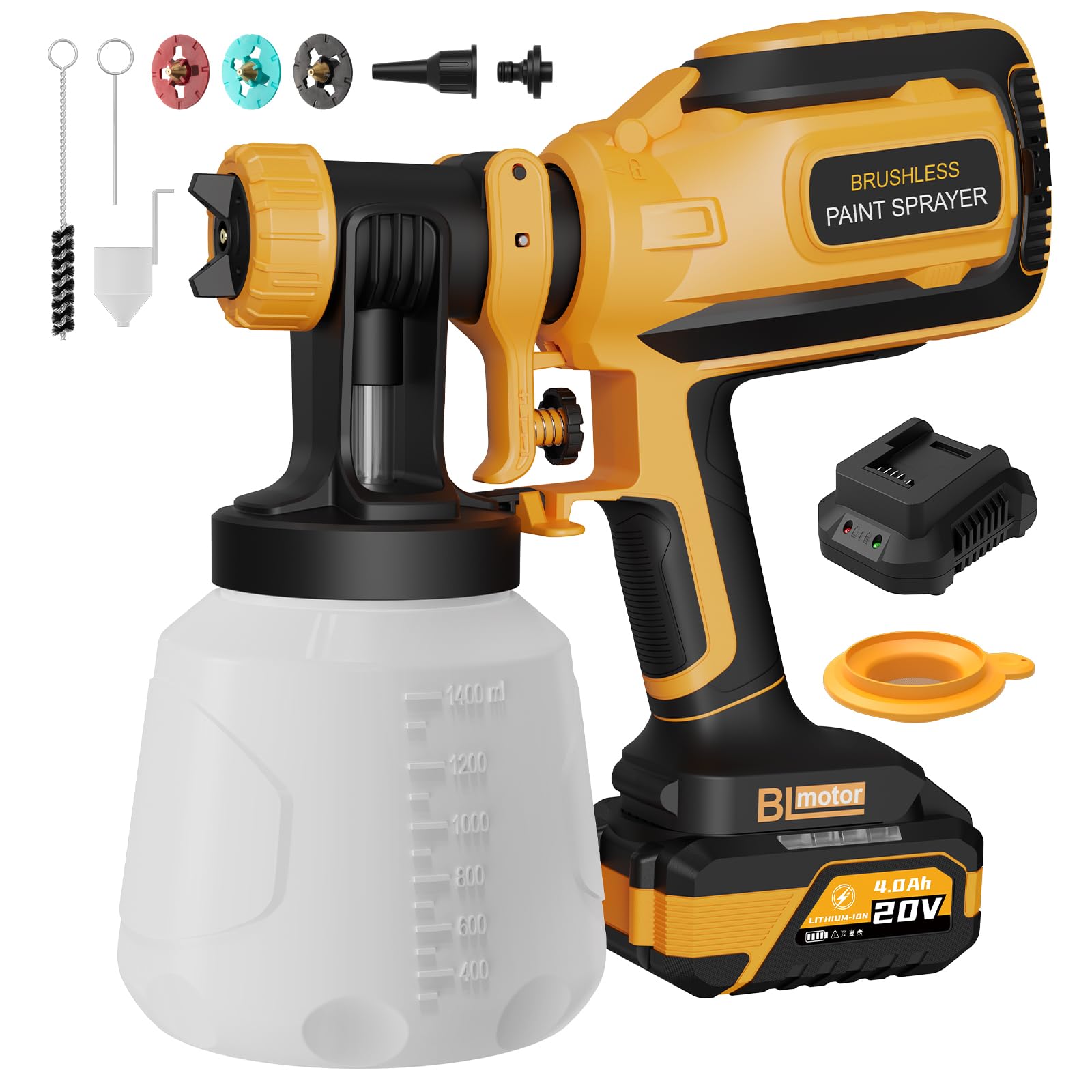
The largest container in the group at 1400 ml and three brass nozzles that handle cabinet primers and topcoats alike.
For a full kitchen cabinet run, that means fewer trips to the paint tray and more continuous spraying. The three brass nozzles (1.0 mm, 1.5 mm, and 2.0 mm) give you the range you need: the 1.0 mm for thin stains and primers on detailed cabinet trim, the 1.5 mm for standard latex topcoats on flat door panels, and the 2.0 mm if you push through thicker paints.
The brushless motor keeps the spray consistent, and shoppers say that the included 20V 4.0Ah battery and charger run long enough for a full cabinet set on one charge. Low-voltage and overload protection circuits add safety, which matters when you are spraying for extended periods. The cleaning kit and detachable container make post-project cleanup straightforward — you remove the cup, rinse the nozzles, and flush the gun.
The trade-off at this price point is build quality. The PULENDY uses a plastic body that does not feel as solid as the Wagner or Graco, and the trigger action is not as smooth as more expensive units. It is a capable entry-level sprayer for a single kitchen project, but frequent users may find the components wear faster than a premium model.
Capacity King
- 1400 ml container is the largest here — spray more doors between refills
- Three brass nozzles cover stains, primers, and thick latex with interchangeable tips
- Complete kit with battery, charger, and cleaning tools included
Build Compromise
- Plastic construction feels less durable than the Wagner or Graco
- Trigger response is not as precise, making it harder to dial in a perfect spray pattern
Good for: a single cabinet project where you want the largest paint capacity and a full accessory kit at the lowest entry price. Not for a pro or a frequent user who needs a tool that survives years of regular cabinet work — the plastic build has a shorter lifespan.
7. Litheli 20V Cordless Paint Sprayer
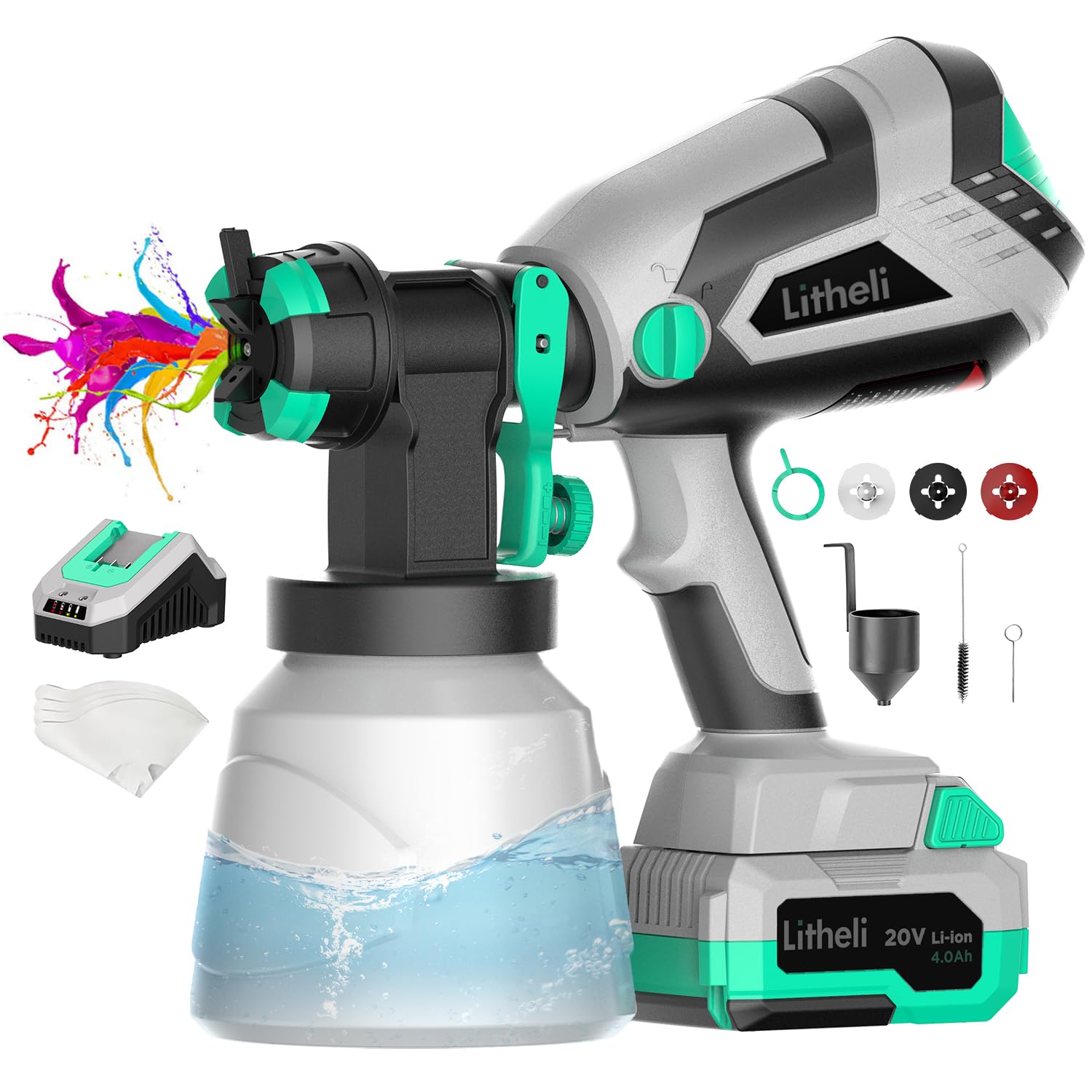
At 3.5 lbs it is slightly heavier than the Bosch (2.4 lbs) but at a fraction of the price — and it includes a battery.
The Litheli weighs 3.5 lbs — slightly heavier than the Bosch at 2.4 lbs — but costs far less and comes with a 4.0Ah battery and charger in the box. The 200W pure copper motor spins at 36000 RPM, which is enough for thinning paints and stains on cabinet doors, though it falls short of the Tilswall’s 90000 RPM for ultrafine atomization. You get three spray patterns (horizontal, vertical, circular) and three nozzles (1.5mm, 1.8mm, 2.2mm) to adjust for different paint viscosities.
The 1000 ml container is standard for this price tier, and the stepless flow control knob lets you dial back output to 760 ml/min on detailed work so you do not waste material. Buyers highlight how easy the quick-disassemble structure makes cleaning — you pop the front end apart, rinse the parts, and reassemble without tools. The ergonomic grip is comfortable for one-handed operation, and the light weight means less fatigue holding it at cabinet-door height for extended periods.
The catch is that the 36000 RPM motor is noticeably less powerful for thick latex. You will need to thin cabinet paint more aggressively than with the Tilswall or Wagner to avoid clogging. The build quality is in line with the price — it works great for a few projects, but the plastic components and copper motor (rather than brushless) may not last as long under heavy use.
Lightweight Winner
- Ultra-light at 3.5 lbs — easy to control on cabinet doors for hours
- Full kit with battery and charger at a budget-friendly entry point
- Quick-disassemble design and included cleaning kit simplify maintenance
Motor Limits
- 36000 RPM motor needs paint thinned more than higher-RPM alternatives
- Copper motor not brushless — shorter lifespan compared to the Tilswall or Bosch
Reach for it if: you are a first-time sprayer who wants a very lightweight, complete kit to paint one kitchen on a tight budget. Look elsewhere if you expect to spray thick latex regularly or want a motor that lasts through years of projects — the Tilswall or Bosch gives better longevity.
Understanding the Specs
Motor Speed (RPM)
Revolutions per minute tells you how fast the motor spins the internal fan or turbine that breaks the paint into droplets. Higher RPM — like the Tilswall’s 90000 RPM — produces finer atomization, which means the paint lands as a smooth mist on cabinet doors rather than a bumpy orange-peel texture (a bumpy look like the skin of an orange). Lower RPM sprayers (around 36000 RPM) still work, but you will need to thin the paint more to get a similar finish.
Tank Volume
Measured in milliliters, this is how much paint the container holds before you need to stop and refill. A 500 ml tank (like the Bosch) is fine for a few cabinet doors but forces frequent stops on a full kitchen. A 1400 ml tank (like the PULENDY) lets you spray continuously through most of a cabinet set. More capacity means fewer interruptions but a heavier front end — balance that against the size of your typical project.
Nozzle Size
Nozzle openings are measured in millimeters, and they control the spray pattern width and paint droplet size. A 1.0 mm or 1.5 mm nozzle is ideal for thin stains, primers, and fine detail work on cabinet trim. A 2.0 mm or larger nozzle handles thicker latex paints. Having multiple interchangeable nozzles in the kit means you can switch between materials without buying separate tips.
HVLP vs Airless
HVLP (High Volume Low Pressure) uses a fast-moving air stream to break paint into droplets and push it onto the surface. It wastes less paint through overspray (the mist that drifts past your workpiece and settles on the floor) and works well for detailed work, but you generally need to thin the paint. Airless sprayers (like the Graco) use a piston pump to push paint straight through the tip at high pressure — they handle unthinned paint but produce more overspray and require a steadier technique.
FAQ
What nozzle size should I use for painting cabinets?
Do I need to thin paint for a cordless HVLP sprayer?
How long does a 20V battery last when spraying cabinets?
Can I spray latex paint on cabinets with a cordless sprayer?
How do I clean a cordless paint sprayer after painting cabinets?
Is a brushless motor worth the extra cost for a cabinet sprayer?
What is the difference between HVLP and airless for cabinets?
Can I share batteries between different cordless sprayer brands?
Final Thoughts: The Verdict
For most homeowners, the cordless paint sprayer for cabinets winner is the Wagner FLEXiO 3550 because its dedicated Detail Finish Nozzle and two-battery system give you cabinet-ready quality without buying extras. If you want the finest possible motor speed and already own DEWALT batteries, the Tilswall Shark700 with its 90000 RPM brushless motor is the performance pick. And for a pro-grade finish that sprays unthinned paint straight onto cabinet doors, the standout is the Graco Ultra Cordless Airless — provided the premium price fits your project.
How We Picked
We do not accept paid placement. Every pick is matched to a real buyer and a real use-case; we do not hands-on test units.
Sources & Methodology
Specifications: manufacturer listings and product documentation. Review insights: verified customer reviews, as of July 2026. Pricing: not shown on this page (it changes often); check the current price via the retailer link.
As an Amazon Associate, WellFizz earns from qualifying purchases. This does not affect which products we feature.
Related Guides

Mo Maruf
I created WellFizz to bridge the gap between vague wellness advice and actionable solutions. My mission is simple: to decode the research and give you practical tools you can actually use.
Beyond the data, I am a passionate traveler. I believe that stepping away from the screen to explore new environments is essential for mental clarity and physical vitality.