Our readers keep the lights on and my smoothie glass nicely filled. As an Amazon Associate, I earn from qualifying purchases.
Finding a cordless microphone that delivers clear, reliable audio without dropouts or that hollow, tinny quality can feel like a gamble. Many models promise freedom from cables but deliver static, short battery life, or complicated pairing that kills the mood right before a performance or a critical recording session. The market is flooded with options, but only a select few solve the real-world frustrations of feedback, interference, and range limitations.
I’m Mohammad Maruf — the founder and writer behind WellFizz. My approach to this guide involved cross-referencing technical specifications like frequency response, battery capacity, and transmission method against verified buyer experiences to separate the truly functional wireless microphones from the ones that just look good on paper.
Whether you need a reliable system for a wedding toast, a hands-free lavalier for content creation, or a rugged wireless setup for regular stage use, this analysis of the best cordless microphones will help you pick the right tool for your specific audio demands.
How To Choose The Best Cordless Microphones
Selecting a cordless microphone system comes down to understanding your primary use case. A handheld system for karaoke has very different requirements than a clip-on lavalier for a YouTube video or a headset for a live theatrical performance. Focusing on the transmission method, power source, and physical form factor will narrow your options considerably.
Transmission Frequency: UHF vs 2.4GHz vs Bluetooth
UHF systems operate on dedicated radio frequencies (typically 500-900 MHz) and are the standard for professional live sound because they cut through interference from Wi-Fi routers and Bluetooth devices. Systems like the Phenyx Pro PTU-71 use a 500 MHz band to avoid congestion. 2.4GHz systems, found in products like the ECHOMUSSY karaoke set, are more common in consumer gear and are perfectly fine for home use, but they can experience latency and dropouts in environments with lots of wireless networks.
Battery System: Rechargeable vs AA
Built-in rechargeable batteries (often lithium-ion, USB-C charged) are convenient for daily use and reduce ongoing costs — the BOYA BY-V2 offers 9 hours while the ECHOMUSSY boasts 40 hours. However, AA-powered systems like the top-tier Phenyx Pro PTU-71 allow you to swap in fresh batteries instantly during a long event, eliminating downtime. If you run a venue or church, AA reliability might outweigh the convenience of internal batteries.
Form Factor and Microphone Capsule Quality
Handheld dynamic microphones are best for singing because they handle high sound pressure levels and reject feedback. Lavalier and headset mics, like those in the DJI Mic Mini or RØDE Wireless Micro, are optimized for clean speech pickup and need to stay out of the frame. The capsule type matters — a cardioid polar pattern is essential for a handheld vocal mic, while an omnidirectional pattern makes sense for a stationary lapel mic that might shift around.
Quick Comparison
On smaller screens, swipe sideways to see the full table.
| Model | Category | Best For | Key Spec | Amazon |
|---|---|---|---|---|
| Phenyx Pro PTU-71-1H1B | Professional UHF | Churches & Live Stages | 328ft Range, 16 hrs (AA) | Amazon |
| RØDE Wireless Micro | Smartphone Creator | Content Creation & Vlogs | 18 hrs (Case), 2 TX + RX | Amazon |
| DJI Mic Mini | Ultra-Compact Lavalier | Interviews & Livestreaming | 300m Range, 11.5 hrs | Amazon |
| Phenyx Pro PDP-1-1B | Single Channel Digital | Solo Performers & Karaoke | 15 UHF Channels, 200ft | Amazon |
| HWWR U30 | Dual Handheld Set | Home Karaoke & Parties | 50M Range, 12 hrs | Amazon |
| ECHOMUSSY YA-01 | Family Karaoke | Casual Singing & Speech | 40 hrs Battery, 200ft | Amazon |
| BOYA BY-V2 | Lightning Lavalier | iPhone Video Recording | 9 hrs, Lightning Connector | Amazon |
In‑Depth Reviews
1. Phenyx Pro PTU-71-1H1B

This is the system you buy when you need professional reliability without pro prices. The metal receiver packs dual UHF channels operating in the 530-580 MHz range, which avoids the heavy Wi-Fi congestion found in higher frequencies, and the Auto Scan feature locks onto the clearest channel in seconds. In tests with up to eight simultaneous units, interference and dropouts were virtually nonexistent, making this a top choice for small churches and event spaces.
The package includes a dynamic handheld with a cardioid capsule that feels weighty and balanced, plus a bodypack that works with both the included headset and lavalier mics. The handheld microphone intentionally mimics the ergonomics of a Shure SM58, with a recessed mute button that prevents accidental cuts mid-performance. On battery life, four AA batteries provide up to 16 hours of continuous use, which encourages venues to keep a spare set on hand rather than scheduling recharge breaks.
The bodypack transmitter is the noticeable weak point — its plastic chassis feels less durable than the metal handheld, and some users reported the battery door feels flimsy. The headset mic also requires some EQ work to sound full, though the lavalier performs well for speech. Still, for a dual-channel metal-receiver system at this tier, the PTU-71 delivers exceptional range and audio clarity for demanding live environments.
Why it’s great
- Sturdy metal receiver and handheld body
- UHF 500MHz band avoids wireless interference
- Auto Scan and 200 selectable frequencies
- Includes headset, lavalier, and handheld in one box
Good to know
- AA batteries require continuous replacement
- Bodypack clip and battery door feel fragile
- Headset mic needs EQ adjustment for optimal tone
2. RØDE Wireless Micro
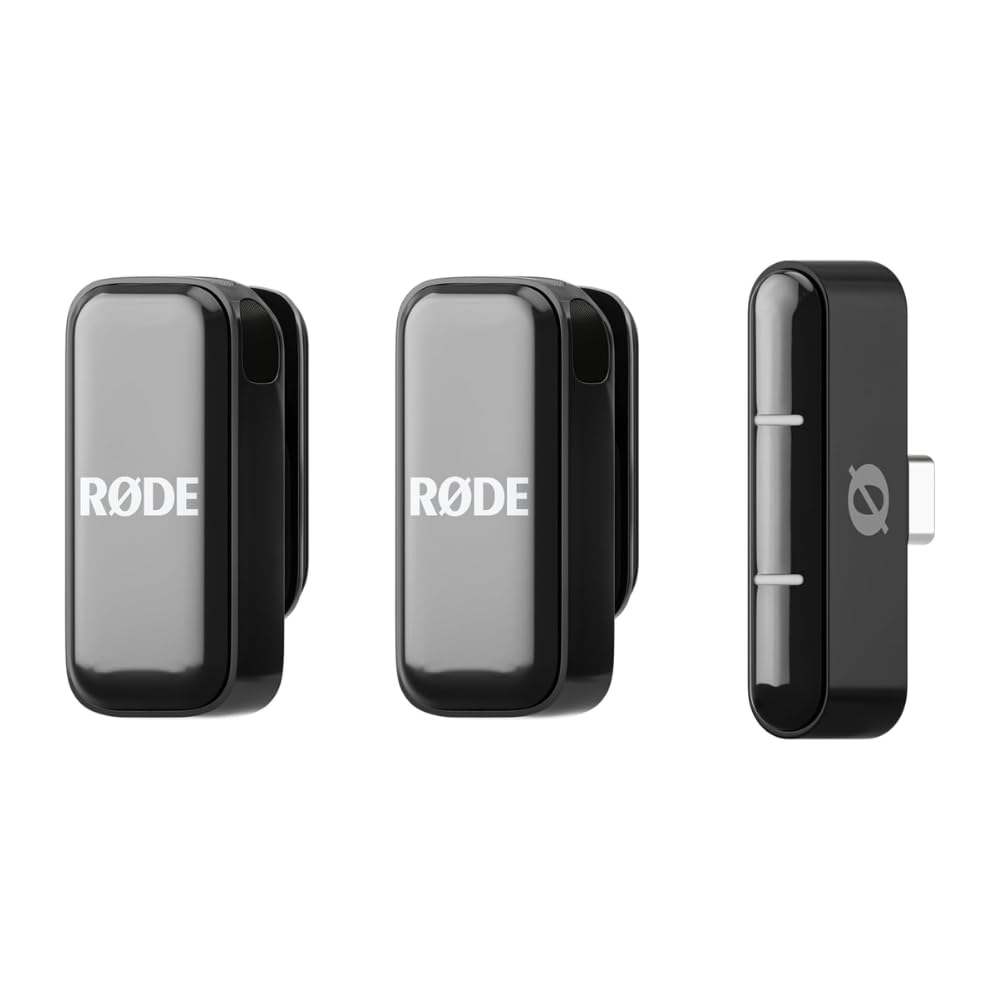
RØDE has designed a system that prioritizes simplicity without sacrificing audio fidelity. The receiver plugs directly into a USB-C smartphone with no dongles or breakout cables, and the two transmitters pair automatically the moment they are powered on. The included charging case provides two additional full charges, extending total runtime to 18 hours — enough for a full day of on-location capture without hunting for a power outlet.
The built-in microphones capture a surprising amount of low-end fullness for a device this small, but the real star is the intelligent GainAssist technology. It automatically adjusts the input levels to prevent the clipped, distorted audio that ruins many budget wireless recordings. In noisy environments like a busy street, the audio remains clear and usable, and the furry windscreens effectively eliminate wind rumble during outdoor shoots without muffling the high frequencies.
One physical limitation surfaced repeatedly in user feedback: the USB-C connector on the receiver sits flush against the phone, which means thick protective cases will prevent a proper connection. You will likely need a short USB-C extension cable. Also, while the magnetic attachment is convenient, the transmitters themselves are lightweight plastic and lack the premium feel some creators expect at this level. For a grab-and-go system that delivers clean, broadcast-ready audio, this is hard to beat.
Why it’s great
- True plug-and-play with USB-C phones
- Excellent automatic GainAssist audio leveling
- Included charging case extends runtime significantly
- Small and discreet on-camera footprint
Good to know
- USB-C plug incompatible with thick phone cases
- No standard microphone input on transmitters
- Plastic build feels less durable than alternatives
3. DJI Mic Mini
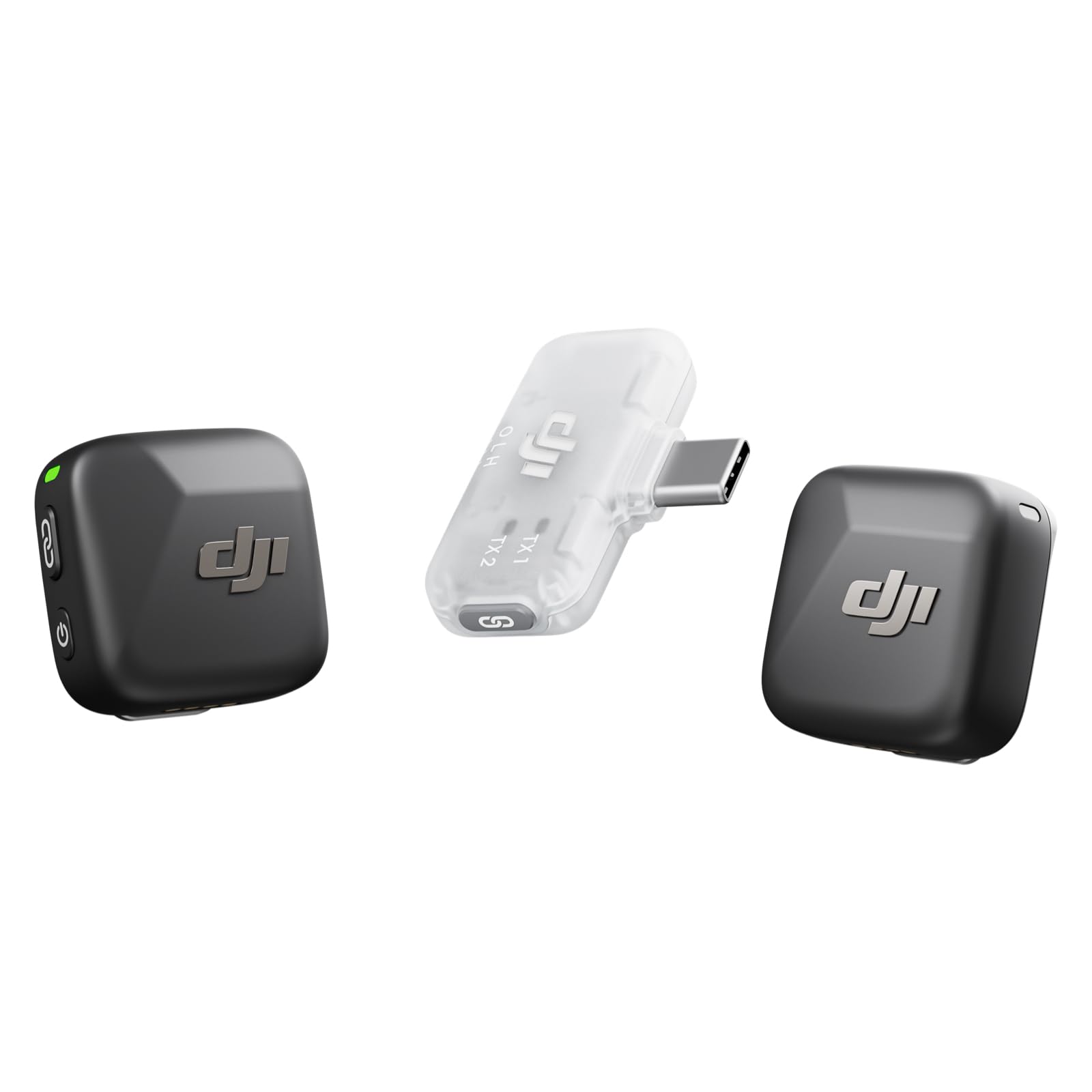
The DJI Mic Mini is engineered for creators who prioritize an invisible audio setup. Each transmitter weighs just 10 grams and can attach via clip or the included magnetic backing, making them unobtrusive on a lapel or collar. The 300-meter maximum transmission range is exceptional for a 2.4GHz system, allowing stable audio capture even across large outdoor venues or during active, wide-shot interviews.
Audio quality is detailed and natural, benefiting from two levels of noise cancellation. The “Basic” mode works well for indoor settings, while the “Strong” mode aggressively filters out constant environmental noise like traffic or HVAC hum without making the voice sound artificial. Automatic limiting prevents clipping when the speaker gets louder, a feature that reliably protects your track from distortion in unpredictable recording conditions.
The most significant advantage is the direct OsmoAudio integration with DJI cameras, eliminating the need for a receiver entirely. However, for non-DJI users, the system remains fully functional via the USB-C receiver. The main trade-off is the lack of a charging case — the transmitters charge via a dedicated dock that is less portable than a case solution. If you already own a DJI camera ecosystem, this is the most seamless audio upgrade available.
Why it’s great
- Extremely light (10g) and discreet design
- Outstanding 300-meter line-of-sight range
- Excellent noise cancellation with two modes
- Direct connection to DJI OsmoAction/Pocket cameras
Good to know
- No dedicated charging case for the whole system
- Limited to 2.4GHz, subject to Wi-Fi congestion
- Requires separate receiver for non-DJI devices
4. Phenyx Pro PDP-1-1B

The PDP-1-1B is a single-channel UHF system built around a compact plug-in receiver that connects directly to a mixer, powered speaker, or amplifier via a 6.35mm jack. The bodypack transmitter connects to either the included headset or lavalier microphone using a 3-pin mini XLR connector, which locks securely for rigorous movement. The digital 48kHz/24Bit circuitry delivers delay-free, encrypted audio that avoids the crosstalk issues common in analog budget systems.
What sets this system apart at its tier is the 15 selectable UHF frequencies in the 902-928 MHz band, giving you room to navigate around interference in venues with multiple wireless systems. Both the receiver and bodypack charge via USB-C, which is a welcome upgrade over proprietary connectors. Battery life is solid — the 1500mAh receiver and 550mAh transmitter can easily cover a multi-set performance, and the dual USB-C cable charges both units simultaneously.
User feedback highlights the quality of the headset mic, which remains secure during active singing and delivers clear audio with minimal wind noise. The lavalier, however, received mixed marks for inconsistent output levels and a tendency toward feedback at higher volumes. The instruction booklet is famously tiny and hard to read. If you need a single-channel UHF system for a solo performer who wants hands-free operation, this is a well-specced option.
Why it’s great
- USB-C charging on both receiver and transmitter
- 15 UHF tunable frequencies for interference management
- Secure mini XLR connector for headset/lavalier
- Digital 48kHz/24Bit audio with minimal latency
Good to know
- Lavalier microphone quality is inconsistent
- Instruction booklet is very difficult to read
- Buttons for power, mute, and channel are close together
5. HWWR U30
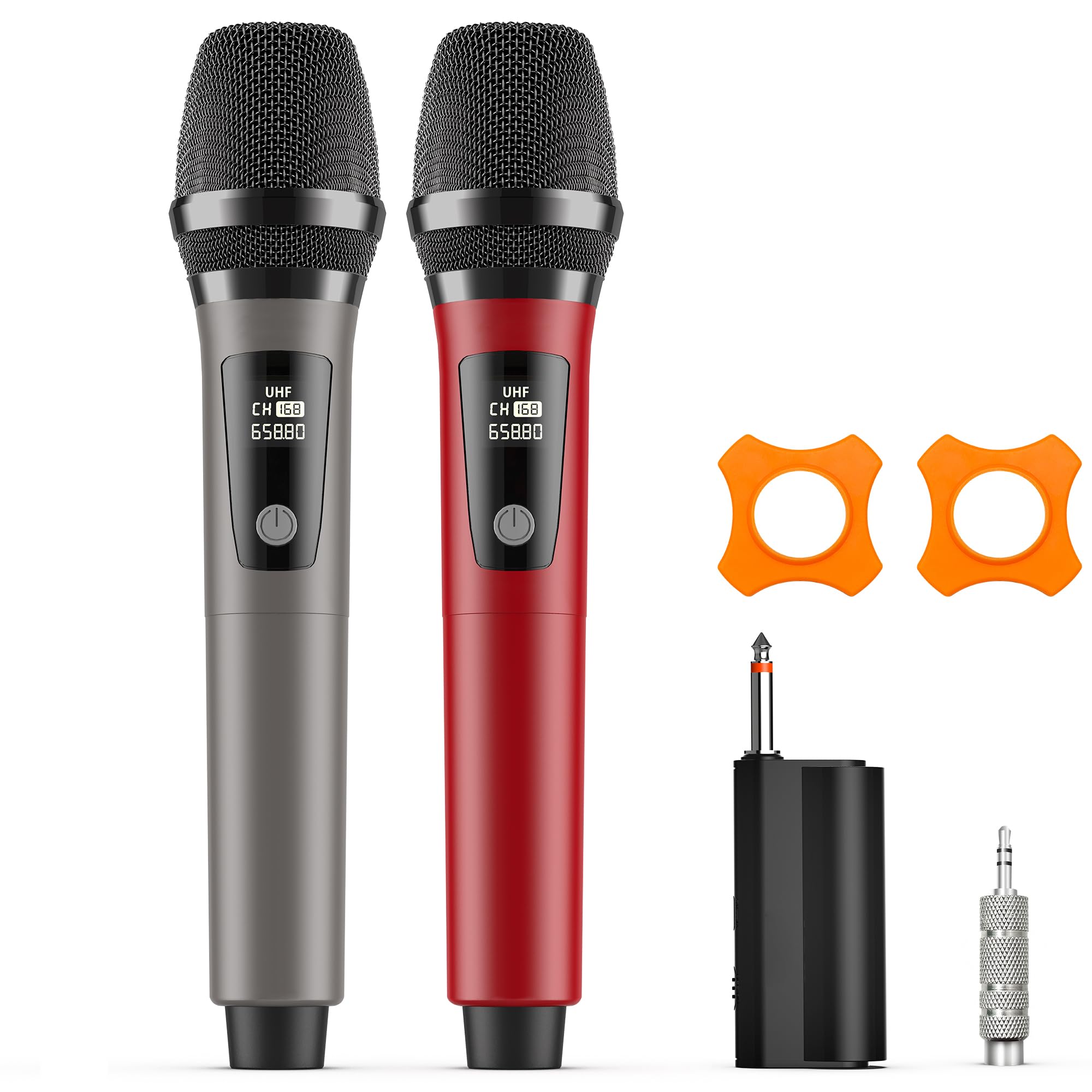
The HWWR U30 is a straightforward dual-handheld system aimed squarely at home karaoke nights, classroom presentations, and small venue speeches. The receiver is compact and connects to any speaker or PA system with a standard 6.35mm or 3.5mm auxiliary input, so there is virtually no learning curve. Users consistently report that the audio is clear, distortion-free, and naturally reproduces the voice without the tinny or hollow resonance some budget mics produce.
The 50-meter transmission range is generous for the price and easily covers a large garden party, a church hall, or a stage running up to the sound booth. The metal mic head houses a high-density sponge that minimizes plosive pops, and the dynamic capsules do a solid job of rejecting feedback at moderate volumes. Battery life is rated at 12 hours, which survived multi-hour use over several days in real-world testing.
At this tier, the build quality is commendable — the microphones feel substantial and the red finish stands out visually. The biggest limitation is the lack of advanced features like multiple channel options or a UHF frequency scan; this is a fixed-frequency system. If you use it in an area with many competing wireless devices, you may experience occasional interference. For pure plug-and-play karaoke fun, it delivers consistent value.
Why it’s great
- Solid metal mic head with plosive-reducing sponge
- Simple auxiliary connection works with most speakers
- Good battery life for long events
- Substantial feel for the price range
Good to know
- Fixed frequency, no channel scanning available
- Limited range compared to UHF pro systems
- Auxiliary connection only, no XLR output
6. ECHOMUSSY YA-01

The ECHOMUSSY YA-01 is built around an exceptionally long 1200mAh battery that delivers up to 40 hours of continuous use per microphone, making it the endurance champion of this list. The system uses dual-chip 2.4GHz processing for a stable connection, and the integrated DSP noise reduction effectively cleans up background noise for clearer vocal reproduction. The cardioid pickup pattern ensures the microphone primarily captures the sound directly in front of it, reducing room echo and feedback.
The package includes everything you need out of the box: two microphones, a USB receiver, USB-C charging cables, and a 6.35mm adapter. The LED color effects cycle through multiple modes and add a lively aesthetic for parties and karaoke. Performance is generally plug-and-play — users report instant pairing and a notable absence of static or crackle within the 200-foot range. The sound quality is described as “studio-quality” relative to the category, with good vocal clarity.
The most critical limitation is compatibility: these microphones require a dedicated MIC INPUT (6.35mm or 3.5mm) and will not work with standard AUX ports, laptop combo jacks, or smartphones without a specialized adapter. Buyers who skip this detail may find themselves unable to use the product. The build is primarily ABS plastic rather than metal, which keeps weight down but reduces durability. For dedicated karaoke machines, amplifiers, and PA systems, this is a cost-effective performer.
Why it’s great
- Extraordinary 40-hour battery life per mic
- Effective DSP noise reduction for clean vocals
- Plug-and-play with auto pairing
- Fun multicolor LED light effects
Good to know
- Only works with true MIC INPUT jacks
- Plastic chassis feels less substantial
- Not compatible with smartphones or laptops
7. BOYA BY-V2

The BOYA BY-V2 is one of the few wireless lavalier systems built specifically for iPhone and iPad users, featuring an MFi-certified Lightning connector for direct digital audio input without adapters. The clip-on transmitter weighs only 10.5 grams and is small enough to be nearly invisible on a shirt collar. The receiver includes a USB-C charging port that passthrough-charges your phone while recording, which is a thoughtful feature for long-form content like interviews or livestreams.
One-click noise cancellation is genuinely effective — users tested it successfully in noisy environments including near airplane engines and weed whackers, and the audio remained crisp and clear. The omnidirectional capsule provides consistent audio pickup regardless of slight positional changes, which is ideal for speakers who move their head or shift their posture frequently. The 328-foot line-of-sight range doubles what the previous BY-V series offered, making it suitable for large conference rooms or outdoor interviews.
Durability is the primary concern raised by long-term users. Although the system performs excellently out of the box, there are multiple reports of units failing after a few months of regular use. The absence of a charging case is also notable — each transmitter charges via its own USB-C cable rather than docking into a pocketable case. For content creators on a strict budget who need reliable iPhone-native audio right now, the BY-V2 offers impressive clean sound.
Why it’s great
- True plug-and-play with Lightning iPhones/iPads
- Passthrough charging keeps phone powered during recording
- Effective one-click noise cancellation
- Very low weight for comfortable all-day wear
Good to know
- Some units have reported premature failure
- No charging case, cables required per transmitter
- Long-term durability is uncertain
FAQ
Can I use a 2.4GHz wireless microphone in a church with a lot of Wi-Fi networks?
What is the practical difference between a cardioid and omnidirectional capsule in a cordless mic?
Why does my wireless microphone produce a humming sound when connected to my speaker?
Final Thoughts: The Verdict
For most users, the best cordless microphones winner is the Phenyx Pro PTU-71-1H1B because it combines professional UHF reliability, a full set of transmitters, and metal build quality in a package designed for serious live use. If you want a discreet wireless system for smartphone content creation, grab the RØDE Wireless Micro for its effortless USB-C connectivity and intelligent audio leveling. And for a budget-friendly dual handheld set that simply works for home karaoke and parties, nothing beats the HWWR U30.

Mo Maruf
I created WellFizz to bridge the gap between vague wellness advice and actionable solutions. My mission is simple: to decode the research and give you practical tools you can actually use.
Beyond the data, I am a passionate traveler. I believe that stepping away from the screen to explore new environments is essential for mental clarity and physical vitality.