Our readers keep the lights on and my smoothie glass nicely filled. As an Amazon Associate, I earn from qualifying purchases.
A miter saw that wobbles, drifts off the cut line, or fails to hold its bevel setting is worse than no saw at all — it wastes material and destroys confidence. For anyone trimming out a room, building cabinets, or cutting crown molding, the saw’s ability to lock a setting and repeat it without measurement is the entire point of owning one. The difference between a frustrating afternoon and a smooth workflow comes down to the detent plate, the bevel lock, and the rigidity of the arm.
I’m Mohammad Maruf — the founder and writer behind WellFizz. I spent hundreds of hours analyzing motor specs, bevel mechanisms, arbor systems, and rail designs to find the corded miter saw models that deliver real-world repeatability instead of just headline power numbers.
This guide digs into the details that matter — blade size, bevel range, slide mechanism, and detent quality — so you can choose with confidence. These reviews represent the top options in the best corded miter saw category for 2025.
How To Choose The Best Corded Miter Saw
Choosing a corded miter saw comes down to balancing three factors: blade size determines what you can cut, the bevel mechanism determines how you cut angles, and the slide system determines how wide a board you can crosscut. Ignoring any one of these leads to frustration on the job.
Blade Size: 10-Inch vs. 12-Inch
A 10-inch saw is lighter, cheaper, and perfectly capable of cutting 2x framing lumber and most crown molding up to about 6-5/8 inches nested. A 12-inch saw handles thicker stock and deeper bevel cuts without needing to flip the workpiece. For trim carpenters, a 10-inch saw with a quality blade usually offers better balance and blade life. For anyone cutting wide baseboards or thick hardwoods regularly, the 12-inch format saves time.
Slide vs. Non-Slide Cutting Capacity
A non-sliding miter saw has a fixed cutting width, typically around 5 to 7 inches. A sliding miter saw uses rails or an axial arm to pull the blade through the workpiece, allowing crosscuts on boards up to 12 inches or wider. Sliding saws are bulkier and require more bench space, but they handle wide shelving and deck boards without repositioning. The trade-off is rigidity — some rail systems develop play over time, which affects cut accuracy.
Bevel Mechanism: Single vs. Dual
A single-bevel saw tilts the blade in one direction (usually left) for angled cuts. A dual-bevel saw tilts both left and right, which is essential for crown molding and picture frames where you need mirrored angles without flipping the workpiece. Dual-bevel saws are heavier and more expensive, but for finish work they pay for themselves in reduced setup time.
Motor Power and Speed
Almost all corded miter saws use a 15-amp motor, which provides sufficient torque for cutting hardwoods and pressure-treated lumber. No-load speed ranges from 4,000 to 5,000 RPM. Higher RPM is useful for clean cuts on softwoods and composites, but torque and blade quality matter more for dense hardwoods. A saw that stalls on a 4×4 post indicates poor gearing, not just low RPM.
Quick Comparison
On smaller screens, swipe sideways to see the full table.
| Model | Category | Best For | Key Spec | Amazon |
|---|---|---|---|---|
| Bosch CM10GD | Premium | Precision finish work | Axial-Glide system, 10″ blade, 64 lbs | Amazon |
| DEWALT DWS716 | Premium | Heavy use / job site | 12″ blade, double bevel, 48.3 lbs | Amazon |
| Makita LS1019L | Premium | Wide crown molding | Linear ball bearing slide, 6-5/8″ nested capacity | Amazon |
| Delta 26-2241 | Mid-Range | DIY / semi-pro shop | 10″ dual bevel, shadow guide, 4,000 RPM | Amazon |
| Makita LS1040 | Mid-Range | Portable trim work | 10″ compound, 4,600 RPM, 27 lbs | Amazon |
| Evolution R255SMS+ | Mid-Range | Multi-material cutting | 10″ sliding, cuts metal/wood, 41.8 lbs | Amazon |
| Metabo HPT C10FCG2 | Budget-Friendly | Value / light DIY | 10″ compound, shadow line, 24 lbs | Amazon |
| Genesis GMS1015LC | Budget-Friendly | Beginner / home projects | 10″ compound, laser guide, 9 detents | Amazon |
| Evolution R185SMS+ | Budget-Friendly | Compact multi-material cuts | 7-1/4″ sliding, 1,500W motor, lightweight | Amazon |
In‑Depth Reviews
1. Bosch CM10GD Compact Miter Saw

The Bosch CM10GD replaces traditional sliding rails with the Axial-Glide system — a pivoting arm that moves the blade forward without any rail play. This eliminates the wobble and binding that plague cheaper sliding saws, especially when cutting wide stock. The saw sits flush against a wall, taking up about 10 inches less bench depth than a comparable rail-based 10-inch slider.
The 15-amp motor drives a 60-tooth carbide blade at 3,650 RPM. Cutting capacity reaches about 12 inches of crosscut on a 2× and up to 6-5/8 inches of nested crown molding. The up-front bevel controls and square lock fences make angle changes quick without reaching around the back. The dust collection chute works well when connected to a shop vac, though the included dust bag is barely adequate.
Ergonomics are excellent — the ambidextrous soft-grip handle and clear lower guard give good visibility. The saw does lack soft-start, so it lurches on startup, and the trigger safety can feel awkward depending on your grip. At 64 pounds, it is not a job-site carry-around but sits solidly on a dedicated stand. For a stationary shop saw where accuracy per cut matters more than portability, this is the reference standard.
Why it’s great
- Axial-Glide system eliminates rail slop for dead-straight cuts.
- Compact footprint fits tight bench spaces.
- Up-front bevel and miter controls are fast and intuitive.
Good to know
- No soft-start — motor jerks on startup.
- Dust bag is nearly useless; plan on using a shop vac.
- Heavy at 64 lbs; not ideal for daily job-site moves.
2. DEWALT DWS716 12-Inch Double-Bevel Miter Saw

The DWS716 is the 12-inch evolution of the DW716, built for pros who need repeatable accuracy across a full day of cutting. The stainless steel miter detent plate offers 14 positive stops with a cam lock handle and detent override, so you can micro-adjust without fighting the detent. The tall sliding fences support 6-5/8 inches of nested crown and 6-1/2 inches of base molding standing vertically.
The 15-amp motor drives the 12-inch blade at 3,850 RPM. Cutting capacity is generous — you get a 0–50 degree miter range left and right and a 0–48 degree double-bevel with positive stops at 0, 22.5, 33.9, and 45 degrees. The saw weighs 48.3 pounds, which is fairly light for a 12-inch dual-bevel, and the carry handle makes job-site trips manageable.
Owners report that the saw arrives reasonably square out of the box but benefits from about an hour of fine-tuning for maximum precision. The dust collection is decent with a shop vac — better than most in this class. The included blade is sharp but many users upgrade to a high-tooth-count blade for finish work. For framers, deck builders, and trim carpenters who work across multiple sites, this is the defense standard.
Why it’s great
- 14 positive stops for fast, repeatable miter angles.
- Tall sliding fences handle large crown and base without add-ons.
- Relatively portable for a 12-inch dual-bevel saw.
Good to know
- Requires initial tuning for sub-1/32″ accuracy.
- Base design limits compatibility with some universal stands.
- Stock blade is meant for rough cuts, not fine woodworking.
3. Makita LS1019L 10″ Dual-Bevel Sliding Compound Miter Saw

The LS1019L packs the crown molding capacity of a 12-inch saw (6-5/8 inches nested) into a 10-inch platform that weighs 57.9 pounds. The secret is the linear ball bearing system and two-steel-rail design that glides smoothly without the side-play common in budget sliders. The direct drive gearbox also increases vertical cutting capacity to 5-1/4 inches, letting you cut taller material without flipping.
The 15-amp motor spins the 10-inch blade at 4,600 RPM. The dual-bevel design tilts 0–45 degrees on both sides with front-accessible bevel controls. The miter detents have zero play and are easy to override for fine adjustments. Dust collection with a vac adapter is excellent — owners report 80–90% capture, which is rare for a sliding saw. The stock 60-tooth micro-polished blade delivers clean cuts out of the box.
Some units have arrived with a blade carriage alignment defect, so it is worth checking with a dial indicator early. The laser is dim and shows multiple lines until the blade is lowered, which reduces its usefulness in bright conditions. The work clamp, while effective, is slow to adjust. For trim carpenters and finish woodworkers who need a compact slider with big capacity, this saw delivers where it counts.
Why it’s great
- Linear ball bearing slide provides smooth, accurate motion with no wobble.
- Crown molding capacity rivals 12-inch saws in a lighter 10-inch body.
- Excellent dust collection with a shop vac connection.
Good to know
- Check blade carriage alignment on arrival — some units need adjustment.
- Integrated laser is dim and less useful in bright shop light.
- Work clamp is functional but slow to reposition.
4. Delta 26-2241 10″ Sliding Compound Miter Saw

The Delta 26-2241 stands out for its sliding mechanism — the dual “robot arms” glide on belts and bearings rather than traditional rails. This produces a buttery smooth motion with almost no effort and eliminates the rear clearance needed for sliding rails. The shadow guide cuts a consistent line by casting a blade-shaped shadow, no batteries required and no calibration drift.
The 15-amp motor spins the 10-inch blade at 4,000 RPM. The dual-bevel design gives you 45 degrees left and right with seven positive bevel stops. Miter range is 50 degrees left and 60 degrees right with ten detents. The saw weighs 55 pounds and includes a molded handle for carrying. The up-front miter control and front bevel release make angle changes quick without reaching around.
The dust collection is the weakest point — the bag catches almost nothing, and even with a shop vac you will still get a significant spray of sawdust. Owners also note slight arm flex on cuts wider than about 6 inches, though slow, perpendicular cuts mitigate it. The shadow line works well indoors but is hard to see in direct sunlight. For a DIY workshop where you value smooth motion and a compact footprint, this saw offers excellent value in the mid-range tier.
Why it’s great
- Belt-driven sliding mechanism is exceptionally smooth and space-efficient.
- Shadow guide provides a battery-free cut line that stays accurate.
- Generous miter range (60° right) and dual-bevel for crown molding.
Good to know
- Dust collection is poor — expect to clean up sawdust manually.
- Slight arm flex can affect accuracy on very wide cuts.
- Shadow line is difficult to see under bright sunlight.
5. Makita LS1040 10″ Compound Miter Saw

The LS1040 is a non-sliding compound saw that prioritizes portability and rock-solid accuracy over wide cutting capacity. At 27 pounds, it is easy to carry to trim jobs across multiple rooms or floors. The single pivot arm design eliminates the slop that develops in sliding mechanisms over time, which is why many trim carpenters prefer this saw for baseboard, casing, and shoe molding.
The 15-amp motor delivers 4,600 RPM with enough torque to cut through pressure-treated lumber and PVC without bogging. Miter range is 0–45 degrees left and 0–52 degrees right with nine positive stops at common angles. The dual-post compound pivoting arm allows bevel cuts up to 45 degrees left. The machined aluminum base and dual slide rails provide a flat reference surface.
The saw includes a vertical vise, 40-tooth blade, wrench, and triangular rule. Extension wings are sold separately and require M6x20mm screws to attach. The saw starts with a loud jolt — no soft-start — and the blade change bolt can be extremely tight from the factory. For finish carpenters who value precision over maximum cut width, this saw offers reliable performance in a compact, portable package.
Why it’s great
- Lightweight and compact — ideal for carrying to trim jobs.
- Rigid single pivot arm delivers repeatable accuracy with no play.
- Strong motor with good torque for hardwoods and pressure-treated lumber.
Good to know
- No sliding mechanism — limited crosscut capacity of about 5 inches.
- Loud startup with a noticeable jolt.
- Blade change bolt is often over-tightened from the factory.
6. Evolution R255SMS+ 10″ Sliding Miter Saw

The R255SMS+ is built for users who cut multiple materials in a single day — wood, wood with embedded nails, composite decking, mild steel, aluminum, and plastic. The proprietary TCT blade handles steel without producing hot sparks or burrs, which is a genuine time-saver in fabrication and renovation work. The 15-amp motor and optimized gearbox keep the blade speed consistent through material transitions.
The bevel range is 0–45 degrees and the miter range is 50 degrees left and right. The sliding mechanism uses standard rails and provides enough capacity for 10-inch crosscuts. The plus package includes dual quick-release clamps, taller fences, a slide rail protector, and a 3-meter power cord. Soft-start prevents the motor from tripping weak breakers on startup.
Some parts are plastic, and the clamp is adequate but not heavy-duty. The laser is only accurate for the first few inches of cut. The saw throws chips rearward, so eye protection is essential. For metalworkers, fence installers, and demo crews who regularly cut through mixed materials, this saw eliminates the need to swap blades constantly.
Why it’s great
- Cuts steel and aluminum cleanly with the included TCT blade.
- Soft-start motor prevents breaker trips on startup.
- Dual quick-release clamps hold workpieces securely.
Good to know
- Some plastic components feel less durable than full-metal rivals.
- Laser guide is only accurate for the first few inches.
- Throws chips rearward — always wear eye protection.
7. Metabo HPT C10FCG2 10″ Compound Miter Saw
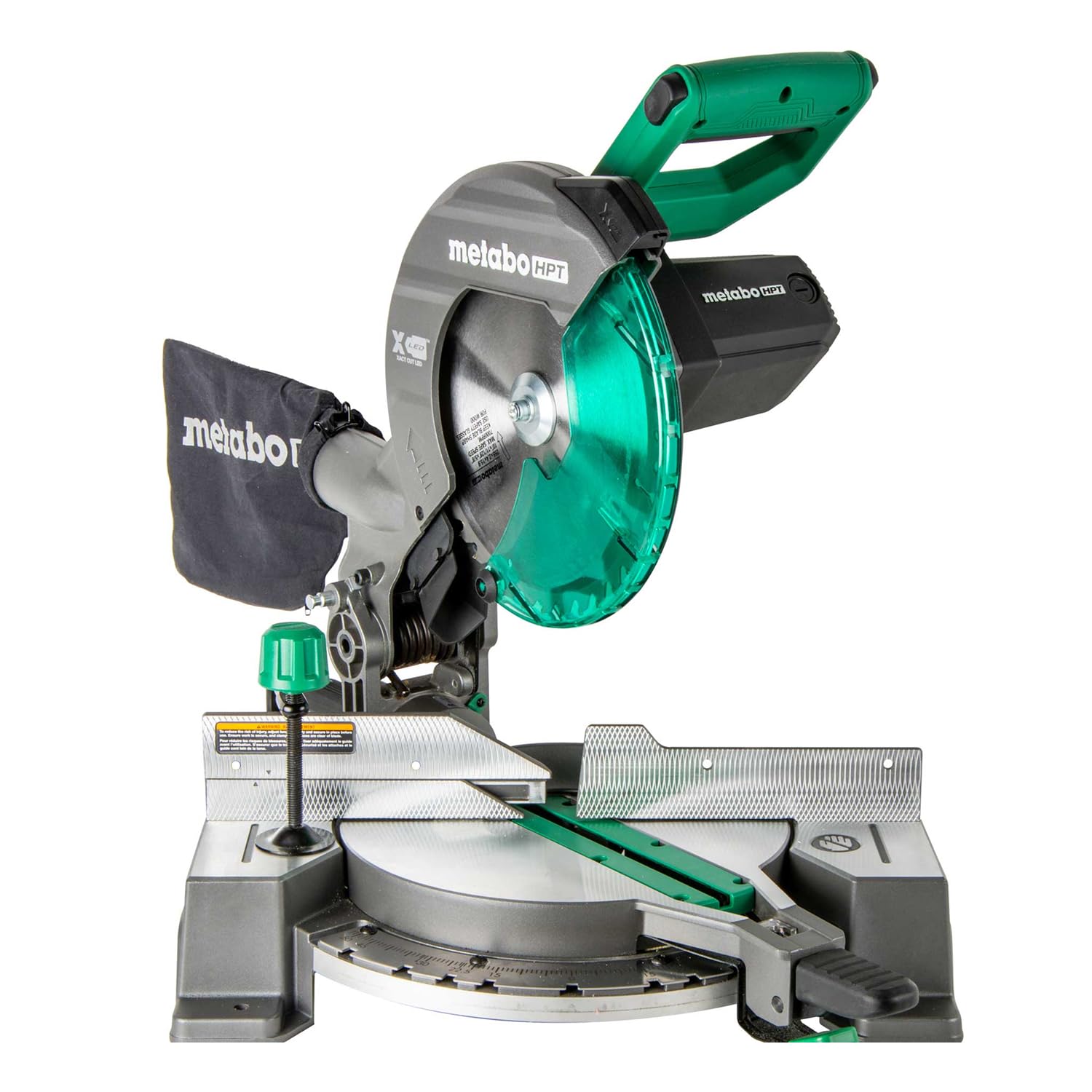
The C10FCG2 is a 10-inch compound saw that delivers genuinely impressive value for the budget tier. The 15-amp motor spins the included 40-tooth TCT blade at 5,000 RPM, which cuts cleanly through pine, oak, and composites. The Xact Cut shadow line projects an accurate cut indicator without batteries or calibration drift. At 24 pounds, this is one of the lightest saws in its class, making it easy to carry to small projects.
The miter range is 0–52 degrees left and right with an improved scale and controls. The single bevel adjusts 0–45 degrees left with positive stops. The vice clamping system secures the workpiece well for safety and precision. Owners report that the saw arrives square out of the box and requires minimal setup — just attach the included blade wrench and you are cutting.
The dust collection is adequate but not great — expect some airborne sawdust. The depth adjustment uses a set screw that some owners replace with a thumbscrew for easier use on small stock. The motor can run unevenly during the first few minutes of use but smooths out after a brief break-in period. For DIYers and hobbyists who need a reliable saw for weekend projects, this is tough to beat at the price.
Why it’s great
- Lightweight and easy to carry at 24 lbs.
- Shadow line guide is accurate and requires no batteries.
- Powerful 15-amp motor with 5,000 RPM for clean cuts.
Good to know
- Dust collection is only fair — some mess is expected.
- Motor may run unevenly during initial break-in.
- Depth adjustment set screw is awkward without a thumbscrew replacement.
8. Genesis GMS1015LC 10″ Compound Miter Saw

The GMS1015LC is an entry-level compound saw that keeps costs low while including features that matter for beginner woodworkers. The 15-amp motor handles 2x4s and 4x4s without hesitation, though the saw is loud enough that ear protection is mandatory. The integrated laser guide projects a red line that shows exactly where the blade will cut, which is helpful for new users learning to align workpieces.
The miter range is 0–45 degrees left and right with nine positive stops at common angles. The bevel tilts up to 45 degrees left. The die-cast aluminum base keeps the saw stable and contributes to accuracy. Included accessories are generous: a 60-tooth carbide blade, hold-down clamp, dust bag, two extension wings, blade wrenches, and two AAA batteries for the laser.
The dust bag is largely ineffective because of the angle of the dust port, and even a shop vac only partially reduces the mess. The clamp can loosen with vibration over time and needs periodic retightening. This saw is not designed for cutting metal — the heat can melt plastic components. For homeowners who need to cut trim, baseboards, and picture frames a few times a year, this saw provides capable performance at a low entry price.
Why it’s great
- Laser guide improves alignment for new users.
- Powerful motor cuts 2x4s and 4x4s without effort.
- Comes with a 60-tooth carbide blade and two extension wings.
Good to know
- Dust collection is very poor — expect a mess.
- Clamp loosens with vibration and needs regular tightening.
- Not for cutting metal — heat can damage plastic parts.
9. Evolution R185SMS+ Sliding Miter Saw

The R185SMS+ uses a 7-1/4-inch blade and a 1,500-watt motor to cut wood, plastic, aluminum, and mild steel from a compact frame. This is a purpose-built multi-material saw for users who need to cut metal studs, aluminum extrusions, or decking with embedded nails without changing blades. The TCT blade cuts steel without sparks or burrs, which is a real advantage over abrasive cutoff wheels.
The bevel range is 0–45 degrees and the miter range is 50 degrees left and right. The sliding mechanism extends cut capacity beyond what a non-sliding saw of this size can manage. The package includes a laser guide, carry handle, a three-piece clamp system, and a dust bag. The saw is genuinely lightweight, making it easy to bring to tight attic or crawlspace jobs.
The included blade is good for general cutting but leaves rough edges on wood — upgrading to a higher-tooth-count blade improves finish cuts. The laser is adequate for rough alignment but not precision work. The plastic components feel less robust than full-metal saws, but the motor and gearing are solid. For electricians, plumbers, and handymen who cut mixed materials on the fly, this saw earns its place in the truck.
Why it’s great
- Cuts steel, aluminum, and wood without a blade swap.
- Compact and lightweight for easy transport to job sites.
- Sliding mechanism provides wider crosscut capacity than fixed saws.
Good to know
- Stock blade leaves rough edges on wood — upgrade for finer cuts.
- Laser guide is more of a rough indicator than a precision tool.
- Plastic components feel less durable than metal alternatives.
FAQ
Does a dual-bevel saw matter for crown molding?
Why do some sliding miter saws develop play over time?
Can I put a 12-inch blade on a 10-inch miter saw?
What does the shadow line do and is it better than a laser?
How important is the miter detent plate for accuracy?
Final Thoughts: The Verdict
For most users, the best corded miter saw winner is the Bosch CM10GD because the Axial-Glide system delivers rail-free precision in a compact footprint, making it the most accurate slider for finish work. If you want a portable dual-bevel saw for job-site use, grab the DEWALT DWS716. And for maximum versatility at a lower cost, nothing beats the Evolution R255SMS+ which cuts steel, aluminum, and wood with the same blade.

Mo Maruf
I created WellFizz to bridge the gap between vague wellness advice and actionable solutions. My mission is simple: to decode the research and give you practical tools you can actually use.
Beyond the data, I am a passionate traveler. I believe that stepping away from the screen to explore new environments is essential for mental clarity and physical vitality.