Our readers keep the lights on and my smoothie glass nicely filled. As an Amazon Associate, I earn from qualifying purchases.
Your cordless drill struggles, the battery dies mid-hole, and you are left with a frustrating half-finished pilot hole in masonry or thick lumber. That is the moment you stop guessing and start plugging in. A quality corded drill delivers consistent, high-torque power on demand, with no battery anxiety and no downtime for recharging — it simply runs until the work is done.
I’m Mohammad Maruf — the founder and writer behind WellFizz. I have spent hundreds of hours analyzing power tool specs, poring over owner reviews, and comparing motor amperage, chuck quality, gear housing materials, and vibration control across dozens of models to help you find the right best corded drill for your next project.
This guide cuts through the noise, examining key specs like amperage ratings, hammer-action mechanisms, chuck security, and ergonomic handle designs that separate a reliable workhorse from a frustrating gadget.
How To Choose The Best Corded Drill
Selecting the right corded drill means evaluating torque delivery, impact mechanism, build quality, and physical ergonomics. These are the critical categories to understand before you buy.
Motor Amperage and Torque Delivery
Amperage is the most direct indicator of a corded drill’s sustained power. A 6-amp motor suffices for light masonry and wood drilling, while 8.5 to 10 amps provide the torque needed for large hole saws, mixing paddles, and repetitive concrete anchor holes. Higher amp ratings usually mean heavier tools, so balance raw power against the physical fatigue of overhead or prolonged use.
Hammer-Action Mechanism vs. Standard Rotation
If you drill into brick, block, or poured concrete regularly, a hammer drill’s pulsing impact mechanism fractures the substrate ahead of the bit, dramatically speeding up progress. A standard drill lacks this feature and will stall or produce dust rather than penetration. Dual-mode selectors let you switch between hammer and rotation-only for clean work on wood or metal.
Chuck Design and Bit Retention
The chuck must grip bits securely without slipping under load. Three-jaw chucks with a tightening key are the standard for heavy-duty hammer drills because they lock tighter than keyless chucks. However, some users report three-jaw designs failing to hold bits with four flat surfaces. Check that the chuck jaws match your bit shank profile, especially for masonry bits with multiple flattened facets.
Handle Configuration — Pistol Grip vs. Spade Handle
Pistol-grip drills with an auxiliary side handle offer good balance and control for overhead drilling and standard hole making. Spade-handle (D-handle) drills provide two-handed leverage and better torque reaction control for mixing mortar, self-leveling compound, or driving large hole saws. Choose based on whether precision or brute torque is your primary need.
Quick Comparison
On smaller screens, swipe sideways to see the full table.
| Model | Category | Best For | Key Spec | Amazon |
|---|---|---|---|---|
| DEWALT DWD520 | Hammer Drill | Heavy concrete drilling | 10-Amp motor, 2-speed | Amazon |
| Bosch HD18-2 | Hammer Drill | Pro-level torque & safety | 8.5-Amp, slip clutch | Amazon |
| DEWALT DW130V | Spade Handle | Mixing & high-torque tasks | 9-Amp, 0-550 RPM | Amazon |
| Bosch 1191VSRK | Hammer Drill | Compact masonry work | 7-Amp, 4.1 lbs | Amazon |
| RIDGID R71111 | Basic Drill | Large hole saws | 8-Amp, 6.5 lbs | Amazon |
| Makita HP1640 | Hammer Drill | Entry-level hammering | 6-Amp, 5/8″ concrete | Amazon |
| Makita DS4012 | Spade Handle | Professional mixing | 8.5-Amp, 0-600 RPM | Amazon |
In‑Depth Reviews
1. DEWALT Hammer Drill, 1/2-Inch, 10-Amp, Pistol Grip (DWD520)

The DEWALT DWD520 sits at the top of the corded drill hierarchy thanks to its 10-amp motor — the highest amperage in this comparison — and a patented motor design that delivers 50 percent more overload protection than standard builds. That translates to sustained torque without tripping the thermal breaker, even during extended concrete boring with 3/8-inch bits. The two-speed gearbox lets you drop into low range for high-torque mixing or hole-saw work, then switch to high speed for clean drilling in wood and steel.
The 360-degree locking side handle wraps around the metal gear housing, providing multiple gripping positions for lateral control on heavy loads. Users report drilling dozens of anchor holes in old concrete foundations without stalling or overheating, and the soft-grip two-finger trigger allows precise variable-speed feathering. The included chuck key does not have a factory-stored holster — owners have improvised solutions, which is a minor irritation on an otherwise excellently built tool.
At 7.75 pounds, this drill demands two-handed operation for prolonged use, but the weight delivers stability under load. The hammer action engages with a fast, impact-wrench-like pulse that fractures masonry efficiently. For anyone who needs one drill to handle framing, concrete anchors, and occasional paddle mixing, the DWD520 is the benchmark.
Why it’s great
- 10-amp motor provides the highest sustained torque in this class
- Metal gear housing withstands real jobsite abuse
- Two-speed range covers high-torque and high-speed drilling
Good to know
- No built-in chuck key storage; you will need a third-party solution
- Heavier than compact 7-amp models, causing fatigue overhead
2. Bosch HD18-2 Two-Speed Hammer Drill
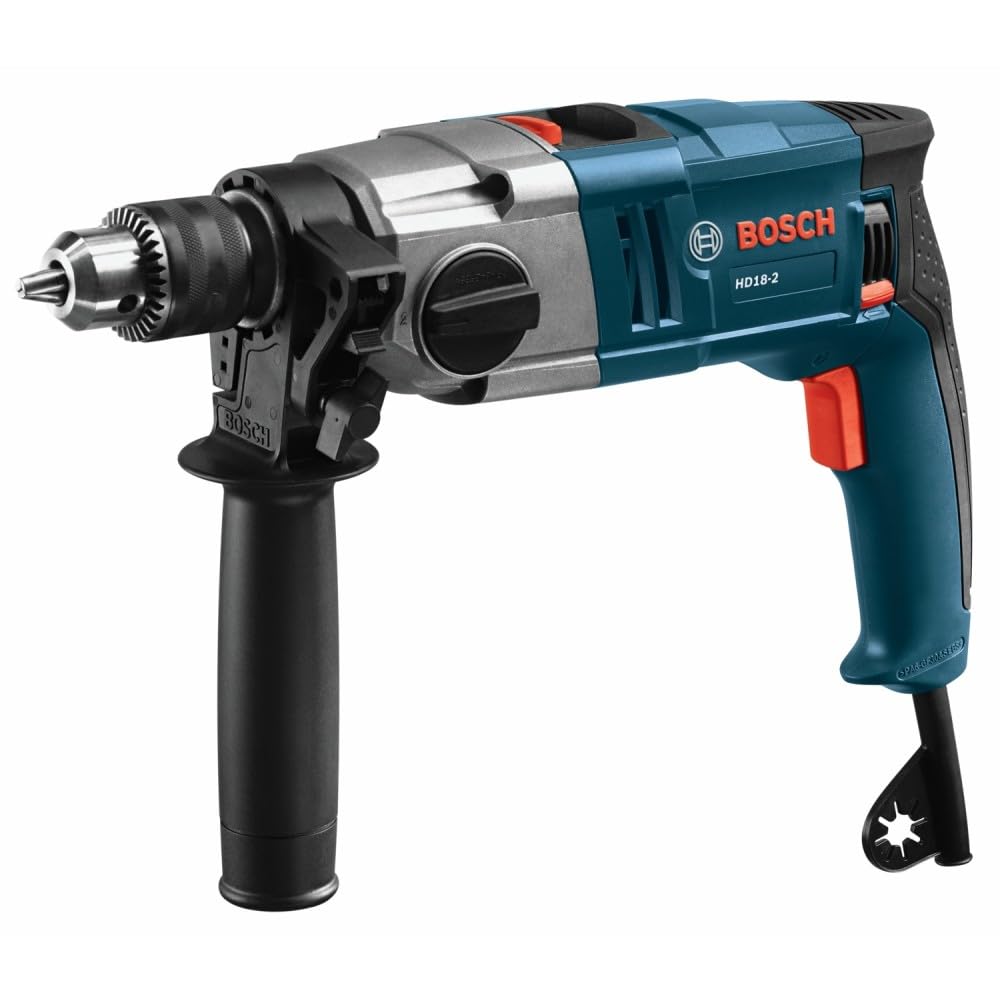
The Bosch HD18-2 stands out for its integral slip clutch — a rare safety feature that disengages the output shaft if the bit binds, protecting your wrists from sudden kickback. That alone makes it a top-tier choice for drilling rebar-laced concrete where a catch is likely. The 8.5-amp motor provides ample torque for thick table tops, brass prep, and masonry work, and the rotating brush plate ensures equal power in forward and reverse for extended brush life.
The dual-mode selector switches between hammer and rotation-only operation, and the two-speed range offers high-torque low gear alongside a faster drilling gear. The auxiliary handle incorporates a built-in depth gauge, so you can preset consistent hole depths without measuring each time. Owners report very little runout in the 1/2-inch three-jaw chuck, which improves accuracy when using drill guides or jigs.
Some users note that the three-jaw chuck does not always securely grip masonry bits with four flat surfaces — the bit slipped during concrete drilling for a few owners. This appears bit-specific rather than a chuck defect, but it is worth verifying your bit shank profile. The drill runs slightly heavier than compact options at 8 pounds, but the weight helps damp vibration during sustained hammer drilling.
Why it’s great
- Slip clutch protects hands from dangerous binding kickback
- Depth gauge built into the auxiliary handle for repeatable holes
- Rotating brush plate extends motor life in forward and reverse
Good to know
- Chuck can struggle with bits having four flat shank surfaces
- Slight learning curve for the two-mode selector switches
3. DEWALT Electric Drill, Spade Handle, 1/2-Inch, 9-Amp (DW130V)

The DEWALT DW130V abandons the pistol grip in favor of a spade-handle (D-handle) configuration designed specifically for high-torque, low-speed tasks like mixing mortar, joint compound, and self-leveling cement. The 9-amp motor pairs with a 0-550 RPM gearbox, trading rotational speed for immense twisting force. Users have mixed upwards of 60 buckets of concrete for fence posts without straining the motor, indicating excellent thermal management.
The three-position side handle and two-position rear handle give you multiple gripping angles for controlling the drill during mixing. The variable-speed trigger plus a reversing switch helps avoid air bubbles when stirring, and at 8 pounds with the handles attached, the tool stays planted during heavy loads. The included chuck key holder is practical, though the key is still easy to misplace on a busy site.
This is not a general-purpose hammer drill — there is no hammer action, and the low RPM range makes it slow for standard drilling in wood or metal. It is a specialized tool for mixing and large-diameter hole saws where torque is the priority. If your primary work involves stirring buckets or driving big augers, the DW130V delivers substantial power without the complexity of a hammer mechanism.
Why it’s great
- 9-amp motor handles continuous mixing loads without overheating
- Spade handle provides superior two-handed torque control
- Low 0-550 RPM range ideal for paddle mixing and large hole saws
Good to know
- No hammer action; not suitable for concrete drilling
- Low speed range feels slow for standard wood drilling
4. Bosch 1191VSRK 120-Volt 1/2-Inch Single-Speed Hammer Drill

The Bosch 1191VSRK proves that a lighter tool can still handle serious masonry work. At 4.1 pounds and a 7-amp motor, it punches above its weight, drilling 1/2-inch anchor holes in poured concrete foundations without bogging down or overheating during run. The 360-degree auxiliary handle with a quick-release depth gauge gives you flexible hand placement and consistent depth control even in tight spaces.
The single-speed design is simple — pull the trigger and the variable-speed control modulates power. The two-mode selector switches between rotation-only and hammer-and-rotation, making it easy to transition from drilling concrete to clean work in wood or steel. Owners consistently report that the drill delivers dependable power and control for small-diameter applications, and the included carrying case keeps the chuck key and depth gauge organized.
With only one speed range, you lose the high-torque low gear that some 8-amp+ models offer for hole saws or paddle mixing. This is a precision tool for 1/4-inch to 1/2-inch holes, not a brute-force machine. The lightweight design significantly reduces arm fatigue compared to 8-plus pound drills, making it an excellent choice for overhead work or extended use on ladder rungs.
Why it’s great
- Only 4.1 pounds reduces fatigue during overhead or long-duration drilling
- 360-degree handle with depth gauge for precise repeatable holes
- 7-amp motor delivers surprising concrete penetration for its size
Good to know
- Single-speed range lacks a low-gear option for high-torque mixing
- Not ideal for hole saws larger than 1-1/2 inches
5. RIDGID 8 AMP Corded 1/2 in. Heavy-Duty Variable Speed Reversible Drill R71111

The RIDGID R71111 is a straightforward heavy-duty drill built for tough material handling. The 8-amp motor delivers reliable torque for 3-inch and larger hole saws in wood and sheet metal, and the variable-speed trigger provides controlled starts to avoid tearing the workpiece. At 6.5 pounds, it has a solid feel that absorbs vibration, yet it remains well balanced for side-to-side cutting with spade bits.
The drill does not include a hammer action, so it is not suited for concrete or brick boring. Where it excels is in low-gear torque applications — users report using it for drilling through thick steel brackets and driving self-feed bits in framing lumber. The metal gear housing adds jobsite durability, and the 90-day satisfaction guarantee plus limited three-year warranty offer some peace of mind.
A key consideration is that Amazon is not an authorized RIDGID reseller for this model, so you cannot register the tool for the Lifetime Service Agreement that RIDGID offers when purchased through Home Depot. If the lifetime warranty matters to you, buy locally. Otherwise, the R71111 is a solid, no-frills workhorse for wood and metal drilling.
Why it’s great
- 8-amp motor powers large hole saws and self-feed bits easily
- Metal gear housing holds up to repeated heavy use
- Well-balanced design reduces fatigue during prolonged cuts
Good to know
- No hammer action; not suitable for masonry drilling
- Lifetime warranty cannot be registered when purchased from Amazon
6. Makita HP1640 5/8-Inch Hammer Drill

The Makita HP1640 serves as a sensible entry point into corded hammer drilling. Its 6-amp motor is the lowest amperage in this roundup, but it still delivers enough impact energy for 5/8-inch holes in brick and light concrete walls common in residential renovation. The rubberized soft-grip handle provides reasonable comfort, and the dual-mode selector allows you to switch between hammer drilling and standard rotation.
Users report that the drill performs well on home walls and brick partitions when paired with the correct masonry bit. The lightweight 4-pound body makes it one of the least fatiguing hammer drills for overhead anchoring, and the extended carbon brush service life helps compensate for the lower power ceiling. The included chuck key is larger than average, making it easier to hand-tighten without fumbling.
The 6-amp motor will struggle with sustained concrete boring deeper than 2 inches or with larger diameter bits. Several owners noted that the drill does not include a built-in work light, which can be inconvenient in dim crawlspaces. For a homeowner who occasionally drills into brick or block, the HP1640 offers a capable, affordable alternative to a high-amperage pro model.
Why it’s great
- Lightweight 4-pound build makes overhead drilling manageable
- Rubberized grip provides secure hold during hammer operation
- Extended carbon brush life reduces maintenance frequency
Good to know
- 6-amp motor may overheat during prolonged concrete boring
- No built-in work light for low-visibility environments
7. Makita DS4012 Spade Handle Drill, 1/2-Inch

The Makita DS4012 is a dedicated spade-handle drill engineered for daily mixing of mortar, plaster, self-leveling cement, and paint. Its 8.5-amp motor drives a variable speed 0-600 RPM range, delivering high torque at low speeds ideal for thick mixes. The D-handle rotates 360 degrees with 24 detent stops, allowing you to position the rear grip at any angle for wrist-neutral operation — critical during long mixing sessions.
Users report mixing dozens of buckets of Structo-Lite plaster and joint compound without bogging down or overheating, and the forward/reverse lever makes cleanup and bit removal convenient. At 7 pounds, the drill has heft that helps it stay planted in the mix, reducing the need to brace against the bucket. The well-balanced design minimizes vibration transmission to the hands, and the metal gear housing reinforces durability.
The plastic housing for the main handle threads and the rear handle rotation are points of concern for some users who worry about long-term durability under daily professional use. A few owners reported that the rear handle can spin under heavy load, reducing control. For small to medium batch mixing, the DS4012 is exceptionally capable, but for continuous high-volume mixing, you may want a model with all-metal handle construction.
Why it’s great
- 8.5-amp motor handles small to medium mortar batches without strain
- D-handle rotates to 24 positions for custom ergonomic setup
- Low 0-600 RPM range delivers excellent paddle mixing torque
Good to know
- Handle threads into plastic, a potential failure point under heavy daily use
- Rear handle can slip in rotation during high-torque mixing loads
FAQ
What amp rating do I need for drilling into concrete foundations?
Can I use a hammer drill for mixing joint compound or mortar?
Will a keyless chuck hold masonry bits securely during hammer drilling?
Why does my corded drill chuck slip on bits with four flat surfaces?
Final Thoughts: The Verdict
For most users, the best corded drill winner is the DEWALT DWD520 because its 10-amp motor, metal gear housing, and dual-speed hammer action offer the best balance of concrete drilling power and overall versatility. If you prioritize wrist safety and precision depth control during heavy concrete work, grab the Bosch HD18-2 with its integrated slip clutch and depth gauge. And for frequent mixing of mortar, cement, or paint, nothing beats the specialized torque of the DEWALT DW130V spade-handle drill.

Mo Maruf
I created WellFizz to bridge the gap between vague wellness advice and actionable solutions. My mission is simple: to decode the research and give you practical tools you can actually use.
Beyond the data, I am a passionate traveler. I believe that stepping away from the screen to explore new environments is essential for mental clarity and physical vitality.