A corded belt sander is the power tool you reach for when you need to remove material fast—whether you’re stripping paint from a deck, leveling a glued-up butcher block, or shaping a curve in hardwood. The aggressive cut of a spinning abrasive belt, paired with the steady torque of a live power cord, makes this the workhorse of any serious woodworking shop. But not all belt sanders track straight, stay cool under load, or collect the cloud of dust they kick up.
I’m Mohammad Maruf — the founder and writer behind WellFizz. I’ve spent hundreds of hours analyzing motor specs, belt tracking mechanisms, dust collection designs, and real user experiences across the belt sander market to separate the true workhorses from the frustrating ones.
This guide compares seven of the most popular models available today to help you find the right best corded belt sander for your shop and your workflow.
How To Choose The Best Corded Belt Sander
Choosing the right belt sander comes down to matching the tool’s power delivery, belt size, and dust handling to the scale of your projects. A weekend furniture refinisher has different needs than someone flattening butcher block countertops every week. Focus on these four factors to cut through the noise.
Motor Amperage and Belt Speed
Amperage is the most direct indicator of a corded sander’s ability to sustain material removal under load. An 8-amp motor will handle most DIY tasks, but a 10-amp motor resists bogging down when you lean into a heavy pass on end grain. Pair that with belt speed—measured in feet per minute (FPM)—and you get a practical picture of cutting aggression. Faster FPM combined with higher amps means you take off more material per pass, but it also means you need steadier hands to avoid gouging.
Belt Size: 3×21 vs 4×24
The vast majority of portable belt sanders use a 3-inch by 21-inch belt. This is the universal standard for cabinetry, furniture, and door refinishing because it balances reach, maneuverability, and availability of abrasives. A 4×24 belt covers a larger surface per pass, making it the go-to for flattening wide panels and large decks, but the tool itself is heavier and harder to control in tight spots. If you only own one sander, start with 3×21.
Dust Collection Compatibility
Nearly every budget model ships with a cloth dust bag that clogs and leaks fine particles. The real differentiator is the dust port size and shape. A round port that matches a standard shop-vac hose (typically 1.25 to 1.5 inches) transforms a dusty mess into a manageable operation. Square or proprietary ports force you to improvise with duct tape or third-party adapters. If you work indoors or value your lungs, prioritize a sander with a round rear port over one with an awkward square outlet.
Variable Speed vs Single Speed
Single-speed sanders run at a fixed belt speed, usually around 1,000 to 1,200 FPM. That works fine for heavy stock removal, but it becomes aggressive for finish work, softwoods, or sanding against the grain. Variable speed gives you a dial to dial down the belt speed for lighter passes, reducing swirl marks and extending belt life. It’s a worthwhile upgrade for anyone who sands different species of wood or switches between roughing and finishing in the same session.
Quick Comparison
On smaller screens, swipe sideways to see the full table.
| Model | Category | Best For | Key Spec | Amazon |
|---|---|---|---|---|
| Metabo HPT SB8V2 | 3×21 Handheld | Professional refinishing | 9-Amp / 1,020W motor | Amazon |
| Triton T41200BS | 4×24 Handheld/Bench | Large panel flattening | 10-Amp / 1.6HP motor | Amazon |
| WEN HB424V | 4×24 Handheld/Bench | High-volume stock removal | 10-Amp / up to 1,310 FPM | Amazon |
| Genesis GBS321A | 3×21 Handheld | Entry-level DIY projects | 8-Amp / up to 18,000 RPM | Amazon |
| Jellas 7Amp | 3×21 Handheld/Bench | Bench sander conversion | 7-Amp / variable speed | Amazon |
| Ingersoll Rand 315G | Pneumatic Air Sander | Automotive body work | 3,000 SPM / air-powered | Amazon |
| SKIL BB9504-00 | Benchtop Combo | Fixed workshop station | 4.5-Amp induction motor | Amazon |
In‑Depth Reviews
1. Metabo HPT SB8V2 3×21 Belt Sander

The Metabo HPT SB8V2 strikes the best balance of power, ergonomics, and warranty coverage in the 3×21 category. Its 9-amp motor delivers sustained torque that doesn’t fade under load, and the variable speed dial at the base of the handle gives you fine-grained control over belt speed when switching from stripping to finishing. The clear front cover is a subtle but valuable detail—it lets you see exactly where the belt meets the work surface, which reduces the risk of sanding through a veneer or rounding over an edge.
Dust collection on this sander is notably better than most in its class. The left-mounted dust bag routes debris away from the work area and does a decent job capturing the bulk of coarse particles, though you will still want a shop vac connected for extended indoor sessions. The flush-side design lets you sand right into corners without needing to switch to a detail tool, and tracking adjustments stay locked once set, which is a mark of quality belt tension mechanics.
The five-year warranty is the longest in this roundup and reflects the build quality Metabo HPT stakes its reputation on. If you sand frequently and want a tool that will outlive several projects, this is the one to buy.
Why it’s great
- 9-amp motor handles heavy stock removal without bogging.
- Variable speed dial offers real control over belt aggression.
- Flush-side design allows corner sanding without a secondary tool.
- Five-year warranty is best-in-class for this category.
Good to know
- Heavy at 9.5 pounds; fatiguing for overhead or vertical sanding.
- Dust bag works well but is not a substitute for a vac hookup.
2. Triton T41200BS 4×24 Belt Sander

The Triton T41200BS brings 10 amps and 1.6 horsepower to a 4×24 belt platform, making it one of the most aggressive portable sanders in this lineup. Where most 3×21 sanders top out around 1,000 FPM, the Triton’s variable speed ranges from 200 to 400 meters per minute, which translates to roughly 656 to 1,312 FPM. That upper band is enough to level a glue-up tabletop in a fraction of the time a 3×21 would take, and the belt’s wider footprint reduces the risk of digging uneven troughs into the work surface.
The dual-mode design is genuinely useful: flip the included clamps over, mount the sander upside down on a bench, and it becomes a stationary belt sander for shaping small parts or beveling edges. The rubber over-molded grip and lock-on button reduce hand fatigue during extended passes, and the rear dust port accepts a standard 1.2-inch or larger shop-vac hose directly—a huge upgrade over the square ports found on cheaper models. Users consistently note that the dust collection with a vac attached is night-and-day better than using the included bag.
At just over 4.6 pounds, the Triton is surprisingly light for a 4×24 sander, which helps with control during freehand work. The main tradeoff is noise: the 10-amp brushed motor is loud, so ear protection is non-negotiable. The three-year warranty is solid, though shorter than Metabo HPT’s five-year coverage. This is the best choice if you regularly flatten large panels and want the versatility of a stationary bench sander in one tool.
Why it’s great
- 10-amp motor delivers fast material removal on large panels.
- Inverts to a stationary bench sander for edge shaping.
- Rear dust port fits standard shop vac hoses without an adapter.
- Lightweight for a 4×24 platform; reduces arm fatigue.
Good to know
- Brushed motor is loud; hearing protection is mandatory.
- No hard case included for transport or storage.
3. WEN HB424V 4×24 Belt Sander

The WEN HB424V delivers the same 10-amp motor and variable-speed range as the Triton at a significantly lower entry point, making it the standout value in the 4×24 category. The belt speed dial spans from 660 to 1,310 FPM, giving you the same wide window for matching speed to material—slow for softwoods and finishes, fast for lumber and paint removal. The quick-release belt tension lever is genuinely tool-less; you flick it open, slide the belt on, and snap it shut without hunting for a wrench.
The dual benchtop/handheld format works well here, though the included mounting clamps feel less premium than the Triton’s. The lock-on trigger is a welcome feature for extended sanding passes, and the 1.2-inch dust port is round, which means you can connect a shop vac with minimal fuss. That said, the included dust bag is borderline useless for anything beyond light work—the cloth lets fine dust escape, and the port connection is not as secure as dedicated vac ports on more expensive models.
User reviews consistently praise the motor’s willingness to chew through material without bogging, and the weight—at over 12 pounds—actually helps keep the belt planted during heavy passes. The main durability concern is the quality of the plastic belt-tension housing; a few users reported cracks after extended use. At this price point, the WEN is a budget-friendly workhorse that outperforms its cost, provided you pair it with a shop vac for dust control.
Why it’s great
- 10-amp motor rivals premium models at a lower cost.
- Variable speed up to 1,310 FPM suits multiple sanding tasks.
- Tool-less belt change saves time between grits.
- Round dust port is vac-compatible out of the box.
Good to know
- Plastic belt housing is less durable than metal alternatives.
- Heavy at over 12 pounds; not ideal for overhead sanding.
4. Genesis GBS321A 3×21 Belt Sander

The Genesis GBS321A is an entry-level 3×21 sander that focuses on the essentials: a single-lever belt change, variable speed from 0 to 18,000 RPM, and an adjustable front handle for comfort. The 8-amp motor is adequate for stripping paint from doors, smoothing rough lumber, and small furniture refinishing projects. It won’t sustain heavy commercial use, but for a weekend workshop or a first-time buyer, it provides enough power to get real work done without overwhelming the user.
The low-profile design is a genuine advantage for sanding inside cabinets or between joists—the narrower front end lets you get closer to vertical surfaces than bulkier models. Belt tracking is easy to dial in with the side knob, and the tool-less change mechanism is reliable if you keep the belt alignment arrow pointed in the correct rotation direction. The dust bag included with the unit is where the compromises show: the cloth is thin, the bag clogs quickly, and the square port does not accept a standard shop-vac hose without modification.
Several long-term users reported that the dust collection port shape is the biggest frustration, and some found that dust buildup inside the housing eventually fouled the motor brushes, causing intermittent startup issues. Cleaning the brush area periodically and running a shop-vac hose taped to the port resolves both problems. For the price, the Genesis offers solid cutting performance and easy belt swaps, but plan on upgrading the dust solution from day one.
Why it’s great
- Tool-less single-lever belt change saves time on the job.
- Low-profile design fits into tight spaces like door jambs.
- Variable speed dial gives basic control over cut aggression.
- Adjustable front handle improves comfort during long passes.
Good to know
- Square dust port is incompatible with standard shop vacs.
- Dust bag is thin, clogs easily, and leaks fine particles.
- Motor brushes may need cleaning if used in dusty conditions.
5. Jellas 7Amp 3×21 Belt Sander
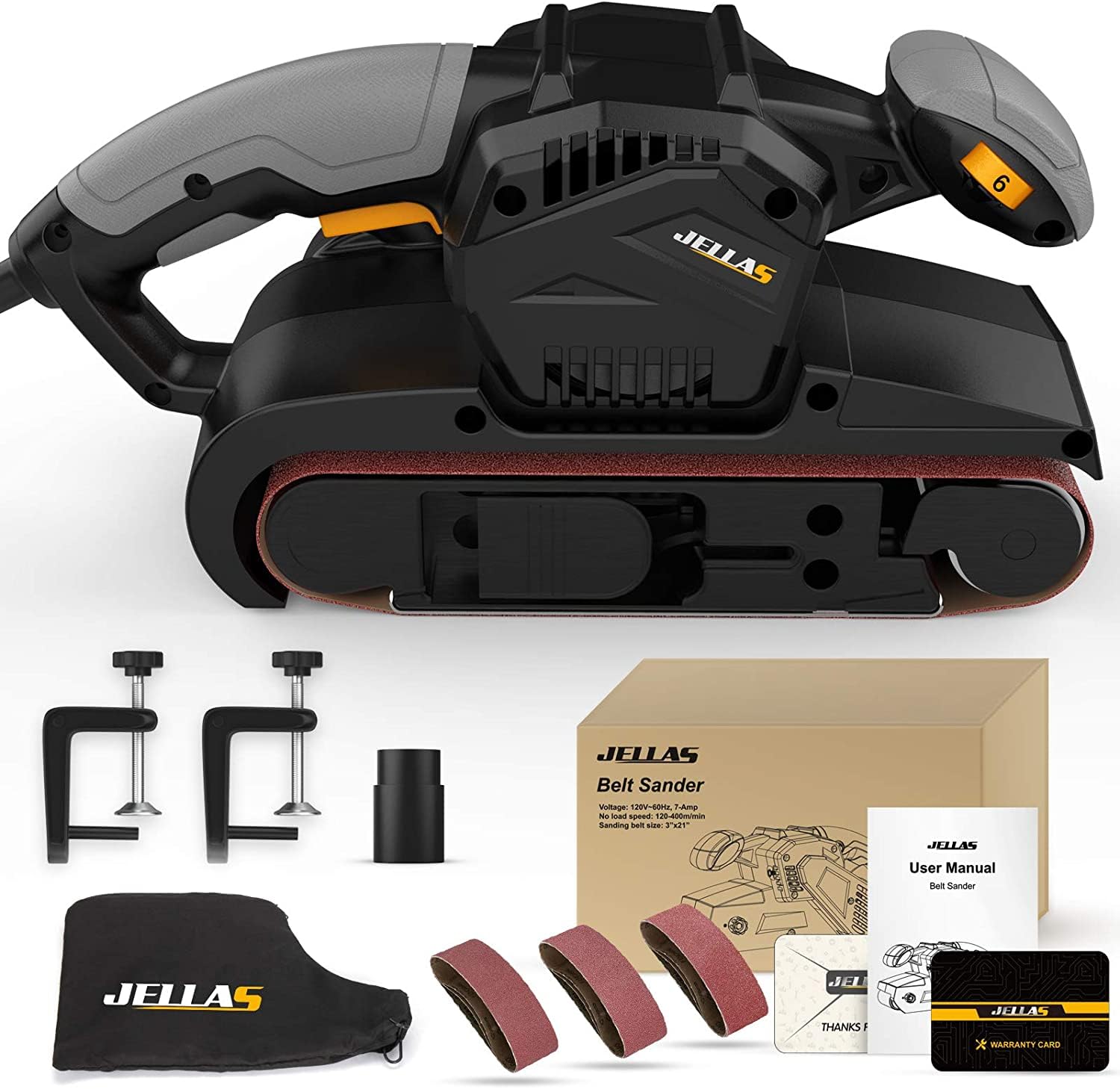
The Jellas 7Amp belt sander aims to deliver maximum value by bundling ten sanding belts across five grits (40 to 180) and including C-clamps for converting the tool into a bench sander. The 7-amp motor is the least powerful in this roundup, but the variable-speed dial with six settings—from 120 to 400 RPM—lets you dial back the aggression for lighter tasks like breaking edges or sanding between coats. It is a good entry point for hobbyists who want one tool that does a bit of everything.
The “cruise control” lock-on button is a nice touch for long passes, and the soft-grip handle reduces vibration transmission to the hand. The 10-foot power cord is genuinely useful for reaching outlets without an extension cord. However, the dust bag has a known flaw: a small hole upstream from the spring clamp allows fine dust to escape onto the user’s hand during operation. The 2-in-1 vacuum adapter (35mm and 32mm) is a clever workaround, but it requires a separate purchase of a vacuum hose that fits those sizes.
Belt tracking on the Jellas is stable once set, but the belt itself has a noticeable joint bump that can leave tracks on the work surface if you are not careful during finishing passes. The plastic construction of the belt housing feels less substantial than the Genesis or WEN, so it is best suited for light to moderate use. For under , the Jellas is a capable starter sander that earns its keep through value, not raw power.
Why it’s great
- Includes ten sanding belts across five grits—ready to work out of the box.
- 10-foot power cord reduces the need for an extension cord.
- Converts to a bench sander with included clamps.
- Soft-grip handle reduces hand fatigue during extended use.
Good to know
- 7-amp motor bogs down under heavy pressure on hardwoods.
- Dust bag has a small leak that drops fine dust on your hand.
- Belt joint bump can leave tracks on finish passes.
6. Ingersoll Rand 315G Straight Line Air Sander
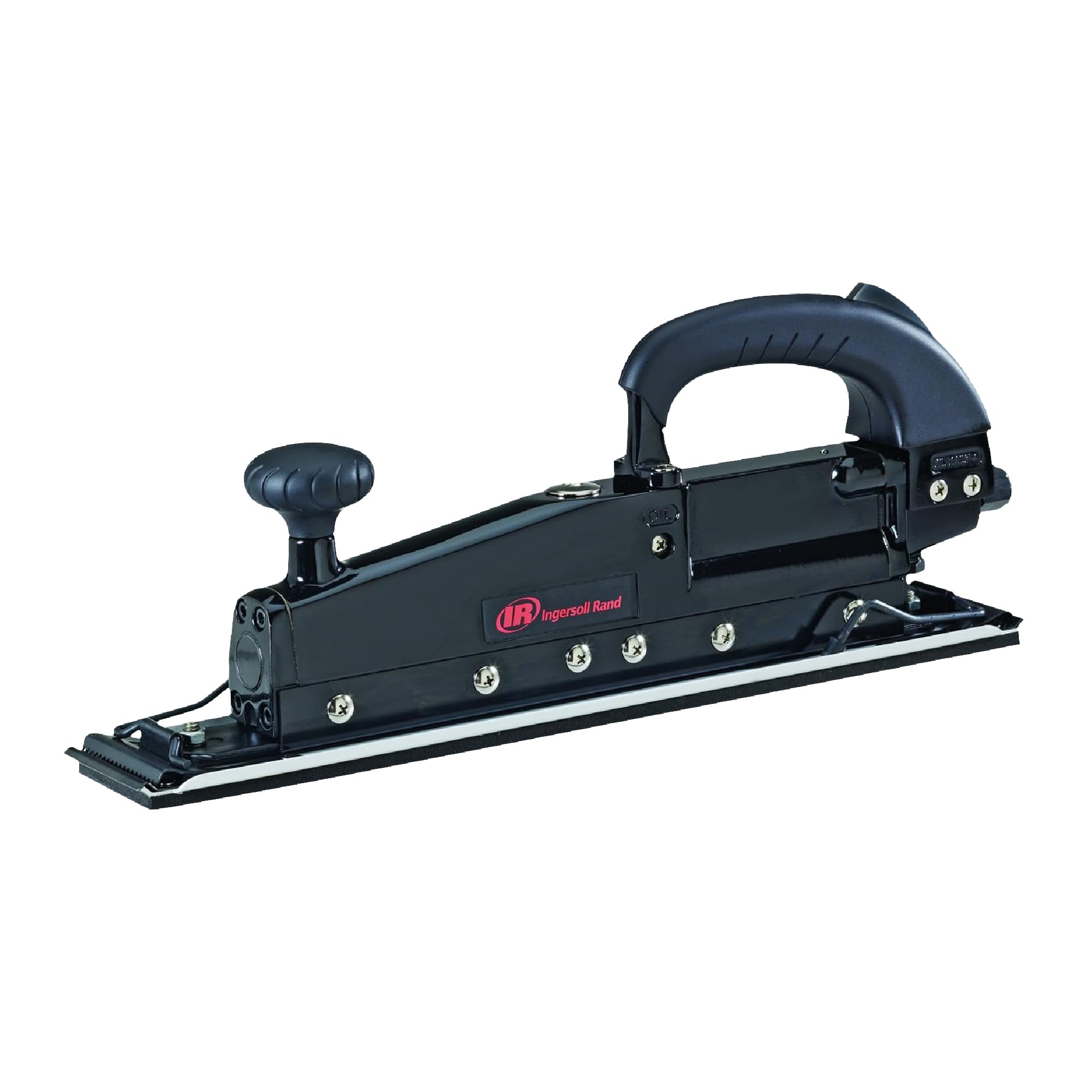
The Ingersoll Rand 315G is not a belt sander—it is a pneumatic straight-line air sander designed for automotive body work—but it deserves a place in this roundup for the buyer who needs the linear sanding motion of a belt sander in a compressed-air format. Its twin-piston design delivers 3,000 strokes per minute, providing enough aggressive reciprocating action to flatten body filler and shape large flat surfaces without the rotary swirl marks a random-orbit sander would leave behind.
The pad size is 2.75 inches by 15 inches, narrower than a standard 3×21 belt but ideal for working between body panels and along compound curves. The ergonomic grip and low-vibration body allow for extended use without hand fatigue, and the fast-action paper clamps make swapping abrasive sheets quick. Users report that the tool performs best at around 60 PSI and cuts through mud and filler faster than any electric palm sander. It also holds up well to moisture from a compressor, which is a common failure point for cheaper air tools.
This is a specialized tool. It requires an air compressor with adequate CFM output, and the abrasive paper (17.5 inches long) is less commonly stocked than standard belt sandpaper. The lack of a belt sander’s aggressive cut means it is best for smoothing and leveling rather than heavy stock removal. For the automotive body shop or boat builder, the 315G is a top-shelf solution that outperforms electric sanders in its narrow use case.
Why it’s great
- Twin-piston design prevents stalling under heavy load.
- Low vibration and comfortable grip allow extended use.
- Reciprocating motion leaves no swirl marks on filler.
- Built to last; handles compressor moisture better than cheaper air tools.
Good to know
- Requires an air compressor—not a standalone tool.
- Specialty abrasive paper is less readily available than standard belts.
- Narrow pad is faster than a palm sander but slower than a belt sander for heavy removal.
7. SKIL BB9504-00 Belt and Disc Combination Sander

The SKIL BB9504-00 is a fixed benchtop combination sander, not a portable belt sander. It offers both a 4-inch by 36-inch belt and a 6-inch disc on a single stand. This is the right tool if you need a dedicated sanding station in your shop for shaping, deburring, and beveling small parts rather than refinishing large surfaces like doors or tabletops. The belt tilts from 0 to 90 degrees for bevel sanding, and the miter gauge guides crosscuts on the disc.
The 4.5-amp induction motor delivers constant torque without the speed drop that brushed motors experience under load. The belt speed is fixed, but for a benchtop station, consistency matters more than adjustability. The quick-release lever makes belt changes simple, and the 2.5-inch dust port accepts standard shop-vac hoses directly, keeping the work area clear of debris. The belt and disc run simultaneously, which means you need to be mindful of the disc’s rotation when the belt is in use—loose clothing near the disc is a genuine hazard.
At 25.6 pounds, this sander is heavy enough to stay planted during aggressive passes without needing to be bolted down, though pre-drilled holes are available for permanent mounting. The build quality feels superior to the similarly priced WEN combination sander—the tables lock securely without wobble, and the motor does not bog down when pushing workpieces into the belt. For the garage woodworker who needs a stationary sanding station for smaller parts, the SKIL BB9504-00 is the most reliable option in its class.
Why it’s great
- Induction motor delivers constant torque without speed sag.
- Belt tilts from 0 to 90 degrees for bevel sanding.
- 2.5-inch dust port fits standard vac hoses securely.
- Sturdy 25.6-pound frame stays planted during heavy use.
Good to know
- Fixed belt speed; no variable-speed control.
- Belt and disc run simultaneously; requires caution near the disc.
- Not portable—designed for a permanent benchtop position.
- Not suitable for large surface refinishing like doors or decks.
FAQ
What is the difference between a 3×21 and a 4×24 belt sander?
Can I connect a shop vac to any belt sander dust port?
How often should I replace the sanding belt on my sander?
Is variable speed worth paying extra for on a belt sander?
Can I use a belt sander to sharpen knives or tools?
Final Thoughts: The Verdict
For most users, the best corded belt sander winner is the Metabo HPT SB8V2 because it delivers the ideal mix of 9-amp power, reliable belt tracking, five-year warranty coverage, and flush-side corner sanding capability. If you frequently flatten large panels and want the raw speed of a 4×24 belt, grab the Triton T41200BS for its 10-amp motor and true dual-mode handheld/benchtop design. And for the budget-conscious DIYer who needs a capable sander without overspending, the WEN HB424V offers 10-amp performance and bench conversion at a fraction of the premium tier cost.

Mo Maruf
I created WellFizz to bridge the gap between vague wellness advice and actionable solutions. My mission is simple: to decode the research and give you practical tools you can actually use.
Beyond the data, I am a passionate traveler. I believe that stepping away from the screen to explore new environments is essential for mental clarity and physical vitality.