Our readers keep the lights on and my smoothie glass nicely filled. As an Amazon Associate, I earn from qualifying purchases.
A coping saw is the only hand tool that lets you thread a blade through a tiny pilot hole and then carve sinuous curves, tight inside corners, and delicate scrollwork into wood, plastic, or even soft metal. Its thin blade is under tension inside a deep C-frame, giving you the control to follow a pencil line exactly — no powered jigsaw can match its agility in a confined space.
I’m Mohammad Maruf — the founder and writer behind WellFizz. I’ve spent countless hours combing through blade geometry, frame rigidity specs, and real user reports to find which coping saws actually deliver precision without frustration.
Whether you’re trimming baseboard miters or cutting intricate fretwork patterns, finding the right best coping saw means balancing frame stiffness, blade tension range, handle comfort, and the types of cuts you need to make.
How To Choose The Best Coping Saw
Not all coping saws are the same under the hood. Frame material, throat depth, blade tensioning mechanism, and handle ergonomics separate a frustrating tool from one that feels like an extension of your hand.
Frame Stiffness and Depth
A rigid steel frame resists twisting under load, keeping your cut on line even when you lean into the blade. Deeper throat depth (the distance from the blade to the frame’s back) allows you to cut further into large panels — 6 to 8 inches is typical for most woodworking tasks.
Blade Tension and Compatibility
Higher blade tension eliminates blade drift and produces a cleaner kerf. Look for saws with a turnbuckle or wing-nut adjustment that lets you dial tension precisely. Flat pin-end blades (usually 6-1/2 inches long) are the standard, but some frames accept spiral blades for multi-directional cutting without reorienting the workpiece.
Handle Comfort and Grip
Wooden handles absorb vibration better than many plastics and warm up in your palm, but a well-contoured high-impact plastic or rubberized grip also reduces fatigue during long scroll sessions. The handle shape should let you rotate the blade 360 degrees without your hand cramping.
Quick Comparison
On smaller screens, swipe sideways to see the full table.
| Model | Category | Best For | Key Spec | Amazon |
|---|---|---|---|---|
| FreeStyle Spyral | Premium | All-direction scroll cutting | 3 spiral blade sizes included | Amazon |
| JEWEL TOOL 8″ Deep Throat | Premium | Intricate piercing and fretwork | 8-inch deep throat, wood handle | Amazon |
| JORGENSEN Pro | Mid-Range | General woodworking and curves | 6-1/4″ frame depth, 15 TPI blade | Amazon |
| GreatNeck CP9 | Mid-Range | Entry-level pattern cutting | Includes 3 extra blades (fine/med/coarse) | Amazon |
| SUBRILLI Diamond Wire | Budget | Stone, ceramic, and glass cuts | 1 meter of 0.45mm diamond wire | Amazon |
In‑Depth Reviews
1. FreeStyle Coping Saw with Spyral Blades
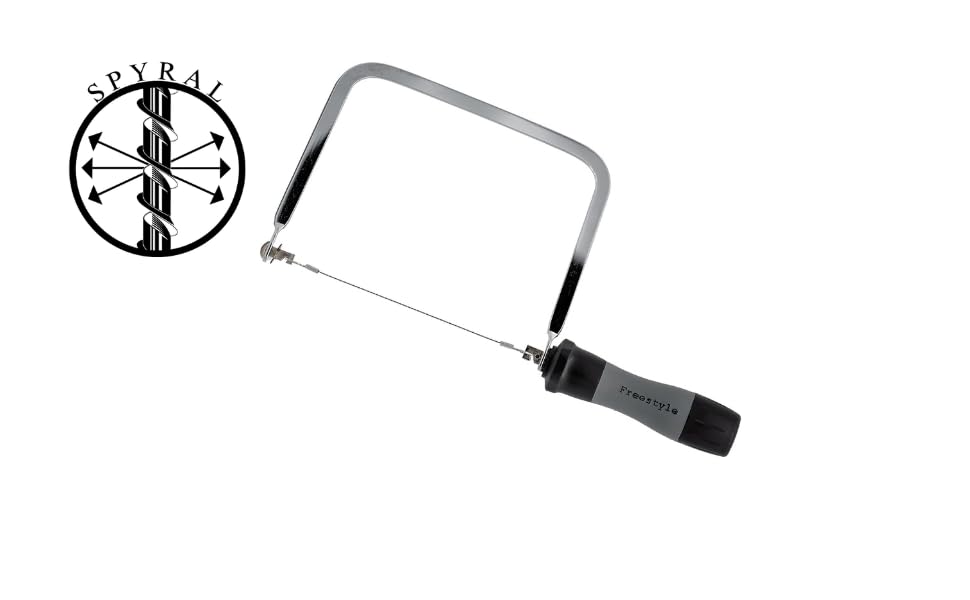
The FreeStyle saw rethinks the coping saw entirely by replacing traditional flat blades with a 360-degree spiral tooth design. Instead of stopping to twist the frame with every change of direction, you simply steer the saw and the spiral blade follows — cutting forward, backward, left, or right without binding. It comes with five Spyral blades in three diameters (.028″, .040″, and .050″), so you can match the kerf and aggressiveness to the material.
The frame itself is metal with a comfortable ergonomic handle and keyless blade changes. Users report cutting accurate rectangular holes in desks for power strips and performing intricate scrollwork that would normally require a jeweler’s saw. The spiral blades cut wood, plastic, bone, aluminum, and brass, and they can even be twisted off to function as a hole saw.
There is a learning curve — the spiral tooth pulls in every direction you push, so practice is needed to avoid wandering off your line. Once mastered, it eliminates the constant blade rotation that frustrates traditional coping saw users.
Why it’s great
- Unique spiral blade cuts in any direction without twisting the frame
- Five blades in three sizes included for versatility
- Keyless blade change saves time and frustration
Good to know
- Spiral blades leave a slightly rougher finish than flat blades on straight cuts
- Initial practice required to control multi-directional cutting
2. 8 Inch Deep Throat German Saw Frame

This German-style frame from JEWEL TOOL delivers an 8-inch deep throat, giving you the clearance to cut well into the middle of large panels without the frame hitting your workpiece. The 4-1/2 inch wooden handle is shaped for a comfortable, secure grip that reduces hand fatigue, and the nickel-plated steel frame resists corrosion while staying rigid under tension.
The tension system uses turn screws and a wing nut, which users find simple to adjust. Many reviewers compare this saw favorably to the much more expensive Knew Concepts frame, noting that with quality blades like Pegas SK7, it performs similarly for dovetail waste removal and intricate fretwork at a fraction of the cost. The adjustable top jaw makes piercing (threading the blade through a pilot hole) straightforward.
The frame accepts blades up to 5-1/2 inches long, which is slightly shorter than some modern standards, so you may need to source blades that fit. A few users report needing minor file work on the tensioning mechanism out of the box, but overall construction is solid for the price tier.
Why it’s great
- 8-inch deep throat for large workpieces
- Comfortable wooden handle dampens vibration
- Rigid nickel-plated steel frame resists twisting
Good to know
- Accepts only blades up to 5-1/2 inches long
- Minor adjustment may be needed on tension hardware
3. JORGENSEN Pro Coping Saw

The JORGENSEN Pro strikes an excellent balance between affordability and performance. It features a 6-1/4 inch frame depth, which is enough for cutting baseboards, crown molding, and medium-sized workpieces without the frame lip catching. The 15 TPI (teeth per inch) blade is a good middle ground — aggressive enough for fast cuts in softwood and PVC, yet fine enough for decent curve detail.
Blade installation is handled by twisting the handle: one direction releases tension, the opposite direction locks the new blade in place. No tools are needed, though some users report that compressing the frame enough to install the blade requires significant hand strength — almost a two-person job without a clamp. Once tensioned, the saw holds the blade securely and tracks accurately through hardwood.
The kit includes two replacement 6-1/2 inch blades plus the pre-installed 15 TPI blade. Reviewers consistently praise the saw’s rigidity for the price, noting that it feels much more solid than cheaper hardware-store models. It works well for DIY scrollwork, coping joints, and light metal cutting.
Why it’s great
- Rigid frame holds blade securely for accurate cuts
- Twist-to-tension handle simplifies blade changes
- Includes two spare blades for extended use
Good to know
- Blade installation requires significant frame compression
- Plastic handle less comfortable than wood for long sessions
4. GreatNeck CP9 Coping Saw

The GreatNeck CP9 is a classic entry-level coping saw that offers surprising value with its included three-blade assortment: fine, medium, and coarse. The heavy-duty steel frame is fully polished to resist rust, and the blade rotates a full 360 degrees, allowing you to cut in any orientation without repositioning the workpiece. The high-impact plastic handle provides a firm grip for basic woodworking and craft tasks.
At just 4.8 ounces, it’s one of the lightest frames in this lineup, making it easy to handle for smaller hands or short-duration projects. Users have successfully cut hardwood for crafting and trimmed molding for cabinets without issue. The limited lifetime warranty adds peace of mind for a tool at this level.
Some units have arrived with a slight bend in the frame, which can affect tracking. The thin steel frame also flexes more under heavy tension than premium options, so it’s best suited for light to moderate use rather than high-volume professional work.
Why it’s great
- Three included blades cover fine, medium, and coarse cuts
- 360-degree rotating blade for multi-directional cutting
- Very lightweight at 4.8 ounces
Good to know
- Frame can arrive with slight bends affecting cut accuracy
- Plastic handle offers less control than wood handles
5. SUBRILLI Coping Saw with Diamond Wire

The SUBRILLI saw is a niche tool that replaces the standard metal blade with a 1-meter length of 0.45mm diamond-coated wire. This design makes it capable of cutting materials that would destroy a traditional coping saw blade: jade, ceramic, glass, marble, granite, and even thin carbide. The steel frame itself is standard, with a rubberized grip, but the star is the diamond wire tensioned across the throat.
Users report effective cutting of softer to medium-hard stone slabs for lapidary work and freeform shapes. The thin kerf and smooth cutting action produce less chipping than abrasive wheels, and the wire can follow intricate curves. For extremely hard agates, a powered trim saw is still recommended, but for most hobbyist stonework, this saw gets the job done.
The diamond coating wears off with use — some users went through the entire 1-meter wire cutting just a 1-inch rock. The wire is consumable, so factor in replacement costs. The frame is nicely made, but the supplied wire may not last long for heavy users, and installing new wire is fiddly.
Why it’s great
- Cuts stone, ceramic, glass, and carbide — not just wood
- Diamond wire produces a smooth, fine kerf
- Frame is sturdy with a comfortable rubberized grip
Good to know
- Diamond coating wears off relatively quickly on hard materials
- Replacement wire must be sourced separately
FAQ
What TPI (teeth per inch) is best for a coping saw?
Can I use a coping saw for cutting metal?
How do I install a blade in a coping saw?
Final Thoughts: The Verdict
For most users, the best coping saw winner is the FreeStyle Coping Saw with Spyral Blades because its spiral tooth design eliminates the constant blade twisting that slows down traditional saws. If you want a deep throat for large panels and a comfortable wood handle, grab the 8 Inch Deep Throat German Saw Frame. And for cutting stone, ceramic, or glass, nothing beats the SUBRILLI Diamond Wire Coping Saw.

Mo Maruf
I created WellFizz to bridge the gap between vague wellness advice and actionable solutions. My mission is simple: to decode the research and give you practical tools you can actually use.
Beyond the data, I am a passionate traveler. I believe that stepping away from the screen to explore new environments is essential for mental clarity and physical vitality.