Our readers keep the lights on and my smoothie glass nicely filled. As an Amazon Associate, I earn from qualifying purchases.
Cooperative board games swap the solitary winner for a shared victory — or a collective defeat. Instead of one player dominating a race to the finish, every person at the table either triumphs together or watches the game win. That shift in dynamics changes how you strategize, communicate, and even how you feel when the last card flips. Finding the right one means matching a group’s tolerance for tension with the complexity of its rules.
I’m Mohammad Maruf — the founder and writer behind WellFizz. This guide distills countless hours of comparing rulebooks, win-rate percentages, playtime claims, and real player feedback to isolate the cooperative games that actually deliver on their promise of teamwork.
Whether you are gathering a family for a lighthearted evening or assembling a team of veteran strategists, the right best cooperative board games can transform a simple game night into a shared adventure that tests your collective wits.
How To Choose The Best Cooperative Board Games
The best cooperative game for your shelf depends entirely on who sits around the table. A game that thrives with five adults may fall flat with two players or bore a group looking for quick rounds. Matching the game’s core loop to your group’s preferred style — deep strategy, fast chaos, or thematic immersion — determines whether the box collects dust or becomes a weekly staple.
Player Count and Scaling
A game designed for 4 players often feels different at 2 or 6. Some titles, like We’re Doomed, explicitly reward larger groups with more negotiation and betrayal dynamics. Others, like The Night Cage, maintain tension even with a duo. Check whether the rulebook includes scaling adjustments for difficulty or simply adds more turns — the latter rarely produces a satisfying experience at the extremes of the player range.
Playtime vs. Setup Complexity
A 50-minute playtime on the box can stretch to 90 minutes for a new group reading rules for the first time. Games like 5-Minute Dungeon lean into short bursts with near-instant setup, while a multi-act game like Bedlam in Neverwinter demands a dedicated session. Consider how much time your group realistically has between dinner and winding down, and whether you enjoy setting up boards, tiles, and token bags before the first turn.
Replayability and Randomness
Cooperative games live or die by replay value. A game with a fixed narrative or a single puzzle solution, like many escape-room-style titles, offers a finite number of plays before the group knows all the secrets. Games with randomized tile layouts, variable monster abilities, or adjustable difficulty settings (like Forbidden Jungle or The Night Cage) keep the experience fresh across many sessions. Read reviews specifically for the word “replayability” — players rarely mention it unless the game earned the term.
Quick Comparison
On smaller screens, swipe sideways to see the full table.
| Model | Category | Best For | Key Spec | Amazon |
|---|---|---|---|---|
| Forbidden Jungle | Strategic Co-op | Team puzzle-solving | 45 min playtime, tile-laying | Amazon |
| The Night Cage | Atmospheric Horror | Immersive tension | Candlelit vision limit | Amazon |
| We’re Doomed! | Party Co-op | Large groups, negotiation | 15-minute timer, 10 players | Amazon |
| 5-Minute Dungeon | Real-time Action | Fast-paced family chaos | 5-minute rounds, card matching | Amazon |
| D&D: Bedlam in Neverwinter | Escape Room | Narrative puzzle solving | 3 acts, 90 min each | Amazon |
| Horrified: Greek Monsters | Monster Fighting | Team-based monster defense | 6 unique monster challenges | Amazon |
| LOTR: Adventure to Mount Doom | Thematic Co-op | Fantasy quest fans | 50 min playtime, dice-rolling | Amazon |
In‑Depth Reviews
1. Forbidden Jungle

Forbidden Jungle represents the refined evolution of the co-op design pioneered by Matt Leacock. Every player gets a unique role with special abilities, and the team must align crystal tiles to activate a portal while alien eggs hatch and sinkholes swallow the map. The game pushes the pressure of escalating threats further than its predecessors without crossing into frustration.
The tile-laying mechanic forces the group to balance exploration against immediate survival. Revealing a new tile might expose eggs that spawn aliens, but staying still guarantees the threat level rises. The included miniature pawns and thick cardboard tiles hold up well to repeated handling, and the adjustable difficulty settings let a group calibrate the challenge after a few wins.
Players report the 45-minute playtime holds true for experienced groups, though the first session will stretch closer to an hour while learning the alien escalation sequence. The game scales well from 2 to 5 players, and role asymmetry ensures every player feels essential rather than like a passive participant.
Why it’s great
- Role asymmetry keeps every player engaged throughout the full session.
- Adjustable difficulty ensures the game stays fresh after multiple victories.
- Alien escalation mechanic creates genuine tension without relying on player elimination.
Good to know
- First playthrough requires careful reading of the alien spawn and threat card rules.
- The high number of small plastic pieces demands a system for storage and sorting.
2. The Night Cage

The Night Cage swaps bright game boards for a fog of war that players navigate with a single candle. Each tile only reveals itself when a player’s token occupies it, and the rest of the board remains black. Wax Eaters stalk the darkness, and the team must collect keys and find the gate before the maze collapses. The atmosphere is the game’s main draw—dim lighting and ambient music elevate the experience dramatically.
The tile system guarantees high replayability because the labyrinth forms randomly each session. Players cannot memorize a map, so communication and memory become the core skills. The blindfold-like mechanic where the candle’s glow shrinks forces the group to stay close and share information verbally, which creates a cooperative dynamic that feels more urgent than standard strategy games.
Advanced mode introduces new monsters and obstacles that increase the difficulty curve beyond the basic gate escape. The rulebook could be clearer on the interaction between Wax Eater movement and candle placement, but the community has standardized the interpretation. Best played with 3-4 players for optimal tension.
Why it’s great
- Limited vision mechanic forces genuine teamwork and verbal communication.
- Randomized tile layout ensures the labyrinth never plays the same way twice.
- Advanced mode adds meaningful difficulty layers for experienced groups.
Good to know
- Rulebook could benefit from clearer examples of monster movement and candle mechanics.
- The atmospheric design works best when played in a dark room, which may not suit all settings.
3. We’re Doomed!

We’re Doomed! puts a sand timer at the center of the table and tells everyone the world is ending. Players share the goal of building an escape rocket, but only the most influential members earn a seat. The cooperation is real up to the moment the rocket launches — then the betrayal begins. The 15-minute timer keeps the pace frantic and forces quick negotiation.
The game scales exceptionally well from 4 to 10 players because the influence mechanic creates natural tension regardless of group size. Quiet players can win by accumulating resources without drawing attention, while loud negotiators can sway votes. Event cards introduce chaos that disrupts even the best-laid plans, ensuring no session unfolds predictably.
The portable box and simple rules make this an ideal choice for parties or gatherings where not everyone is a board game enthusiast. Players familiar with social deduction games will grasp the negotiation dynamic immediately. The game does require a minimum of 4 players to function properly — smaller groups lose the betrayal element that makes the rocket launch moment so memorable.
Why it’s great
- 15-minute timer keeps the pace frantic and the decision-making pressure high.
- Large player count support makes it a standout party game that rewards negotiation.
- Simple rule set allows new players to jump in without a lengthy explanation.
Good to know
- The betrayal element means some players may feel left out if they fail to secure a rocket seat.
- Not suitable for groups smaller than 4 players — the negotiation dynamic requires critical mass.
4. 5-Minute Dungeon

5-Minute Dungeon strips cooperative board games down to a single frantic mechanic: match cards to symbols before the timer runs out. Each player controls a hero with a unique ability, and the dungeon deck throws obstacles, monsters, and bosses at the team. The real-time pressure transforms the game into a shouting match of coordination that works brilliantly for families.
The updated version includes 25 additional cards and a harder Dungeon Master boss, extending the base content beyond the original release. The free timer app features six themed narrators that add personality to each round. The hero mats are double-sided, offering 10 distinct characters, so the team composition can vary significantly between sessions.
The biggest surprise for new players is how much strategy hides beneath the card-matching surface. Choosing when to use a hero’s special ability versus saving it for a boss encounter requires split-second decision-making. The game plays equally well with two players controlling multiple heroes as it does with a full group of five.
Why it’s great
- Instant setup and 5-minute rounds make it perfect for quick game sessions or warm-ups.
- Unique hero abilities add strategic depth beneath the simple card-matching surface.
- The timer app with themed narrators enhances the dungeon-crawling atmosphere.
Good to know
- The real-time chaos can overwhelm players who prefer slower, deliberate strategy games.
- The beautiful card art is hard to appreciate during the fast-paced rounds.
5. Dungeons & Dragons: Bedlam in Neverwinter

Bedlam in Neverwinter bridges the gap between traditional dungeon-crawling board games and escape room puzzles. The game splits into three acts, each lasting about 90 minutes, and follows a connected narrative where players investigate disappearances, battle monsters, and solve riddles. The dynamic gameboard builds and changes as players unlock new locations, maintaining the illusion of exploring a living city.
Character creation uses a card-combo system where players choose race, class, and starting weapon, which then determines available skills and combat options. The D20 die introduces skill tests that add a satisfying risk element to puzzle attempts. The included secret envelopes contain clues and items that should only be opened when specific conditions are met, enforcing the escape room rule of not peeking ahead.
The primary limitation is replayability — once the group has solved all three acts, the surprises diminish. The combat system is deliberately streamlined to keep the focus on puzzle-solving, so players expecting deep D&D tactical combat may find the encounters too simple. The component quality, including plastic figures and thick gameboards, justifies the investment for a dedicated game night series.
Why it’s great
- The dynamic gameboard that builds as players progress creates a genuine sense of exploration.
- Character creation through card combos adds personalization without complex rulebooks.
- Three-act structure with long playtime offers a complete adventure in a single dedicated session.
Good to know
- Limited replayability — after solving all puzzles, the game loses its main draw.
- Combat encounters are simplified and may feel too easy for experienced D&D players.
6. Horrified: Greek Monsters
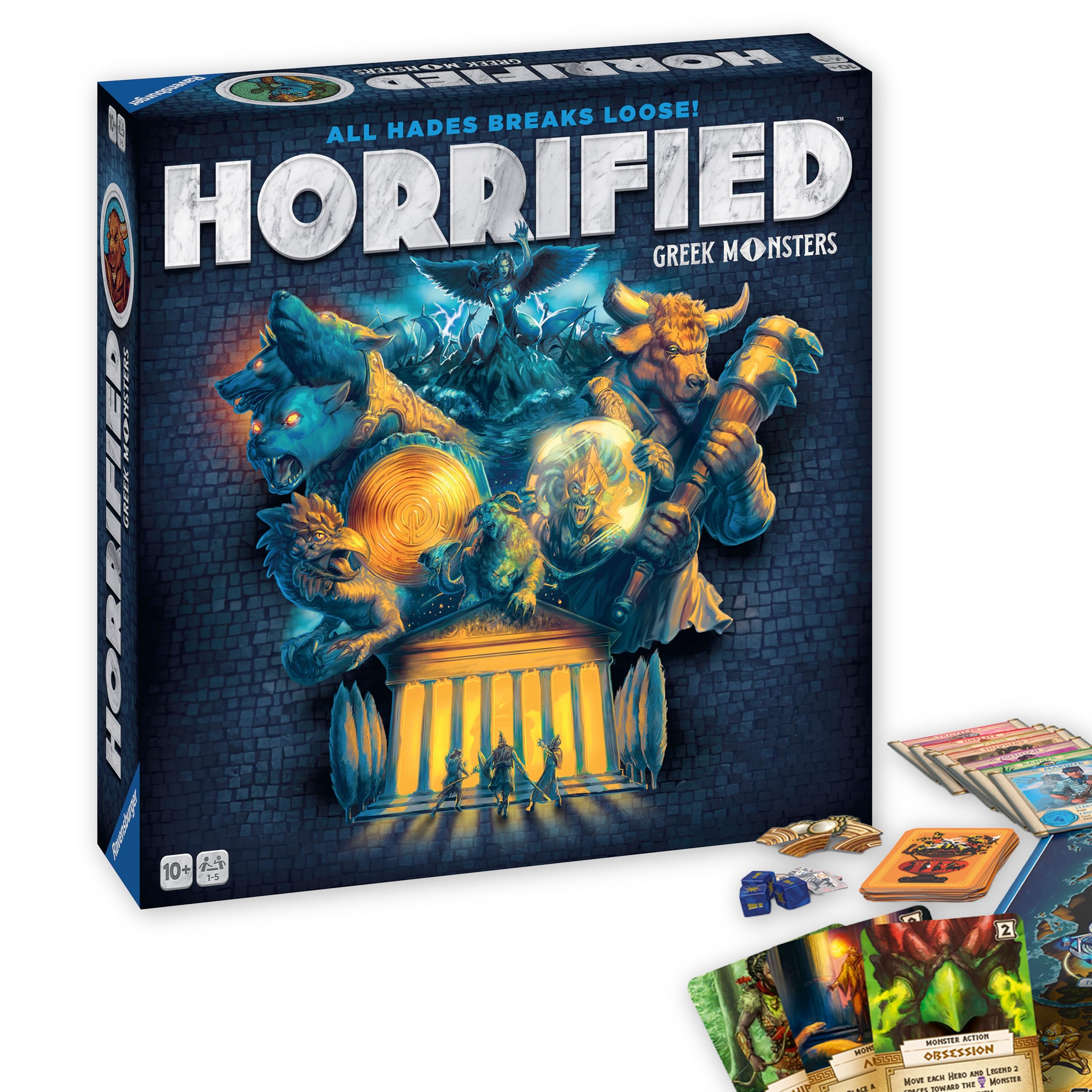
Horrified: Greek Monsters applies the successful formula of its predecessors to Greek mythology, challenging players to defeat six iconic monsters including Medusa, Cerberus, and Chimera. Each monster presents a unique puzzle that must be solved differently, requiring the team to adapt their strategy as new threats emerge. The pick-up-and-deliver mechanic combined with monster-specific defeat conditions creates a rich tactical experience.
The heroes in this version feature unique Favor of the Gods abilities that tie into their mythological backgrounds. The Shepherd hero, for example, gains advantages through leadership, while other heroes excel in direct combat or resource gathering. The game includes six monster mats, six monster figures, and a substantial collection of tokens and cards that fill the box with high-quality components.
Groups familiar with previous Horrified titles will recognize the core loop, but the Greek mythology reskin introduces new mechanics like lair discovery and monster-specific terror effects. The rulebook is clearly written, making this an accessible entry point for groups new to cooperative strategy games. The 60-minute playtime estimate holds reliably for most groups.
Why it’s great
- Each of the six monsters presents a unique puzzle, preventing the game from feeling repetitive.
- Hero abilities tied to mythological themes add thematic depth and strategic variety.
- Accessible rules make this a strong choice for groups new to cooperative strategy games.
Good to know
- The core gameplay loop is similar to other Horrified titles — choose your favorite monster theme.
- Monster mats are printed on thinner cardboard than other components and can catch inside the bag.
7. The Lord of The Rings: Adventure to Mount Doom

Adventure to Mount Doom guides players through the iconic journey of Frodo and the Fellowship, using dice-rolling and card-drawing mechanics to simulate the perilous trek across Middle Earth. The cooperative objective is straightforward — help Frodo destroy the ring while avoiding the Ringwraiths. The game captures the narrative beats of Tolkien’s story without requiring players to read lengthy lore passages.
The dice-rolling mechanic introduces enough randomness to keep the tension high, but the strategic card play gives players meaningful agency. Players report a win rate around 50-60 percent, which strikes the sweet spot between challenging and frustrating. The 50-minute playtime includes a high-stakes endgame sequence that ratchets up the pressure as Frodo approaches Mount Doom.
The rulebook has been criticized for scattering rules across example sections rather than consolidating them in one place, so new groups should budget extra time for the first session to clarify edge cases. The artwork and component quality are strong, and the game accommodates solo play for those who want to test their strategy alone.
Why it’s great
- The 50-60 percent win rate creates satisfying tension without feeling punishing.
- High-quality artwork and thematic components immerse players in Middle Earth.
- Solo play option adds flexibility for individual practice or enjoyment.
Good to know
- The rulebook layout is confusing, with rules distributed across examples rather than in a dedicated section.
- The dice-rolling component means luck can override good strategy in some sessions.
FAQ
How does a cooperative board game differ from a team vs. team game?
What is the ideal player count for a co-op board game?
Can cooperative board games be played solo?
Why do some cooperative games have a reputation for being difficult to win?
Final Thoughts: The Verdict
For most groups, the best cooperative board games winner is the Forbidden Jungle because it balances accessible rules with escalating tension that rewards genuine teamwork. If you want high-octane communication under pressure, grab the 5-Minute Dungeon. And for large party settings where negotiation drives the fun, nothing beats the We’re Doomed! for turning cooperation into chaos.

Mo Maruf
I created WellFizz to bridge the gap between vague wellness advice and actionable solutions. My mission is simple: to decode the research and give you practical tools you can actually use.
Beyond the data, I am a passionate traveler. I believe that stepping away from the screen to explore new environments is essential for mental clarity and physical vitality.