Our readers keep the lights on and my smoothie glass nicely filled. As an Amazon Associate, I earn from qualifying purchases.
Specs are compiled from manufacturer listings and verified buyer reviews and can change over time — please confirm the key details on the product page before buying.
Finding a board game the whole family can agree on usually means one thing: someone has to lose. That competitive tension — the quiet stare across the table, the “are you sure that move is legal?” — can turn a fun evening into a grudge match. Cooperative games flip that entirely. Your family sits on the same side, working together against the game itself, which means everyone wins or everyone loses together. The real prize is the conversation, the shared strategy, and the high-fives when a plan actually works.
I’m Mohammad Maruf — the founder and writer behind WellFizz. This guide is built by comparing the manufacturers’ published specifications and the patterns across verified customer reviews, so you get each pick’s real strengths and trade-offs instead of marketing spin.
These games reward teamwork, not individual glory, which makes them a natural fit for families with mixed ages and skill levels. Whether you are looking for a quick 30-minute word game or an epic 90-minute dungeon crawl, the right cooperative board games for families can turn any ordinary evening into a shared adventure that everyone looks forward to.
Our Picks at a Glance


How To Choose The Best Cooperative Board Games For Families
The big trap families fall into is picking a game that looks fun on the box but asks for more time or reading skill than the youngest player has. A game that takes 90 minutes to play might be fantastic for a teen-only evening, but it will lose a six-year-old by minute ten. Start by checking the age rating on the box and the estimated playing time — those two numbers tell you more about fit than any description.
Playing Time and Attention Span
Games in this category range from rounds as short as 5 minutes to sprawling adventures that last over an hour. If you have younger children, look for a playing time of 30 minutes or less. A 60-minute game is a solid choice for families with kids aged 10 and up, especially if the gameplay is engaging enough to keep everyone focused.
Player Count
Cooperative games handle odd numbers of players much better than competitive games because there are no teams to balance. Most games support 2 to 6 players, but check the maximum — a game that tops out at 4 players will leave someone sitting out during a larger family gathering. Some games also let people team up on a single role, which is a handy workaround.
Replayability
A strong cooperative game changes each time you play it. Look for games with modular components, variable difficulty settings, or a mix of challenges that appear randomly. If a game has a fixed storyline with pre-solved puzzles, you will likely get one good playthrough from it. That can still be a wonderful experience, but it is worth knowing upfront.
Quick Comparison
| Model | Best For | Playtime | Players | Age Range | Amazon |
|---|---|---|---|---|---|
| Asmodee So Clover!★ Best Overall | Word Association Fun | 30 min | 3-6 | 10+ | Amazon |
| Ravensburger Horrified Greek MonstersTop Performer | Mythological Strategy | 60 min | 1-5 | 10+ | Amazon |
| Thames & Kosmos LOTR AdventureAdventure Pick | Fantasy Dice Rolling | 50 min | 1-4 | Adult | Amazon |
| Hasbro D&D Bedlam in Neverwinter | Dungeon Crawl Mystery | 90 min | 2-6 | 12+ | Amazon |
| Fireside Games Castle Panic | Tower Defense Action | 45 min | 1-6 | 8+ | Amazon |
| Wiggles 3D 5-Minute Dungeon | Chaotic Fast Card Play | 5 min | 2-5 | 8+ | Amazon |
| Asmodee Concept Kids Animals | Young Children Learning | 20 min | 2-12 | 4+ | Amazon |
| Smirk & Dagger The Night Cage | Atmospheric Labyrinth | — | 1-5 | 14+ | Amazon |
| Asmodee Paleo | Stone Age Survival | 60 min | 2-4 | 10+ | Amazon |
In‑Depth Reviews
1. Asmodee So Clover! Party Game
Our pick — over 4.5★ from 950+ verified ratings; the strongest balance of quality and price.
The word game that turns everyone into a clue-giving genius, no shouting required.
So Clover! asks you to write a single clue that connects two random keywords on your clover leaf, then your teammates have to figure out which keywords each clue belongs to. The catch is you cannot just say “they are both red” — you have to be clever enough to make the connection clear but not so obscure that the team gets stuck. The result is a game that gets everyone’s brain working in a completely different way than a standard trivia or party game.
The things owners love most here are the gameplay itself and how easy it is to pick up. The game comes with 220 password cards, 6 clover boards, markers, a scorecard, and a rulebook. Families report that it works for ages 8 to 80, travels well, and keeps appearing at every vacation and family gathering. As the review pages sum it up: “Have played countless hours and will do many more.” The 30-minute playtime is a balance — long enough to feel satisfying, short enough to play multiple rounds.
There is really no downside for cooperative families, though if you have a player who struggles with vocabulary or wordplay, they might find the clue-writing pressure a bit much. The game encourages teamwork, so stronger players can help weaker ones, which is exactly the point.
Why It Works
- Ultra-clear rules let you start playing in under a minute
- Holds up to 6 players easily, and more can team up
- High replayability because every round uses different random keywords
Reach For It If
- You want a game that exercises vocabulary and creative thinking together
- Your family loves word games like Codenames but wants a cooperative twist
Grab This When: You need a game that is portable, easy to teach to grandparents and kids alike, and guarantees laughter without anyone feeling attacked.
Think Twice If: Your family includes reluctant readers or very young children — the game asks for writing clues, so a non-reader will need a teammate to write their clues for them.
2. Ravensburger Horrified Greek Monsters
A cooperative strategy game where you and your family become heroes facing Medusa and Cerberus.
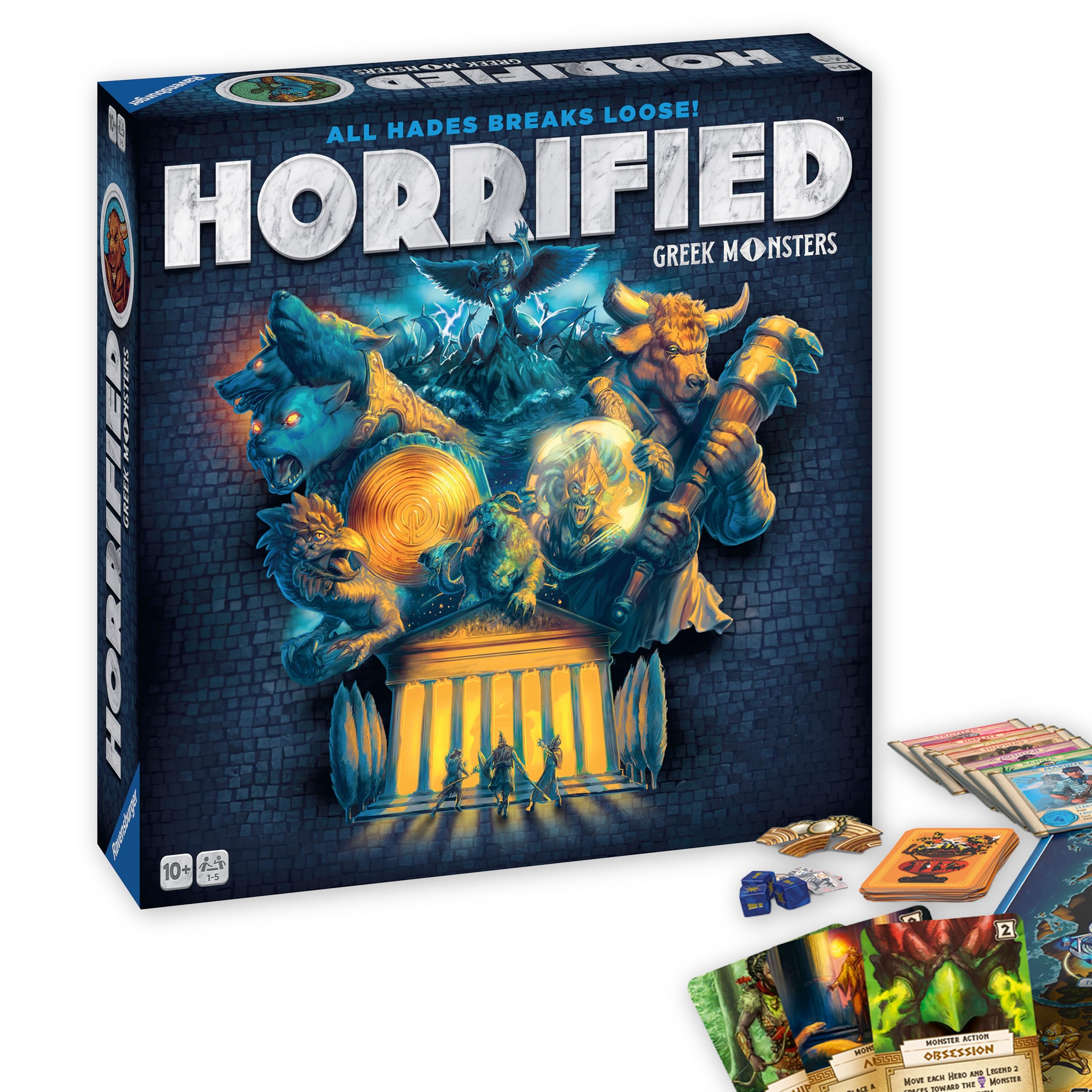
If your family has a Percy Jackson fan or anyone who loves Greek mythology, this is the game that marries theme with solid cooperative mechanics. You defend Elysium against 6 different monsters including Medusa, Cerberus, and Chimera. Each monster has its own unique challenge, which means every play session is a new puzzle to solve. The estimated playing time is 60 minutes, which fits neatly into a long evening without dragging too late.
The gameplay wins the most praise here — 53 owners single it out as the best part. The game quality comes in second, with buyers noting the thick cardboard and vibrant artwork. The cooperative nature is central: you communicate, trade items, and plan moves together to bring down the monsters. A typical game includes 6 monster figures, hero tiles, item tokens, dice, and a rulebook. The 60-minute session gives you time to develop a real strategy without overstaying its welcome, and the 60-minute playtime, compared to the 30-minute So Clover!, means you get a deeper, more thoughtful experience.
The difficulty rating is mixed — some families find the learning curve a bit steep compared to simpler party games. The monster mats are also noted as a bit flimsy compared to the thicker board components. If you have younger kids who get frustrated with rules, this one works better with ages 10 and up who can handle strategy.
Best For Myth Lovers: The theme is rich and the monster-specific challenges keep each game fresh — buyers report it works well for both solo play and groups of 5.
Heads Up On: The rulebook is streamlined and lacks monster backstory, so fans of the lore might want to read up on the myths separately before playing.
Pick This If: Your family likes strategic planning and has a soft spot for Greek mythology — the cooperative puzzle-solving is genuinely rewarding.
skip it if: You need a quick 30-minute game after dinner; the 60-minute commitment and setup time require a dedicated game night slot.
3. Thames & Kosmos Lord of the Rings Adventure to Mount Doom
Roll dice, draw cards, and help Frodo destroy the One Ring before the Ringwraiths catch you.
This is the game for the family that grew up on the movies and wants to recreate the journey through Middle-earth together. You and up to 3 other players roll dice and draw cards to move Frodo across the board and avoid the Ringwraiths. The estimated playing time is 50 minutes, and the game can also be played solo. The mechanics are straightforward — dice-rolling with strategic choices about which risks to take.
The artwork is a standout feature that owners consistently mention. The game board and cards are beautifully illustrated, and the theme pulls everyone into the story. The difficulty level sits in a comfortable middle ground: challenging enough that winning feels earned, but not so punishing that casual players give up. Owners mention a rough win rate of 50-60%, which keeps the tension high without making the game feel impossible. The gameplay changes each time because the cards and dice outcomes are random, so the journey never plays out exactly the same way twice.
Instructions are where some families hit a snag. A few owners found the rulebook confusing at first, though the gameplay itself is simple once you get past the initial learn. If your family includes a hardcore strategy gamer, this might feel a bit simple for them — it is designed for casual play and family fun, not deep tactical planning.
The Big Draw: The theme is irresistible for LOTR fans and the 50-minute playtime hits a nice middle ground between quick and epic.
One Caveat: The rulebook could be clearer — watch a quick tutorial video before your first game to avoid confusion.
Perfect For: A family that wants a themed adventure game without the complexity of a full RPG — it is a wonderful bridge for casual gamers.
Not For: Groups who prefer pure strategy over luck-based mechanics; the dice rolls are a significant factor in your success.
4. Hasbro Gaming Dungeons & Dragons Bedlam in Neverwinter

Three acts of escape-room puzzles and monster battles, all inside a changing game board.
This game combines the cooperative puzzle-solving of an escape room with the character creation and combat of Dungeons & Dragons. Players choose a Race, Class, and Starting Weapon, then work together to investigate a series of disappearances in Neverwinter. The game has 3 acts, each estimated to take about 90 minutes, making it a significant commitment that works best for dedicated game nights or weekend sessions. The dynamic game board builds and changes as you solve puzzles that open up new locations and clues.
Owners praise how accessible the game is for non-D&D players — it captures the spirit of the RPG without requiring the deep rules knowledge of a full campaign. The puzzles range from wordplay to multi-card visual riddles, and the numbered card system is cleverly designed. The 298 cards, 6 plastic figures, 11 gameboards, and secret envelopes create a rich, story-driven experience. The biggest trade-off reported is replayability: once you have solved the puzzles and discovered the mystery, there is not much reason to play again. But for the three evenings it lasts, the experience is described as excellent and rich.
A minor irritation some note is that all the character cards and miniatures depict female characters. If your group prefers a mix of representations, be aware of this before buying. The combat itself is described as simple and fast, keeping the focus on the story and puzzles rather than complex battle mechanics.
What Wins People Over
- Excellent introduction to D&D themes without the rules overhead
- High-quality components and rich artwork
- Three acts give you multiple sessions of cooperative fun
The Real Trade-off
- One-time play experience — once puzzles are solved, the mystery is gone
- Long 90-minute acts require focused attention from all players
Reach For This When: You want a special-event game night with teens or adults who love puzzles and storytelling — it makes for an unforgettable three-evening adventure.
Look Elsewhere If: You need a game your family will play again and again; this is a finite experience designed for one winning playthrough.
5. Fireside Games Castle Panic 2nd Edition

Defend the castle together as monsters surge in from all sides in this tense 45-minute battle.
Castle Panic puts every player in the same corner: your castle has three towers, and monsters are coming from every direction. You trade cards, coordinate attacks, and make tough calls about which threat to handle first. The game has 3D towers, vibrant monster tokens, and an illustrated board that makes the siege feel real. The gameplay gets the most praise — 53 owners highlight it — with cooperative play and ease of use following close behind.
The 2nd edition offers four different modes: cooperative, solo, a competitive Master Slayer mode, and an Overlord mode where one player controls the monsters. This variety means the same box can feel like a different game depending on your group’s mood. Families report playing it 15 times in a single month and then buying the expansion. The difficulty escalates as the game progresses, so the first few rounds are manageable while later rounds demand real teamwork and communication. It works for 1 to 6 players aged 8 and up, and the 45-minute playtime fits neatly into a school night.
The artwork is described as functional rather than beautiful, and experienced gamers might find the strategic depth a bit thin for repeated plays. The base game is accessible by design, which is exactly what makes it so good for mixed-age groups, but dedicated strategy fans may want the expansions to add more complexity.
The Thing Everyone Raves About: The cooperative tension — you genuinely need to talk and plan together to survive the later waves of monsters.
Who This Fits: Families with kids aged 8 to 12 who love the idea of defending a castle together without complicated rulebooks.
Best For: Regular family game nights where you want a cooperative game that is easy to teach but still offers real strategic choices.
Not Ideal If: Your family has hardcore strategy gamers who want deep, complex mechanics — this is designed for accessibility first.
6. Wiggles 3D 5-Minute Dungeon

A chaotic race against the clock where every round lasts exactly five frantic minutes.
Your family will be shouting, laughing, and frantically slapping cards down in this real-time cooperative card game. Each dungeon run is timed to 5 minutes, and you have to match your cards to the symbols in the dungeon deck to survive. The game comes with 275 cards, 5 double-sided hero mats (giving you 10 different heroes), and 3 double-sided boss mats (6 bosses). There is a free timer app with six different themed narrators to keep the pressure on.
Gameplay is the top-mentioned aspect, with 82 owners praising the intense, fast-paced action. The pacing earns 46 mentions as a standout feature — the short rounds mean you can play several dungeons in one sitting, and the whole experience feels like an adrenaline shot compared to slower strategy games. The cooperative nature gets 17 mentions, and families note that even younger players can jump in because the mechanics are so simple: match the symbols. The unique character abilities mean each player feels like they have a special role in the team’s success.
The intensity is mentioned as both a positive and a negative — 9 owners flag it as mixed, meaning the chaotic speed can be stressful for players who prefer thoughtful, turn-based games. If your family has a member who hates being rushed, this might cause more frustration than fun. The cards and box are praised for their quality and portability, making it an excellent travel game.
What Makes It Work
- Extremely fast setup and teardown — perfect for short attention spans
- High replayability with 6 different bosses and 10 heroes
- Free companion app with themed narrators adds variety
Who Might Struggle
- Players who dislike time pressure or find fast-paced games stressful
- Families who prefer deep strategy over reaction speed
Pick This For: High-energy families who love fast reactions and loud, fun game sessions — it turns a coffee break into a mini-adventure.
Not The Right Fit: Calm, think-through-every-move families who prefer turn-based games without a clock counting down.
7. Asmodee Concept Kids Animals

The youngest players finally get a cooperative game designed specifically for their level.
Concept Kids Animals strips away all reading and complex rules. Players place pawns on illustrated icons to hint at the features of animals, and the team tries to guess which animal is being described. The game includes 110 animals divided into two difficulty levels, so you can start with easy ones like cat and dog and work up to more exotic creatures. A single round takes about 10 minutes, and the estimated playing time of 20 minutes for a full game keeps young minds engaged without wandering.
Educational value is the second-most praised aspect after gameplay itself. Kids learn to observe details — is it a flipper or a foot? Does it live in water or on land? The cooperative nature means there is no losing, just learning together. Parents report that 4-year-olds pick up the concept quickly, and older siblings still enjoy giving and receiving clues. The game board, 110 cards, 16 rings, and card holder are all beautifully illustrated, adding to the appeal.
The durability of the components gets some negative mentions — the cardboard tokens and cards may show wear with heavy use from young children. Additionally, some of the animals on the cards are quite obscure, and there is no animal key printed on the cards, which means an adult may need to look up unfamiliar species. The “hard” and “easy” categories on the cards are not always consistent, so you may want to preview the deck before playing with very young kids.
The Big Win: This game teaches observation and deduction without any reading, making it accessible to pre-literate children and non-native speakers alike.
The Minor Catch: Some animals are obscure enough that adults will need to help identify them — a quick phone search is the workaround.
Ideal For: Families with children aged 4 to 7 who want a screen-free activity that builds vocabulary and observation skills through teamwork.
Less Suitable For: Older kids or teens who will find the animal-guessing concept too simple — this is firmly aimed at the early childhood crowd.
8. Smirk & Dagger The Night Cage

A shifting maze in total darkness where your only light is a single candle.
The Night Cage is unlike any other game on this list. You and your team are trapped in a labyrinth that only reveals itself when your candle is nearby. Dark tiles swallow paths you leave behind, so you have to stay close together and communicate constantly to collect keys, find the gate, and escape before the maze collapses. The recommended experience is to play in a dark room with real candles and the Spotify playlist — the atmosphere is the whole point.
The gameplay wins 38 mentions as the standout feature, with game quality close behind at 24. The cooperative teamwork required is intense because limited vision means no single player can see the whole picture. The game includes adjustable difficulty settings and an Advanced Game mode with new monsters and obstacles, extending replayability significantly. The tile system creates a unique maze every time, so no two games play out the same way. The boxed weight is 1100 grams, and the item dimensions are 10.75 x 10.75 x 3 inches.
The difficulty level is genuinely mixed — 25 owners mention it as a challenge point. The rulebook could be clearer for beginners, and some players find the limited vision mechanic frustrating rather than atmospheric. With 4 or 5 players, there is a risk that one or two dominant players will drive the strategy, leaving quieter players feeling like followers. The game also requires a bit of setup and a dedicated space to play with the dark-room atmosphere.
The Unique Appeal
- rich candlelit gameplay creates real tension and teamwork
- High replayability with adjustable difficulty and advanced mode
- Eerie minimalist art that perfectly matches the theme
Heads Up
- Rulebook could be clearer — expect a learning game before the real fun starts
- Not ideal for groups where one player tends to quarterback the whole session
Best For: Teens and adults who love atmospheric, horror-tinged experiences and want a game that feels genuinely tense and strategic.
pass on it if: You have young children or players who get anxious with dark themes — the game is rated ages 14+ for good reason.
9. Asmodee Paleo Board Game

Keep your Stone Age tribe alive by gathering food, crafting tools, and facing unexpected dangers.
Paleo takes you back to 10,000 BCE, where every decision matters for your tribe’s survival. You send characters to diverse locations to collect resources like food and wood, then craft items and complete quests to bring a mammoth cave painting to life. The game comes with 222 cards, 40 wood tokens, 98 cardboard tokens, boards, dice, and a graveyard where your fallen tribe members end up. The estimated playing time is 60 minutes, and the age rating starts at 10 years.
The cooperative element here is pure survival — if one player fails to bring back enough food, the whole tribe suffers. The gameplay earns 14 positive mentions, and the cooperative nature gets 7. The game has multiple modules that introduce new people, locations, and quests, which keeps the experience fresh even after many plays. Buyers who have owned the game for 6 months report there are still versions they have not explored yet. The immersion in the Paleolithic theme is strong — you gather food, craft essential items, and protect your group from threats like predators and weather events.
The learning curve is the biggest hurdle. The rulebook is information-heavy and not particularly intuitive, and some of the mechanics — like turning to craft a spear — require a few games to master. Players who push through the initial confusion find it deeply rewarding, but casual families might bounce off the first time they play. The mixed reviews on rules (6 negative mentions) and difficulty (6 mixed mentions) suggest this is best for families who enjoy learning a slightly complex game together.
The Core Draw: Meaningful strategic choices where every resource counts — it is the closest thing to a survival simulation for the tabletop.
The Catch: The setup and rule explanation will take patience the first time; commit to playing at least twice before judging the experience.
Perfect For: Families who enjoy a thematic challenge and do not mind a learning curve — the depth and replayability pay off after a few sessions.
Not For: Groups that want to open the box and start playing in under 5 minutes; this one needs a deliberate learning session.
Understanding the Specs
Playing Time
The number on the box tells you how long a typical game takes from start to finish. For younger children, 30 minutes is usually the upper limit before attention starts to drift. Older kids and adults can comfortably handle 60 to 90 minutes, especially if the theme and mechanics keep everyone engaged. The fastest games on this list — 5-Minute Dungeon and Concept Kids Animals — can be played multiple times in one sitting if the first round leaves everyone wanting more.
Player Count and Age Rating
A cooperative game with a maximum of 4 players means someone sits out at a larger family gathering. Look for games that support 5 or 6 players if you have a big family. The age rating matters more for cooperative games than competitive ones because the mechanics need to be comprehensible to the youngest player — if they cannot participate meaningfully, the whole team suffers. Games with no-reading-required mechanics, like Concept Kids Animals, are perfect for bridging the gap between a 4-year-old and a teenager.
Replayability
Games with modular components, random card draws, or variable challenges offer more value over time. A game like So Clover! changes every round because the keywords are random. A game like Bedlam in Neverwinter has fixed puzzles that are solved once. Neither is wrong — you just need to know which kind of experience you are buying. Escape-room-style games give you a memorable few evenings, while modular games keep coming back to the table year after year.
Complexity vs Accessibility
Not all cooperative games are simple. Some, like Paleo and The Night Cage, have multi-step rules and require strategic thinking. Others, like Castle Panic and 5-Minute Dungeon, can be taught in a minute or two. Be honest with yourself about how much patience your family has for learning games. A game that takes 20 minutes to explain might be fantastic once you get there, but if the explanation session kills the excitement before the first round, it will not get played again.
FAQ
What is the difference between cooperative and competitive board games?
Can cooperative games be played with only 2 players?
What is the best cooperative board game for a 4-year-old?
How long do cooperative board games typically take to play?
Can you play cooperative board games alone?
What happens if one player is much better than the others in a cooperative game?
How many players do most cooperative family games support?
Are cooperative board games less fun than competitive ones?
What is the best cooperative board game for a family with teenagers?
Final Thoughts: The Verdict
If you want one dependable pick, the cooperative board games for families winner is the Asmodee So Clover! because its simple rules, 30-minute playtime, and word-association fun work across nearly every age group and play style. If you want a monster-defeating adventure with deeper strategy, grab the Ravensburger Horrified Greek Monsters. And for families with very young children aged 4 and up, the Asmodee Concept Kids Animals is the one to reach for — it delivers educational play with zero reading required and supports up to 12 players, making it perfect for large gatherings.
How We Picked
We do not accept paid placement. Every pick is matched to a real buyer and a real use-case; we do not hands-on test units.
Sources & Methodology
Specifications: manufacturer listings and product documentation. Review insights: verified customer reviews, as of July 2026. Pricing: not shown on this page (it changes often); check the current price via the retailer link.
As an Amazon Associate, WellFizz earns from qualifying purchases. This does not affect which products we feature.
Related Guides

Mo Maruf
I created WellFizz to bridge the gap between vague wellness advice and actionable solutions. My mission is simple: to decode the research and give you practical tools you can actually use.
Beyond the data, I am a passionate traveler. I believe that stepping away from the screen to explore new environments is essential for mental clarity and physical vitality.