Our readers keep the lights on and my smoothie glass nicely filled. As an Amazon Associate, I earn from qualifying purchases.
Finding a board game that truly works for exactly two players — and keeps both of you engaged rather than one waiting for the other to act — is surprisingly hard. Most so-called two-player games are either competitive slugfests or scaled-down versions of larger party games that lose their magic at low player counts. The real sweet spot lies in cooperative experiences where you share a dilemma, debate a move, and win or lose together.
I’m Mohammad Maruf — the founder and writer behind WellFizz. I’ve spent countless hours analyzing gameplay mechanics, component quality, and replay value to identify which titles deliver genuine tension and teamwork for a pair of players rather than just tolerating them.
The market is flooded with options, but the very best cooperative board games for 2 players blend asymmetric roles, tight resource puzzles, and enough strategic depth to stay fresh after a dozen plays.
How To Choose The Best Cooperative Board Games For 2 Players
A two-player cooperative game must solve a problem that doesn’t exist at higher player counts: what happens when both players know the same information and the usual hidden-hand trick is gone. The best designs introduce limited communication, asymmetric abilities, or a shared resource economy that forces real collaboration rather than parallel solitaire play. Look for games where you cannot win by simply optimizing your own side in isolation.
True Co‑op vs. Team‑based Competition
Many games marketed as cooperative are actually team‑versus‑team at heart, which doesn’t work well with only two players. A true co‑op asks you to beat the game itself — a timer, a spreading threat, a common goal — rather than each other. For two players, the best options are those where the game’s AI or difficulty scaling adjusts for exactly one or two characters, giving you a satisfying puzzle without needing to quarterback.
Replayability Through Variable Setup
A two‑player co‑op can burn out fast if the setup is static. The most durable titles offer randomized boards or card pools, multiple win conditions, or character pairings that change how you approach every turn. A game with a single scripted scenario might be a wonderful one‑evening experience, but for a regular duo it needs to feel different on the tenth play than it did on the first.
Play Time and Complexity Weight
Two‑player sessions often happen on a weeknight after the kids are asleep or during a quiet Saturday morning. A game that demands a three-hour rules teach and a two‑hour playtime may sit on the shelf. Thirty to sixty minutes is the sweet spot for most couples and friends. Complexity should land at a medium weight — rules that fit on a two‑page reference sheet but with tactical decisions that reward repeated plays.
Quick Comparison
On smaller screens, swipe sideways to see the full table.
| Model | Category | Best For | Key Spec | Amazon |
|---|---|---|---|---|
| Everdell Duo | Strategy | Woodland-themed campaign play | Standalone; 30 min playtime | Amazon |
| 7 Wonders Duel | Strategy | Competitive two‑player drafting | Three distinct win conditions | Amazon |
| Lord of the Rings: Duel | Thematic | LOTR fans wanting tight duels | Asymmetric Fellowship vs Sauron | Amazon |
| Adventure to Mount Doom | Co‑op | True cooperative LOTR quest | Up to 4 players; dice-rolling | Amazon |
| Dittle Dice Battle | Family | Quick bar or coffee table game | Wooden board; 15 min playtime | Amazon |
| Bedlam in Neverwinter | Escape Room | Immersive D&D puzzle adventure | 3 acts; 90 min each | Amazon |
| Forbidden Jungle | Co‑op | Matt Leacock fans | Adjustable starting threat level | Amazon |
In‑Depth Reviews
1. Everdell Duo
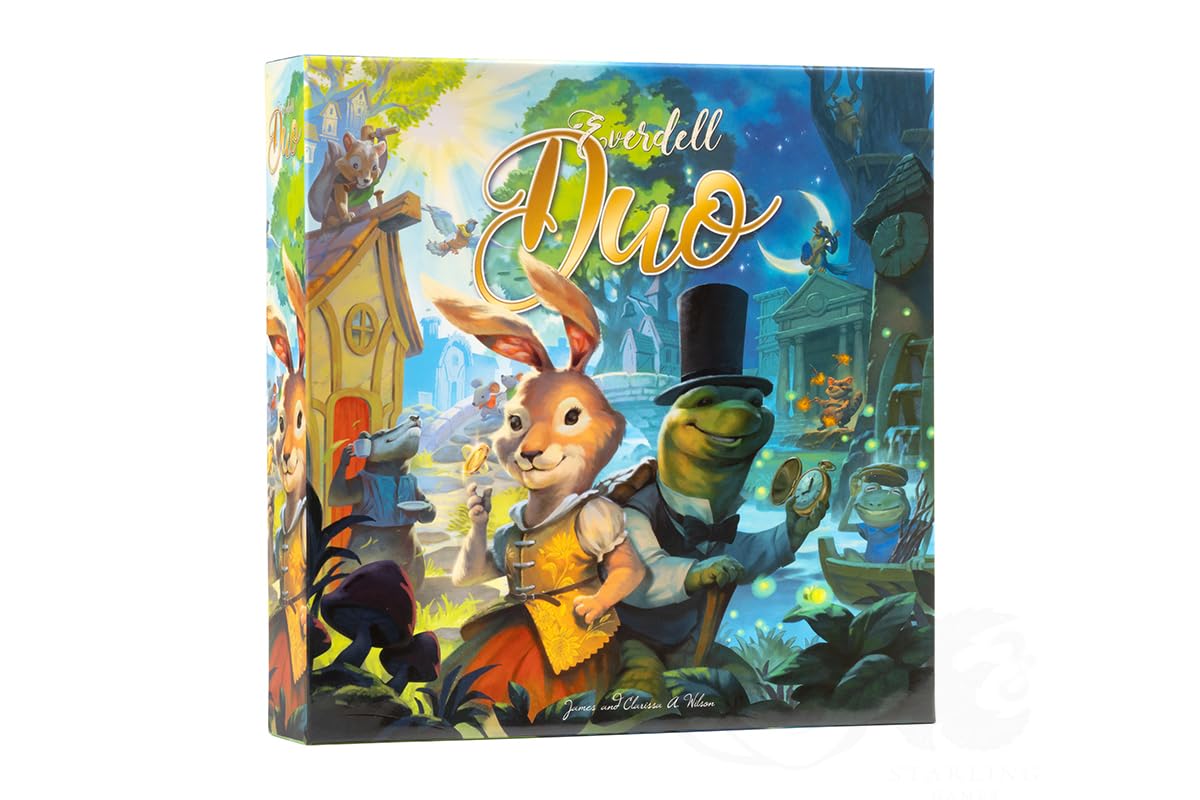
Everdell Duo is the rare standalone that was built from the ground up for exactly two players — no base game needed, no awkward scaling. Instead of being a trimmed version of a larger title, it introduces sun and moon tokens and a shifting meadow mechanic that keep the card‑drafting tight and tactical. The 15‑chapter campaign adds persistent stakes that pressure both players to coordinate resources across multiple sessions.
The worker‑placement and engine‑building loop is familiar to anyone who has played the original Everdell, but the duo‑specific rules trim away the downtime that plagues four‑player games. Each turn matters because your partner’s choices directly affect the available meadow. The 30‑minute playtime means you can finish a chapter during a lunch break or squeeze in two games back to back.
Component quality is exceptional — thick Critter cards, wooden meeples, and a double-sided board that flips for the campaign mode. The rulebook is clear enough that you can teach it in the first round, but the strategic depth emerges as you learn which chapter events to prioritize together.
Why it’s great
- True standalone for two with no base game required
- Campaign mode adds long‑term motivation and variety
- High‑quality components and charming woodland art
Good to know
- Box may need horizontal storage to avoid component spillage
- Kickstarter‑exclusive short stories not included in retail
2. 7 Wonders Duel

7 Wonders Duel is the gold standard for two‑player civilization drafting. The card‑pyramid layout — some face up, some face down — creates a constant risk‑reward puzzle as you decide which cards to deny your opponent versus which to claim for yourself. The three victory conditions (military, scientific, points) mean the game can end suddenly, keeping tension high from the first turn to the last.
The military tug‑of‑war is particularly elegant. Neglect your defenses and your capital falls; over‑invest in them and you bleed resources that could fund wonders or scientific progress. The science victory, requiring six unique symbols, forces a deliberate race that can completely short‑circuit a points‑based strategy. With the Agora expansion, the depth increases further, but the base game alone provides dozens of fresh matchups.
Setup is fast once you internalize the card pyramid rule, and the 30‑minute runtime makes it easy to justify a rematch after a loss. The card art is clean and thematic, and the symbol language is intuitive after a single play.
Why it’s great
- Three distinct win paths keep every game unpredictable
- Card‑denial mechanic forces interactive drafting
- Plays in 30 minutes with very quick setup
Good to know
- Learning curve for card types and token interactions
- Some Progress token and Guild card combos can feel unbalanced
3. Lord of the Rings: Duel for Middle‑Earth

Lord of the Rings: Duel for Middle‑Earth takes the 7 Wonders Duel engine and wraps it in asymmetric Tolkien combat. One player commands the Fellowship, the other controls Sauron, and each side has unique abilities, objectives, and card pools. The three win conditions — Quest for the Ring, Alliance with six Peoples, or Dominating Middle‑earth — mean that a single misplay can shift the entire momentum.
Borrowing the face‑up/face‑down card pyramid from its predecessor, the game adds area control elements and a tower‑building mechanic that gives each chapter a distinct feel. The asymmetrical leaders provide strong replayability; swapping which side you play changes the puzzle completely. The art is colorful and faithful to the source material, and the components — 69 cards, 44 pawns, and two player boards — feel sturdy.
Sessions average around 30 minutes, but the tactical crunch per minute is high. The resource economy is less punishing than 7 Wonders Duel, making it more forgiving for new players while still offering depth for veterans. Every decision carries weight, and the tug‑of‑war dynamic keeps both players locked in.
Why it’s great
- Asymmetric Fellowship vs Sauron roles are brilliantly balanced
- Area control adds a new layer to the classic card pyramid
- Stunning, lore‑accurate artwork throughout
Good to know
- Not a cooperative game — it’s head‑to‑head with thematic win conditions
- Some repeat‑turn abilities can feel overpowered in early games
4. Lord of the Rings: Adventure to Mount Doom

Adventure to Mount Doom is a true cooperative experience where two players roll dice and play cards to help Frodo navigate Middle‑earth while evading Ringwraiths. Unlike the Duel version, this is fully collaborative — you win or lose together. The dice‑rolling mechanics introduce a luck element that keeps each playthrough tense, and the strategic card play lets you mitigate bad rolls and push the Fellowship forward.
The game is designed for up to four players but scales beautifully to two because each player controls multiple characters. The 50‑minute playtime gives you enough room to feel the narrative arc of Frodo’s journey without overstaying its welcome. The art is faithful to Tolkien’s world, and the component quality — board, dice, cards — holds up to repeated handling.
The rulebook could be clearer; some players report needing to cross‑reference examples scattered across the pages. Once you internalize the flow, though, the game becomes a tight resource‑management puzzle where communication between two players is essential. The win rate hovers around 50‑60%, offering a satisfying challenge without being punishing.
Why it’s great
- Fully cooperative with a clear shared objective
- Dice‑rolling creates exciting risk‑reward moments
- High replayability with random card draws
Good to know
- Rulebook layout can be confusing for first‑time players
- Dice luck can sometimes override strategic planning
5. Dittle Dice Battle

Dittle Dice Battle is a deceptively simple dexterity and strategy hybrid where you tilt and jump dice across a wooden board to reach the opponent’s side. Scoring is based on the face value of each die that crosses, so you must decide whether to push high‑value dice carefully or sacrifice points for aggressive positioning. The playtime is just 15 minutes, making it the fastest game in this list.
The board is made from sustainably sourced New Zealand wood and doubles as coffee table decor when not in use. The rules are simple enough for a six‑year‑old yet offer enough tactical depth — blocking, jumping, and reading your opponent’s dice orientation — to keep adults engaged. The eco‑friendly angle, with a tree planted for each game sold, adds a feel‑good factor.
Component quality is strong: a solid wood board and large dice that are easy to handle. The only downside is that the instruction manual can be ambiguous about certain jumping rules, but a quick YouTube video clarifies everything. It’s the ideal filler game for a pub, a patio, or a quick break between heavier sessions.
Why it’s great
- Ultra‑fast 15‑minute games for quick bursts
- Beautiful, sustainable wood construction
- Simple enough for all ages but tactical for adults
Good to know
- Rules feel slightly ambiguous for edge‑case jumps
- Deck‑based strategy purists may want more depth
6. Dungeons & Dragons: Bedlam in Neverwinter

Bedlam in Neverwinter is a cooperative escape‑room board game set in the D&D universe. Two players create characters by choosing race, class, and starting weapon, then work through a three‑act story where each act takes about 90 minutes. The game board builds dynamically as you solve puzzles and unlock locations, revealing new clues and monsters as the mystery deepens.
The puzzle variety is impressive — wordplay, multi‑card visual riddles, and exploration‑based challenges — all tied together with a d20 skill‑test system that gives the game genuine D&D flavor. Combat is streamlined for accessibility, focusing on tactical decisions rather than complex rulebooks. The 298 cards, four secret envelopes, and 11 gameboards create a robust, self‑contained campaign.
The main caveat is that the game is designed for a single playthrough; after completing all three acts, the surprise of the puzzles is gone. However, components are reusable and the narrative is strong enough that fans will enjoy replaying with different character builds. At this price point, it offers a premium evening of entertainment for a dedicated duo.
Why it’s great
- Immersive D&D escape‑room experience without a DM
- Dynamic board reveals keep discovery exciting
- Solid component quality with miniatures and dice
Good to know
- Limited replay value after solving all puzzles
- All character miniatures are female, which may disappoint some
7. Forbidden Jungle

Forbidden Jungle is the latest cooperative tile‑laying game from Matt Leacock, the designer behind Pandemic. Two players take on unique roles — each with special abilities — and work together to align crystal tiles, reveal the jungle, and escape before the threat level overwhelms them. The alien life cycle (egg to hatchling to adult) introduces a persistent pressure that forces tough decisions about resource allocation.
The game offers an adjustable starting threat level, letting you dial in the difficulty. At the standard setting, the win rate is challenging but fair; at the beginner level, it’s a good introduction to the Forbidden series. The 44 cards, 47 miniatures, and numerous tokens create a rich tactile experience, though the box is packed tight with small components that need careful organization.
For two players, each can control one or two characters, giving you flexibility to scale up complexity. The puzzle quality is high — you must balance revealing new tiles, managing alien spawns, and moving toward the exit. It’s harder than Forbidden Island but comparable to Forbidden Sky, offering a solid challenge for experienced duos.
Why it’s great
- Adjustable threat level suits both beginners and veterans
- Unique player roles force genuine cooperation
- High‑quality tiles and miniatures
Good to know
- Many small components require careful storage
- Advanced difficulty can feel punishing on bad draws
FAQ
Can most cooperative board games be played with only two players?
How important is replayability for a two‑player co‑op game?
What is the ideal playtime for two‑player cooperative games?
Final Thoughts: The Verdict
For most users, the cooperative board games for 2 players winner is the Everdell Duo because it’s a true standalone design with a campaign that keeps you coming back, beautiful components, and a tight 30‑minute loop. If you want a classic, endlessly replayable duel with multiple win conditions, grab the 7 Wonders Duel. And for a quick, tactile coffee‑table game that works in 15 minutes, nothing beats the Dittle Dice Battle.

Mo Maruf
I created WellFizz to bridge the gap between vague wellness advice and actionable solutions. My mission is simple: to decode the research and give you practical tools you can actually use.
Beyond the data, I am a passionate traveler. I believe that stepping away from the screen to explore new environments is essential for mental clarity and physical vitality.