Our readers keep the lights on and my smoothie glass nicely filled. As an Amazon Associate, I earn from qualifying purchases.
When the heat cranks up past your comfort zone—whether you’re on a construction site, riding a motorcycle, or managing MS heat intolerance—a cooling vest isn’t a luxury, it’s a necessity that keeps you productive, safe, and sane. The real challenge is cutting through a market where evaporative fabrics promise hours of relief while ice-phase vests offer brute-force chilling, forcing you to choose between weight, runtime, and convenience. I’m Mohammad Maruf — the founder and writer behind WellFizz. I’ve spent hundreds of hours analyzing the thermodynamics, material science, and real-world user data behind the most popular cooling vests to separate the true performers from the wet towels with zippers. Whether you need to survive a 100°F work shift or reclaim your summer garden without triggering heat sensitivity, the right cooling vest comes down to understanding how evaporative vs. ice-based systems interact with humidity, airflow, and your body’s heat load.
How To Choose The Best Cooling Vest
Finding the right cooling vest means understanding the heat you’re fighting—dry and windy environments favor evaporative fabrics, while humid or low-airflow settings demand ice-phase materials that don’t rely on evaporation to work. Your choice also depends on how long you need relief, how much weight you can tolerate, and whether you need to wear it under clothing or over everything. Focus on these three factors to narrow the field.
Evaporative vs. Ice-Based Technology
Evaporative vests use super-absorbent materials like PVA or embedded polymer fabrics that release water slowly to create a cooling sensation as wind passes over them. They work best in dry climates or when you have constant airflow from a fan or motorcycle speed, lasting 4–10 hours depending on humidity. Ice-phase vests use freezable water or gel packs that absorb body heat as they melt, delivering intense core cooling for about 1–2 hours per set regardless of humidity. Fan-assisted vests add a third option, using battery-powered fans to pull heat away from your torso, but add weight and noise.
Weight, Fit, and Material Durability
A vest that feels light when dry can double in weight when saturated with water, so check whether the evaporation material stays manageable when wet. Ice vests typically weigh 3.5 to 5 pounds with frozen packs. Sizing is critical—many evaporative vests shrink up to two sizes when wet, requiring you to buy larger. Look for adjustable straps, front zippers, and breathable mesh panels that prevent the vest from trapping heat underneath its own fabric. Materials like rip-stop nylon and neoprene resist seam failure better than budget polyester shells under frequent use.
Runtime and Recharge Method
For evaporative vests, the recharging method is as simple as dipping in water and wringing out—no freezer required, making them ideal for remote job sites. Ice-based vests need 10–12 hours in a freezer to fully freeze, and you’ll need multiple panel sets if you work an eight-hour shift. Fan vests rely on battery capacity measured in milliamp-hours; larger packs (like 30,000 mAh) can run all day but add bulk to pocket placement. Match the recharge cycle and runtime to your work schedule or activity length before you buy.
Quick Comparison
On smaller screens, swipe sideways to see the full table.
| Model | Category | Best For | Key Spec | Amazon |
|---|---|---|---|---|
| FlexiFreeze Professional Series | Ice-Based Heavy Duty | Extended shifts, high-visibility jobs | Ice panels ~1.5 hrs each, Hi-Vis rip-stop | Amazon |
| THEKUKU T5 | Active Fan | Construction, cosplay, all-day outdoor work | 30,000 mAh battery, cooling plate | Amazon |
| FlexiFreeze Personal Series | Ice-Based Light Duty | Motorcycle, gardening, MS relief | 3.5 lbs, <1″ thick, neoprene | Amazon |
| TechNiche Women’s Deluxe | Women’s Evaporative | Equestrian, biking, heat sensitivity | 5–10 hrs cooling, mandarin collar | Amazon |
| Ergodyne Chill-Its 6667 | Budget Evaporative | Construction, roofing, mild heat | PVA material, lightweight mesh | Amazon |
| HyperKewl Sport V-Neck | Value Evaporative | Motorcycle, yard work, 100°F+ dry heat | HyperKewl fabric, 5–10 hr runtime | Amazon |
| TechNiche HyperKewl Sport | Mid-Range Evaporative | Motorcycle riding, dry climates | Quilted nylon, 8 oz dry weight | Amazon |
In‑Depth Reviews
1. FlexiFreeze Professional Series Ice Vest

The Professional Series from FlexiFreeze is the gold standard for anyone who needs intense phase-change cooling in a genuinely durable shell. The heavy duty rip-stop fabric resists snags on job sites, while the 3M reflective striping gives you Hi-Vis Class 1 compliance—a critical safety feature for road crews and warehouse workers that most vapor vests skip entirely. At less than four pounds when fully frozen, the three pure-water ice panels attach via full-length Velcro strips and deliver about 90 minutes of true core-chilling power per set.
What sets this vest apart from the Personal Series is the build quality: solid YKK zippers replace the weaker zipper found on the cheaper model, and the hook-and-loop closure version (Navy) eliminates zipper failure altogether for food industry use. Real-world tests show roughly 60–70% of the ice melts after 38 minutes at 91°F, which tracks with the advertised 1.5-hour runtime per panel set. The adjustable bungee sides and shoulder straps accommodate sizes from XS to 6X without flapping or bunching.
Owners praise it for preventing heat-induced migraines during Arizona summers and for offering reliable cooling inside bee suits, but a few note that the Velcro hooks can pill synthetic shirts if you wear the vest without ice packs installed. It’s a premium investment, but buyers who rotate extra panel sets easily get through full eight-hour shifts with only a brief swapping break in between.
Why it’s great
- YKK zipper and rip-stop nylon hold up to daily abuse
- 3M reflective fabric adds crucial visibility on roads and sites
- Fit adjusts from XS to 6X without excess bulk
Good to know
- Velcro backing can pill shirts when worn without ice packs
- Each ice set lasts only ~90 minutes; need 3+ sets for all-day use
2. THEKUKU Cooling Vest with 30000mAh Power Bank

THEKUKU’s active fan vest takes a completely different approach from evaporative or ice-phase designs by combining a thermoelectric cooling plate with two rechargeable fans for active heat extraction. This is the only vest on the list that doesn’t require water or freezing, making it ideal for environments where you need consistent cooling regardless of humidity. The 30,000 mAh power bank promises an entire shift of continuous operation, though the fans and cooling plate create noticeable noise in quiet indoor settings.
Construction uses breathable fabric with adjustable shoulder straps for a unisex fit, but user feedback reveals a key design flaw: the battery pockets sit low on the abdomen, which can make the vest sag and slap against your body when walking or running. The Velcro straps also lack the tension needed to keep the vest snug against your torso, and the included cables can accidentally unplug during vigorous movement, stopping all cooling until reconnected. Despite these ergonomic issues, the fan speed and cooling plate provide a rapid temperature drop that helps with food delivery, gardening, and cosplay.
Owners recommend wearing a thin undershirt to avoid direct contact with the fan modules and have noted that the fan noise is unacceptable in quiet libraries or offices. Assembly quality feels closer to a mid-range product than a premium one, with the sagging strap design being the most common complaint. If you can tolerate the weight distribution and the fan hum, the active cooling approach eliminates the wet-shirt problem that plagues evaporative vests.
Why it’s great
- Cooling plate and fans work in any humidity—no water needed
- 30,000 mAh battery runs all day without recharging
- Adjustable shoulder straps fit varied body shapes
Good to know
- Battery placement causes sagging and hard-to-reach pockets
- Fan noise is noticeable; cables can disconnect during movement
3. FlexiFreeze Personal Series Ice Vest

This makes it the top choice for motorcycle riders, MS patients, and anyone who needs a slim profile under a jacket. Each freezable panel contains 96 water cubes that latch onto the vest via strong Velcro strips, and the four-point adjustable waist ensures the vest wraps snugly around your torso without shifting at highway speeds.
Cooling time per panel set runs about 60 to 90 minutes depending on ambient temperature and your activity level, which aligns with the 1.5-hour claims from the Pro series. The biggest difference is build quality: the personal version uses a less robust zipper that several long-term users report failing after roughly 50 cycles, and the nylon fabric can begin pulling from the seam near the zipper base over time. That said, the vest still offers better value than competing gel-pack vests because water ice transfers heat more efficiently per gram than chemical PCMs.
Owner feedback highlights the vest’s effectiveness at 100°F on motorcycles and its convenience for gardening and dog walking, but nearly every long-term review recommends buying an extra set of replacement panels for full-day use. The vest machine-washes easily after removing the ice sheets, and the neoprene lining prevents condensation from soaking your shirt—a major advantage over evaporative models that leave you damp.
Why it’s great
- Only 3.5 lbs and under 1″ thick—wears well under outer layers
- Pure water ice cools more efficiently than gel packs or PCMs
- Four-point adjustment for a motorcycle-tight fit
Good to know
- Zipper durability is suspect; may fail after ~50 uses
- Nylon seam near zipper can fray under heavy use
4. TechNiche International Women’s Deluxe Sport Vest
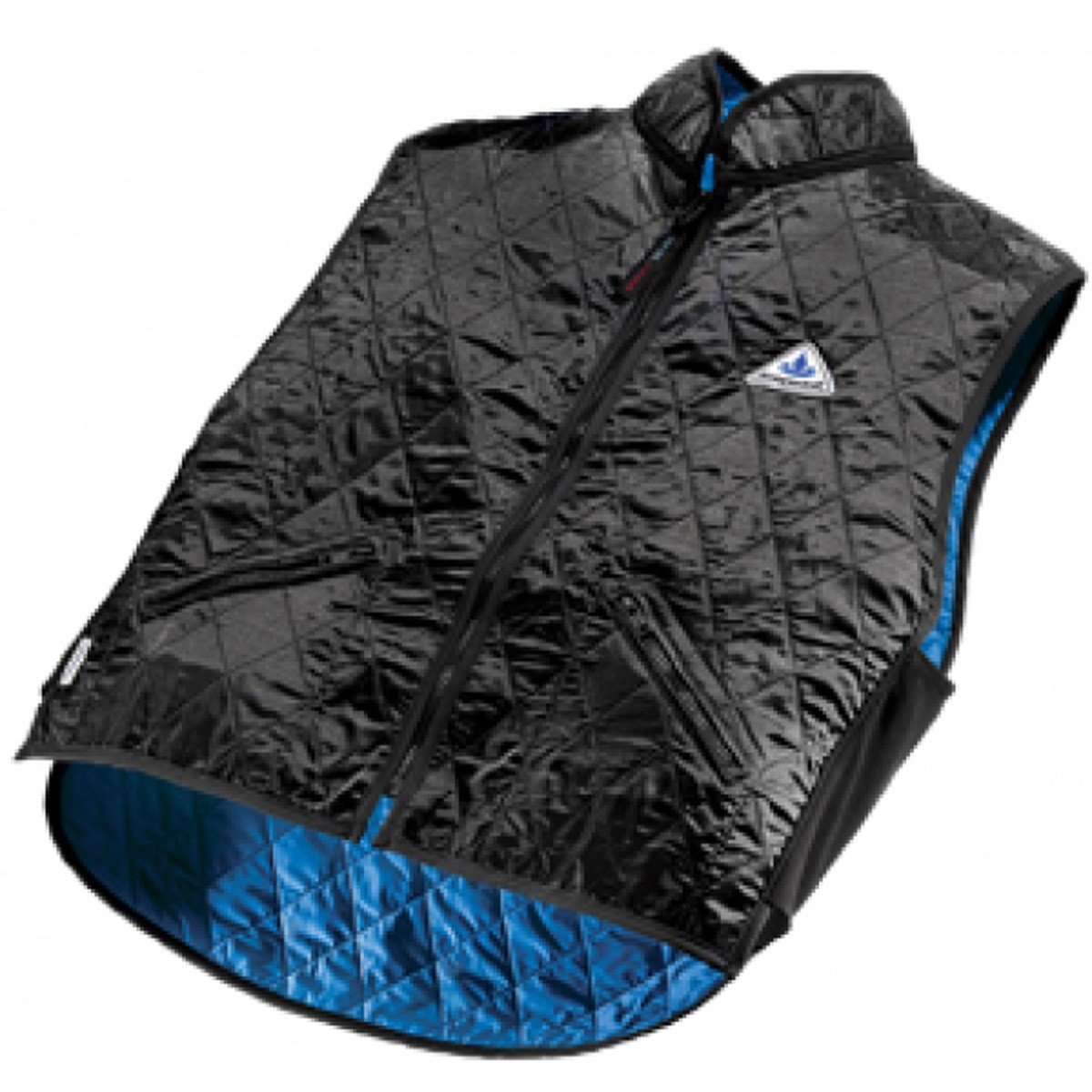
TechNiche’s women-specific Deluxe Sport Vest solves the fit problems that plague unisex evaporative designs, offering a higher mandarin collar for sun protection and two zippered front pockets that equestrians and bikers actually use. The HyperKewl polymer fabric inside the quilted nylon shell activates with a simple water soak and delivers 5 to 10 hours of evaporative cooling across the core. The women’s cut is shorter in length to accommodate riding positions and tighter in the shoulders, though bustier users should order up one size for proper skin contact.
Real-world performance shines for multiple sclerosis patients who need temperature regulation: several reviews describe major improvements in heat tolerance, enabling walks and gym sessions that were previously impossible. The vest does leave a thin layer of moisture on your shirt during use, but the fabric dries quickly once removed. One concern is that the gel-embedded inner surface can shed small bits of polymer at the seams during the first few uses—this stops after the initial activation cycle and doesn’t affect cooling performance.
Users in humid conditions still get relief, but the vest works best when there’s some airflow from riding or a fan. The large size fits full-figure frames but can feel tight and short; sizing up to XL causes the shoulders to gap, so careful chart checking is essential. For women seeking a dedicated evaporative option with riding-ready features and proven medical-grade temperature relief, this is the most refined choice available.
Why it’s great
- Women-specific tailoring with mandarin collar and front pockets
- Life-changing temperature relief for MS heat sensitivity
- 5–10 hour runtime from a single water soak
Good to know
- Busty wearers need to size up for full skin contact
- Gel polymer can shed at seams during first uses
5. Ergodyne Chill-Its 6667 Cooling Vest

The Ergodyne Chill-Its 6667 is the most accessible entry point into evaporative cooling, using a lightweight PVA material that activates in seconds under running water and stays cooler than ambient air for hours. The breathable mesh panel siding prevents the heavy, waterlogged feeling that makes many evaporative vests uncomfortable, and the front zipper makes on-and-off easy during fast-paced work like roofing or landscaping. At this budget tier, you get immediate cooling relief without needing a freezer or power bank, making it ideal for job sites with only a water hose.
The biggest catch is PVA’s unique behavior: the vest shrinks about two full sizes when saturated, so buyers must order up significantly—a medium-wearing person needs a large or XL to avoid a tight, restrictive fit when wet. The material also stiffens as it dries, requiring rewetting to soften, and the upper back area tends to dry out fastest during wear. Several Florida users confirm the vest works well in extreme humidity when coupled with direct airflow from a box fan, but the cooling effect weakens noticeably in still air.
Owners rave about the vest’s light weight when dry and its effectiveness for short outdoor stints, but note that the roughly 1–3 hour runtime in high heat is shorter than HyperKewl competitors. There are no reflective elements, making this a poor choice for nighttime road work. For the lowest price in the category, you get genuine PVA-phase cooling that outperforms fabric wicking vests, but you must accept the wet shrinkage and the wet-dry stiffness cycle.
Why it’s great
- Ultra-lightweight and activates instantly with tap water
- Breathable mesh siding reduces the heavy wet feeling
- Budget-friendly entry into true evaporative cooling
Good to know
- Shrinks two full sizes when wet—must order significantly up
- PVA material stiffens as it dries; no reflective safety elements
6. HyperKewl Light Weight Evaporative Cooling Sport V-Neck Vest

HyperKewl’s Sport V-Neck Vest uses the brand’s patented polymer fabric that absorbs and releases water through evaporation more evenly than standard PVA, offering 5 to 10 hours of continuous cooling in dry heat conditions. The V-neck design is a rare style choice in this category, giving it a sportier look that works under a mesh jacket for motorcycle riders. The fabric maintains a dry-to-the-touch feel on the outside while the inner layer stays damp, which helps prevent the soaking-shirt problem that plagues many evaporative competitors.
User reports from California and Arizona confirm the vest performs admirably in 105–110°F dry heat, lasting well over three hours before needing a quick 5-minute re-soak. The sizing runs accurate when worn as directed—soak 4 minutes, wring lightly, and wipe off excess before wearing. Wind exposure from riding or a fan dramatically increases the cooling effect, making it a strong match for highway commutes. A few users note that the vest’s pores trap moisture and dry very slowly when stored indoors, requiring an extra fan-drying session before packing away to prevent mildew.
The biggest limitation is humidity: in muggy conditions above 70% RH, the vest stays damp without producing significant chill, which aligns with the physics of evaporative cooling. The outer shell lacks reflective elements, so visibility at night is poor. For dry-climate riders and outdoor workers who want a low-maintenance, no-freezer solution that’s stylish enough to wear under an open collar, this V-neck version is the clear leader.
Why it’s great
- V-neck and dry-touch outer layer are rare in this category
- 5–10 hour runtime in dry heat with minimal re-wetting
- Proven performance at 105°F+ temperatures in the Southwest
Good to know
- Cooling effect drops significantly in high humidity
- Slow to dry when stored; needs fan-drying to avoid mildew
7. TechNiche International Adult HyperKewl Cooling Sport Vest
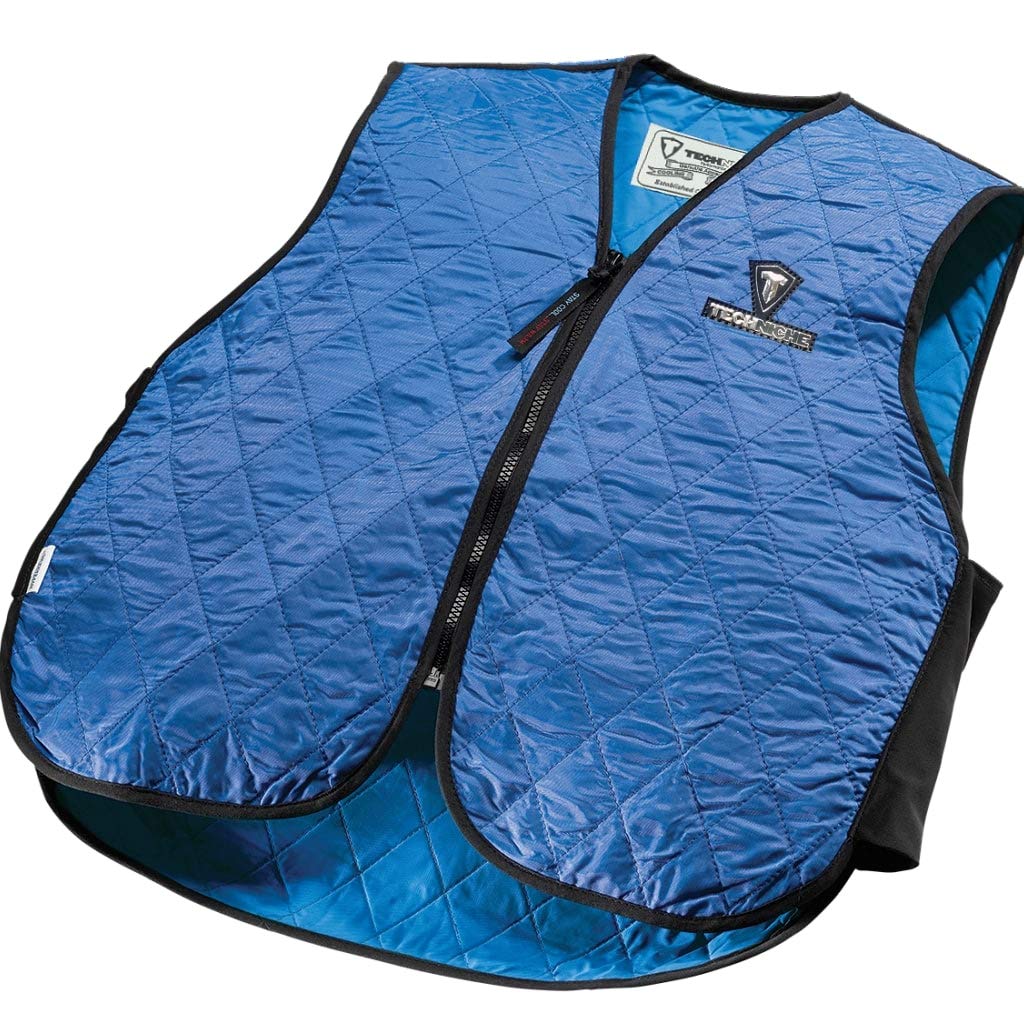
TechNiche’s unisex HyperKewl Sport Vest is the workhorse evaporative option that has been on the market since 2004, proving its durability across two decades of use. The quilted nylon outer adds a layer of abrasion resistance that flat-weave vests lack, while the inner water-repellent liner directs moisture back into the HyperKewl fabric rather than soaking your shirt. The blue colorway with black polyester trim looks clean under a work vest or riding jacket, and the whole package weighs only 8 ounces dry—light enough to forget you’re wearing it.
Cooling duration matches the other HyperKewl offerings at 5–10 hours per soak, with the 8-ounce weight keeping the wet mass manageable compared to PVA vests that can double in weight when saturated. Multiple users confirm it works well in 92°F humid conditions when paired with wet sun sleeves and head wrap, and the vest recharges in just 5–10 minutes under a sink. A motorcycle rider noted the heavy-damp feeling when soaking wet, recommending a heavy wring to reduce drips before zipping a jacket over it.
The one sizing nuance is that this vest runs slightly large, so ordering down can improve core contact. The quilted pattern does add a bit of bulk compared to sleeker HyperKewl models, but the trade-off is better thermal retention in breezy conditions. A small minority of owners report that the vest feels uncomfortably heavy when fully saturated and that the polyester trim can irritate bare skin during prolonged wear. For a mid-range evaporative vest with a proven track record and water-repellent liner, this is a safe, reliable choice.
Why it’s great
- Quilted nylon outer resists abrasion better than flat fabric vests
- Inner water-repellent liner keeps shirt drier than PVA vests
- Weighs only 8 oz dry and recharges in 5–10 minutes
Good to know
- Runs slightly large; sizing down improves core contact
- Quilted bulk is noticeable compared to standard HyperKewl models
FAQ
How long does each type of cooling vest actually work in direct sun?
Should I buy a bigger size in evaporative vests to account for shrinkage when wet?
Can I use an evaporative cooling vest if I have Multiple Sclerosis or heat sensitivity?
Final Thoughts: The Verdict
For most users, the cooling vest winner is the FlexiFreeze Professional Series because its ice-phase cooling works in any humidity, the rip-stop construction outlasts everything else, and the Hi-Vis reflective fabric adds genuine job-site utility. If you want evaporative simplicity for dry climates, grab the HyperKewl Sport V-Neck Vest. And for a lower-budget start that still delivers real PVA evaporative relief, nothing beats the Ergodyne Chill-Its 6667—just remember to size up two full sizes before you soak it.

Mo Maruf
I created WellFizz to bridge the gap between vague wellness advice and actionable solutions. My mission is simple: to decode the research and give you practical tools you can actually use.
Beyond the data, I am a passionate traveler. I believe that stepping away from the screen to explore new environments is essential for mental clarity and physical vitality.