Our readers keep the lights on and my smoothie glass nicely filled. As an Amazon Associate, I earn from qualifying purchases.
When the thermometer hits triple digits and you still have six hours of roofing, landscaping, or warehouse work ahead, your body’s ability to shed heat becomes the limiting factor. A cooling vest that actually works shifts that equation, letting you stay focused, hydrated, and safe instead of driving home dizzy and depleted.
I’m Mohammad Maruf — the founder and writer behind WellFizz. I’ve spent hundreds of hours analyzing thermal management products, comparing phase-change materials, evaporative fabrics, and battery-powered airflow systems to find what truly keeps outdoor workers productive through the worst summer conditions.
No matter how tough you are, heat stress catches up. The right cooling vest for outdoor workers can drop your core temp ten degrees and keep you comfortable for an entire shift.
How To Choose The Best Cooling Vest For Outdoor Workers
Every cooling vest fights heat differently. Some rely on evaporation, others on frozen water or phase-change gel packs, and a growing category uses electric fans to pull air across your torso. The best choice depends on your climate, shift length, and how much weight you’re willing to carry.
Cooling method: evaporative vs. ice vs. fan-powered
Evaporative vests (like the Ergodyne Chill-Its) are lightweight and activate with plain water, but they only work below about 60 percent humidity — in a muggy Southern summer they stop cooling entirely. Ice-based vests (FlexiFreeze, Glacier Tek) deliver powerful, predictable cooling regardless of humidity, but each frozen pack set lasts around one to two hours, meaning you need extras and a freezer. Fan-powered vests with battery packs (THEKUKU, 21V Cooling Vest) blow air that accelerates sweat evaporation; they work in any humidity but require carrying a power bank and the fans can be noisy.
Cooling duration and recharge logistics
Look at the real-world runtime, not the marketing number. Evaporative vests need re-soaking every two to four hours. Ice vests need frozen packs swapped roughly every ninety minutes. Battery vests depend on your power bank — a 10,000 mAh bank may give you six hours on low, while a 30,000 mAh unit can run a full twelve-hour shift. If you have no access to a freezer or a charging outlet on the job, that constraint alone will narrow your options.
Quick Comparison
On smaller screens, swipe sideways to see the full table.
| Model | Category | Best For | Key Spec | Amazon |
|---|---|---|---|---|
| Glacier Tek Cool Vest | Phase Change | 12-hour shifts with freezer access | 59°F for 2.5 hours per pack set | Amazon |
| FlexiFreeze Pro Series | Ice Cube | Job sites needing hi-vis safety compliance | 96 pure-water cubes per panel set | Amazon |
| THEKUKU With 30000mAh | Fan + Plate | Dawn-to-dusk without freezer access | 30,000 mAh included power bank | Amazon |
| FlexiFreeze Personal Series | Ice Cube | Budget entry into reliable ice cooling | 3.5 lbs with three frozen panels | Amazon |
| 21V Cooling Fan Vest | Fan-Powered | Active jobs like landscaping or Disney days | 12,000 RPM dual fans with 20,000 mAh battery | Amazon |
| Cooling Vest with Air Fans | Fan-Powered | Budget-friendly fan cooling with ice pack pockets | Three-speed fans; ice pack mesh back pocket | Amazon |
| Ergodyne Chill-Its 6685 | Evaporative | Dry-heat climates with low humidity | Up to 3 days cooling per soak | Amazon |
In‑Depth Reviews
1. Glacier Tek Cool Vest Personal Cooling, 59 Degrees for 2.5 hours 8 Cool Packs

The Glacier Tek vest uses eight PureTemp phase-change packs that hold a steady 59°F for up to two and a half hours in 100°F ambient heat. That consistency matters — unlike ice, which starts painfully cold and warms fast, PCM delivers the same chilling sensation from minute one to the end. The eight packs distribute evenly across four pockets, covering your entire torso without any single spot freezing your skin.
Recharging is uniquely fast: submerge the packs in ice water for twenty minutes, or toss them in a freezer for an hour. In practice, workers on extended shifts buy a second pack set and swap mid-day for seamless coverage. The vest itself weighs just under five pounds with all packs inserted, and the elastic side straps plus shoulder adjusters create a snug fit for chest sizes from 29 to 52 inches.
Durability feedback is strong — the nylon shell and stitching hold up to daily job-site abuse. The only downside is bulk: the packs give the vest a noticeably padded feel that may limit freedom of movement in very tight crawl spaces or when layering under a tight uniform.
Why it’s great
- Consistent 59°F temperature for 2.5 hours — no icy start, no lukewarm finish
- Fast recharging: 20 minutes in ice water or one hour in the freezer
- Eight phase-change packs provide even core coverage across chest and back
Good to know
- Bulky profile may feel restrictive under tight work shirts or in confined spaces
- Requires planning — you need freezer access or a cooler with ice water to recharge packs mid-shift
2. FlexiFreeze Professional Series Ice Vest

This Pro Series vest upgrades the Personal Series with heavy-duty rip-stop fabric, 3M reflective striping, and solid YKK zippers — all built for the construction site. It’s rated Class 1, Type O hi-vis, which means it satisfies safety vest requirements on many job sites while also cooling you. The cooling mechanism is the same 96 pure-water cubes per panel set, providing roughly ninety minutes of effective chill per frozen set.
The adjustable features are more refined than the entry-level model: hook-and-loop shoulder straps, elastic side bungees, and a full-length front zipper let you dial in the fit even over a heavy work shirt. Buyers consistently note the vest fits users up to 6-foot-4 and 260 pounds with room to spare. The water cubes stay flexible when frozen, so the vest bends with your body rather than acting like a stiff board.
The primary trade-off is cooling duration. At ninety minutes per panel set, a full eight-hour shift requires at least four or five sets, and extra panel packs are a significant additional expense. Users also report the Velcro backing can snag and pill cotton shirts when worn without the ice panels inside.
Why it’s great
- Meets ANSI Class 1 hi-vis standards with 3M reflective material for job-site compliance
- Durable rip-stop fabric and YKK zippers hold up to daily construction use
- Adjustable shoulders and bungee waist fit from XS to 6X
Good to know
- Only 90 minutes of cooling per frozen panel set — you will need extras for a full shift
- Velcro contact points can cause pilling on work shirts when panels are removed
3. THEKUKU Cooling Vest with 30000mAh Power Bank

The THEKUKU combines a fan-forced airflow vest with a physical cooling plate system — an uncommon hybrid that pulls heat off your torso while circulating air across your skin. The included 30,000 mAh power bank is the largest battery you will find bundled with any vest in this category, and it’s enough to run the fans on high for a full workday without recharging. That alone eliminates the biggest frustration of fan vests: dead batteries by lunch.
Real-world feedback confirms the cooling plates make a noticeable difference in the first few minutes, dropping skin temperature fast. The two-speed fan control lets you save battery during moderate heat and crank it up when the sun peaks. Users recommend wearing a thin undershirt to prevent direct fan contact from feeling too intense on bare skin.
The build quality shows some cost-cutting. The Velcro shoulder straps tend to sag over time, letting the whole vest sit lower on the torso, and the battery pockets are placed at the bottom rear, making them awkward to access while wearing the vest. Fan noise is a factor in quiet settings — not an issue on a loud job site, but noticeable if you work in relatively silent environments.
Why it’s great
- 30,000 mAh battery runs fans a full shift without needing a recharge or swap
- Cooling plate system adds conductive heat draw beyond simple fan airflow
- Two adjustable speed settings let you match airflow to ambient conditions
Good to know
- Velcro shoulder straps can loosen over time, causing the vest to ride low on the torso
- Fan noise is audible; not ideal for quiet job settings or indoor work
4. FlexiFreeze Personal Series Ice Vest (Zipper Closure)

The Personal Series is the entry point into FlexiFreeze’s water-cube cooling system, and it delivers the same core thermal performance as the Pro model for a lower cost. The vest weighs only 3.5 pounds with all three frozen panels inserted, making it one of the lightest ice-based options available. The neoprene shell insulates the ice sheets from ambient heat, focusing the chilling effect on your body rather than bleeding it into the air.
Each set of three panels (left front, right front, back) cools for about 60 to 90 minutes depending on exertion and temperature. The panels attach via full-length Velcro strips, so swapping in a frozen spare set takes seconds — no zippers or buttons to fiddle with. The vest adjusts at four points (shoulders and side bungees) and claims to fit XS through 6X, though some users report the sizing runs small and buying up is wise.
Durability concerns come up consistently. The nylon outer fabric can fray at the seams after steady use, and the front zipper — a standard plastic coil zipper — has been reported to fail after approximately fifty open-close cycles. For seasonal or occasional use it holds up fine, but daily job-site abuse may shorten its lifespan.
Why it’s great
- Lightest ice vest in the roundup at just 3.5 pounds with all three panels frozen
- Velcro-attached panels swap in seconds — no fumbling with zippers on the ice packs
- Four-way adjustability accommodates a wide range of body sizes from XS to 6X
Good to know
- Fabric fraying and zipper failure reported after roughly 50 uses under heavy conditions
- Only 60-90 minutes per panel set; keeping cool all day requires multiple spare sets
5. 21V Cooling Fan Vest for Men and Women, 20000mAh Battery
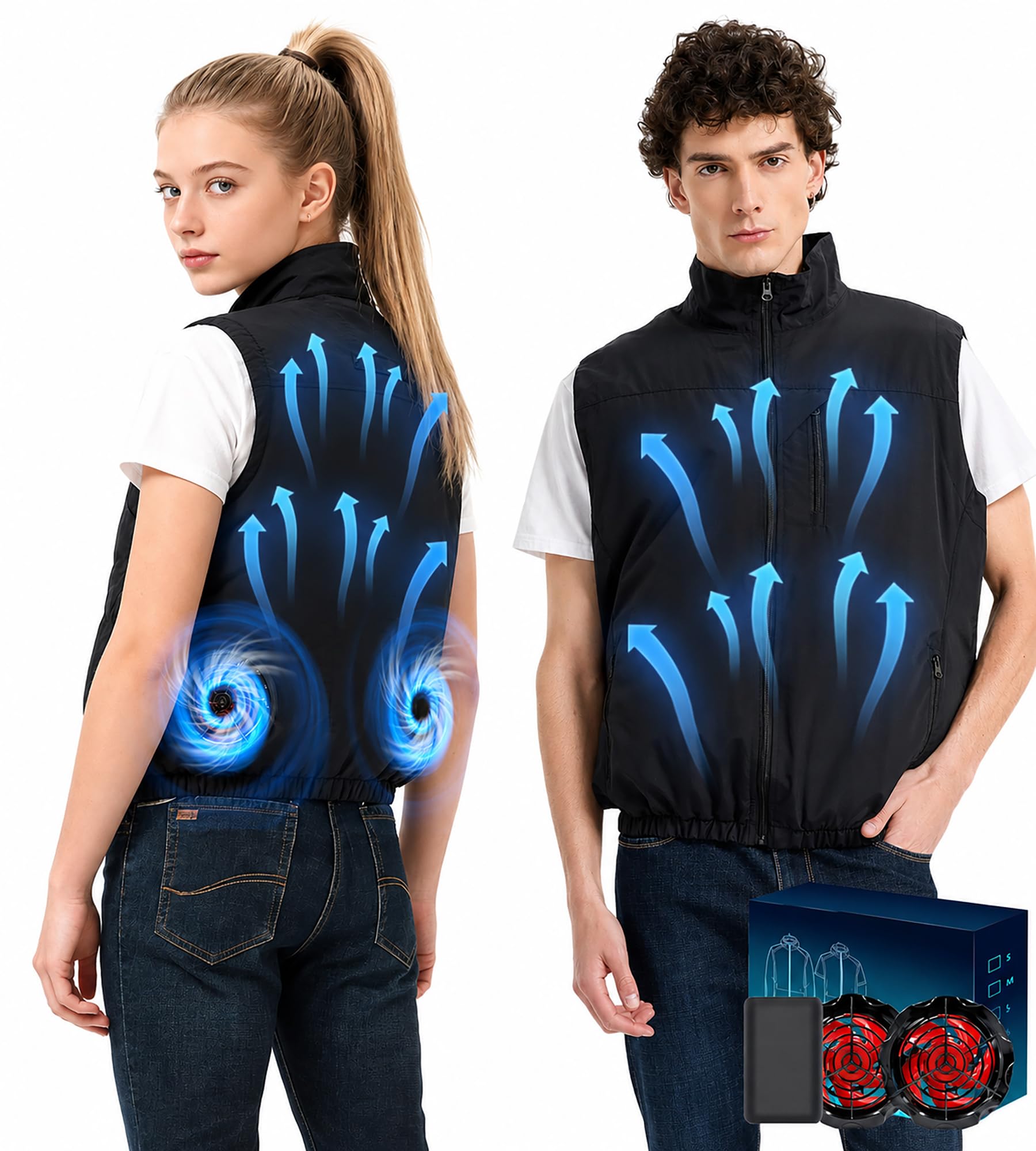
This fan vest runs on a 21-volt system — higher voltage than most competitors — and drives two fans at a maximum 12,000 RPM. The airflow is noticeably stronger than typical 5-volt alternatives, which translates to better evaporative cooling in still air. The included 20,000 mAh battery provides up to 16 hours on the lowest speed setting, though cranking the fans to max will cut that substantially.
Reviewers consistently praise the vest’s effectiveness in dry heat and its comfort during extended wear. One user wore it for nine hours at a Disney park and returned home with 40 percent battery remaining. The lightweight, water-resistant shell resists sweat and minor rain, and the fan housings are small enough to avoid digging into your back when you bend or lift.
Sizing is the weak point. Multiple buyers report the vest runs significantly small — several XL purchasers say they should have ordered a 5X. The fans are not removable for washing, and the water resistance applies only to the vest shell, not the fan electronics, so submerging or pressure-washing the vest will damage it.
Why it’s great
- 21-volt system delivers stronger airflow than standard 5V fan vests
- 20,000 mAh battery offers genuine all-day runtime on lower speed settings
- Lightweight, water-resistant shell resists sweat and light rain on the job
Good to know
- Sizing runs very small — most users recommend ordering 2-3 sizes up from normal
- Fans are not removable for washing, limiting long-term cleanliness options
6. Cooling Vest for Men and Women with Air Conditioning Fans
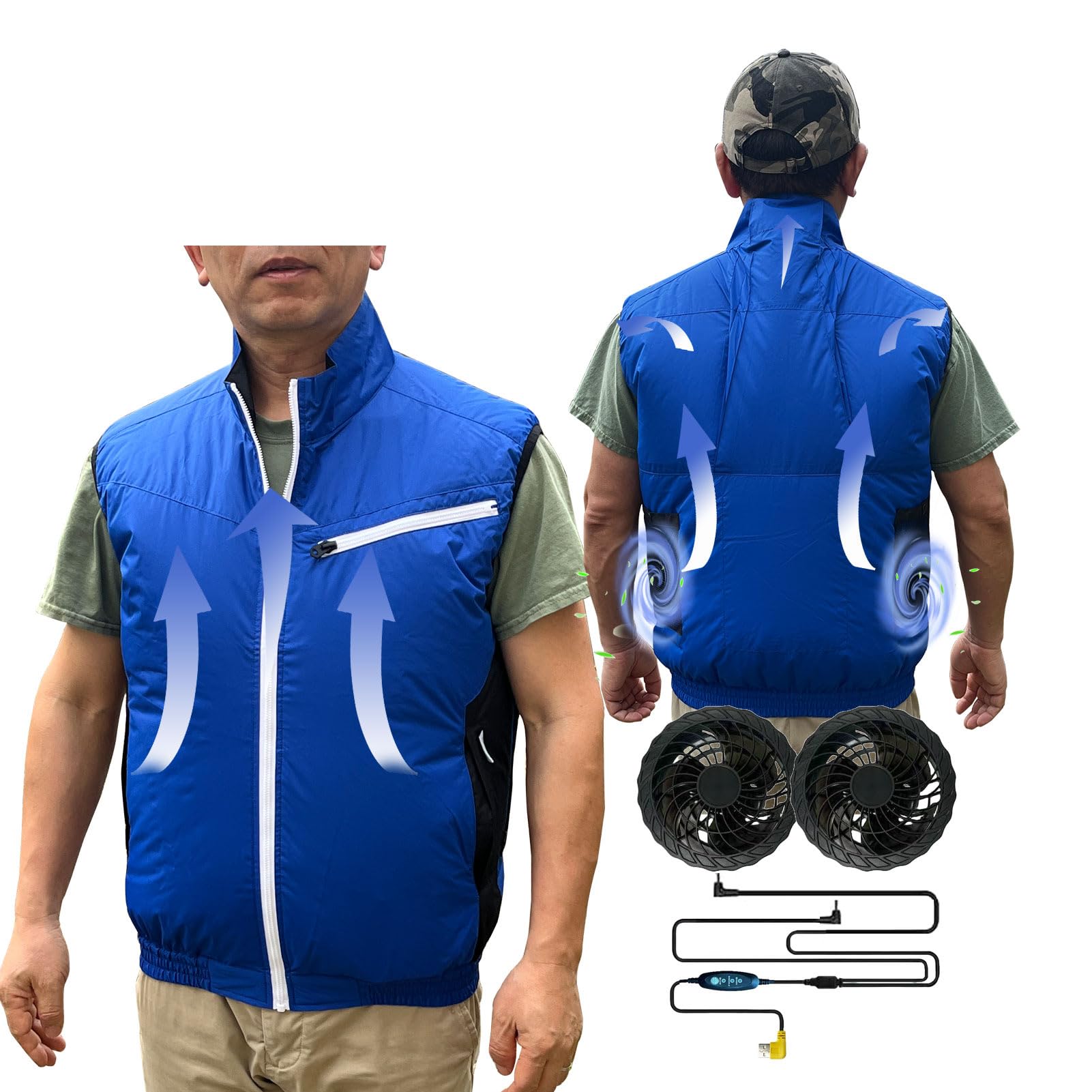
This budget-friendly fan vest uses a clever dual approach: two USB-powered fans pull air through the vest fabric, while a mesh back pocket lets you insert ice packs for extra conductive cooling. The three-speed fan control gives flexibility — low for general relief, high for brutal direct sun. The water-resistant outer layer also provides UV protection, adding value for workers exposed to full-sun environments.
The vest runs on any standard 5-volt USB power bank, which you supply separately. A 10,000 mAh bank yields 6-13 hours depending on speed; a 20,000 mAh bank stretches to 18 hours. That modular approach keeps the initial cost low, but it’s easy to forget a power bank on laundry day or lose it on the job site. The vest also has a dedicated back pocket designed for ice packs, which work well if you have access to a cooler.
Fit and fan retention are the main friction points. The sizing runs small consistently — reviewers recommend ordering at least one size up, sometimes two. The fans sit in open pockets and can shift around or even fall out when the vest is not worn, so some users resort to zip ties to hold them in place.
Why it’s great
- Ice pack back pocket adds conductive cooling to complement fan airflow
- Three-speed fans and UV-protective, water-resistant shell for outdoor work
- Works with any standard 5V USB power bank you already own
Good to know
- Runs very small — order 1-2 sizes up from your normal shirt size
- Fans can shift in their pockets and may fall out when vest is handled off-body
7. Ergodyne Chill-Its 6685 Evaporative Cooling Vest
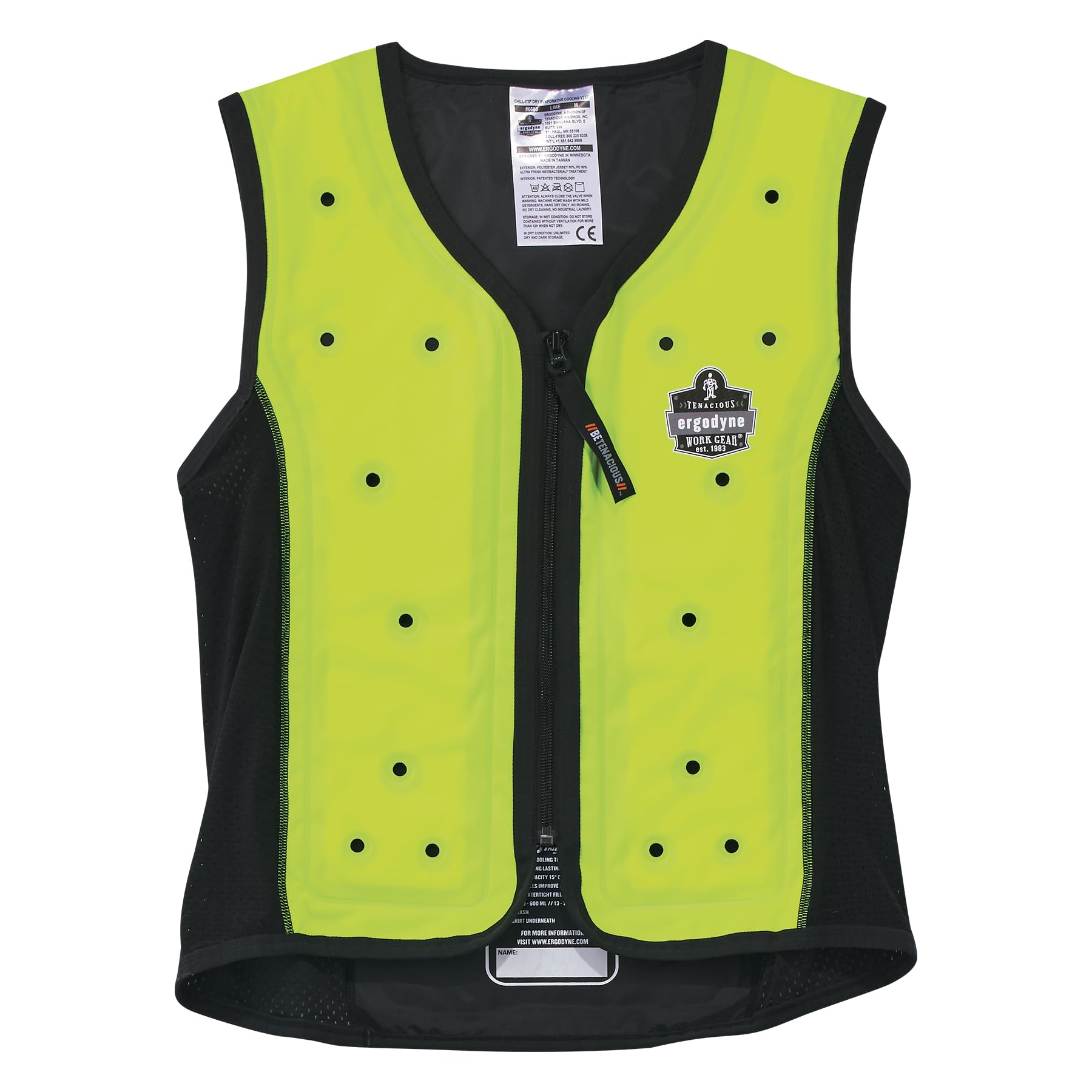
The Ergodyne Chill-Its uses a patented evaporative fabric that absorbs 13 to 20 ounces of water then slowly releases it to pull heat away from your body. The activation is dead simple: soak the vest for a few minutes, wring out the excess, and wear it. The proprietary dry technology keeps the outer fabric feeling dry to the touch even while the inner layer is actively cooling — a genuine comfort improvement over wet-shirt sensations from other evaporative vests.
Cooling duration is impressive in the right conditions. In dry heat — think Arizona at 100°F with single-digit humidity — a single activation can last four hours, and the manufacturer claims up to three days of “cooling power” between re-soaks. Mesh side panels add ventilation, and the lightweight nylon shell holds up well on the job site. The front zipper and V-neck design make it easy to pull on and off.
This vest is a specialist tool. It fails completely in high humidity — users in Florida or the Gulf Coast report it stops cooling after fifteen minutes because evaporation cannot happen when the air is already saturated. The patented layer also contains polyurethane, which can make the vest feel warm and clammy if it dries out and stops evaporating. Sizing runs slightly snug, and the leak-prone water ports have been reported to fail after a few uses in rare cases.
Why it’s great
- Exceptional 4+ hours of active cooling per soak in dry, low-humidity climates
- Patented dry technology keeps the outer fabric feeling dry against work clothes
- Lightweight design with mesh side panels for additional ventilation
Good to know
- Completely ineffective in high humidity — do not buy for use above 50% relative humidity
- Water inlet ports can develop leaks; fabric may feel clammy when not actively evaporating
FAQ
How long does a frozen cooling vest actually stay cold on a 95-degree job site?
Can I wear a cooling vest under my high-visibility safety vest or hard hat?
Why does the Ergodyne Chill-Its evaporative vest get great reviews but some users call it useless?
Final Thoughts: The Verdict
For most users, the cooling vest for outdoor workers winner is the Glacier Tek Cool Vest because its 59°F phase-change packs deliver consistent cooling for 2.5 hours without the temperature swings of ice or the humidity limits of evaporative vests. If you need hi-vis job-site compliance and prefer the raw power of frozen water, grab the FlexiFreeze Pro Series. And for all-day protection without needing a freezer, nothing beats the THEKUKU with 30,000 mAh battery — a true dawn-to-dusk solution for the most extreme heat.

Mo Maruf
I created WellFizz to bridge the gap between vague wellness advice and actionable solutions. My mission is simple: to decode the research and give you practical tools you can actually use.
Beyond the data, I am a passionate traveler. I believe that stepping away from the screen to explore new environments is essential for mental clarity and physical vitality.