Our readers keep the lights on and my smoothie glass nicely filled. As an Amazon Associate, I earn from qualifying purchases.
Specs are compiled from manufacturer listings and verified buyer reviews and can change over time — please confirm the key details on the product page before buying.
Keeping your drinks cold and your sandwich dry on a jet ski is the real challenge — not horsepower. Most coolers are too wide, too tall, or too heavy for a cramped tank well, and once you hit the chop, you find out fast what works. The right cooler fits like it was measured for your ski, stays strapped down, and holds ice longer than your arms can last on the throttle.
I’m Mohammad Maruf — the founder and writer behind WellFizz. This guide is built by comparing the manufacturers’ published specifications and the patterns across verified customer reviews, so you get each pick’s real strengths and trade-offs instead of marketing spin.
This roundup of the cooler for jet ski use focuses on real-world fit, ice retention, and weight so you can pack smart and ride hard — whether you own a stand-up, a cruiser, or a performance ski.
Our Picks at a Glance

How To Choose The Best Cooler For Jet Ski
Picking a cooler for a personal watercraft (PWC, the official name for a jet ski) is different from picking one for a campsite. The three rules are: it must fit in the tank well (the recessed storage area in front of the seat), it must stay put when you carve hard, and it must keep your stuff cold without weighing you down. Here is what to check before you click buy.
Fit and dimensions
Measure your tank well first. Most jet skis have a rectangular cutout that is roughly 18 to 19 inches wide and 13 to 14 inches deep. A cooler that is too long or too wide will sit on top of the seat or hang off the back, and that shifts your center of gravity — making the ski feel unstable in turns. A soft cooler like the Pelican ExoChill (18.75 x 13.75 x 5 inches) slides right in because of its slim profile. A hard cooler needs similar footprint discipline — anything larger than 30 quarts often won’t fit the typical well.
Weight when loaded
A jet ski accelerates hard and turns sharp. A heavy cooler full of ice and cans shifts that momentum, and 20+ pounds of hard cooler plus contents can make the nose feel sluggish, even dangerous. Soft coolers generally weigh less than 2 pounds empty, while roto-molded hard coolers run closer to 20 pounds. If your ski is small, go soft. If you want serious ice retention and have a larger ski, a compact hard cooler is worth the trade-off.
Ice retention vs. space
Thicker insulation keeps ice longer but eats interior room and adds weight. A hard cooler with 2 to 3 inches of polyurethane foam (the kind of foam used in high-end coolers) — like the Pelican Elite — can hold ice for days, but its internal capacity for cans may be smaller than the outside suggests. A soft cooler with 0.5-inch insulation gets you a few hours of real cold — fine for a day trip. Decide if you need all-day ice for a long ride or just a few cold drinks for a short session.
Securing it down
On the water, your cooler needs tie-down points. Look for molded-in slots or loops on hard coolers, and D-rings (metal rings shaped like the letter D) or webbing loops on soft bags. A cooler that does not have a way to strap it in will shift, flip, or fly off the first time you hit a wake. Most jet skis have bungee hook points, so check that the cooler’s attachment points line up with yours.
Quick Comparison
| Model | Best For | Capacity | Weight | Insulation | Amazon |
|---|---|---|---|---|---|
| Ninja FrostVault 30qt★ Best Overall | Separate dry storage drawer | 30 quarts | 20.41 lbs | 3 inches polyurethane foam | Amazon |
| Pelican ExoChill Soft Cooler | Fitting tight tank wells | 17 liters | 1.28 lbs | 0.5 inch PEVA | Amazon |
| Blue Coolers Companion 30qt | Roto-molded durability on a budget | 30 quarts | — | 2.25 inches polyurethane foam | Amazon |
| Pelican 30 Quart Elite | Extreme ice retention (days) | 30 quarts | 21.7 lbs | 2 inches polyurethane + freezer gasket | Amazon |
In‑Depth Reviews
1. Ninja FB131BL FrostVault 30qt Hard Cooler with Dry Zone
Our pick — over 4.5★ from 650+ verified ratings; the strongest balance of quality and price.
The cooler that keeps your sandwiches bone-dry while your drinks stay buried in ice
The Ninja FrostVault 30qt is the only hard cooler here with a pull-out drawer that stays at fridge temperature (under 40°F) — so your fruit, cheese, and lunch meat never swim in meltwater. That drawer is the reason the outside dimensions are larger than a typical 30-quart: the walls pack up to 3 inches of polyurethane foam, and buyers report “we put ice in on a Friday night and we still had ice Sunday night.” The 30-quart main chamber fits 26 cans with ice or 48 without, which is enough for a full day of riding with a passenger. The heavy-duty integrated handles make hauling it across sand or a marina dock much easier than you expect from a cooler that weighs 20.41 pounds empty. Load it up and you will feel the weight — the trade-off is that this is not a quick-grab soft bag. It belongs on a larger ski or a tow-behind where you have the deck space for a 17.07 by 23.94 by 18.78-inch box. The lockable lid and drawer latch also mean you can padlock it if you stop for lunch, and the latch is smooth enough to open one-handed. Compared to the Pelican 30qt Elite, the FrostVault gives up some ice-retention longevity but gains a dry-food compartment that the Pelican simply does not offer. The most-mentioned praise by a wide margin is its cooling performance, followed closely by temperature retention. A recurring note is weight — at 47 mentions it is the aspect flagged most as a negative, but buyers consistently say “it’s worth it for how long it stays cold.”
What makes it a winner
- Integrated dry-storage drawer keeps food separate from ice and meltwater so lunch stays crisp
- Insulation up to 3 inches thick delivers multi-day ice retention for weekend trips
- Premium latch opens easily one-handed, locks for security at the dock
Where it asks a trade-off
- Heavy at 20.41 pounds empty; even heavier when you pack it full — affects handling on small skis
- Large footprint — measure your tank well because it may not fit a compact ski
Reach for this if: you want the unique convenience of a dry-storage drawer that keeps food at fridge temperature while ice lasts for days, and your jet ski or tow-behind has room for a full-size 30-quart box.
Think twice if: your ski has a small tank well or you need something you can grab one-handed and stow under a seat; the FrostVault’s weight and footprint are serious commitments.
2. Pelican ExoChill Soft Cooler Bag

The 1.28-pound featherweight that slides into a tight tank well and disappears under your knees
At just 1.28 pounds and measuring only 5 inches deep, the Pelican ExoChill is the only pick here that is truly designed to fit inside a jet ski’s tank well. Made from 420 Denier material (a standard nylon with a good strength-to-weight ratio) with 0.5-inch PEVA (a type of foam insulation) — it is a soft bag that holds up to 17 liters — enough for about 12 cans plus a sandwich bag. Owners mention that it “held ice most of the day in the Florida 100 degree heat,” which is exactly the kind of real-world performance a day rider needs. The slim profile means you can stash it under your legs in a cramped cockpit, as one paddler noted: “my cockpit area is especially tight but it fit nicely under my legs to have easy access to drinks.” The bag comes with a removable shoulder strap and handles on each side, plus a front pocket with hooks for small gear like keys or a phone. Integrated loops let you clip carabiners (metal snap hooks) to lash it down, and the reflective logo adds a small visibility boost at dusk. The catch is temperature retention — some owners note the thin insulation does not hold ice overnight, and a few report leakage along the bottom seams if the bag sits in standing water. For a short afternoon rip where every cubic inch counts, the ExoChill is the obvious choice. Against the Ninja FrostVault’s 20.41-pound bulk, the ExoChill’s 1.28 pounds feel like a different world — a 1.28-pound vs 20.41-pound weight gap that makes it the right pick for small and mid-size skis. The aspect that wins the most praise here is fit — owners repeatedly mention how it hugs the tank well without shifting.
Decisive advantage: the 5-inch depth and 1.28-pound weight mean it fits where no hard cooler can. If your ski has a tight well and you need cold drinks for a day-long ride, this is the answer.
The honest limit: the 0.5-inch PEVA insulation is not built for multi-day trips; ice will not survive past a single day in extreme heat, and the soft construction is not bear-proof or crush-proof.
Best for: riders with small tank wells who need a lightweight, grab-and-go soft cooler for day-long outings — especially on stand-up paddleboards, kayaks, and compact jet skis.
Look elsewhere if: you need ice to last more than a day, or you plan to leave the cooler sitting in the sun for hours; the thin insulation and potential seam leakage are real constraints.
3. Blue Coolers Companion Cooler – 30 Quart, Roto-Molded
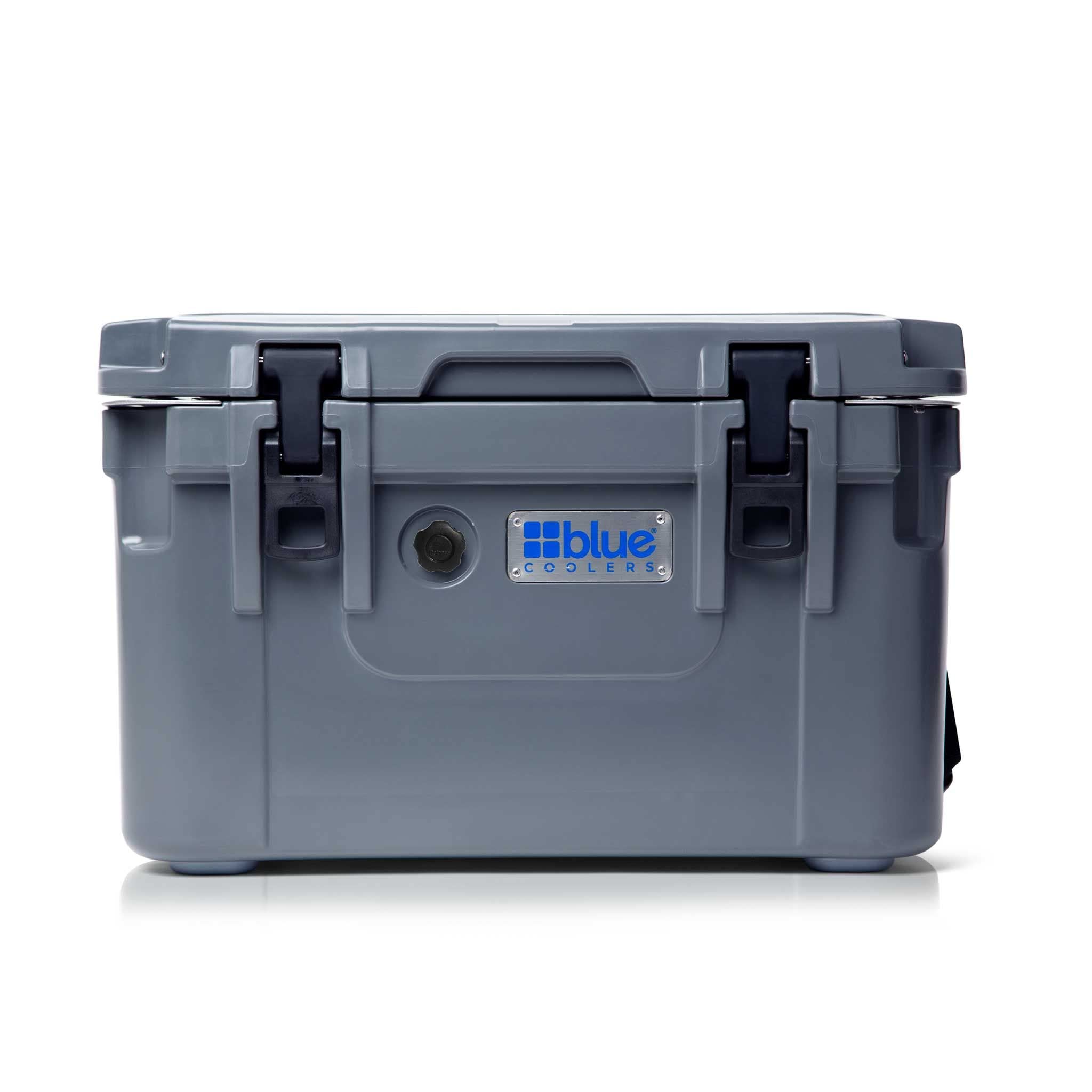
Roto-molded toughness at a price that leaves room for gas money
For buyers who want the durability of a roto-molded (single-piece plastic shell) cooler without paying Yeti or Pelican prices, the Blue Coolers Companion 30qt delivers. It uses 2.25 inches of polyurethane foam insulation, which the brand claims delivers up to 5 days of ice retention. The 30-quart internal space is roomy enough for a weekend’s worth of drinks and food, though the thick insulation does eat into the usable chamber dimensions — a trade-off owners note is that it is smaller inside than the outside suggests, but that thickness is what keeps ice. The non-skid feet and sure-grip handles are practical for a boat or ski deck, and the freezer-style gasket (a rubber seal that goes all the way around the lid) seals tight enough that customers note no drips. The roto-molded HDPE (high-density polyethylene, a tough plastic) shell is essentially indestructible for any normal use — it will handle being dropped off a dock or bounced around in a truck bed. The built-in rapid drain system and utility port add convenience, though a few owners note the handles can rattle against the sides during transport, creating road noise. The brand positions this as a cooler for camping, boating, and beach days, and it is perfectly sized for a larger jet ski’s tank well. Unlike the Ninja FrostVault, there is no dry-storage drawer, and the ice retention is shorter than the Pelican Elite’s reported 10 days. But for a simpler, no-frills roto-molded package that still keeps ice for days, one owner’s summary says it best: “the ice lasts a long time, very leak resistant.” Some buyers also flag that the cooler does not include tie-down straps, so factor in the cost of a couple of ratchet straps or bungee cords.
What earns it a spot
- Roto-molded construction delivers premium durability at a mid-range price
- Brand claims up to 5 days of ice retention with 2.25 inches of polyurethane foam
- Non-skid feet and sure-grip handles keep it stable on a wet deck
Where you give ground
- Handles can rattle against the shell; some owners find the road noise annoying
- No tie-down straps included — you have to buy those separately
- Interior space is smaller than expected for a 30-quart exterior
Grab it if: you want a rotomolded hard cooler that holds ice for up to 5 days and you are happy to spend slightly less than the premium Pelican or Yeti equivalents.
skip it if: you need a cooler that fits a very compact tank well, or you cannot tolerate rattling noises during transit; also consider whether you mind buying tie-downs separately.
4. Pelican 30 Quart Elite Cooler

The cooler that turns your lunch into a block of ice for days — literally
If your top priority is extreme ice retention, the Pelican 30 Quart Elite is the one to reach for — and it carries a lifetime guarantee so you will likely never need to replace it. With 2 inches of polyurethane foam and a 360-degree freezer-grade gasket (a continuous rubber seal around the lid), reviewers point out ice lasting up to 10 days, and blocks staying frozen “like a rock” even in southern heat. Three-inch locking latches provide a seal so tight that a 0.25-inch lid gap is intentionally left as a dry-ice vent (a small space to release pressure if you use dry ice). This is the cooler that buyers consistently call “better than Yeti” — primarily because the latches are easier to work and the seal is just as good. The molded-in tie-down slots are perfectly positioned for jet ski bungee hooks, and the overmolded carry handle is comfortable even when the cooler is fully loaded at 21.7 pounds. Four self-draining cup holders in the lid are a clever touch for a boat or dock, and the stainless steel bottle opener is a nice bonus. The non-skid rubber feet keep the cooler planted on a wet fiberglass deck. That said, 21.7 pounds empty is substantial — loaded with ice and cans you are looking at nearly 40 pounds, which is a lot for a compact ski. This is a cooler for a larger two-seater or a touring model where you have the deck space and horsepower to handle the extra weight. Compared to the Ninja FrostVault, the Pelican Elite beats it on raw ice retention longevity (the Pelican has up to 10 days reported, while the Ninja gets a weekend) but lacks the Ninja’s dry-storage drawer. The Blue Coolers Companion offers similar roto-molded construction for less, but the Pelican carries a legendary lifetime guarantee — “you break it, we replace it. Forever.” The most-mentioned aspect across reviews is durability, with owners praising how “built like a tank” the shell is.
The heavy lifter
- Extreme ice retention — owners confirm ice lasts up to 10 days, some say with a block frozen solid
- Three-inch locking latches with a 360-degree freezer gasket ensure a perfect seal every time
- Legendary lifetime guarantee from Pelican — “you break it, we replace it. Forever.”
- Molded-in tie-down slots and non-skid feet make it secure on a boat or ski deck
The honest weight
- At 21.7 pounds empty, it is the heaviest pick here; fully loaded it approaches 40 pounds
- No dry-storage drawer or separate compartment — everything is in one chamber
- Premium price point makes it a real investment for a jet ski accessory
Take this home if: ice retention is your absolute priority and you want a cooler that will outlast your jet ski — the lifetime guarantee and 10-day ice reports are unique here.
Pass if: your ski is small or you need to save weight; at 21.7 pounds plus contents, this cooler will affect handling. The Ninja FrostVault is a smarter choice if you want the dry drawer and similar performance at lower weight.
Understanding the Specs
Insulation thickness and ice retention
The single biggest factor in how long your ice lasts is how much foam stands between the inside and the outside. Thicker is better: 2 to 3 inches of polyurethane foam (found in the Ninja, Blue, and Pelican hard coolers) can deliver multi-day or even week-long ice retention. The Pelican ExoChill uses just 0.5 inches PEVA, which is fine for a day trip but will not keep ice overnight in summer heat. For a jet ski trip where you are on and off the water in one day, thin is fine. For long-distance or multi-day rides, go thick and heavy. Bear in mind: thicker walls also mean less usable interior space for a given external size.
Weight and deck stability
Weight matters on a jet ski more than it does in a truck bed. A 20+ pound hard cooler full of ice and drinks can shift your center of gravity and make the ski feel sluggish in the turns. Soft coolers like the Pelican ExoChill sidestep this by weighing under 2 pounds, but they trade off ice retention and crush protection. A roto-molded cooler (the Blue Companion and Pelican Elite) is nearly indestructible but demands a large, stable ski to carry its weight without affecting handling. If you ride a small stand-up or a compact runabout, a soft cooler is the balanced choice. If you have a touring ski or a two-seater, a 30-quart hard cooler is feasible — just strap it down securely in the tank well.
FAQ
Will a 30-quart hard cooler fit inside my jet ski tank well?
How do I strap a cooler onto a jet ski securely?
What is the difference between roto-molded and injection-molded coolers?
Can I use a soft cooler like the Pelican ExoChill on a stand-up paddleboard or kayak too?
How long does ice actually last in these coolers on a hot day on the water?
Is a cooler with a dry-storage drawer worth it for a jet ski trip?
How important is a freezer-style gasket on a jet ski cooler?
What are self-draining cup holders and do I need them on a jet ski cooler?
Can I lock a cooler to prevent theft at a beach or dock?
Final Thoughts: The Verdict
For most riders, the cooler for jet ski decision depends on how much space and weight your ski can handle. The clear winner for versatility is the Ninja FrostVault 30qt because its dry-storage drawer solves the wet-sandwich problem while still holding ice for a full weekend — a unique combo no other pick matches. If your tank well is tight and you want a cooler that disappears into the cockpit, grab the Pelican ExoChill Soft Cooler at just 1.28 pounds. For those needing hardcore ice retention for extended trips, the Pelican 30 Quart Elite with its lifetime guarantee and 10-day ice reports is the one to reach for — just be ready for the 21.7-pound empty weight. And if you want roto-molded durability without the premium price, the Blue Coolers Companion 30qt is the budget-friendly hard cooler that holds its own on a weekend adventure.
How We Picked
We do not accept paid placement. Every pick is matched to a real buyer and a real use-case; we do not hands-on test units.
Sources & Methodology
Specifications: manufacturer listings and product documentation. Review insights: verified customer reviews, as of July 2026. Pricing: not shown on this page (it changes often); check the current price via the retailer link.
As an Amazon Associate, WellFizz earns from qualifying purchases. This does not affect which products we feature.
Related Guides

Mo Maruf
I created WellFizz to bridge the gap between vague wellness advice and actionable solutions. My mission is simple: to decode the research and give you practical tools you can actually use.
Beyond the data, I am a passionate traveler. I believe that stepping away from the screen to explore new environments is essential for mental clarity and physical vitality.