Our readers keep the lights on and my smoothie glass nicely filled. As an Amazon Associate, I earn from qualifying purchases.
Specs are compiled from manufacturer listings and verified buyer reviews and can change over time — please confirm the key details on the product page before buying.
A cooler for fishing has to do more than just chill drinks — it has to survive the salt spray, the sun beating down on the deck, and a day of hauling gear out of a kayak or boat. The wrong one leaves you with melted ice, soggy sandwiches, and a trip that turns sour fast. This guide cuts through the noise on the seven coolers built specifically for the water, comparing real ice retention, portability, and the features that actually make a difference when the fish are biting.
I’m Mohammad Maruf — the founder and writer behind WellFizz. This guide is built by comparing the manufacturers’ published specifications and the patterns across verified customer reviews, so you get each pick’s real strengths and trade-offs instead of marketing spin.
This guide ranks the top models to help you find the right cooler for fishing, from lightweight soft bags that pack into a kayak to massive wheeled chests that ride along on the sandbar.
Our Picks at a Glance

How To Choose The Best Cooler For Fishing
Picking the right cooler for the water means looking beyond just how many cans it holds. You need to think about the environment you fish in, how you get your gear there, and how long you plan to stay out. Here is what separates a boat-ready cooler from a backyard one.
Ice Retention Is Everything
On a hot deck with the sun directly overhead, a cooler with thin foam walls can lose its ice in a few hours. Look for at least 1.5 inches of closed-cell foam or polyurethane insulation. A tight, leak-proof gasket (the rubber seal around the lid) keeps the cold air inside and stops water from sloshing out when the boat rocks.
Size vs Weight: The Real Trade-Off
A 120-quart cooler holds a huge catch and days of drinks, but it is heavy and takes up serious deck space. A 25-quart cooler is light enough to strap into a kayak but limits you to a single day trip. Match the capacity to your typical outing length and how much you can physically carry or wheel across sand.
Durability on the Water
Salt water, UV rays, and rough handling will destroy a cheap cooler fast. A high-density polyethylene (HDPE) shell or a heavy-duty nylon fabric like the YETI’s DryHide resists punctures and sun damage. Stainless steel hardware (hinges, latches, drain plugs) does not rust, which is critical for any cooler that spends time on a boat.
Quick Comparison
| Model | Best For | Capacity | Weight | Ice Retention Style | Amazon |
|---|---|---|---|---|---|
| YETI Hopper M30★ Best Overall | Kayak & SUP Trips | 2267 cu in | 9.85 lbs | Closed-cell foam | Amazon |
| Engel UC30Angler’s Drybox | Solo Fishing & Gear Protection | 30 qts | — | Molded Polystyrene | Amazon |
| Coleman Marine 120qt | All-Day Boat Crews | 120 qts | — | Polyurethane | Amazon |
| Igloo Trailmate 25qt | Budget Boat Ride | 25 qts | 10.8 lbs | 1.5-inch foam | Amazon |
| CUDDY 40QT | Floating & Sandbar Parties | 40 qts | 24.7 lbs | Dual-walled HDPE | Amazon |
| RTIC 52 Quart Ultra-Light | Beach & Camp Hauling | 52 qts | 28.5 lbs | 2.5-inch foam | Amazon |
| MORXPLOR Fish Bag 72″ | Big Catch Tuna & Mahi | 150 L | 5.81 kg | 10mm Cotton Foam | Amazon |
In‑Depth Reviews
1. YETI Hopper M Series Portable Soft Coolers with MagShield Access
Our pick — over 4.5★ from 900+ verified ratings; the strongest balance of quality and price.
A hauler that fits in the bow of a kayak and shrugs off the sun all day.
You get a 2267-cubic-inch soft cooler that seals shut with magnets — no zipper to fight with wet hands. The MagShield Access uses powerful magnets to create an ultra leak-resistant seal that you flip open with one hand and push closed gently. The exterior is a high-density fabric called DryHide Shell that resists punctures and UV rays (ultraviolet sunlight damage), so it survives a drop on the dock or a scrape against an anchor locker.
Buyers report that ice stays solid for 2 to 3 days in low 70-degree weather, which is strong for a soft-sided bag. At 9.85 pounds it is also significantly lighter than a hard cooler of similar size, beating the Igloo Trailmate (10.8 pounds) for anyone who hikes to a fishing spot. The HitchPoint Grid lets you clip on a SideKick dry bag or tools like zingers and nippers directly to the cooler.
The trade-off is capacity with the magnetic seal: one reviewer noted that packing a case of soda plus ice makes it tough to get the magnets to marry, requiring some force on the nylon straps. Still, for a portable fishing cooler that keeps ice for days and fits where a hard chest cannot, this is the pick.
On-the-water verdict: Best for kayakers, SUP anglers, and bank fishermen who need a light, tough bag that seals without a zipper.
Real limit: The form-factor struggles with a full load — you may need to lean on it to seal the magnetic closure after packing heavy.
Reach for this: When you are paddling solo or hiking to a river spot and want ice retention that rivals a hard cooler in a flexible package.
Pass if: You need a hard, stackable chest to haul a full catch of fish or want a wheeled option for sand.
2. Engel UC30 Leak-Proof, Air Tight, Fishing Drybox Cooler
A gear-safe box that doubles as a cooler and rod holder on the deck.
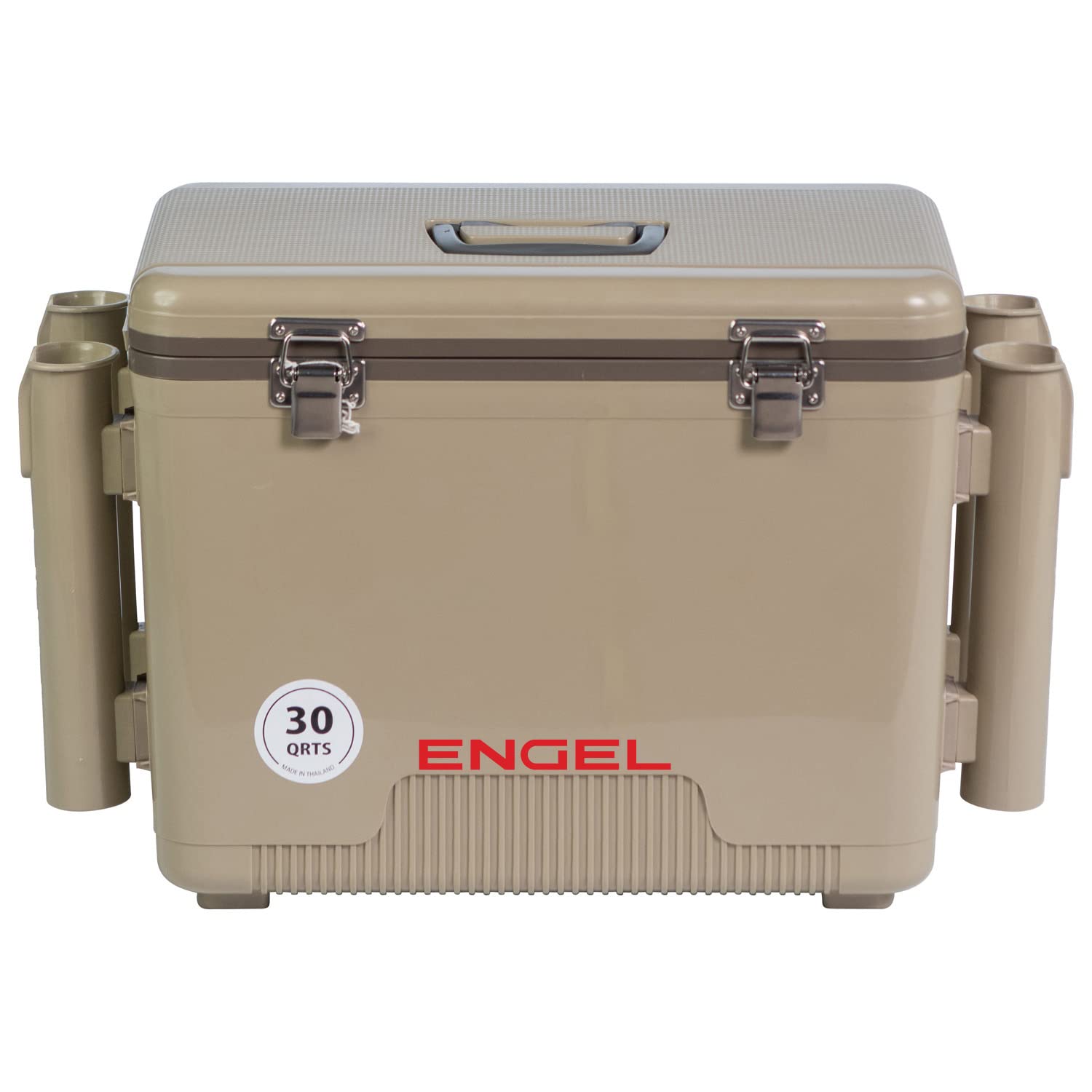
The Engel UC30 is a 30-quart drybox (an airtight, waterproof container) that protects your electronics from splash or rain while keeping your drinks cold. It features four integrated rod holders on the top, so you can rig rods without cluttering the deck. The recessed ethylene-vinyl acetate gasket seal makes it completely air tight and leak proof, meaning you can store expensive camera equipment or electronics inside without worrying about water intrusion — a feature most coolers lack entirely.
It uses high-grade molded polystyrene foam insulation and a hard plastic outer shell, and holds up to 45 cans with a 2:1 ratio of ice to cans. One buyer mentioned that the Engel UC30 is “lighter than Yeti” and that the rod holders keep rods off the deck and beach. The ice retention is honest: one owner reported “ice melts faster than Yeti but lasts all day; drinks stay cold.” At 23″ x 12.5″ x 14.5″ it is compact enough for a kayak hatch or the floor of a small boat, and includes a removable hanging accessory tray to keep sandwiches separate from melting ice.
Why anglers buy it
- Integrated rod holders keep rods organized and out of the way.
- Air-tight, leak-proof seal protects electronics and cameras.
- Stainless steel hardware resists corrosion from saltwater spray.
What to expect on ice retention
- Ice melts faster than premium rotomolded coolers like the YETI.
- Best for day trips — you will get all-day cold, not multi-day ice.
Best suited for: The solo angler or SUP paddler who needs a lighter, lockable drybox with rod storage for a full day on the water.
Not for: Multi-day trips where you need ice to last 48+ hours — the Igloo or Coleman hold ice longer for less money.
3. Coleman Marine Cooler with UV Guard, 120 Quart

A deck monster that swallows 204 cans and still keeps ice for three days.
The Coleman Marine 120 quart holds 204 cans and its lid supports up to 250 pounds — so you can sit on it while reeling in a catch. The UVGuard coating protects the plastic from sun damage, and the rust-resistant stainless steel hardware means it will not corrode after a season of saltwater use.
Owners mention “excellent ice retention in 95°F heat inside a black car; ice packs still frozen after 6 hours,” proving the polyurethane insulation works even in extreme heat. The recessed lip makes opening easy with slippery hands, and the integrated ruler is a nice touch for checking catch length. It dwarfs the Igloo Trailmate (120 quarts vs 25 quarts — a 4.8x capacity gap) but that size comes with obvious weight and storage space costs. A buyer noted the lid lacks a latch, so it is worth securing with a bungee in rough water.
Who it fits: The bass boat owner or offshore crew that needs a single giant cooler for a full weekend of food and drinks.
The catch: No lid latch — you will want a bungee or aftermarket latch for rough seas. Also big, so it eats up deck space.
Choose it for: Group trips where capacity trumps everything — this cooler handles the whole crew’s provisions for days.
skip it if: You fish solo or from a kayak — you need something under 40 quarts for maneuverability.
4. Igloo Trailmate Cooler 25 Quart
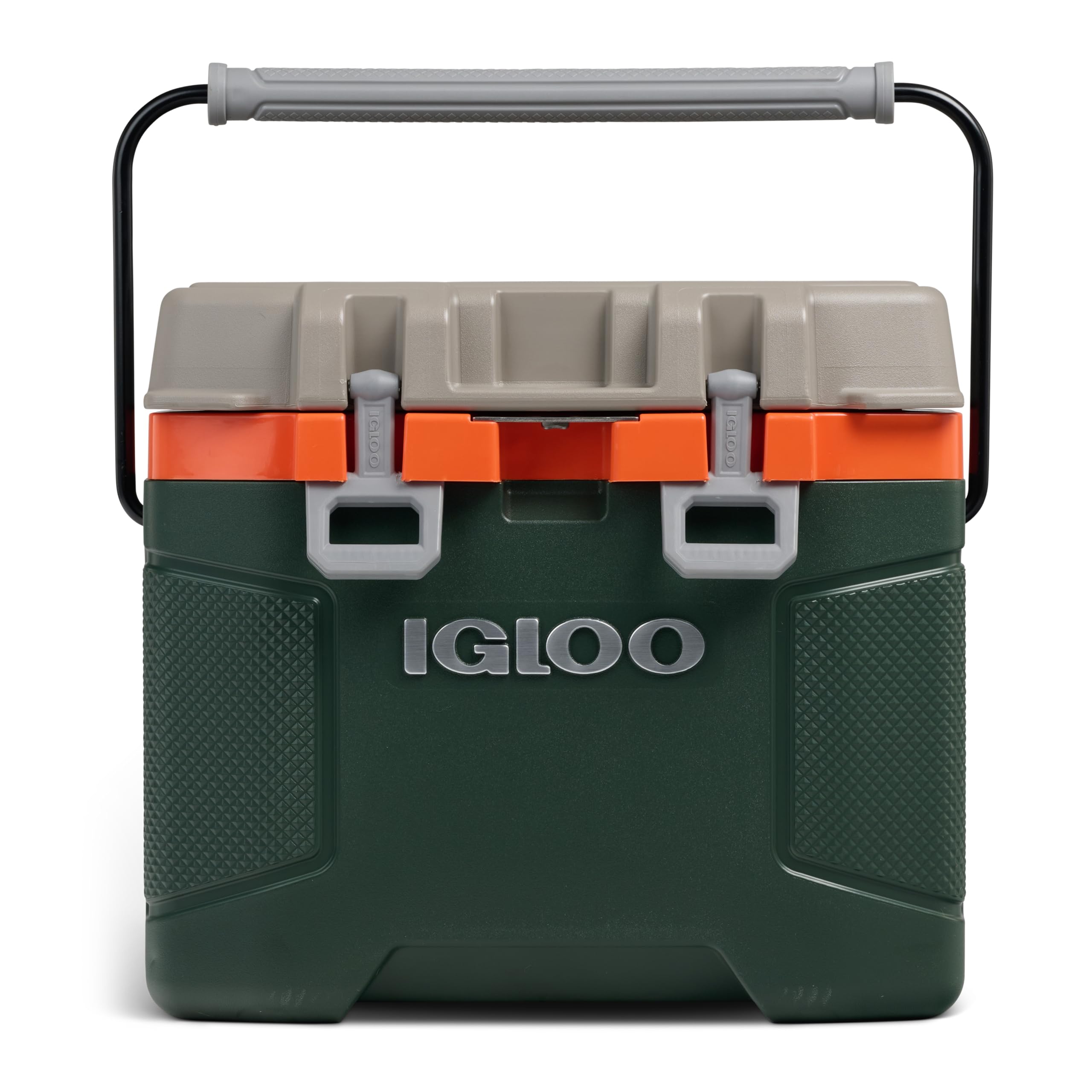
The budget 25-quart that punches above its weight in ice retention.
The Igloo Trailmate 25 Quart uses 1.5-inch foam-insulated walls — unusually thick for a cooler at this price — and Cool Riser Technology that improve the body off hot surfaces, so a hot boat deck or sand does not cook the ice from below as fast. The Sure-Lock rubber latches fasten with two fingers, giving you a secure closure without wrestling a hard latch.
Customers note that “ice formed a solid block over contents; outperformed Rtic, saved.” Another reviewer who had a lifetime cooler said this Igloo “outperforms it with temp control.” At 10.8 pounds it is close to the YETI Hopper M30 (9.85 pounds) but holds less capacity. One customer observed the handles are tough to latch and unlatch when new, though reviewers also say it retains cold and ice for a week in moderate use. For a budget-friendly, packable cooler for a solo bank or pier trip, this one delivers where it counts.
What stands out
- 1.5-inch foam insulation is thick for this class — ice holds for days.
- Cool Riser Technology helps ice last longer on hot decks or sand.
- Sure-Lock rubber latches are easy to open and close with wet hands.
Trade-offs to know
- Heavy for its size at 10.8 pounds when empty.
- Latches can be stiff to work initially.
Ideal for: The budget-conscious angler who wants an efficient cooler for day trips without spending premium money.
Look elsewhere if: You need a wheeled cooler for hauling across sand or a huge capacity for a group.
5. RTIC 52 Quart Ultra-Light Wheeled Hard Cooler
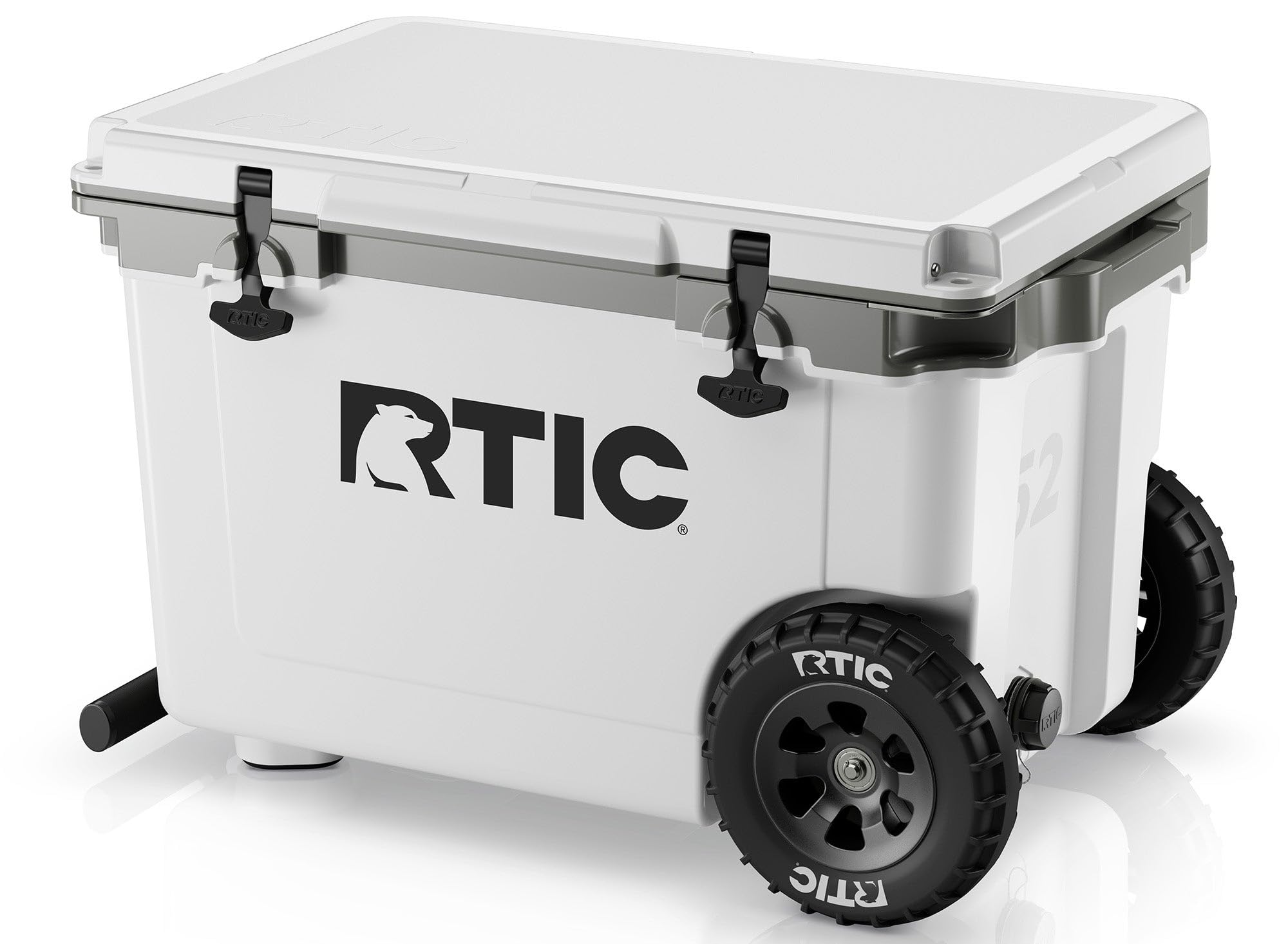
A wheeled chest that goes from sand to boat ramp without the rotomolded weight.
The RTIC 52 Quart Ultra-Light is a wheeled cooler built for the beach-to-boat transition. It uses 2.5 inches of closed-cell foam insulation and is engineered to be 30% lighter than a standard rotomolded cooler of the same capacity — a real advantage when you drag it across sand or load it into a truck bed. The puncture-resistant all-terrain wheels and an ergonomic silicone-gripped, no-slam aluminum handle make it easy to tow with one hand.
Buyers confirm that “the handle and wheels make it maneuverable” and that ice stays cold “for a few days providing it’s not in direct sunlight.” The 52-quart capacity holds up to 78 cans, which is a solid middle ground between a tiny personal cooler and a huge crew chest. One reviewer who took it to the beach twice said the ice is still cold until the next day, and appreciated that there is enough room for two 12-packs plus sandwich fixings. It is heavier than the Igloo Trailmate at 28.5 pounds, but the wheels more than compensate when you are moving loaded gear.
The big value: A 52-quart chest with wheels and premium ice retention at a friendlier price than the big-name competitors.
Honest note: It is not rotomolded, so extreme abuse (like someone standing on it) is not advised. But for the beach, pier, or boat ramp, the weight savings and wheeled ease are a real benefit.
Best for: The shore angler or beach-goer who wants wheeled convenience without the heavy weight of a traditional rotomolded cooler.
pass on it if: You need something compact for a kayak or something that can double as a bear-proof food locker.
6. CUDDY 40QT Floating Cooler and Dry Storage Vessel

A cooler that floats beside you while you fish, tow, or anchor at the sandbar.
The CUDDY 40QT is an amphibious floating cooler and dry storage vessel — it is designed for non-powered towing behind a kayak, SUP (stand-up paddleboard), or inflatable raft, so you have your drinks and catch on the water without cramming everything into the boat. The sturdy HDPE (high-density polyethylene) shell and dual-walled insulation keep 40 quarts of contents cool, and the two large lids with four built-in cup holders make it easy to grab a drink without climbing back into your boat.
Reviewers point out it held up to a 28-mile canoe trip with only bottom scratches from dragging, and that it acts like a trailer that can pull the boat tail around river bends. At 24.7 pounds it is heavy compared to a soft cooler, but it is unsinkable by design. One user highlighted that ice “lasted into the next day” for pool parties, but another cautioned that ice lasts about one afternoon, so it is best for single-day use. The 6-foot tow strap with carabiner is included, so you can tie it off and drift.
Best use-case
- Floats alongside your kayak, raft, or SUP for easy drink access on the water.
- Tows easily with the included 6-foot strap and carabiner.
- Dual lids with cup holders let you grab drinks without digging through ice.
Biggest limit
- Ice retention is modest — expect it to last one afternoon, not multiple days.
- At 24.7 pounds, it is heavy for a floating cooler.
Perfect for: Tubing, floating rivers, kayak angling, and sandbar socials where you want drinks within arm’s reach in the water.
Not for: Multi-day camping trips or offshore fishing that demands serious insulation — stick with the RTIC or YETI.
7. MORXPLOR Insulated Fish Cooler Bag, 72-Inch
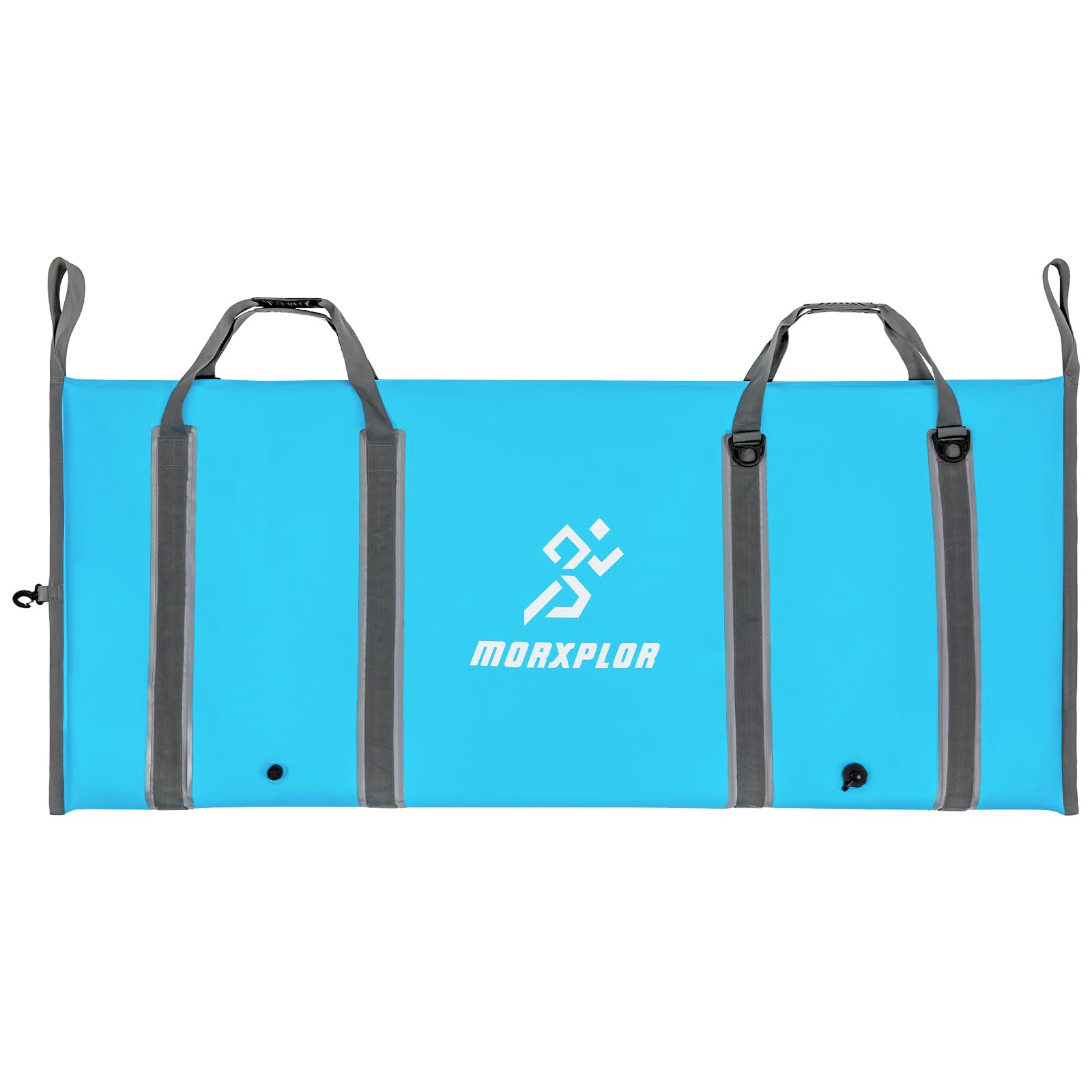
A massive PVC bag that swallows a 60-inch tuna and fits in a kayak.
The MORXPLOR 72-inch insulated fish cooler bag is for the serious offshore or kayak angler who needs to keep a large catch cold without a hard chest. It uses a heavy-duty PVC (polyvinyl chloride) material with 10mm thick cotton foam insulation and electrowelded seams — no stitching that can burst under the weight of a big wahoo or mahi-mahi. The 3-point fold-up design means it collapses flat for storage, so you keep it in a kayak hatch or a boat locker when not in use.
Shoppers say that the 60-inch version is “large enough for Wahoo, Tuna, Mahi-mahi; fits kayak” and that the welded-seam construction prevented any leaks. One reviewer recommended lubricating the zipper first to avoid damage, and the cooler includes clear instructions and zipper grease. It is 150 liters (about 40 gallons) of capacity, which dwarfs the YETI Hopper M30 in volume, but at 5.81 kg (12.8 pounds) it is light for its size. The built-in drain plug makes cleanup easy, and the removable shoulder strap helps carry a heavy load.
Who it’s for: The kayak angler or small-boat fisherman who needs a collapsible bag for large pelagic fish without the space of a hard cooler.
The catch: The zipper is not airtight-leakproof, and one buyer experienced delamination after a few uses (the company resolved it with a replacement). It is a value pick that works best for day trips.
Choose it: When you need the biggest possible fish bag that stores flat and is easy to clean, especially for kayak-based offshore fishing.
Pass if: You need multi-day ice retention or a leakproof, airtight seal for gear protection — the Engel UC30 is a better drybox.
Understanding the Specs
Insulation & Ice Retention
The most important job of a fishing cooler is keeping ice frozen as long as possible. The spec to look for is the type and thickness of foam. Closed-cell polyurethane foam (found in the RTIC and YETI) is the most efficient — it traps air bubbles that block heat transfer. Polystyrene foam (used by Engel) is also effective but less dense. Thicker is always better: 1.5-inch walls (Igloo) are good for a day trip, while 2.5-inch walls (RTIC) can keep ice for multiple days. A tight gasket seal, like the ethylene-vinyl acetate gasket on the Engel, prevents cold air from escaping and warm air from leaking in.
Construction Material & Durability
A fishing cooler lives in a harsh environment: salt spray, direct sun, and rough handling. High-density polyethylene (HDPE), used in the Igloo and CUDDY, is the standard tough plastic that resists cracking. Some coolers use polypropylene (PP), like the RTIC, which is slightly more flexible and lighter. For soft coolers, look for high-density nylon or PVC: the YETI’s DryHide fabric resists punctures, while the MORXPLOR uses heavy-duty PVC with electrowelded seams for waterproofing. Stainless steel hardware (latches, hinges, drain plugs) is a non-negotiable for saltwater — it will not rust like standard steel.
Capacity & Portability
Capacity in quarts (qts) or liters tells you how much it holds, but the real question is how you carry it. A 25-quart cooler like the Igloo is light enough for one person to carry by the handle, but a 120-quart Coleman needs two people or wheels. Soft bags (YETI Hopper) collapse when empty and fit into tight kayak hatches. The RTIC’s wheels make a 52-quart cooler maneuverable on sand, while the CUDDY floats so you tow it. Think about your typical outing: a kayak trip calls for a bag under 30 quarts; a pier trip might welcome a wheeled 52-quart chest.
Drybox vs Cooler
Some fishing coolers, like the Engel UC30, are designed as dryboxes — they are completely air-tight and leak proof, so you can store electronics, cameras, or dry clothes inside without any risk of water intrusion. The trade-off is that the ice retention tends to be lower than an insulated cooler because the drybox gasket prioritizes a watertight seal over thermal efficiency. A standard cooler (like the Igloo or Coleman) keeps ice longer but may leak water if tipped. If you are bringing a phone, GPS, or camera on a kayak, a drybox hybrid is a smarter choice than a pure ice chest.
FAQ
How long will ice last in a fishing cooler?
Can I sit on a fishing cooler?
What is the difference between a drybox cooler and a regular cooler?
Is a soft cooler or a hard cooler better for fishing?
What size cooler do I need for a fishing trip?
Will a cooler float in water?
What does UV Guard coating do for a cooler?
How do I clean a fishing cooler after a trip?
What is Cool Riser Technology?
Can I use a fishing cooler for other activities?
Final Thoughts: The Verdict
Across the board, the cooler for fishing winner is the YETI Hopper M30 because it delivers premium ice retention in a lightweight, durable soft bag that fits into a kayak or small boat. If you want an all-in-one drybox with rod holders for solo day trips, grab the Engel UC30. And for the angler who wheels gear across sand or to a boat ramp, the standout is the RTIC 52 Quart Ultra-Light for combining wheeled convenience with excellent cold holding.
How We Picked
We do not accept paid placement. Every pick is matched to a real buyer and a real use-case; we do not hands-on test units.
Sources & Methodology
Specifications: manufacturer listings and product documentation. Review insights: verified customer reviews, as of July 2026. Pricing: not shown on this page (it changes often); check the current price via the retailer link.
As an Amazon Associate, WellFizz earns from qualifying purchases. This does not affect which products we feature.
Related Guides

Mo Maruf
I created WellFizz to bridge the gap between vague wellness advice and actionable solutions. My mission is simple: to decode the research and give you practical tools you can actually use.
Beyond the data, I am a passionate traveler. I believe that stepping away from the screen to explore new environments is essential for mental clarity and physical vitality.