Our readers keep the lights on and my smoothie glass nicely filled. As an Amazon Associate, I earn from qualifying purchases.
Specs are compiled from manufacturer listings and verified buyer reviews and can change over time — please confirm the key details on the product page before buying.
The AMD Ryzen 7 9800X3D runs hot under load, and a weak cooler means lost clock speeds and frustrated gaming sessions. Your choice depends on a quiet, leak-proof air tower or a liquid AIO (all-in-one cooler) that handles sustained all-core stress without breaking a sweat. You need a cooler that keeps the 9800X3D below its thermal throttle point so you get full gaming performance, and the right pick delivers real-world temperatures and noise you can live with every day.
I’m Mohammad Maruf — the founder and writer behind WellFizz. This guide is built by comparing the manufacturers’ published specifications and the patterns across verified customer reviews, so you get each pick’s real strengths and trade-offs instead of marketing spin.
For extreme overclocking headroom or dead-silent gaming sessions, the right cooler for 9800x3d keeps your system fast, stable, and quiet for years.
Our Picks at a Glance


How To Choose The Best Cooler For 9800X3D
The 9800X3D is not an easy chip to cool — its 3D V-Cache layer makes it sensitive to sustained heat, and a cooler that cannot move that heat fast enough will cost you boost clocks and frame rates. Two main paths work: a large dual-tower air cooler with thick heat pipes, or a 360mm all-in-one liquid cooler that moves the heat to a distant radiator.
Air Tower vs AIO: Which one fits your build?
Air coolers are simpler and carry zero leak risk. A dual-tower design with seven heat pipes and dual 120mm fans handles the 9800X3D in gaming loads comfortably, idle temps land in the 30s and gaming in the 50s. The catch is height — a 154mm tower needs a wide case. AIOs push the heat to a radiator mounted at the top or front, leaving the motherboard area clear. A 360mm radiator keeps a fully loaded 9800X3D from throttling under all-core work, but the pump adds a failure point and some noise.
Heat pipe count and TDP rating
Six heat pipes is the floor for the 9800X3D. Seven or eight pipes give extra margin for hot ambient temps or a quiet fan curve. TDP ratings matter only as a rough guide — a cooler rated for 250W or more is a solid match — because the 9800X3D can pull around 160W under gaming loads and peak higher in stress tests. A 270W-rated air cooler covers that with room to spare.
RAM clearance and case fit
Dual-tower coolers often overhang the RAM slots. Many have a cut-out in the front fin stack so tall RAM sticks fit, but that clearance ranges from 36mm to 63mm depending on the model. Check your RAM height before buying. Case width is the other limit — a 154mm tall cooler needs at least 160mm of clearance. Mid-towers are fine; most compact cases are not.
Quick Comparison
| Model | Best For | Type | Heat Pipes | Noise Level | Amazon |
|---|---|---|---|---|---|
| Thermalright Phantom Spirit 120SE★ Best Overall | Best Overall | Air | 7 | ≤25.6 dB(A) | Amazon |
| Thermalright PS120SE ARGBBest Value with RGB | Best Value with RGB | Air | 7 | ≤25.6 dB(A) | Amazon |
| ID-COOLING FROZN A620Compact Power | Compact Air | Air | 6 | ≤29.85 dB(A) | Amazon |
| be quiet! Pure Rock Pro 3 Silver | Premium Air | Air | 6 | 34.8 dB(A) | Amazon |
| upHere CPU Air Cooler | High Pipe Count | Air | 8 | ≤26 dB(A) | Amazon |
| ARCTIC Liquid Freezer III Pro 360 | Best Value AIO | Liquid | — | — | Amazon |
| CORSAIR Nautilus 360 RS | Simple AIO | Liquid | — | 36 dB(A) | Amazon |
| be quiet! Light Loop 360 | Quietest AIO | Liquid | — | 36.8 dB(A) | Amazon |
In‑Depth Reviews
1. Thermalright Phantom Spirit 120SE
Our pick — over 4.5★ from 900+ verified ratings; the strongest balance of quality and price.
The air cooler that rivals AIOs for a fraction of the cost — and has the reviews to prove it.
This is the crowd favorite for a reason. Seven 6mm heat pipes with AGHP 4.0 technology handle vertical and horizontal mounting without the usual gravity-related performance loss. The dual 120mm TL-C12B V2 fans push 66.17 CFM of airflow while keeping noise at or below 25.6 dB(A) — quiet enough that many buyers report hearing nothing at all during normal use. On a Ryzen 9800X3D, idle temps sit in the 30s and gaming loads stay well south of 60°C, matching what a liquid cooler delivers.
The cooling performance is the most-praised aspect across over 200 buyers, and value runs a close second. A moderate drawback is the height — at 154mm it fits most mid-towers, but small cases are out. Owners replacing old AIOs found similar or better thermals, with max temps only a few degrees hotter than their former liquid setup, and no pump or leak worries at all.
Stock fans can develop a slight noise after extended use, though replacement with Arctic P12 or Noctua fans is a common and inexpensive fix. Buyers also note that the cooler blocks M.2 access on some boards, so install it before the GPU if possible.
Real-world take: The cooler that owns the balance — peerless cooling, near-silent operation, and a price that leaves you wondering why people spend more.
Who should skip it: Anyone in a case under 160mm wide or anyone who wants zero RAM slot overhang.
Best for: Gamers who want AIO-like temps without AIO complexity.
Think twice if: Your case is narrow or your RAM is very tall — check clearance first.
2. Thermalright PS120SE ARGB
Same seven-pipe beast in a more notable outfit — with smoothly diffused ARGB lighting.
This is the Phantom Spirit with a neat extra. The dual TL-C12B-S V2 fans carry 5V 3-pin ARGB (addressable RGB that syncs with the motherboard) for up to 17 lighting modes, and the atomized blade surface spreads the glow evenly rather than spotting. The cooling core is identical — seven 6mm heat pipes, AGHP 4.0 technology (anti-gravity heat-pipe technology that works in any orientation), 154mm height — so it keeps a 9800X3D just as cool as the non-RGB version, with owners reporting max temps around 78°C under heavy load on a 9950X3D. If you want RGB with the same core performance as the Phantom Spirit 120SE, grab this one.
The noise level matches its sibling at ≤25.6 dB(A), and installation remains straightforward. Buyers who upgraded from single-tower coolers say the drop in both temperature and noise is dramatic. The front fan can slide up slightly to clear four RAM sticks without losing meaningful cooling performance, a detail owners regularly note as a lifesaver for tall DIMMs.
Aspect counts show cooling performance leading again with over 180 mentions, and performance feedback runs a strong second. The size gets a mixed reception — some call it massive, but that mass is what makes it work.
Light show verdict: If you want the same elite cooling with synchronized bling and zero pump risk, this is the pick.
Reach for this if: RGB matters and maximum cooling at the price matters more.
Look elsewhere if: You need a cooler under 150mm tall or want absolute silence above 1500 RPM.
3. ID-COOLING FROZN A620 Black
A shorter dual-tower that slides into tighter cases without sacrificing cooling.
At 153mm tall, this cooler is the shortest dual-tower on the list — a full millimeter shorter than the Thermalright, which matters in compact mid-towers. It packs six 6mm copper heat pipes and dual 120mm FDB (fluid dynamic bearing) fans that spin up to 1800 RPM and push 78.25 CFM of air. The noise rating of 29.85 dB(A) is slightly higher than the Thermalright, but owners describe it as a deep hum that blends into case fan noise.
The 270W TDP rating gives it more headroom than the 9800X3D will ever demand. Owners running LGA 1700 13700K builds say it outperforms the popular Thermalright Peerless Assassin by about 4°C. The RAM clearance is generous — 63mm with the front fin cut-out — so tall RGB sticks fit without lifting the fan.
Installation is the aspect owners talk about mixed. Several call the mounting mechanism fiddly, with screws hard to reach between the fin stacks. But for the price, the value score is high, and the performance is undeniable.
Why owners love it
- 153mm fits cases most dual-towers cannot
- 78.25 CFM airflow is the highest among air picks here
- 63mm RAM clearance for tall RGB kits
The headache
- Mounting mechanism is tight; follow the manual carefully
- Fans have a noticeable hum at full speed
- A few units arrive with minor defects per reviews
Who this fits: Anyone cramming a strong cooler into a case with limited vertical space.
Who should measure twice: First-time builders — the tricky mount can frustrate; watch a guide first.
4. be quiet! Pure Rock Pro 3 Silver

German engineering with a nickel-plated base and a fan curve that stays silent at idle.
be quiet! earns its name here. The Pure Rock Pro 3 Silver uses six nickel-plated copper heat pipes with direct-touch (HDT) technology and a compact offset design that improves RAM and VRM clearance. The Pure Wings 3 120mm PWM fan spins up to 2000 RPM but stays quiet in practice — owners call it a whisper at idle and only moderately audible under load. The convex cold plate makes solid contact with the 9800X3D’s integrated heat spreader.
Cooling performance draws the most praise among buyers, with noise level a close second. On a 5900XT, it runs cool with no throttling, and owners say it beats some water coolers for value. The silver finish is subtle and clean.
The hardware is where things slow down. The mounting requires swapping the motherboard’s fan bracket, and the brackets are orientation-specific, which means reading the manual is not optional. Heat pipes overhang the RAM slots, so tall modules may block clearance. It is also large — measure your case width before buying.
On the bench: Terrific cooling and silence, held back by a fiddly mount that demands patience.
Build for it if: You value near-silent operation and premium looks over easy installation.
Think twice if: You want tool-free mounting or have top-slot RAM with tall heat spreaders.
5. upHere CPU Air Cooler

Eight heat pipes in a dual-tower — more copper than most coolers this size even try.
Eight 6mm copper heat pipes is an unusual count at this tier, and it translates to excellent thermal transfer. The dual 120mm fans run at a max 1650 RPM and push 68.2 CFM at or below 26 dB(A) — very quiet for the airflow. At 155mm tall, it fits many small cases, and the non-disassembly installation lets you mount it without removing the motherboard or RAM.
Owners coming from stock or 65W coolers report dramatic temperature drops: one system dropped idle temps from 55-60°C to 37°C. On a 12700K, Cinebench temps dropped from 90-100°C to 60°C. The build comes with thermal paste and all brackets, though note that no AM4/AM5 backplate is included — you reuse the motherboard’s stock backplate.
The RAM clearance is generous enough for most kits. A few owners note it barely fits mid-tower cases, so confirm your case width. The branding is understated, and the RGB lighting on select versions adds a clean glow.
Standout strengths
- Eight heat pipes handle high-load spikes easily
- 155mm height fits cases other dual-towers miss
- 5-minute install once brackets are on
One check
- No dedicated AM5 backplate — verify yours is stock
- Case clearance is borderline for some mid-towers
Ideal for: Builders who want extra thermal pipe headroom for quiet fan curves.
Check before buying: Motherboard backplate compatibility and case width.
6. ARCTIC Liquid Freezer III Pro 360

A thick 38mm radiator and a VRM fan make this AIO the coolest value in liquid cooling.
ARCTIC’s Liquid Freezer III Pro stands out with a 38mm thick radiator — thicker than the standard 27mm, which means more coolant volume and better heat soaking. The three P12 Pro fans spin up to 3000 RPM and push 77 CFM. The integrated VRM fan cools the voltage regulators around the CPU socket, a detail most AIOs ignore. On a 9800X3D, owners mention max temps around 82°C under load compared to 95°C on a 240mm AIO, with idle around 40°C and gaming in the 60-65°C range.
The native offset mounting shifts the cold plate toward the CPU hotspot — useful for both AMD and Intel. But buyers consistently warn about the included MX-6 thermal paste, which several found dried or putty-like. Plan to buy fresh paste separately. The mounting system is also tight; some owners had to loosen brackets to align screws.
Noise is well-controlled for a 3000-RPM fan set, and the price undercuts most 360mm competitors while delivering better cooling than many.
Crucial tip: Order fresh thermal paste with this cooler. It makes the difference between great temps and frustration.
Best for: Overclockers who want the most cooling per dollar in a 360mm form factor.
Not for: Anyone who wants paste included that is not a rock.
7. CORSAIR Nautilus 360 RS
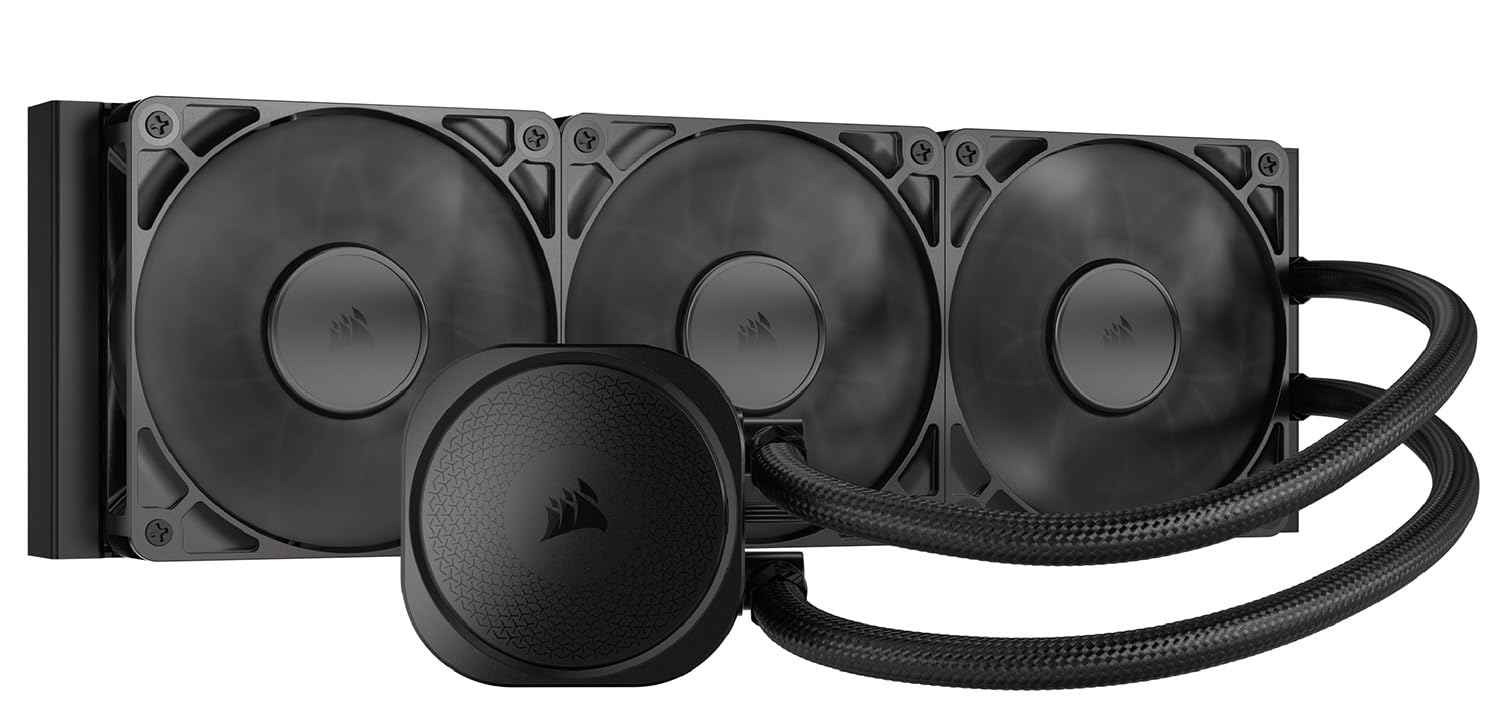
CORSAIR’s cleanest AIO — daisy-chain fans, a convex cold plate, and a whisper-quiet pump.
CORSAIR brings its trusted engineering to a simpler, no-frills 360mm AIO. The pump runs at just 20 dBA — quiet enough that owners call it nearly silent under light loads. The convex cold plate makes maximum contact with the 9800X3D’s integrated heat spreader, and the pre-applied thermal paste is applied in an tune pattern for quick installation. The three RS120 fans feature AirGuide technology and Magnetic Dome bearings for high static pressure through the radiator.
Daisy-chain connections reduce cable clutter — one cable runs to a single 4-pin PWM header. On a Ryzen 9 9950x, customers note excellent temps, and one build dropped gaming temps from 75°C to 65°C after replacing the pre-applied paste with a quality alternative. The 36 dB(A) fan noise rating is moderate, but owners describe it as an acceptable whoosh under heavy loads.
Cooling performance leads the positive feedback with 71 mentions. Noise gets mixed reactions — some find it quiet, a few report pump grinding at low RPMs, which may be a unit variance.
Honest summary: An excellent, fuss-free AIO that rewards you if you swap the thermal paste early.
Reach for this if: You want CORSAIR reliability with easy cable management and clean looks.
Check reviews first if: You are sensitive to pump noise — a small number of units have minor issues.
8. be quiet! Light Loop 360
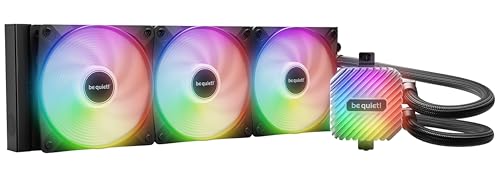
The quietest liquid cooler on the list — and it keeps a 9800X3D below 65°C through hours of gaming.
be quiet! designed the Light Loop 360 for noise-sensitive builders without compromising performance. The pump uses a progressive IC (integrated circuit) to reduce switching noise, and the three Light Wings LX 120mm PWM fans (pulse-width modulation fans that adjust speed automatically) with 9 airflow-tune blades produce a max of 36.8 dB(A) — but owners consistently report it as “super silent” in practice. One owner running a 9800X3D saw temps stay below 65°C during 4+ hours of maxed-out gaming, making it quieter than the Phantom Spirit 120SE under load.
The metal jet plate inside the pump increases coolant flow speed, and the high-density fin stack on the cold plate pulls heat from the CPU fast. A refill port and included coolant bottle extend the lifespan beyond typical sealed AIOs. The 64 total LEDs (fans + block) sync through an ARGB-PWM hub that controls six PWM fans and six ARGB components from one header each.
Build quality and noise level tie as the most-mentioned positive aspects. One owner running a 7800X3D with PBO and undervolt saw temps never exceed 70°C in multi-threaded stress tests. The RGB controller needs SATA power, which some find slightly annoying, but the result is a build that looks and sounds premium.
What owners say: “Super quiet and gorgeous to look at.” The silence at idle is real, and the RGB is stunning without being garish.
Best for: The builder who wants liquid cooling performance with dead-silent fans and showpiece lighting.
Think twice if: You are on a strict mid-range budget — this is a premium investment.
Understanding the Specs
Heat Pipe Count and Diameter
The number and thickness of copper heat pipes determine how fast heat moves from the CPU to the fin stack. Six 6mm pipes is the baseline for the 9800X3D; seven or eight pipes give extra margin for quiet fan curves or warmer rooms. Thicker pipes handle more heat, but the number of pipes matters more than fractional width differences.
TDP Rating and Real-World Power
TDP (thermal design power) is the wattage a cooler can handle. The 9800X3D pulls around 160W in gaming and peaks higher in stress tests, so a cooler rated for 250W or more leaves room. But TDP ratings vary between manufacturers — check them as a rough rank rather than an absolute guarantee.
Noise Level in dB(A)
Decibels measure sound pressure. Every 10 dB(A) is roughly twice as loud to human ears. A cooler at 25 dB(A) is near silent; 35 dB(A) is noticeable; 40+ dB(A) is distracting. Heatsink design and fan quality affect noise more than the raw number — read user reports for real-world quietness.
RAM Clearance and Offset Design
Dual-tower coolers overhang the RAM slots. Some have a cut-out in the front fin stack that clears tall modules, while others require lifting the front fan. Check your RAM’s height (typically 32-45mm for standard, up to 60mm for RGB-heavy kits) and compare against the cooler’s stated clearance. Offset designs push the tower back for extra room.
FAQ
Will a 240mm AIO be enough for the 9800X3D?
Is air cooling better than liquid for the 9800X3D?
How do I know if a cooler fits my case?
Does the cooler come with thermal paste?
Will a dual-tower cooler block my RAM?
What is AGHP technology in Thermalright coolers?
How many heat pipes do I really need for the 9800X3D?
Can I install a 360mm AIO in a standard mid-tower case?
Does the be quiet! Light Loop 360 need separate software?
What offset mount options do AIOs offer for the 9800X3D?
Final Thoughts: The Verdict
If you want one dependable pick, the cooler for 9800x3d winner is the Thermalright Phantom Spirit 120SE because it delivers exceptional air cooling without the complexity or cost of liquid — and the owner consensus across nearly a thousand ratings backs that up. If you want RGB with the same core performance, grab the Thermalright PS120SE ARGB. And for extreme overclocking headroom and a whisper-quiet pump, the be quiet! Light Loop 360 is the one to reach for.
How We Picked
We do not accept paid placement. Every pick is matched to a real buyer and a real use-case; we do not hands-on test units.
Sources & Methodology
Specifications: manufacturer listings and product documentation. Review insights: verified customer reviews, as of July 2026. Pricing: not shown on this page (it changes often); check the current price via the retailer link.
As an Amazon Associate, WellFizz earns from qualifying purchases. This does not affect which products we feature.
Related Guides

Mo Maruf
I created WellFizz to bridge the gap between vague wellness advice and actionable solutions. My mission is simple: to decode the research and give you practical tools you can actually use.
Beyond the data, I am a passionate traveler. I believe that stepping away from the screen to explore new environments is essential for mental clarity and physical vitality.