Our readers keep the lights on and my smoothie glass nicely filled. As an Amazon Associate, I earn from qualifying purchases.
Specs are compiled from manufacturer listings and verified buyer reviews and can change over time — please confirm the key details on the product page before buying.
An overheated bike on a summer ride is a gut-punch — the steam, the worry, the long wait for things to cool down. The coolant you choose is the single most important decision for keeping your engine temperature in check. This guide breaks down the six best coolants for motorcycles by their real specs and what verified buyers actually report, so you know exactly which bottle solves your bike’s specific problem.
I’m Mohammad Maruf — the founder and writer behind WellFizz. This guide is built by comparing the manufacturers’ published specifications and the patterns across verified customer reviews, so you get each pick’s real strengths and trade-offs instead of marketing spin.
Whether your bike runs hot in traffic, leans over on the track, or just needs a reliable fluid for daily commuting, the right coolant makes all the difference. Here is the honest breakdown of the best coolant for motorcycles on the shelf today, backed by real numbers and rider experiences.
Our Picks at a Glance


How To Choose The Best Coolant For Motorcycles
Not all coolants are built the same, and the wrong choice can leave you stranded. The first fork in the road is the chemical base: ethylene glycol or propylene glycol. Ethylene glycol is the traditional choice, offering strong freeze protection and heat transfer, but it is toxic to pets and wildlife if it leaks. Propylene glycol is far less toxic, biodegradable, and often preferred by off-road riders who do not want to poison the trail. Your bike’s manual usually states what is recommended, but a flush gives you the freedom to switch.
Pre-Mixed vs. Concentrate
A pre-mixed (50/50) coolant comes ready to pour straight from the bottle — no need to measure or source distilled water. Concentrate requires you to mix it yourself, which saves a little money but introduces the risk of a wrong ratio that hurts cooling performance. For most riders, a pre-mixed option is the easier and more reliable choice, which is why every coolant on this list is ready to use.
The “Waterless” Difference
Waterless coolants, like the EVANS option below, contain no water at all. That means no corrosion inside the engine, no pressure build-up in the cooling system, and no evaporation over time. The trade-off is a more involved installation — the system must bone-dry before you pour it in — and a higher upfront price. But for a bike that sees extreme heat or long desert trips, the lack of pressure and maintenance is a standout.
What to Look for in Reviews
When you scan buyer feedback, pay attention to two things: did the coolant fix an overheating problem that other coolants could not, and did it work in the specific engine type (dirt bike, street bike, ATV, or scooter)? A coolant that drops temperatures by twenty degrees on a dyno might not do the same in a different engine — so look for reviews that match your exact bike model.
Quick Comparison
| Model | Best For | Chemical Base | Volume | Weight | Amazon |
|---|---|---|---|---|---|
| Maxima Coolanol★ Best Overall | Reliable Daily & Street Riding | Ethylene Glycol | 64 fl oz | 68 oz | Amazon |
| Star Tron Star-CoolAlso Great | High-Performance Street & Track | Propylene Glycol | 128 fl oz | 9.18 lb | Amazon |
| Engine Ice | Off-Road & Dirt Bikes | Propylene Glycol | — | 4.62 lb | Amazon |
| Evans Waterless | Extreme Heat & Desert Riding | Waterless | 1/2 gallon | 4.45 lb | Amazon |
| Red Line Supercool | Track Days & Dyno Tuning | Water-based w/ WaterWetter | 64 fl oz | N/A | Amazon |
| Motorex M3.0 | Scooters & Small Engines | Ethylene Glycol | 1 Liter | 2.6 lb | Amazon |
In‑Depth Reviews
1. Maxima Coolanol 50/50 Blend Treatment
Our pick — over 4.5★ from 750+ verified ratings; the strongest balance of quality and price.
The straight-ahead 50/50 glycol coolant with two years of real-world riding proof.
If you just want a reliable, pre-mixed ethylene-glycol coolant that works and does not cost a fortune, Maxima Coolanol is the simple answer. It comes as a 64 fluid ounce bottle (weighing 68 ounces — notably heavier than the Red Line’s 1 pound despite the same volume, because the ethylene glycol base is denser than a water-WaterWetter blend). The formula is nitrate, amine, and borax-free, and importantly it is 100% biodegradable in its unused form, which is a nice environmental bonus.
This one has a huge base of satisfied owners — it holds a 4.8 rating from over 760 ratings, the most of any product here. One buyer summed up the trust factor: “Have been running it in my bike for 2 years in all temps and have had no issues.” It works in a GSXR 750, in marine steering systems, and in general street use. The flash point is listed at 116°C (about 241°F), so it handles normal engine heat without issue, though it is not as extreme as the Star Tron’s 265°F. For a daily street rider, that margin is plenty.
A fan favorite
- 4.8/5 from over 760 ratings — the most customer feedback of any coolant here
- 100% biodegradable in unused form and free of harmful amines and borates
Not for everyone
- Ethylene glycol is toxic — not the choice for off-road riders who might leak coolant on the trail
Right for: Street riders, commuters, and cruiser owners who want a proven, low-cost 50/50 coolant with a massive track record of happy customers.
Pass on it if: You ride off-road or have pets and want the less-toxic propylene glycol option — the Engine Ice or Star Tron are better there.
2. Star Tron Star-Cool Premium Synthetic PG Engine Coolant + Antifreeze
The heavy-duty gallon that brings Ducati and Aprilia owners back from the brink of overheating.
If your bike runs hot and you want the most fluid for your money, this is the one that stands out. You get a full 128 fluid ounces (that is a full gallon) of propylene-glycol-based coolant ready to pour. It is the heaviest bottle on the list at 9.18 pounds — more than nine times the weight of the Red Line option — simply because it holds double the volume of the next closest competitor. That means one bottle handles most bike systems with some left over for a top-off later.
The story that jumps out from the feedback is from owners of notoriously hot-running Italian superbikes. One reviewer noted simply: “Ducati Panigale and Aprilia RSV4 overheating? This is the answer!” It uses a POAT (Polyol Organic Acid Technology) additive package that seals pinhole leaks and fights corrosion while keeping the system safe up to a flash point of 265°F (a measure of when the fluid could ignite — far above what a typical engine sees). It also protects against freezing down to -26°F, making it a true year-round choice. Buyers report the price fluctuates, so you want to grab it when it drops.
The coolant king: The biggest jug with the widest temperature safety net (265°F boilover / -26°F freeze), proven on high-strung Italian V-twins.
One trade-off: At 9.18 pounds, it is the heaviest product here by a wide margin — shipping weight reflects that, but the contents cover two or more flushes.
Grab it for: Any liquid-cooled bike, especially high-performance street or track machines. The generous volume and broad temperature protection make it the best value-per-ounce pick.
skip it if: You want something in a smaller, lighter single-use bottle — this is a bulk purchase meant to last.
3. Engine Ice Off-Road High-Performance Motorcycle Coolant and Antifreeze
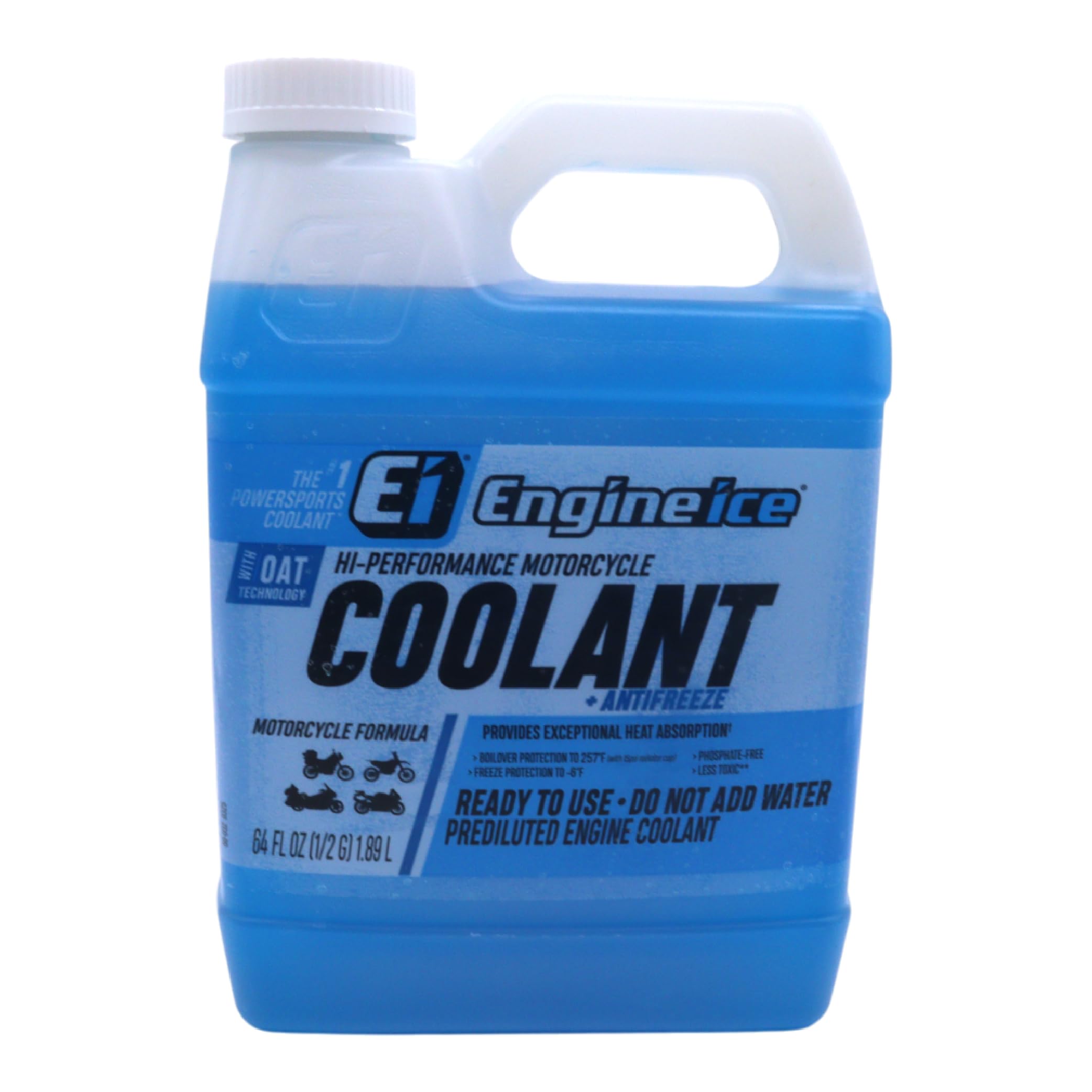
The blue stuff that keeps dirt bikes cool and is gentle on the trail you just rode.
Engine Ice is a staple in the off-road community for a reason — it uses a propylene glycol formula that is biodegradable and phosphate-free, so if a hose pops in the woods, you are not leaving a toxic puddle behind. It is pre-mixed and ready to pour, which matters when you are wrenching before a weekend ride. Buyers consistently say the same thing: “I run this coolant in all of my bikes. runs noticeably cooler in high temp summer days.”
Where it excels versus the Star Tron option is in its composition. Engine Ice is phosphorus and ethylene glycol-free, which owners point out makes it less toxic if ingested by animals and often track-legal at facilities that ban standard glycol coolants. The blue color makes it easy to spot in the sight glass, and at 4.62 pounds the bottle is manageable for a single-bike flush. Note that the technical spec does not list a flash point or exact volume in the public data — it is a ready-to-use formula marketed for temperature reduction, not extreme freezing protection.
Trail-ready and responsible: A biodegradable, non-toxic formula that drops operating temps noticeably, backed by a long trail-riding reputation.
The caution: Without a published flash point, riders in deep-freeze climates might want to check compatibility before winter storage.
Best for: Dirt bike and enduro riders who want a cooler-running engine and a fluid that is safer for the environment if it spills.
Look elsewhere if: You ride in sub-zero temps and need a guaranteed freeze point — the lack of a published spec leaves that uncertain.
4. EVANS Coolant EC72064 Powersports Waterless Engine Coolant

The zero-pressure coolant that solved a CRF450R’s overheating with a single fill.
EVANS takes a radically different approach: it contains no water at all. Without water, there is no corrosion inside the engine, no water-pump cavitation (tiny bubbles that damage the pump), and no pressure build-up in the cooling system — which means hoses and gaskets last longer. The trade-off is a strict installation process — the entire system must be bone-dry before you pour this in, and EVANS sells a prep fluid to flush every last drop of old coolant out. You cannot mix it with water-based coolants; a partial fill ruins the chemistry.
Owners mention serious success with this approach. One owner wrote it “resolved overheating on 2017 CRF450R; no evaporation, single fill needed.” Another noted that an ATV that constantly overheated before the swap “never had any more issues” after switching. The 1/2-gallon (4.45 pounds) bottle is a single-shot quantity for most bikes. It weighs similarly to the Engine Ice bottle, but the technology is completely different — where Engine Ice relies on glycol and water for heat transfer, EVANS uses a pure, waterless fluid that eliminates the system’s boiling point altogether.
Real talk from owners
- “Resolved overheating on 2017 CRF450R; no evaporation, single fill needed” — a common success story for bikes that boil over.
- No system pressure means older hoses and water pumps carry less risk of failure.
The hard requirement
- You must completely remove all old coolant and water before use — a thorough flush with the prep fluid is mandatory, or it will not work.
- Cannot be mixed with any water-based coolant; if you add the wrong fluid later, the whole system needs a re-flush.
The fix for chronic overheating: If your bike consistently runs hot in desert riding, traffic, or at the track, this is the single most effective solution — but only if you follow the dry-install procedure.
Not for casual maintenance: Riders who just want a quick top-off or who share a bike with someone using standard coolant should stick with a pre-mixed glycol option.
5. Red Line 80205 Supercool Extreme Powersports Coolant

The featherweight bottle that dyno-tested a twenty-degree temperature drop.
Red Line’s entry stands out for one concrete reason: it weighs just 1 pound for a full 64 fluid ounces. That is a shockingly light jug — nine times lighter than the Star Tron gallon even though it holds half the volume — because the liquid is a water-based coolant fortified with their WaterWetter additive, not a heavy glycol load. This pre-mixed formula is designed for powersports engines and includes purified, deionized water plus the right WaterWetter percentage to reduce surface tension and improve heat transfer against metal surfaces.
The most compelling buyer report comes from a dyno session: “Dropped my coolant temps by 20° on dyno.” Another reviewer said it dropped the average coolant temperature by roughly 10 degrees on his bike. For riders who primarily do track days or care about peak power, that measurable temperature reduction is exactly what you want. The formula is compatible with all modern aluminum, cast iron, copper, brass, and bronze cooling systems and can be mixed with other antifreeze, making it a flexible choice for top-offs between full flushes.
Dyno-proven results
- Documented temperature drops of 10-20 degrees in real buyer dyno tests
- Extremely lightweight bottle (1 lb) — saves on shipping and is easy to handle
One thing to know
- The water-based formula means it is not freeze-proof on its own — you need the full glycol version for winter storage in freezing climates
Reach for this if: You are chasing every degree of temperature reduction on a track bike or a tuned street engine and want a lighter bottle that delivers proven results.
Consider the Engine Ice instead if: You need freeze protection or a non-toxic propylene-glycol base for off-road use.
6. Motorex 198463 Ready to Use M3.0 Ethylene Glycol Coolant, 1 Liter

The one-liter bottle for the Vespa owner who refuses to pour car antifreeze into a scooter.
Motorex’s M3.0 is the odd-one-out here because it comes in a 1-liter bottle — roughly 34 fluid ounces, or about half the volume of a standard 64-ounce jug. That makes it perfect for scooters, smaller-displacement motorcycles, or bikes that only need a minimal top-off. One buyer explained exactly this: “I needed a small amount of ethylene glycol, 10 ounces, that wasn’t automobile antifreeze. This filed the bill just fine.” The ready-to-use formula means you open it and pour it into the reservoir — no mixing, no measuring.
The formula is silicate, nitrite, amine, borate, and phosphate-free, which is the standard for modern aluminum-engine compatibility. A Vespa owner gave it a glowing five-star review, noting that the manufacturer specifically recommends this coolant for their machine. At 2.6 pounds, the bottle is easy to store in a saddle bag or under the seat. The one production complaint in the reviews: a buyer said the container was leaking when it arrived. That is a shipping issue, not a product flaw, but it is worth checking the seal when it shows up.
Perfect fit for small bikes
- 1-liter size is the right amount for a scooter or dual-sport that does not need a full gallon
- Silicate and borate-free, matching modern engine material requirements
Watch for shipping
- Some buyers received a leaking bottle — inspect the cap and seal on delivery
Best for: Scooter riders, Vespa owners, and anyone with a small liquid-cooled engine who needs exactly one liter of clean, manufacturer-specified ethylene glycol.
Not for: Full-size street bikes or dual-sport machines that need a gallon — you will run out halfway through a flush.
Understanding the Specs
Ethylene Glycol vs. Propylene Glycol
This is the most important choice you will make. Ethylene glycol (found in the Maxima Coolanol and Motorex) is the traditional coolant base — it transfers heat well and protects against freezing, but it is highly toxic if swallowed and can kill pets or wildlife that drink a puddle of it. Propylene glycol (found in the Star Tron and Engine Ice) is far less toxic, biodegradable, and still provides excellent cooling. For off-road or any bike that might leak, propylene glycol is the safer bet. For a street bike that never spills, ethylene glycol is fine and usually costs less.
Flash Point & Boilover Protection
The flash point is the temperature at which the coolant vapor could catch fire. Star Tron lists 265°F, while Maxima Coolanol lists 116°C (about 241°F). Both are well above what a normal engine reaches, but for track bikes, high-compression engines, or bikes stuck in traffic in the desert, a higher flash point gives you a wider safety buffer. If you see a coolant with a lower flash point, it still works for normal riding — just know you have less margin before things get dangerous.
FAQ
Can I mix different coolant brands in my motorcycle?
How often should I change my motorcycle coolant?
Is waterless coolant better than standard glycol coolant?
Do I need to use distilled water with a coolant concentrate?
What does “pre-mixed 50/50” mean on a coolant bottle?
Will using the wrong coolant void my motorcycle warranty?
Can I use car antifreeze in my motorcycle?
Why does my bike overheat even with fresh coolant?
Is propylene glycol safe for pets if the coolant leaks?
Final Thoughts: The Verdict
For most riders, the best coolant for motorcycles is the Star Tron Star-Cool Premium Synthetic PG Engine Coolant + Antifreeze because it gives you the most volume (128 fluid ounces), a proven track record on hot Italian superbikes, and a broad temperature safety range from -26°F to 265°F all in a single bottle. If you ride off-road and want a biodegradable, lower-toxicity option, grab the Engine Ice Off-Road High-Performance Motorcycle Coolant. And if you need to solve a chronic overheating problem that standard coolants cannot fix, the EVANS Coolant EC72064 Powersports Waterless Engine Coolant is the one that will keep you on the trail for years without a refill.
How We Picked
We do not accept paid placement. Every pick is matched to a real buyer and a real use-case; we do not hands-on test units.
Sources & Methodology
Specifications: manufacturer listings and product documentation. Review insights: verified customer reviews, as of July 2026. Pricing: not shown on this page (it changes often); check the current price via the retailer link.
As an Amazon Associate, WellFizz earns from qualifying purchases. This does not affect which products we feature.
Related Guides

Mo Maruf
I created WellFizz to bridge the gap between vague wellness advice and actionable solutions. My mission is simple: to decode the research and give you practical tools you can actually use.
Beyond the data, I am a passionate traveler. I believe that stepping away from the screen to explore new environments is essential for mental clarity and physical vitality.