Our readers keep the lights on and my smoothie glass nicely filled. As an Amazon Associate, I earn from qualifying purchases.
Specs are compiled from manufacturer listings and verified buyer reviews and can change over time — please confirm the key details on the product page before buying.
You need a skillet that handles eggs without sticking, sears meat without burning, and lasts longer than a year — but nonstick coatings wear out, stainless steel requires skill, and ceramic pans can be pricey. The best cooking skillet for you depends on matching the material — nonstick, stainless, or ceramic — to your stove, your cooking style, and how much cleanup you can tolerate.
I’m Mohammad Maruf — the founder and writer behind WellFizz. This guide is built by comparing the manufacturers’ published specifications and the patterns across verified customer reviews, so you get each pick’s real strengths and trade-offs instead of marketing spin.
If you cook eggs daily and want easy release, a nonstick skillet is your best bet. If you sear steaks at high heat and want a pan that lasts decades, go with tri-ply stainless steel. And if you want a single pan that replaces several tools and avoids coating chemicals, a ceramic option like the Our Place Titanium Always Pan Pro might fit — but it demands patience to get nonstick results.
Our Picks at a Glance

How To Choose The Best Cooking Skillet
Walk into any kitchen store and the wall of frying pans is overwhelming. Focus on these three decisions instead of the brand name.
Material: Nonstick vs. Stainless vs. Ceramic
Nonstick is the low-friction choice for eggs, pancakes, and delicate fish — but every coating has a lifespan, typically one to three years with daily use. Stainless steel (especially tri-ply with an aluminum core) lasts a lifetime and delivers superior searing, but it is not grab-and-go: you need to preheat properly and use enough fat to prevent sticking. Ceramic nonstick, often marketed as toxin-free, can be remarkably slick from the start but is the most fragile of the three — many buyers report the coating degrading after several months.
Construction: Tri-Ply vs. Hard-Anodized
Tri-ply construction layers stainless steel on the outside, aluminum in the middle, and another layer of stainless on the cooking surface. That aluminum core is what spreads heat evenly — a necessity for avoiding hot spots on any stovetop. Hard-anodized aluminum is aluminum that has been electrochemically treated to be much harder, which makes it durable and excellent at conducting heat, but it is not magnetic unless a stainless steel base is bonded to the bottom. If you have an induction cooktop, look for a pan that explicitly says “induction compatible” — standard aluminum won’t work.
Size and Weight
An 8-inch skillet is perfect for a single egg, a lunchtime burger, or a small side of vegetables. A 10-inch pan is the true everyday workhorse for omelets, chicken breasts, and two servings of stir-fry. A 12-inch skillet gives you room to brown meat without overcrowding. But bigger also means heavier — a 12-inch hard-anodized pan can weigh over 4.5 pounds empty, which makes one-handed flipping a genuine chore if you have wrist or grip concerns.
Quick Comparison
| Model | Best For | Material | Diameter | Weight | Amazon |
|---|---|---|---|---|---|
| CAROTE Non Stick Frying Pan Set★ Best Overall | Daily nonstick with zero fuss | Granite + Stainless Steel | 8″ + 10″ + 12″ | 2.95 kg (set) | Amazon |
| Tramontina Signature Tri-Ply CladPremium Value | Lifetime tri-ply on a budget | Tri-Ply Stainless Steel | 10″ | 2.3 lb | Amazon |
| Cuisinart MultiClad Pro | Solo meals & perfect eggs | Tri-Ply Stainless Steel | 8″ | 1.09 kg | Amazon |
| Calphalon Hard-Anodized Nonstick Set | Proven nonstick that lasts years | Hard-Anodized Aluminum | 8″ + 10″ | 2.63 kg (set) | Amazon |
| GreenPan Valencia Pro Ceramic | Toxin-free ceramic nonstick | Hard-Anodized + Ceramic | 8″ | — | Amazon |
| KitchenAid Hard-Anodized Nonstick | Big batches with a lid | Hard-Anodized Aluminum | 12.25″ | 4.55 lb | Amazon |
| Our Place Titanium Always Pan Pro | Coating-free premium all-in-one | Tri-Ply Titanium + Stainless | 10.6″ | 3.4 lb | Amazon |
In‑Depth Reviews
1. CAROTE Non Stick Frying Pan Skillet Set
Our pick — over 4.5★ from 700+ verified ratings; the strongest balance of quality and price.
The three-pack that makes breakfast clean-up a ten-second wipe.
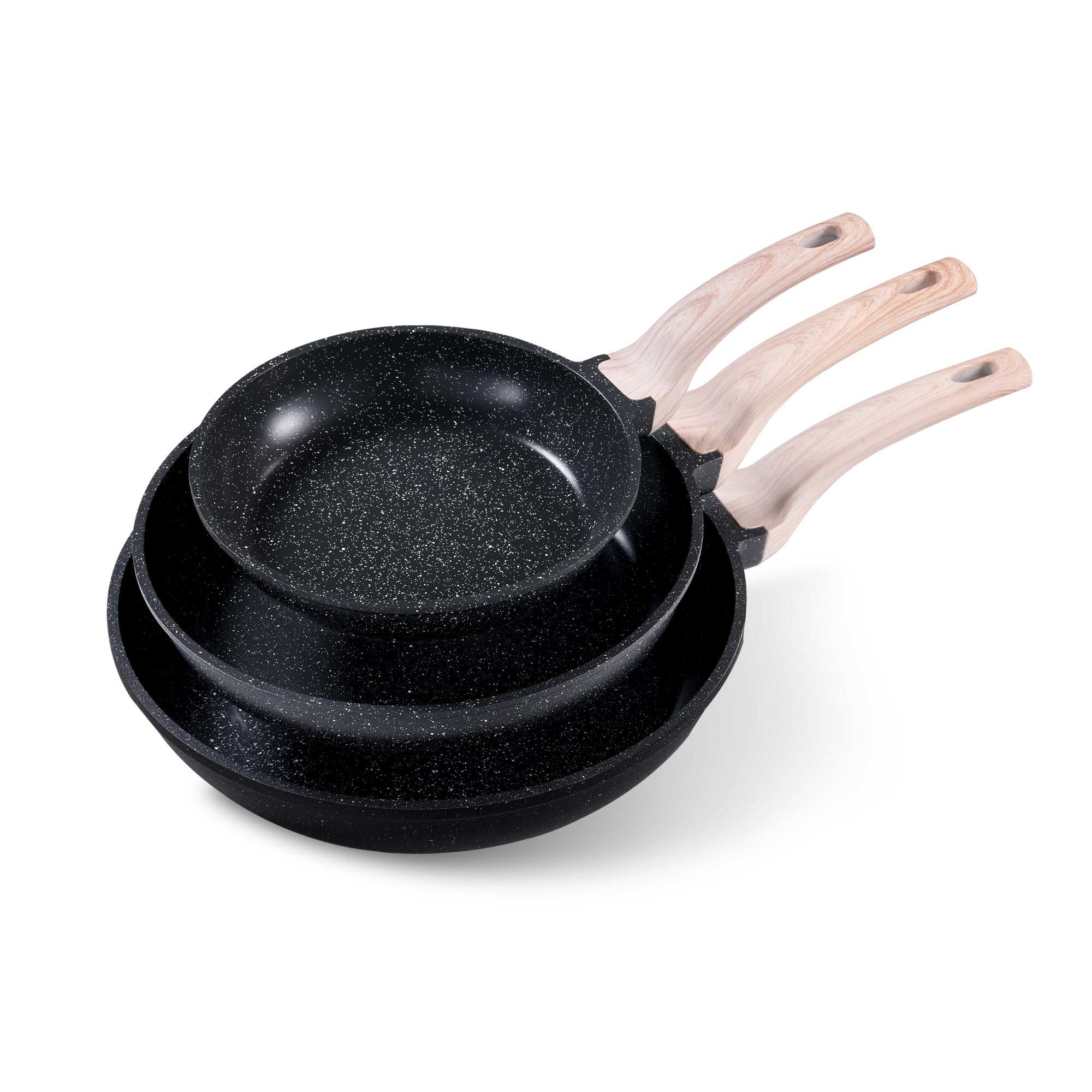
This set gives you an 8-inch, 10-inch, and 12-inch skillet in one box — covering everything from a single fried egg to a family portion of stir-fry. The granite-inspired nonstick coating is free of PFOS and PFOA, so you are not wondering about chemical transfer into your food. Owners mention that eggs slide around with almost no oil, and the coating holds up to daily use without that dreaded peeling that cheap nonstick pans develop.
Heating is quick and even thanks to the magnetic stainless steel base, which means it works on induction burners just as well as gas or electric. The silicone handles stay cool enough to grab without a mitt, and when dinner is done, most messes wipe clean with a paper towel. At 2.95 kilograms for the whole set, each pan feels substantial but not wrist-straining — and the crowd that has bought it describes the quality as “feels expensive” for the price.
The honest trade-off: none of these pans come with lids, and they are not oven-safe. If you routinely finish steaks under the broiler or braise in the oven, you will need a different option. The coating is also nonstick, not indestructible — metal utensils will scratch it over time, so stick to wood or silicone.
What Wins People Over
- Truly nonstick — eggs and fish release without effort, which means very little oil needed
- Three common sizes in one purchase, each one working on induction cooktops
- Handles stay comfortable and cool during stovetop use
The Catch
- No lids included — if you need to simmer with a cover, that is an extra purchase
- Not oven-safe, so you cannot transfer them directly from stovetop to broiler
- The nonstick coating, while durable, will not tolerate metal spatulas long-term
Reach for it if: you want a grab-and-go set that makes cooking and cleaning easy every day, and you are fine skipping oven-to-table recipes.
Look elsewhere if: you need a single pan that can sear at high heat, go into the oven, and outlast a decade — stainless steel suits you better.
2. Tramontina Signature Tri-Ply Clad Stainless Steel 10-Inch Frying Pan
The tri-ply workhorse that sears like a pan for a third of the price.
This 10-inch skillet is built from three bonded layers — 18/10 stainless steel on the outside, an aluminum core, and more stainless on the cooking surface. That aluminum heart is what delivers fast, uniform heat across the entire pan, which means your omelet browns evenly and your chicken breast sears without a raw spot in the middle. It is NSF-certified (a professional kitchen safety standard) and oven-safe up to 500°F, so you can start a steak on the burner and finish it under the broiler.
At 2.3 pounds, the pan feels balanced and solid without being exhausting to lift. The riveted stainless steel handle stays cooler than you expect during stovetop cooking. It is also dishwasher-safe, though the consensus among owners is that a quick hand wash with Bar Keepers Friend keeps the exterior looking like new. Compared to the Cuisinart MultiClad Pro below, the Tramontina gives you a 10-inch cooking surface versus the Cuisinart’s 8 inches for nearly the same investment — a meaningful upgrade if you cook for two.
The real hurdle here is the technique. This is not a nonstick pan, and the review pages sum it up: “This frying pad is absolutely horrible” — if you do not preheat properly and use enough fat, everything sticks. Owners who love it treat it as a learning tool: preheat on medium, add oil or butter, then add food. Once you master that, the nonstick effect is impressive, and unlike coated pans, this one will never wear out.
What It Delivers
- Tri-ply construction means even heat from edge to edge — no hot spots for burning
- Oven-safe to 500°F, so one pan handles sear-and-finish recipes
- NSF certified and backed by a lifetime warranty — buy it once
The Learning Curve
- Not nonstick — you must preheat on medium and use oil or butter, or food will adhere stubbornly
- Stainless steel is not as naturally slick as a coated pan; some owners never adapt
- Slightly heavier than a comparable nonstick pan, which matters if you flip often
Stick with it if: you are willing to spend a week dialing in your preheat routine for a pan that will outlast every nonstick skillet you have owned.
skip it if: you want to crack an egg into a cold pan and have it slide right off — that is nonstick territory, not stainless.
3. Cuisinart MultiClad Pro 8″ Open Skillet

The single-serving skillet that makes a perfect egg every single time.
At 8 inches across, this is not a family-sized pan — it is the exact tool for one burger, two eggs, or a solo lunch. The triple-ply construction (stainless-steel layers sandwiching an aluminum core) heats fast and spreads the temperature evenly, so your scrambled eggs finish at the same doneness from center to edge. The cast stainless-steel handle is riveted for strength and stays cool enough for comfortable gripping, and the rim is tapered for drip-free pouring when you slide food onto a plate.
This pan is oven-safe up to 550°F — higher than most nonstick pans can handle — and it works on induction, gas, and electric stovetops. Weighing 1.09 kilograms, it feels sturdy but manageable for one-handed work. Buyers notice that with the right preheat and a little butter, the nonstick performance rivals pans with much more expensive construction. The crowd-favorite use is, overwhelmingly, eggs that release cleanly without tearing.
The catch is the same one that applies to all uncoated stainless steel: it is not automatically nonstick. If you do not preheat the pan before adding fat, food will stick. The 8-inch size also feels limiting if you are cooking for more than one person — you will need a second pan for sides. At 8 inches, it is smaller than the Tramontina 10-inch, so your cooking capacity is noticeably tighter.
Why It Stands Out
- Excellent heat control in a compact size — ideal for eggs, crepes, and small cuts of meat
- Oven-safe to 550°F, which covers almost any finish-in-the-oven recipe
- Tri-ply build at a price that undercuts most premium single-layer pans
The Trade-Off
- 8 inches is tight for two — you will cook in batches or need a larger companion pan
- Stainless steel requires technique; owners who skip the preheat step get frustrated with sticking
- No lid included, which limits braising and simmering options
Grab it if: you cook for yourself and want an heirloom-quality pan that heats precisely and fits in a small kitchen.
Think twice if: you often need to feed two or more people from one skillet — the 8-inch diameter becomes a bottleneck.
4. Calphalon Hard-Anodized Nonstick 8″ and 10″ Frying Pan Set
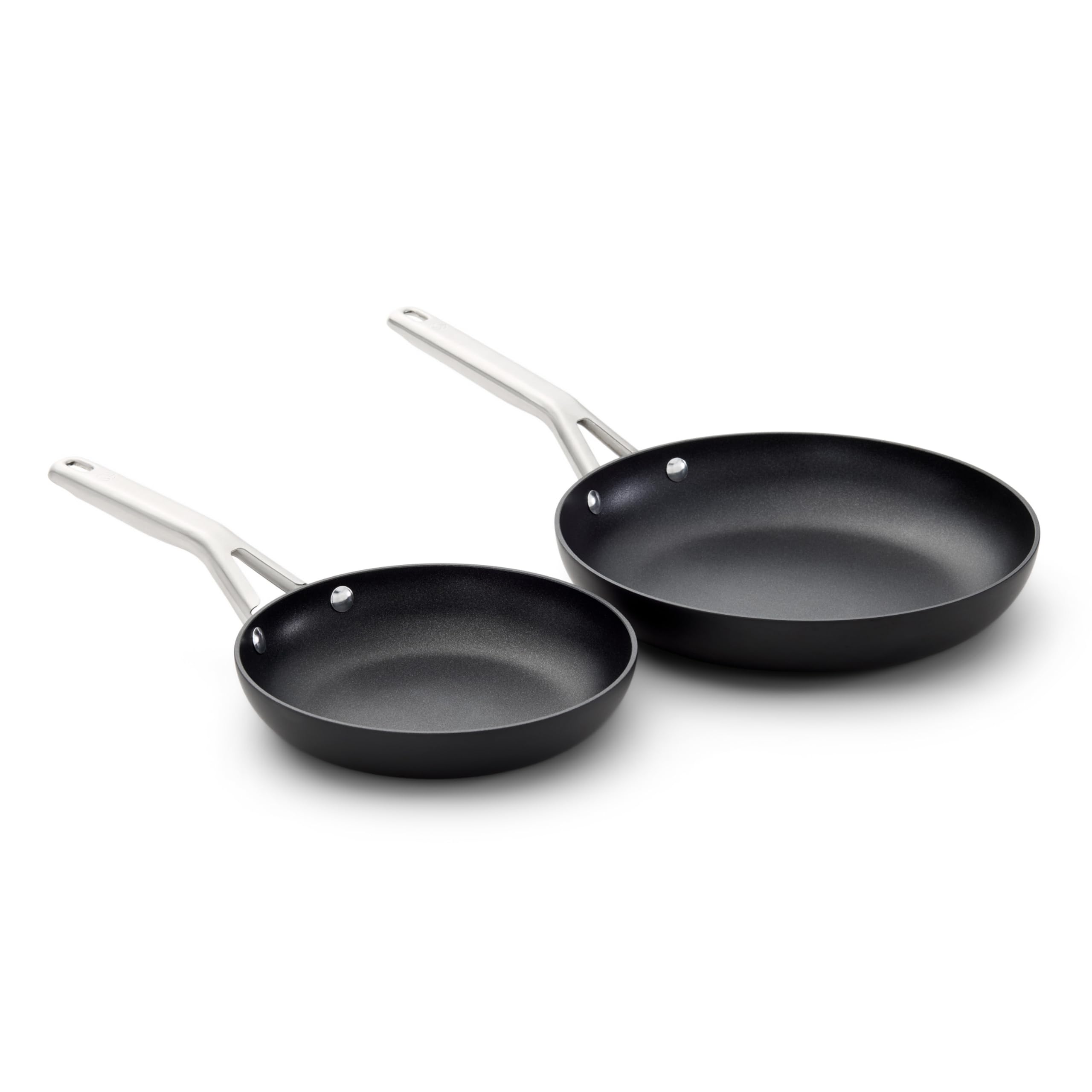
The two-pack with a track record — customers note a decade of daily use.
Calphalon’s hard-anodized construction is the gold standard for nonstick durability. The aluminum body is electrochemically hardened, then coated with a multi-layer nonstick surface. The result is fast, even heating with a release that makes omelets “just slide out of the pan,” according to the buying consensus. This set gives you an 8-inch and a 10-inch skillet, which covers solo meals and two-person dinners without needing a third pan.
The long stainless steel handles stay cool on the stovetop, and the pans are oven-safe up to 450°F — useful for frittatas and finishing dishes. Owners regularly mention that their previous Calphalon set lasted 14 years of daily use before needing replacement, and many have bought this exact set for their adult children. The pan set is dishwasher-safe, though most owners hand-wash to preserve the nonstick surface longer.
The most honest feedback flags a change in build quality compared to older Calphalon models. Some owners note the handles feel hollow and the pan walls are thinner than the previous generation — a cost-saving measure that makes the pans lighter but also slightly less premium in hand. Another common note: keep the heat at medium or below. High heat degrades nonstick faster, and the ideal cooking setting here is around 3 on a standard dial.
The Strengths
- Remarkable nonstick release — eggs and fish come off cleanly with very little fat
- Hard-anodized body heats evenly and resists warping over years of use
- Two-piece set covers single and two-person meals with one purchase
The Changes
- Current construction is lighter than older generations — the handle is folded metal rather than solid
- Nonstick coating is not metal-utensil safe; use silicone or wood
- Oven limit of 450°F is lower than stainless steel alternatives
Choose it if: you want a reliable nonstick set with a proven reputation and are willing to treat the coating with care.
Pass if: you want a pan that handles metal spatulas or withstands high-heat searing — those jobs call for stainless steel.
5. GreenPan Valencia Pro Hard Anodized Healthy Ceramic Nonstick 8″ Frying Pan

The diamond-infused ceramic that won America’s Test Kitchen — but check expectations on lifespan.
GreenPan’s Valencia Pro uses a ceramic nonstick coating infused with diamonds, and it has the accolades to prove it: America’s Test Kitchen named it the best ceramic nonstick 8-inch frypan. The coating is free of PFAS, PFOA, lead, and cadmium, which is the main draw for anyone looking to avoid synthetic chemicals in their cookware. It heats quickly and evenly on all stovetops including induction, and the mirror-polished stainless steel handle stays cool thanks to a V-shaped cutout that allows air to circulate.
At 8 inches, this is an egg-and-side-dish pan, not a family skillet. The oven safety goes up to 600°F — an impressive ceiling that lets you sear on the stove and finish at high oven heat. Cleaning is genuinely easy: most messes wipe clean, and the pan is dishwasher-safe. Owners who love it call it the best nonstick surface they have used, noting that food slides off easily. The DuoForged hard anodized body is scratch-resistant, making the pan tougher than typical ceramic cookware.
The durability mixed feedback is worth weighing. While some reviewers point out the coating failing after a year of regular use, others have used it longer without issues. The pattern suggests that high-heat cooking — particularly searing proteins — accelerates degradation of the ceramic layer. If you mainly cook eggs, pancakes, and vegetables on medium heat, the pan will serve you well. If you blast it with high heat for steaks, expect a shorter life.
What Impresses
- Genuinely slick ceramic nonstick that performs well on eggs and delicate foods
- PFAS-free and cadmium-free for buyers concerned about chemical coatings
- Oven-safe to 600°F — much higher than standard nonstick pans
What to Know
- Ceramic nonstick has a shorter average lifespan than traditional PTFE nonstick
- High-heat searing can damage the coating faster than gentler cooking
- 8-inch size is best for singles or sides, not full meals for two
Go for it if: you want a toxin-free nonstick skillet for eggs and low-to-medium-heat cooking and you value easy cleaning above extreme longevity.
Look away if: you need a pan that survives high-heat searing or you dislike the idea of replacing a premium pan in a year or two.
6. KitchenAid Hard-Anodized Induction Nonstick Frying Pan with Lid

The big 12-inch nonstick that brings a lid — and the heft to prove it.
Most nonstick skillets stop at 10 or 11 inches. This one is 12.25 inches across with a 5-quart capacity and a glass lid, making it the best option on this list if you regularly cook for three or four people. The thick hard-anodized aluminum base distributes heat evenly across the wide surface, so chicken thighs brown consistently rather than charring in one spot and staying pale in another. It works on induction, gas, and electric stovetops.
The triple-layer nonstick interior includes the handle rivets, so food does not get trapped around the fasteners — a small but real convenience when cleaning. The pan is oven-safe up to 500°F (350°F with the lid on), and it is dishwasher-safe. At 4.55 pounds, this is a heavy pan. That weight gives it excellent heat retention, but it makes one-handed flipping or pouring noticeably harder than an 8- or 10-inch alternative. Owners consistently praise the nonstick release and even heating, and many describe it as their go-to pan for daily family cooking.
The construction quality is good overall, but there are reports of the glass lid’s handle getting hot during cooking — a potholder solves it. A smaller number of owners mention scratches developing on the lid’s surface within weeks, even with careful hand washing. The pan itself holds up well if you stick to non-metal utensils and avoid high heat.
The Big Advantages
- Spacious 12.25-inch cooking surface and included glass lid make it a one-pan dinner solution
- Triple-layer nonstick keeps food releasing cleanly, even at the rivet points
- Oven-safe to 500°F, giving you flexibility for oven-finishing recipes
The Weight Factor
- At 4.55 pounds, it is the heaviest pan here — tough for wrist or grip limitations
- Lid handle gets hot; you will want a potholder or mitt nearby
- Some shoppers say premature scratches on the lid’s surface
Buy it for: batch cooking, family-sized stir-fries, and anyone who prefers one big pan with a lid instead of juggling two smaller ones.
pass on it if: you need a lightweight skillet for quick flips or you mainly cook for one and do not need 12 inches of surface.
7. Our Place Titanium Always Pan Pro

The no-coating bet: titanium and stainless fused into a pan that claims to never wear out.
The Always Pan Pro replaces the traditional nonstick coating entirely. Instead of a chemical layer, it uses tri-ply construction — a stainless steel exterior, an ultra-conductive aluminum core, and a titanium interior. The brand claims this titanium surface is 300% harder than stainless steel, naturally hydrophobic (water beads up and slides off), and entirely free of PFAS and other coatings. The theory is that without a coating, there is nothing to wear away, so the pan should last indefinitely. It comes with a modular steam-release lid and a nesting beechwood spatula, making it a near-complete cooking system from the start.
The pan is oven-safe up to 750°F — the highest heat rating on this list — and works on all cooktops including induction. The 10.6-inch diameter and 2.8-quart capacity split the difference between a skillet and a saucepan, and the vertical sides make it useful for shallow frying and pan sauces. Owners who master the preheat routine (90 seconds with oil) report excellent nonstick results with eggs, meats, and vegetables. The included brush and spatula are not afterthoughts — the spatula nests in the pan handle, and the brush is designed for cleaning the titanium surface without scratching.
The price is the obvious hurdle — this is the most expensive pan here — and the nonstick performance is divisive. While many owners find it works beautifully with proper preheating, a significant number report that food sticks stubbornly, particularly when searing steaks. At 3.4 pounds it is heavy, and some buyers prefer a lighter pan for omelets. The lid also does not form a tight seal, which affects steaming and simmering. This is a high-concept pan that delivers best for a specific buyer: someone who wants a single pan for most tasks and is willing to learn its particular preheat ritual.
What Justifies the Price
- No coating to degrade — the titanium surface should theoretically last a lifetime
- Extreme heat tolerance at 750°F for searing and oven finishing
- Comes with lid, spatula, and cleaning brush — a full kit in one box
The Reality Check
- Nonstick performance is inconsistent — some owners get sticking on first use
- Premium price with no guarantee it outperforms a well-seasoned stainless steel pan
- Hefty at 3.4 pounds and the lid does not seal tightly for steaming
Consider it if: you want to eliminate coating-based nonstick entirely and are comfortable spending more upfront for a durable, multi-use tool.
Reconsider if: reliable nonstick from the start is your priority, or a heavy pan that requires precise preheating sounds like a daily hassle.
Understanding the Specs
Nonstick vs. Uncoated Stainless
The biggest fork in the road. Nonstick pans make eggs, fish, and delicate foods easy but the coating is sacrificial — it will degrade over one to three years, especially if you use high heat or metal utensils. Uncoated stainless steel has no coating to fail, but it is not automatically nonstick; you must preheat the pan until a drop of water beads and skates across the surface, then add oil. The payoff is a pan that can sear at high heat, go into the oven, and last decades. There is no right answer — only what matches your cooking style.
Layers and Materials
Tri-ply (three bonded layers) and hard-anodized aluminum are the two premium construction methods. Tri-ply uses an aluminum core sandwiched between stainless steel layers — the aluminum spreads heat evenly while the stainless provides durability and a non-reactive cooking surface. Hard-anodized aluminum is aluminum that has been electrochemically hardened, making it significantly more durable than raw aluminum and excellent at conducting heat. The key difference: tri-ply is naturally magnetic and works on induction, while hard-anodized pans need a stainless steel base bonded to the bottom to work on induction cooktops. Both heat far more evenly than single-layer pans.
Oven Safety Temperature
This number tells you the maximum heat the pan can handle in the oven. Nonstick pans are typically limited to 350°F–500°F because the coating degrades above that range. Stainless steel and titanium pans can handle 500°F–750°F, which allows you to sear meat on the stovetop and then transfer the pan directly to a hot oven to finish cooking. If you like recipes that call for broiling or oven-roasting, a higher oven-safe temperature matters. If you mostly cook on the stovetop, the oven limit is less relevant.
Induction Compatibility
Induction cooktops require a magnetic base — the burner only activates when it detects a ferrous metal. Pure aluminum, ceramic, and some hard-anodized pans are not magnetic and will not work on induction. Look for “induction compatible” or “magneto base” in the specs. The easiest way to check: if a magnet sticks to the bottom of the pan, it works on induction. Most tri-ply stainless pans pass this test; many nonstick and ceramic pans do not unless a magnetic layer is bonded to the base.
FAQ
Can I use metal utensils on a nonstick skillet?
Why does my stainless steel pan stick and how do I fix it?
Which skillet is best for induction cooktops?
How long should a nonstick skillet last before I replace it?
Is ceramic nonstick safer than traditional nonstick?
What size skillet do I really need for everyday cooking?
Can I put a nonstick skillet in the dishwasher?
Does a heavier pan mean better cooking?
Why do some stainless steel pans discolor in the dishwasher?
What does “oven-safe” mean in practical cooking terms?
Final Thoughts: The Verdict
For most people, the best cooking skillet winner is the CAROTE Non Stick Frying Pan Skillet Set because it gives you three sizes (8-inch, 10-inch, and 12-inch) in one purchase, works on every stovetop including induction, and uses a granite-reinforced coating that avoids PTFE (polytetrafluoroethylene, the chemical in older nonstick pans) — owners mention eggs slide off with no oil after months of daily use. If you prefer the durability and searing power of stainless steel, the Tramontina Signature Tri-Ply Clad 10-Inch offers a tri-ply construction (three bonded layers of stainless steel and aluminum for even heat) that should last a lifetime, at a price well below the All-Clad D3 it competes with. And for the buyer who wants a single premium pan that replaces several tools and eliminates coating worries entirely, the Our Place Titanium Always Pan Pro uses a titanium-reinforced ceramic surface (no PTFE or PFOA) that withstands temperatures up to 500°F — but customers note that getting nonstick results requires preheating the pan and using enough oil, so it is not as forgiving as a traditional nonstick coating.
How We Picked
We do not accept paid placement. Every pick is matched to a real buyer and a real use-case; we do not hands-on test units.
Sources & Methodology
Specifications: manufacturer listings and product documentation. Review insights: verified customer reviews, as of July 2026. Pricing: not shown on this page (it changes often); check the current price via the retailer link.
As an Amazon Associate, WellFizz earns from qualifying purchases. This does not affect which products we feature.
Related Guides

Mo Maruf
I created WellFizz to bridge the gap between vague wellness advice and actionable solutions. My mission is simple: to decode the research and give you practical tools you can actually use.
Beyond the data, I am a passionate traveler. I believe that stepping away from the screen to explore new environments is essential for mental clarity and physical vitality.