Our readers keep the lights on and my smoothie glass nicely filled. As an Amazon Associate, I earn from qualifying purchases.
Specs are compiled from manufacturer listings and verified buyer reviews and can change over time — please confirm the key details on the product page before buying.
The right conversation cards rescue a quiet dinner, deepen a first date, or warm up a work retreat. But with dozens of decks all promising to “spark connection,” the real question is which one fits your crowd. This guide cuts through the noise to find the best conversation cards for families, couples, or teams.
I’m Mohammad Maruf — the founder and writer behind WellFizz. This guide is built by comparing the manufacturers’ published specifications and the patterns across verified customer reviews, so you get each pick’s real strengths and trade-offs instead of marketing spin.
After researching dozens of decks, no single deck rules them all — the winners match their prompts perfectly to their audience. This is the best conversation cards guide for real people who need real conversations, not awkward silences.
Our Picks at a Glance


How To Choose The Best Conversation Cards
Conversation cards are simple in theory, but the wrong deck kills the mood fast. The key is knowing your audience’s age, setting, and desired conversation depth.
Age Range and Audience
The most critical spec is the manufacturer’s minimum age. A deck meant for adults can contain questions about relationships or life regrets that are completely wrong for a 6-year-old. Family-focused decks like the TableTopics Kids pack start at age 6, while Christian-themed or deep-relationship decks target teens and adults. Always cross reference the manufacturer minimum age, measured in months, against the youngest person in your group.
Card Themes and Depth
Decks come in four broad flavors: light and silly, moderately deep, faith-based, and emotionally intense. Light decks (like the TableTopics Dinner Party) focus on movies, vacations, and fun stories — perfect for parties with mixed company. Deep decks (like UNPACK THAT) include questions like “The Good, The Bad” and “Tough Questions,” which can be transformative or overwhelming depending on the group’s readiness. Faith-based decks (like Christian Culture) explicitly explore God and Christianity. Pick the emotional temperature that fits your event, not the one that sounds most impressive on paper.
Card Count and Variety
More cards are not better if they repeat the same type of question. The best decks have distinct categories or “color-coded levels” that let you choose the depth on the fly. A deck with 200 cards across five categories (like The Ultimate Date Night Game) gives you more replay value than a deck with 135 cards in a single theme. Look for decks that include a mix of playful and serious prompts, so you can match the energy of the moment.
Quick Comparison
| Model | Best For | Card Count | Target Age | Theme / Depth | Amazon |
|---|---|---|---|---|---|
| TableTopics Kids Pack★ Best Overall | Family dinner & classroom | 120 (3 packs of 40) | 6+ years | Light & Gratitude | Amazon |
| The Ultimate Date Night GameBest Value | Couples date night | 200 + spinner | 17+ years | Romantic & Fun | Amazon |
| Christian CulturePremium Pick | Bible study & youth groups | 103 | 13+ years | Faith & Theology | Amazon |
| UNPACK THAT | Deep conversations | 125 | Adult | Deep & Therapeutic | Amazon |
| Talking Hearts | Couples on the go | 200 + 2 wild cards | Adult | Playful & Thoughtful | Amazon |
| TableTopics Dinner Party | Parties & gatherings | 135 | 12+ years | Light & Social | Amazon |
| BestSelf Relationship Deck | Deep relationship work | 170 | Adult | Relationship & Growth | Amazon |
| TALES Family Edition | Multi-gen family gatherings | 150 | Teen to Adult | Nostalgia & Bonding | Amazon |
| We! Connect Cards | Team building & workshops | 60 | Adult | Professional & Reflective | Amazon |
In‑Depth Reviews
1. TableTopics Kids Conversation Pack
Our pick — over 4.5★ from 900+ verified ratings; the strongest balance of quality and price.
This deck turns dinner table silence into a family debate about tiny objects and favorite smells.
This is the unmistakable crowd favorite for families with children aged 6 to 12, and for good reason. It comes as a boxed set of three separate packs — Giant Teeny Tiny (all about sizes), Five Senses (flavors, smells, sounds), and With Gratitude (thankfulness) — giving you 120 sturdy cards in a plastic slipcase. What wins people over is how easily it gets kids talking. Buyers rave about its family-friendly nature, and the card quality earns consistent praise; the cardstock is substantial enough to survive being left on the dinner table as a visual prompt night after night. The questions are specific enough to spark real engagement (“What smell do you like that other people often don’t like?”) without feeling like homework.
The recurring gripe is that the deck is too advanced for a 4-year-old, which matches its 72-month (6-year) minimum age spec exactly. An occasional card like “Say Something Nice About Your Mom” can feel biased to some families, but most owners simply toss that card and keep going. For a family with kids ages 6 to 12, this deck is the gold standard — it turns a meal into a memory without any screens required.
Kid-friendly icebreakers
- Three distinct themes (120 cards) prevent boredom
- Cardstock is durable enough for daily dinner use
- Questions are inclusive and promote reflective thinking
- Compact 3.25-inch cube fits easily on any table
Small card size
- Too advanced for children under 6
- One or two cards feel biased per some feedback
Playful families: You have kids aged 6 to 12 and want a dinner conversation tool that works every single night without feeling forced.
Serious topics: You need a deck for teens, adults, or couples — this one is squarely for younger children and family bonding.
2. The Ultimate Date Night Game by Relatable
The deck that turned a skeptical wife of three decades into the biggest fan of date night games.
This is not a quiet deck of questions — it is a full game system. With 200 cards divided into five categories plus a spinner, you flick the spinner, draw from the deck, and then do what the card says. The gameplay is what owners praise most, with 76 mentions across the feedback. The prompts range from silly activities to serious discussions, making it far more versatile than a simple Q&A deck. Buyers report it is “not corny” and has simple instructions, which matters a lot for a game you want to play without reading a manual. At a compact 2.95 x 4.92 x 8.94 inches, it fits in a larger purse, making it easy to bring to a restaurant or on a trip.
The honest trade-off is that some find it repetitive after about 30 minutes of play, and a small number of cards might feel “triggering” for some couples — the advice is to simply discard those. If you want a structured, slightly competitive couples game that takes roughly 45 minutes, this is a fantastic pick for the price.
Romantic prompts: The mix of conversation starters and mini-challenges makes this feel more like a game than an interview. Owners love how easy it is to just set up and play.
Repetitive rounds: A mixed number of owners note that after a few rounds, the cards start to feel familiar. Best used for occasional date nights rather than weekly use.
Date nights: You want a fun, non-awkward couples game with a spinner and clear rules that fits in a purse for restaurant date nights.
Solo players: You are looking for a deep, open-ended conversation tool with no game mechanics — this is a game first, conversation starter second.
3. Kulture Games Christian Culture
A faith-based conversation deck that a youth group used five cards from — and the discussions lasted the whole night.
This deck is built specifically for Christian communities, with 103 cards spread across four categories: Icebreakers (blue), Hot Topics (red), Interpretations (green), and Stories (yellow). It is non-competitive and designed for all levels of theological knowledge, so whether you are leading a Bible study or a youth group, everyone can participate. The gameplay and conversation aspects are the top praised features, with owners noting the questions are “intriguing” and “thought-provoking.” A youth leader described selecting 15 cards from three categories and only getting through 5 because the discussions were so good. The deck covers serious topics like disappointment and pain born from a real wilderness experience, but also includes lighter icebreakers.
At a 156-month (13-year) minimum age, it is designed for teens and adults — and at 6.72 ounces, it is lightweight and portable. The manufacturer maximum age is 1080 months (90 years), meaning it truly spans generations. Faith-based questions can be intense for some, so it is best suited for groups already comfortable discussing religion openly.
Faith-centered questions: The four color-coded categories let you pick the depth — start with blue Icebreakers, move to red Hot Topics when the group is ready. Owners consistently call it a hit for Bible study classes and youth groups.
Narrow audience: The entire deck centers on God, Christianity, and life. If your group is not Christian or is interfaith, this deck will feel exclusive.
Church groups: You lead a youth group, Sunday school class, or Bible study and want a deck that generates genuine theological discussion without feeling like a lecture.
Diverse crowds: You need a deck for a secular or interfaith setting — the prompts are explicitly Christian.
4. UNPACK THAT Conversation Cards

A therapist-trusted deck that goes deep fast — maybe too deep for a casual dinner party.
This is the deck for people who want to skip the small talk and go straight to the real stuff. It contains 125 cards organized into five categories: The Good, The Bad, Reflection, Tough Questions, and Wildcards. The card quality and question quality are the top praised aspects, and the deck is explicitly marketed as “therapist-trusted” for use in counseling and coaching. One therapist describes it as a “great way to open everyone up and get the session going.” The deck is used by counselors with students and by couples who want to build emotional intimacy. At 4 x 5 x 6 inches and 6.4 ounces, it is compact enough to bring anywhere.
The catch is that the questions are potent. As some owners put it, they get “deep quickly” and may be “too potent for casual use.” If you or your group are not ready for emotional exploration, the questions can feel overwhelming. This deck is for intentional connection, not light entertainment.
Therapist-designed
- Five distinct categories let you control the depth
- Card quality is frequently praised — thick and durable
- Effective for building emotional intimacy and trust
- Used by therapists, counselors, and coaches
Heavy emotional load
- Questions can be emotionally heavy; not for lighthearted gatherings
- Some owners found the intensity surprising on first play
Deep discussions: You are ready for deep conversations — with a partner, family, or in a therapeutic setting — and you want questions that go beyond surface level.
Light fun: You want a light, fun game for a party or first date where you are not sure about the other person’s readiness for deep topics.
5. Talking Hearts Conversation Cards

A deck that balances playful and profound — 100 silly questions and 100 thoughtful ones, plus two wild cards for spontaneity.
Talking Hearts is designed for couples at any stage, whether it is a first date or a 50th anniversary. The 200 cards are evenly split between 100 playful prompts and 100 thoughtful prompts, which is a smart design choice because it lets each couple choose their own adventure. The gameplay is the most-talked-about feature, and owners consistently describe the cards as “appropriate,” “attractive,” and “easy to use.” The packaging is also praised — it looks nice enough to give as a gift. One couple described using 4 to 5 cards (8 to 10 conversation questions) occasionally, treating it as a ritual rather than a full game.
This deck is specifically marketed as inclusive for all couples “regardless of age, gender, or orientation,” which broadens its appeal. The trade-off is that for very new relationships, the “thoughtful” prompts might feel a bit intense compared to purely silly decks.
Elegant design: The 100/100 split between silly and serious is the smartest design in this category — it gives every couple the flexibility to go deep or stay light. The cards look and feel premium.
Couples only: While it works for any stage, the depth of the thoughtful cards is best suited for couples who already have some shared history.
Romantic bonding: You want a versatile couples deck that works for date nights, road trips, and quiet evenings at home — and you want the option to go either playful or profound.
New partners: You prefer a fully silly deck with no deep questions or if you want a game with competitive rules rather than open-ended conversation.
6. TableTopics Dinner Party Conversation Cards

The deck that keeps a dinner party flowing without anyone having to steer the conversation.
This is the classic TableTopics formula applied to adult dinner parties. The 135 cards in a clear plastic cube are designed to be passed around the table, with questions covering movie moments, vacation preferences, and brush-with-fame stories. The gameplay and conversation aspects are the most praised, and the deck intentionally avoids political and religious topics, making it safe for diverse crowds at work events or family gatherings where not everyone agrees. One owner described using it at a beach event where humidity ruffled the cards (they needed ironing), which is a useful note for damp environments.
The question quality gets a mixed reception — some find the prompts a bit generic compared to deeper decks. But for a stress-free host gift or a tool to keep a party moving, this is the most reliable option on the list. At 4 x 4 x 4 inches, it sits unobtrusively on any table.
Host-friendly themes
- Carefully avoids polarizing topics (politics, religion)
- Clear cube is attractive and easy to pass around
- Perfect for introverts who struggle with small talk
- Works for both social and professional events
Generic questions
- Question quality can feel generic to some users
- Cardstock can warp in humid environments
Dinner parties: You are hosting a dinner party, work mixer, or holiday gathering and need a conversation starter that works for any adult crowd with zero drama.
Intimate chats: You want deep, introspective conversations or if you are hosting a specifically religious or politically-minded group — this deck is intentionally neutral.
7. BestSelf Relationship Deck

A deck designed by mental health professionals that covers the six pillars of a relationship — health, finances, work, relationships, personal growth, and mindfulness.
This is the most structured relationship deck in the lineup. The 170 prompts are divided into six key topic areas that address the full spectrum of a partnership, from the mundane to the profound. Owners describe the prompts as well-thought-out and great for sparking conversations that last hours. The color-coded topics let you pick the mood — you can avoid heavy financial discussions on a light date night and save them for a dedicated check-in session. The card quality is frequently noted as high, with a nice design aesthetic.
The intensity is real. Some owners found the prompts brought up past issues and advise using the cards “lightly” unless both partners are ready for deep work. The deck is also compact at 2.6 x 3.6 x 2.88 inches, making it travel-friendly. A few cards arrived bent in the box for some customers, though the shipping box was pristine, suggesting a quality control issue rather than transit damage.
Structured growth: The six categories cover everything from health to finances to personal growth — no major life area is ignored. It is like a structured relationship check-up in card form.
Intense reflections: This is not a light game. Designed by mental health pros, it can bring up heavy topics. Use it when both partners are ready to engage, not when you just want to relax.
Self-improvement: You and your partner are ready to do intentional relationship work and want a structured tool that covers every important topic in a low-pressure way.
Casual play: You want a light, fun couples game for a casual night in — this deck requires emotional bandwidth.
8. TALES 150 Conversation Cards (Family Edition)
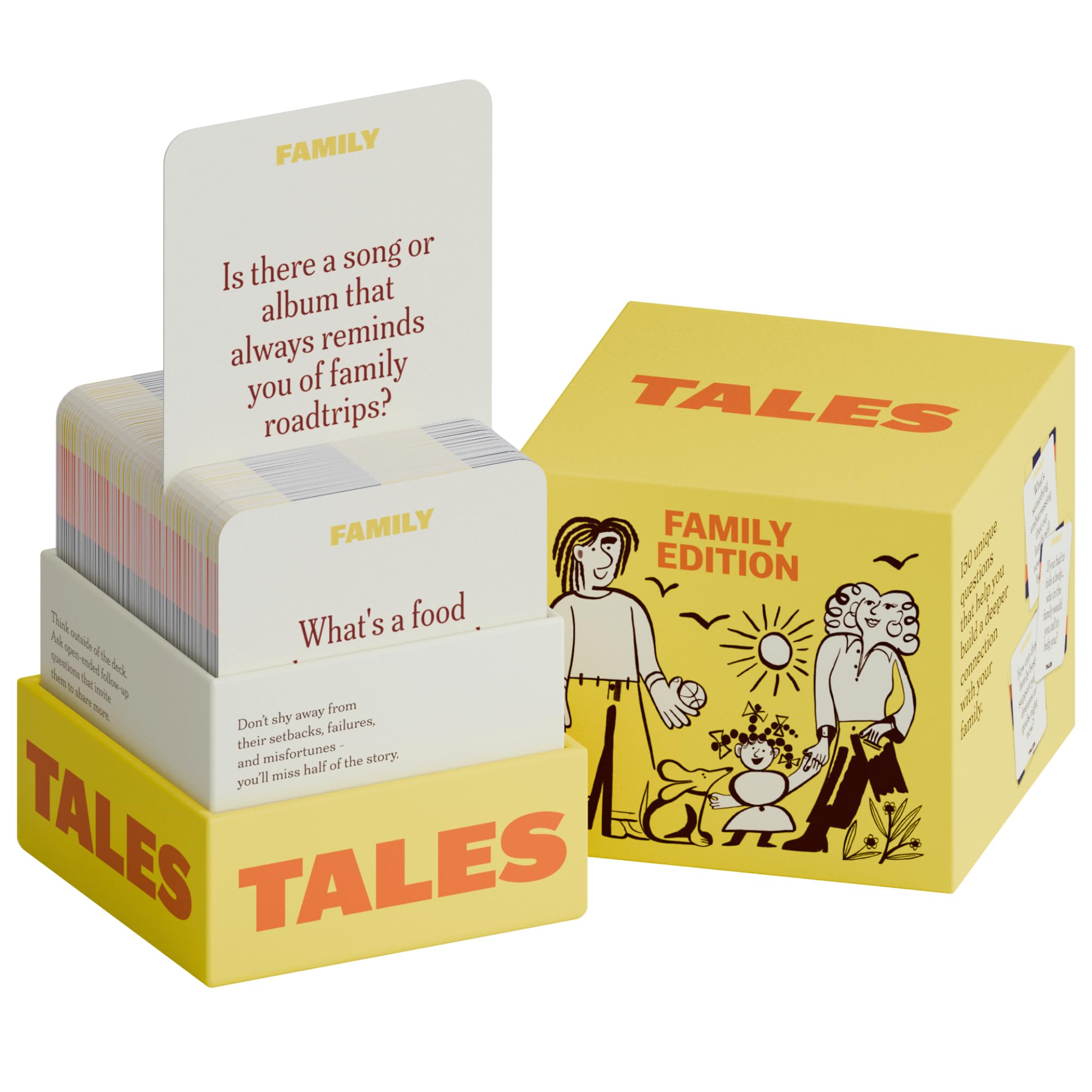
The deck that kept a family reunion laughing as grandparents told forgotten stories the grandkids had never heard.
TALES Family Edition is built specifically for multi-generational gatherings, with 150 conversation starters designed for teens and adults. The gameplay is the most praised aspect by a wide margin, with 120 mentions — this is a deck that people actually play, not just display. Owners describe it as keeping “all generations engaged” at dinner parties and family reunions. One family brought it to their Christmas gathering and “learned new things about” their own family. The questions spark nostalgia and laughter, with the grandchildren especially enjoying hearing the adults tell their stories.
The value for money gets a mixed reception — some find it “well worth the price,” while others feel “it’s disappointing for the money.” This suggests it depends heavily on how much you value the specific nostalgia-driven prompt style. At 0.37 kg, it is portable enough to bring to any gathering.
Family bonding
- Specifically crafted for teens — relatable questions about school, friendships, and goals
- Strong nostalgia element that gets adults telling stories
- Encourages screen-free interaction at family events
Repetitive prompts
- Value for money is a mixed point — not everyone feels the depth justifies the cost
- Designed for teens, so younger children may not engage
Family nights: You host multi-generational family gatherings or have teenagers who need a nudge to put down their phones and talk.
Adult groups: You need a deck for younger children (under 13) or if you are looking for a couples-focused deck — this is for families and reunions.
9. We! Connect Cards
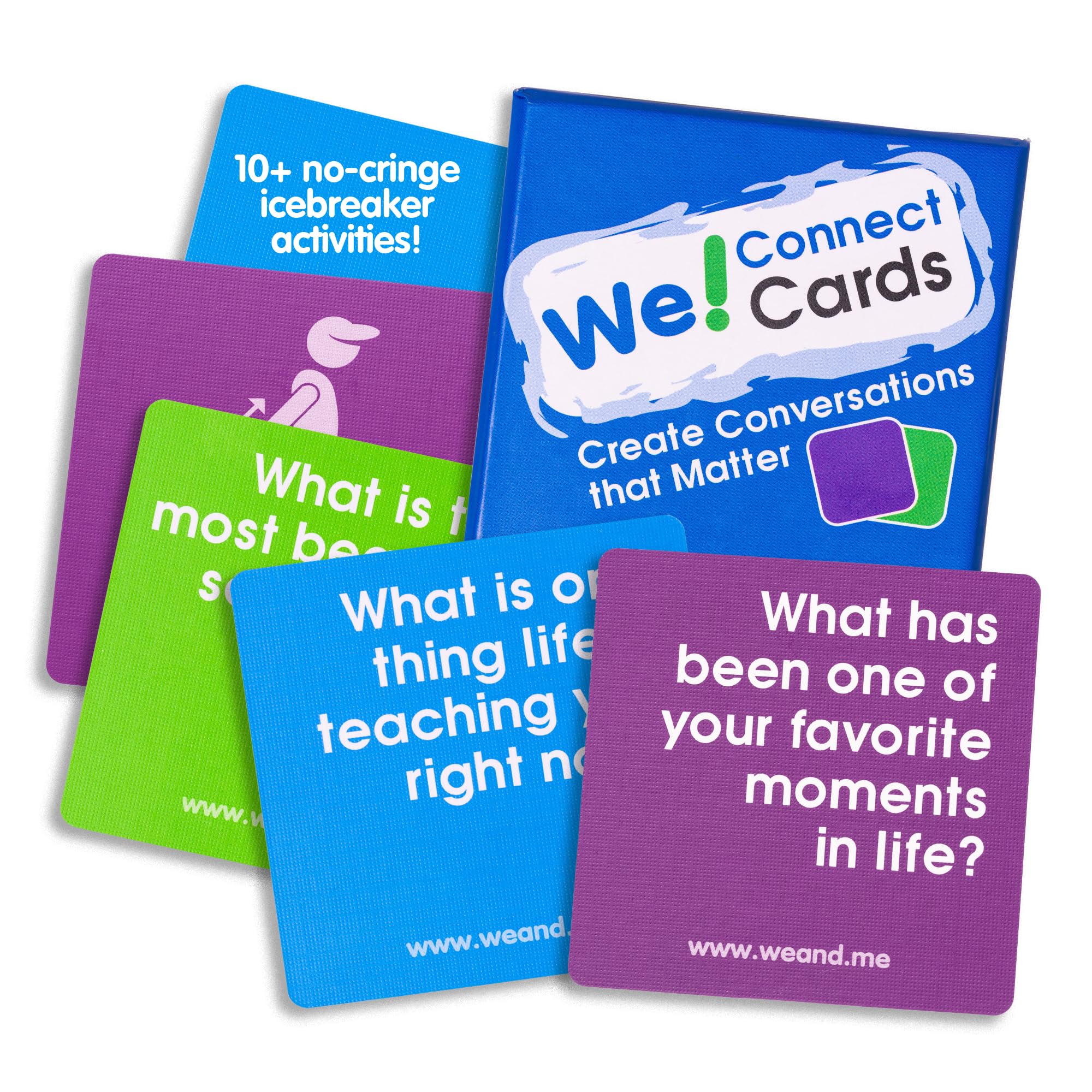
The deck that got senior leaders to open up and set the stage for a workshop on organizational effectiveness.
We! Connect Cards takes a different approach from the other decks. It is designed for professional settings — meetings, workshops, classrooms, and team building — with 60 color-coded cards that range from “fun and light” (green) to “a bit deeper” (blue) to “encourage self-reflection” (purple). It is trusted by 100,000+ professionals and created by bestselling author Chad Littlefield. The deck includes over 10 activity descriptions and video tutorials to help facilitators bring sessions to life. The compact size (3 x 3 x 1.25 inches) makes it easy to toss in a work bag.
At only 60 cards, it has fewer prompts than any other deck in this list, which is a trade-off for the focused professional use case. But each card is designed to generate more than one conversation, and the included facilitation guides mean you get more mileage per card than a simple Q&A deck. The card quality is praised, and owners love the three-level system for controlling the depth of discussion.
Team building: The three color-coded depth levels let facilitators choose the right energy for their group. The included activity descriptions and video tutorials are a unique value-add for leaders.
Small deck: With 60 cards, this is not a deck for casual personal use. It is a tool for intentional group work, and it excels at that specific job.
Work groups: You are a team leader, trainer, facilitator, or educator who needs an icebreaker that actually builds trust and collaboration in a professional setting.
Large parties: You want a personal conversation deck for date nights or family dinners — the design is tune for group facilitation, not intimate connection.
Understanding the Specs
Card Count and Category Structure
Card count matters less than how those cards are organized. A deck with 200 cards spread across five distinct categories (like The Ultimate Date Night Game) gives you far more replay value than a deck with 200 cards on the same theme. Look for decks that use color-coding or named categories (Icebreakers, Hot Topics, Stories) so you can adjust the depth based on the group’s mood and energy level.
Manufacturer Minimum Age in Months
This is the single most overlooked spec. A teenager is not a 6-year-old, and a 6-year-old cannot handle adult relationship questions. The age range is given in months, so divide by 12 to get the year. For example, 156 months means 13 years old. Always check this number against the youngest person who will be using the deck to avoid awkward or inappropriate prompts.
FAQ
How many cards should a good conversation deck have?
Can conversation cards be used for therapy or counseling?
Are these cards durable enough for regular use?
What is the difference between “light” and “deep” conversation cards?
Can these decks be used in a classroom setting?
Are there conversation cards for couples who are not at the “deep” stage yet?
How do I store conversation cards to keep them in good condition?
What if a conversation card makes someone uncomfortable?
Can conversation cards work for a road trip or travel?
How do faith-based conversation cards differ from secular ones?
Final Thoughts: The Verdict
For most buyers, the conversation cards winner is the TableTopics Kids Pack because it nails the hardest job — getting kids to talk at the dinner table — with a huge 120-card set that families rave about. If you want a fun couples game with a spinner and rules, grab the Ultimate Date Night Game. And for deep, intentional relationship work, the UNPACK THAT deck is the one to reach for — just be ready for the depth.
How We Picked
We do not accept paid placement. Every pick is matched to a real buyer and a real use-case; we do not hands-on test units.
Sources & Methodology
Specifications: manufacturer listings and product documentation. Review insights: verified customer reviews, as of July 2026. Pricing: not shown on this page (it changes often); check the current price via the retailer link.
As an Amazon Associate, WellFizz earns from qualifying purchases. This does not affect which products we feature.
Related Guides

Mo Maruf
I created WellFizz to bridge the gap between vague wellness advice and actionable solutions. My mission is simple: to decode the research and give you practical tools you can actually use.
Beyond the data, I am a passionate traveler. I believe that stepping away from the screen to explore new environments is essential for mental clarity and physical vitality.