Our readers keep the lights on and my smoothie glass nicely filled. As an Amazon Associate, I earn from qualifying purchases.
Specs are compiled from manufacturer listings and verified buyer reviews and can change over time — please confirm the key details on the product page before buying.
You get steady, even heat without any noise because a convection heater pulls in cool air, warms it over a heating element, and lets the natural rise and fall of that air circulate warmth around your room. Unlike a fan heater that blasts hot air with a whirring motor, a convection heater is silent. The catch is that convection is slower than forced air, so you need to pick a unit sized right for your space — too small and you will always feel a chill, too big and you will overshoot your comfort zone.
I’m Mohammad Maruf — the founder and writer behind WellFizz. This guide is built by comparing the manufacturers’ published specifications and the patterns across verified customer reviews, so you get each pick’s real strengths and trade-offs instead of marketing spin.
The goal here is to match the right convection heater to your room size, fuel preference, and desired features without getting lost in technical specs.
Our Picks at a Glance

How To Choose The Best Convection Heater
Picking a convection heater depends on one primary question: what size space are you heating? The heater’s heat output, measured in British Thermal Units (BTUs — a unit that tells you how much heat the device can produce per hour) or Watts, directly determines how large a room it can handle. Use the square footage rating as your main filter, then layer in fuel type, form factor, and safety features.
Match BTU Output to Room Size
A general rule of thumb is that you need about 10 Watts of heating power per square foot of space, or roughly 34 BTUs per square foot. A small bedroom of 125 sq ft requires a heater around 1250 Watts (about 4260 BTUs), while a large garage or workshop of 600 sq ft needs a unit closer to 6000 Watts (about 20480 BTUs). Over-sizing leads to short cycling and uneven temps; under-sizing leaves you cold.
Electric vs Propane Fuel Type
Electric convection heaters plug into a standard wall outlet and are silent with no fumes, making them ideal for bedrooms and living spaces. Propane models, on the other hand, produce far higher heat output — often 15,000 to 80,000 BTUs — which suits garages, workshops, and outdoor areas, but they require ventilation and a fuel tank. Propane heaters are heavier and need space, but they heat larger areas faster.
Form Factor and Installation
Baseboard heaters are long and low, fitting along a wall and hardwired in place — they are a permanent solution. Wall panel heaters are slim, mount flush, and plug in or hardwire, saving floor space. Portable tower or pedestal heaters can be moved room to room but take up floor area. The quieter the heater (no fan), the better for sleeping or working, but check that the airflow path around the unit is clear.
Quick Comparison
| Model | Best For | Heat Output | Coverage | Fuel Type | Amazon |
|---|---|---|---|---|---|
| Cadet 3F750W★ Best Overall | Bedrooms & small spaces | 750 W (2560 BTU) | 125 sq ft | Electric | Amazon |
| Mr. Heater 30-80K BTUAlso Great | Large garages & workshops | 80,000 BTU | 2,000 sq ft | Propane | Amazon |
| Ballu Mica Infrared | Smart, whole-room electric | 1500 W (5118 BTU) | 250-500+ sq ft | Electric | Amazon |
| EconoHome Wall Panel | Quiet, energy-saving heat | 600 W (2047 BTU) | 300 sq ft | Electric | Amazon |
| Dura Heat LPC25 | Workshops & outdoor patios | 25,000 BTU | 600 sq ft | Propane | Amazon |
| Comfort Zone CZ650B | Medium rooms on a budget | 5120 BTU (1500 W) | 500 sq ft | Electric | Amazon |
In‑Depth Reviews
1. Cadet F Series 36″ Electric Baseboard Heater (3F750W)
Our pick — 4.5★ from 400+ verified ratings; the strongest balance of quality and price.
The no-frills electric baseboard that reliably warms a small room for decades.
The Cadet 3F750W is a 750-Watt (2560 BTU) electric baseboard heater designed for a single small room up to 125 square feet. It runs on 240/208 Volts and is hardwired into your home’s electrical system, so it serves as a permanent heat source rather than a portable plug-in. The convection method circulates warm air silently along the floor and up through the room without any fan noise. Cadet backs this unit with a limited lifetime warranty, which reflects the build quality.
The heater is 36 inches long and only 4 inches deep, so it sits flush against the baseboard. It includes pre-punched knockouts and universal wiring to make installation straightforward for an electrician. The multi-watt design (750 Watts at 240V, 563 Watts at 208V) means it adapts to your home’s actual voltage. Reviewers often mention these units are workhorses that last for years without issues. The main limitation is that 750 Watts is modest — this heater cannot warm a room larger than about 125 sq ft effectively. For comparison, the Comfort Zone CZ650B covers 500 sq ft with its 1500-Watt output, while the Cadet is best suited for a small bedroom or den.
Solid features
- Limited lifetime warranty adds long-term confidence
- Silent operation with no moving parts
- Compact 36″ size fits standard wall spaces
Before you buy
- Requires hardwiring at 240V — not a plug-and-play option
- 750 Watts only covers 125 sq ft, too small for most living rooms
Right-sized heat: This is a perfect permanent heater for a small bedroom, home office, or den where you want silent, reliable warmth.
Skip if: you need to heat a main living area, want portability, or cannot arrange for a hardwired 240V installation.
2. Mr. Heater Corporation Convection Heater, 30-80K BTU
The heavyweight that heats 2,000 sq ft without a single electrical cord.
If you need to warm a large workshop, garage, or barn, the Mr. Heater is built for the job. It delivers 30,000 to 80,000 BTUs — a massive output that can cover up to 2,000 square feet. At 80,000 BTUs versus the Comfort Zone CZ650B (5120 BTUs), this is a completely different class of heater. It runs on propane from a 100 lb tank and operates up to 14 hours per fill, so you are not constantly swapping tanks.
This unit requires no electricity at all — the standing pilot and convection flow work without a cord. That makes it useful in remote locations or during a power outage, as long as you have propane. It comes with a 10 ft hose and regulator, and it arrives fully assembled. At 13.4 pounds and dimensions of about 16″ x 22″ x 16″, it is heavier and bulkier than portable electric heaters (the Dura Heat LPC25, by comparison, weighs only 7.8 pounds). Buyers report it throws intense, direct heat that quickly takes the chill off a large space. The trade-off is that because it is rated for outdoor use (adequate ventilation is a must), you should never run it in a tightly sealed indoor room without airflow.
One-room powerhouse: For anyone needing serious BTUs on propane for a big garage, job site, or outdoor area, this is the top performer in the list. Not for: indoor bedrooms or living rooms — the ventilation requirement rules out enclosed spaces.
Prime candidate: Grab this one if you have a large, semi-open area like a workshop or barn that needs fast, heavy heat.
Skip if: you want a plug-and-play electric heater for a regular bedroom or office — look at the Ballu or EconoHome instead.
3. Ballu Mica Infrared Space Heater

The smartest electric convection heater that lets you schedule warmth from your phone.
The Ballu Mica Infrared Heater earns its spot for smart control: it is a 1500-Watt electric unit with built-in WiFi and app control, so you can adjust the thermostat, set a 24-hour timer, or turn it on from bed using Alexa voice commands. It uses mica far-infrared heating panels for even, quiet warmth across rooms up to 250 sq ft directly or over 500 sq ft as a secondary heater. The manufacturer claims “up to 37% energy cost saving” from an exposed temperature sensor and adjustable thermostat that aim to reduce wasteful overheating.
Unlike the baseboard-style Comfort Zone, the Ballu is a standing panel on casters, so you can roll it from room to room or wall-mount it if you prefer a fixed look. Owners mention that the heating element warms up in about 10 seconds and that the 180° wide coverage (the manufacturer calls it “panoramic heating”) really does make the room feel evenly warm rather than hot in one spot. The all-metal build feels sturdy, and safety includes an auto shut-off if tipped and overheat prevention. The trade-off is that at 1500 Watts, it draws 12.5 Amps, so you should dedicate a circuit to it in a smaller room to avoid tripping a breaker.
Connected comfort: This heater blends the quiet of convection with the convenience of smart home scheduling. Power draw note: 1500 W is similar to a space heater, so keep it on its own outlet in bedrooms.
Ideal for: tech-savvy homeowners who want app control and quiet, even heat in a medium-to-large room.
Skip if: you need instant heat for a very small space or prefer a permanently mounted heater.
4. EconoHome Wall Mount Space Heater Panel

The ultra-slim wall panel that sips electricity at 600 watts while keeping a room warm.
The EconoHome panel is a 600-Watt convection heater that is rated to cover up to 300 sq ft, which is impressive for its low power draw. It consumes only 0.6 kW per hour — less than one third of what a typical 1500 W space heater uses. The manufacturer claims you can “save up to 50% of your home heating costs” through zone heating, meaning you heat the room you are in rather than the whole house. The panel is only 2 inches deep and 36 inches wide, so it mounts flush on a wall like a picture frame and its paintable design blends into the décor.
Because there is no fan, the EconoHome runs completely silent — no whirring or clicking. That is a big plus for asthma and dust allergy sufferers, as the manufacturer notes the air will not dry out or circulate dust. The unit comes with an adjustable plug-in thermostat (41-86°F range) and is cETL approved. Reviewers comment that it is best for maintaining a steady temperature rather than rapidly heating a cold room, which is typical of all convection heaters. At about 11 kg (24 lbs), it is heavier than a portable heater, but that weight comes from the durable calcium silicate material that the maker says is triple reinforced against cracking.
Constant ambient heat: This is a set-and-forget heater for a bedroom or office you want to keep at a stable temp without noise or dust. Slow warm-up: It should not be your only heater in a drafty room that gets very cold quickly.
Best for: allergy-conscious users and anyone who wants to save on electric bills by heating a single room silently.
Skip if: you need rapid heat or plan to move the heater between rooms — this one mounts to the wall.
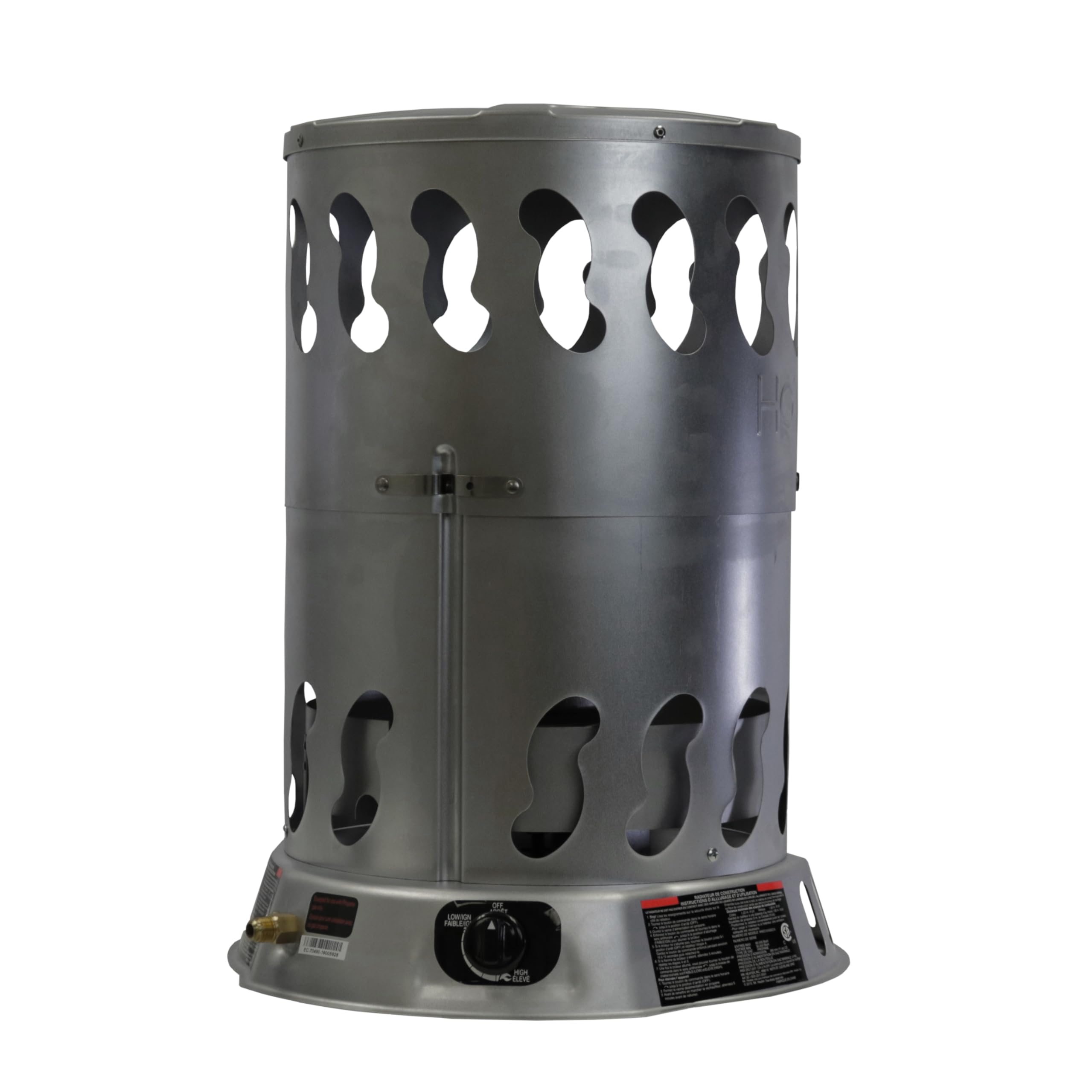
5. Dura Heat LPC25 Propane Convection Heater

A propane heater for the workshop that runs 28 hours on a single 20 lb tank.
The Dura Heat LPC25 is a propane-powered convection heater that outputs between 15,000 and 25,000 BTUs and covers up to 600 square feet. At 600 sq ft versus the Cadet electric baseboard (125 sq ft), it’s a strong option for a garage, barn, or outdoor patio. It runs up to 28 hours on a standard 20 lb propane tank, which is excellent for all-day use over a weekend. The built-in wind shield protects the flame from gusts, so it holds steady in breezy outdoor conditions.
Weighing only 7.8 pounds and standing 13 inches tall, the Dura Heat is compact and portable compared to the Mr. Heater’s 13.4 pounds and larger 22-inch frame. It includes the hose and regulator in the box, so you just connect a propane tank and light it. The safety auto shut-off turns the heater off if it tips over. One thing customers note is that the heat output is adjustable via a valve, which lets you dial down the flame for smaller spaces or milder days. The trade-off is that propane combustion produces moisture and carbon monoxide, so this heater must only be used in well-ventilated areas.
Portable propane power: This is the pick for anyone who needs to heat a medium-sized shop or patio without running extension cords. Ventilation required: Keep the space open — never use this in a tightly sealed indoor room.
Great for: weekend mechanics, campers, or anyone heating a garage or outdoor gathering spot.
Skip if: you want an indoor electric heater for a bedroom or living area — choose the Ballu or Comfort Zone.
6. Comfort Zone Baseboard Heater CZ650B

An electric baseboard heater that gives you 500 sq ft of quiet heat at a budget-friendly price.
The Comfort Zone CZ650B is a 1500-Watt (5120 BTU) electric baseboard heater that covers up to 500 square feet — enough for a medium-sized living room or master bedroom. It runs silently because there is no fan, just natural convection airflow through the fins. The digital thermostat with a clear display lets you dial in a specific temperature, and you can choose between two heat settings. The body stays cool to the touch during operation, which is a useful safety feature if you have children or pets.
Safety also includes a tip-over switch and overheat protection. The end panels are dent-proof, so the heater maintains its sleek black appearance even if it gets bumped by furniture. At about 36 inches long and 6 inches tall, it fits along a baseboard without sticking out awkwardly. Reviewers comment that it takes a while to bring a cold room up to temperature — a normal convection trade-off — but once it is there, it holds steady without cycling on and off as much as a fan heater. Unlike the Cadet baseboard above (which is hardwired), the Comfort Zone plugs into a standard 120V outlet, making installation much simpler. This heater suits you if you want app control and quiet operation; skip it if you need instant heat in a large, cold room.
Quiet and safe: This heater delivers dependable warmth for medium rooms with a digital thermostat and cool-touch body. Patience required: It is not an instant blast of heat, so give it 20-30 minutes to stabilize the room.
Best for: budget shoppers who want a plug-in electric heater for a large bedroom or living area without noisy fan operation.
Skip if: you need to heat a very small space like a bathroom, or you want a permanently installed baseboard heater.
Understanding the Specs
BTU — British Thermal Units
BTU is the standard measure of heat output. One BTU is the amount of heat needed to raise the temperature of one pound of water by one degree Fahrenheit. For a room, you generally need about 34 BTUs per square foot. A 500 sq ft room needs about 17,000 BTUs. Electric heaters are often rated in Watts instead: 1 Watt equals about 3.41 BTUs. So a 1500-Watt heater produces about 5120 BTUs. Propane heaters go much higher — the Mr. Heater delivers up to 80,000 BTUs, enough for 2,000 sq ft.
Watts vs Volts vs Amps
Watts measure the total electrical power a heater consumes. Volts measure the electrical pressure (standard US wall outlets are 120V; large baseboards often use 240V). Amps measure the electrical current drawn. A 1500-Watt heater on 120V draws 12.5 Amps — close to the 15-Amp limit of most standard circuits. That means you should not run anything else on the same circuit. A 750-Watt heater at 240V draws only 3.13 Amps, leaving plenty of room for lights and devices on the same circuit.
FAQ
Is a convection heater better than a fan heater?
Can I use a propane convection heater indoors?
How many square feet will a 1500-watt convection heater cover?
Can I hardwire a wall panel convection heater?
Do convection heaters dry out the air like fan heaters?
What size room does the Cadet 3F750W heat?
How long does a propane tank last with the Dura Heat LPC25?
Is it safe to leave a convection heater on overnight?
Final Thoughts: The Verdict
For the majority of shoppers, the convection heater winner is the Mr. Heater 30-80K BTU because it provides the highest heat output at 80,000 BTUs for very large spaces like workshops and garages. If you want a smart electric heater with app control and quiet operation, grab the Ballu Mica Infrared Heater. And for an energy-efficient wall panel that saves on bills and runs silently in a bedroom or office, the EconoHome Wall Mount Heater is the budget-friendly pick for small rooms.
How We Picked
We do not accept paid placement. Every pick is matched to a real buyer and a real use-case; we do not hands-on test units.
Sources & Methodology
Specifications: manufacturer listings and product documentation. Review insights: verified customer reviews, as of July 2026. Pricing: not shown on this page (it changes often); check the current price via the retailer link.
As an Amazon Associate, WellFizz earns from qualifying purchases. This does not affect which products we feature.
Related Guides

Mo Maruf
I created WellFizz to bridge the gap between vague wellness advice and actionable solutions. My mission is simple: to decode the research and give you practical tools you can actually use.
Beyond the data, I am a passionate traveler. I believe that stepping away from the screen to explore new environments is essential for mental clarity and physical vitality.