Our readers keep the lights on and my smoothie glass nicely filled. As an Amazon Associate, I earn from qualifying purchases.
A racing wheel without proper force feedback is just a spring-loaded toy that masks the difference between a drift and a spin. The gear-driven clatter, the belt-drive slip, or the pure, silent torque of a direct drive motor—each technology defines how deeply you feel the tarmac through your fingertips. Pinpoint steering precision, consistent brake pedal resistance, and a wheel that communicates tire slip before the visual cue appears separate a capable lap-timer from a frustrating afternoon fighting understeer.
I’m Mohammad Maruf — the founder and writer behind WellFizz. This guide is built on hundreds of hours of cross-referencing force feedback torque ratings, pedal sensor types, wheel rotation angles, and platform compatibility across the leading sim racing controllers to identify which setups justify their position on your rig.
Whether you’re chasing tenths on Gran Turismo, hauling cargo through Euro Truck Simulator, or building your first dedicated cockpit, the right controller for racing games determines whether your inputs translate to faster laps or frustrated disconnects.
How To Choose The Best Controller For Racing Games
Choosing a racing controller comes down to matching three interdependent variables: the force feedback system, the pedal quality, and the platform lock-in. A premium direct drive wheel attached to potentiometer pedals creates a bottleneck; a mid-range belt-driven wheel with Hall-effect pedals often delivers a more consistent experience. Understand these trade-offs before you build your rig.
Force Feedback Technology: Gear, Belt, or Direct Drive
Gear-driven units like the Logitech G29/G920 use helical gears to transmit torque. They are affordable and durable but produce a notchy, audible texture that masks fine road detail. Belt-driven wheels (Thrustmaster T128/T248) offer smoother operation with a bit more nuance. Direct drive motors, found in the MOZA R3/R5 and Fanatec DD Pro, attach the wheel directly to the motor rotor, eliminating mechanical lag and delivering the highest fidelity of tire slip, curbing, and weight transfer. Budget often dictates the choice, but if immersion is the goal, direct drive offers a step-change in realism.
Pedal Sensor Type and Build
The accelerator and brake pedals are where races are won or lost. Potentiometer-based pedals wear over time and can introduce noise into your inputs. Hall-effect magnetic sensors, used in the MOZA SR-P Lite and Thrustmaster T3PM, provide contactless, consistent readings that do not degrade. Brake pedal stiffness is another factor: a progressive brake feel (non-linear) helps modulate trail braking, while a simple spring-loaded pedal can feel binary. Some mid-range pedals include a removable rubber block to simulate load-cell resistance without the full cost.
Wheel Rotation and Platform Compatibility
Sim racing wheels typically offer 270° to 1080° of lock-to-lock rotation. Formula and GT racing benefit from the quick response of 270-360° rotation, while truck and rally sims feel more natural with 900° or 1800°. Platform compatibility is non-negotiable: a wheel built for PlayStation (G29) will not work on Xbox (G920), and vice versa. PC remains the most versatile platform, supporting nearly every wheel with proper drivers. Check that the wheel supports your primary console before purchase.
Quick Comparison
On smaller screens, swipe sideways to see the full table.
| Model | Category | Best For | Key Spec | Amazon |
|---|---|---|---|---|
| Fanatec GT DD Pro | Direct Drive | Gran Turismo / PS5 Sim Racers | 5 Nm FluxBarrier DD, 280mm wheel | Amazon |
| MOZA R5 Bundle | Direct Drive | PC Sim Racing Enthusiasts | 5.5 Nm DD, 11-inch wheel, Hall pedals | Amazon |
| MOZA R3 Bundle | Direct Drive | Xbox / PC Entry DD | 3.9 Nm DD, 11-inch wheel, Hall pedals | Amazon |
| Thrustmaster T248 | Hybrid Drive | Xbox / PC Sim Racing | Hybrid FFB, Magnetic paddles, T3PM pedals | Amazon |
| Logitech G29 | Gear-Driven | PS5/PS4/PC Value | 900° rotation, Leather wheel, 16 buttons | Amazon |
| Logitech G920 | Gear-Driven | Xbox / PC Value | 900° rotation, Leather wheel, 16 buttons | Amazon |
| Thrustmaster T128 | Belt-Driven | PS5/PS4/PC Entry Sim | Hybrid FFB, Magnetic paddles, 10″ wheel | Amazon |
| HORI Truck Control System | Belt-Driven | Truck Sim (PC) | 1800° rotation, Hall pedals, 34-button panel | Amazon |
| HORI Racing Wheel Apex | Spring-Loaded | PS5/PS4/PC Budget Sim | 270° rotation, 23 buttons, Clamp mount | Amazon |
In‑Depth Reviews
1. Fanatec GT DD Pro

The Fanatec GT DD Pro represents the pinnacle of console-compatible direct drive racing. Its FluxBarrier motor delivers 5 Nm of torque with exceptional linearity, transmitting curb strikes and weight transfer with a fidelity that gear-driven wheels simply cannot reproduce. The 280mm wheel designed by Polyphony Digital features an integrated OLED display and a sequential RevLED strip, plus four 5-way directional sticks that map directly to Gran Turismo 7’s dynamic adjustment menus for traction control and brake balance.
The base is passively cooled via an aluminum housing that doubles as a heatsink, eliminating fan noise. The included two-pedal set uses standard potentiometers, but the ecosystem supports the optional Load Cell brake upgrade that transforms braking consistency. Setup on PS5 is plug-and-play after a mandatory firmware update via PC, and the QR system allows wheel swaps within seconds. This is the wheel Polyphony Digital designed GT7 around.
For the PC sim racer, the DD Pro is equally at home in Assetto Corsa Competizione and iRacing, though the 5 Nm base can be upgraded to 8 Nm with a separate power supply. Build quality is industrial-grade with metal quick-release and composite end caps. The center calibration may require an initial offset adjustment, but once dialed, the steering feel is among the best available at this price tier.
Why it’s great
- FluxBarrier direct drive provides silky, detailed force feedback with no gear notching.
- OLED display and RevLED strip offer real-time telemetry without on-screen overlays.
- Officially licensed for PS5 and PS4, with seamless GT7 integration.
Good to know
- Standard pedals lack load cell brake; the upgrade is an additional expense.
- Firmware updates require a PC connection; no console-based update path.
- 5 Nm base is excellent, but 8 Nm upgrade kit pushes cost significantly higher.
2. MOZA R5 Bundle

The MOZA R5 bundle brings direct drive performance to the PC sim racing enthusiast at a price that undercuts most premium belt-driven rivals. Its 5.5 Nm base uses a 15-bit high-resolution encoder to deliver ultra-smooth torque delivery with almost zero ripple, meaning the steering feels fluid and detailed across the entire rotation range. The 11-inch D-shaped wheel is wrapped in microfiber leather with an aluminum rim, and it features 22 customizable buttons with an RGB sequential shift light indicator embedded in the wheel rim.
The SR-P Lite pedals are built from pure high-strength steel and use Hall-effect magnetic sensors for contactless throttle and brake reading. The pedal faces are adjustable in spacing and angle, though the brake pedal benefits from a stiffener mod to eliminate excessive travel. The desk clamp is CNC-machined from 5mm steel and fits a variety of table thicknesses without flex. MOZA Pit House software offers intuitive tuning for force feedback curves, button mapping, and telemetry overlays.
Where the R5 truly shines is its upgrade path: the QR system accepts multiple MOZA wheel rims without adapters, and the ecosystem includes a clutch pedal and a brake performance kit. Some users report that the desk clamp’s shallow grip may not suit thick wooden desks, and the pedals can lift off carpet under hard braking without a rig mount. But as a complete PC racing simulator bundle, the R5 delivers direct drive fidelity at a cost that forces serious consideration of higher-priced belt-driven units.
Why it’s great
- 5.5 Nm direct drive motor delivers detailed force feedback without gear or belt artifacts.
- Hall-effect pedals provide consistent, wear-free brake and throttle readings.
- Modular ecosystem with interchangeable wheels and optional load cell brake.
Good to know
- Not compatible with Xbox or PlayStation consoles; PC only.
- Pedals may require a rig mount for stable operation under hard braking.
- Desk clamp grip depth is limited; may not fit very thick tabletops.
3. MOZA R3 Bundle

The MOZA R3 bundle is the first direct drive system to offer native Xbox compatibility at an accessible price point. Its 3.9 Nm torque output is lower than the R5, but the direct drive architecture still provides a noticeable improvement in response time and detail over belt-driven alternatives. The 11-inch round wheel uses durable ISF PU grips on an aluminum alloy rim, and the 22 customizable buttons include all the inputs needed for Forza, F1, and Assetto Corsa on Xbox.
The SR-P Lite pedals included in the bundle use Hall-effect sensors for the throttle and brake, ensuring long-term consistency without the degradation seen in potentiometer-based designs. The desk clamp is CNC-machined from 5mm high-intensity steel and features an angle-adjustable design. MOZA Pit House software runs on PC and mobile, allowing adjustment of force feedback curves, button mapping, and telemetry display. The base runs cool even during extended sessions thanks to intelligent temperature control.
For Xbox players looking to step up from a G920 or T248, the R3 represents a significant leap in steering fidelity. The brake pedal, however, benefits from MOZA’s aftermarket brake mod to achieve a stiffer, more progressive feel. The mobile app interface can be confusing across different platforms, but the core hardware is rock-solid. At this price tier, the R3 offers the best force feedback detail available for Xbox sim racers.
Why it’s great
- Direct drive force feedback with native Xbox Series X|S compatibility.
- Hall-effect pedals eliminate sensor wear and input noise over time.
- Compact design fits small desks without sacrificing performance.
Good to know
- Brake pedal too soft out of the box; aftermarket brake mod is recommended.
- Mobile app control interface is less intuitive than the PC version.
- Torque is lower than the R5 at 3.9 Nm, limiting maximum feedback strength.
4. Thrustmaster T248
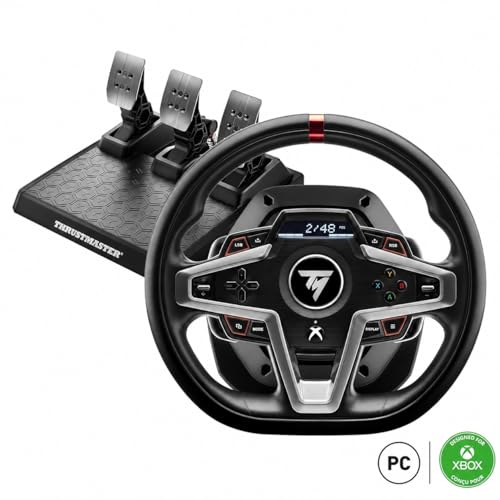
The Thrustmaster T248 occupies a unique position in the sim racing market by combining a hybrid gear-and-belt drive system with a built-in interactive display. The hybrid drive delivers smoother force feedback than pure gear-driven wheels while keeping costs below direct drive systems. The integrated race display shows real-time telemetry including speed, RPM, gear, and force feedback settings, allowing mid-race adjustments without pausing the action.
The included T3PM magnetic pedals use contactless Hall-effect sensors for the throttle, brake, and clutch, delivering consistent input resolution that does not degrade over time. Brake pressure is adjustable via a spring system, and the pedal faces are interchangeable. The magnetic paddle shifters use Thrustmaster’s patented H.E.A.R.T technology, providing a crisp, tactile shift feel with zero contact wear. The quick attachment system secures the wheel to desks up to 5.5 cm thick.
For Xbox and PC sim racers, the T248 offers a clear upgrade path over entry-level wheels. The digital display is genuinely useful for games like F1 23 and Forza Horizon 5, where RPM and gear position are critical. Some users report occasional firmware bugs on Xbox Series X and note that the brake pedal is quite stiff from the factory, but the overall package delivers a detailed, immersive experience that bridges the gap between entry-level and premium sim racing.
Why it’s great
- Hybrid gear-belt drive offers smoother FFB than pure gear systems without the cost of DD.
- Built-in telemetry display lets you monitor lap data and adjust settings mid-race.
- Hall-effect T3PM pedals provide contactless, long-lasting input accuracy.
Good to know
- Firmware updates require a Windows PC; no console-based update tool.
- Brake pedal is very firm out of the box and may need adjustment.
- Accessories limited to the Thrustmaster ecosystem; not cross-compatible with MOZA or Fanatec.
5. Logitech G29
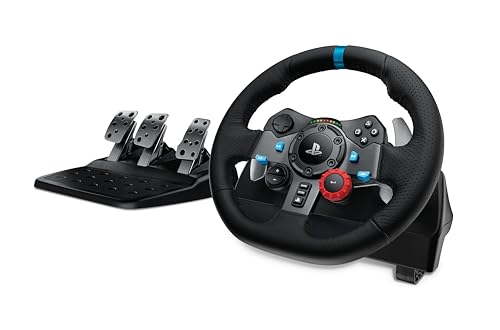
The Logitech G29 is the most recognized entry-level racing wheel for PlayStation consoles, and for good reason. It uses a helical gear-driven force feedback system that, while notchy compared to belt or direct drive, provides a robust and reliable 900-degree lock-to-lock rotation. The hand-stitched leather steering wheel cover feels premium, and the stainless steel paddle shifters are mounted directly to the wheel hub for solid, tactile gear changes.
The pedal assembly features a nonlinear brake pedal that simulates pressure-sensitive braking through a removable rubber block. Many sim racers remove this block to achieve a more linear feel, or they treat it as an early introduction to load-cell-style braking. The gas and clutch pedals are simple potentiometer units, but the entire pedal base is heavy and includes adjustable faces. The wheel clamps securely to desks and racing rigs via a sturdy mount system.
For PlayStation users who want a reliable, proven wheel without spending premium money, the G29 remains the benchmark. It supports Gran Turismo 7, Assetto Corsa, and F1 23 on PS5 with native compatibility. The gear-driven system is audible under heavy feedback, and the brake pedal stiffness polarizes users, but the G29’s durability and wide software support make it a sensible entry point. Logitech’s G HUB software on PC offers detailed tuning options for force feedback curves.
Why it’s great
- Proven gear-driven reliability with 900-degree rotation for realistic steering feel.
- Leather-wrapped wheel and stainless steel paddles provide a premium tactile experience.
- Broad compatibility with PlayStation consoles and PC, supported by major sim titles.
Good to know
- Gear-driven FFB produces audible notching and less detail than belt or DD systems.
- Brake pedal rubber block is divisive; many users prefer to remove it for linear feel.
- Pedal potentiometers can wear over time, requiring cleaning or replacement.
6. Logitech G920
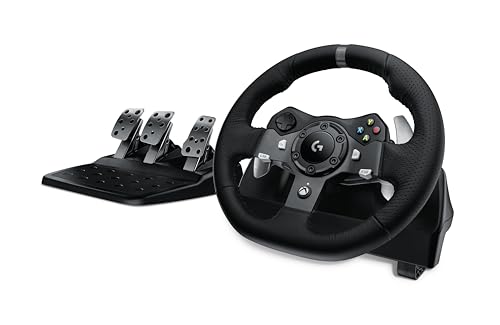
The Logitech G920 is the Xbox counterpart to the G29, sharing the same helical gear-driven force feedback system and 900-degree rotation. The wheel features a hand-stitched leather cover and metal paddle shifters, with the primary difference being the button layout optimized for Xbox controllers. The G920 includes an extra set of buttons on the wheel face compared to the G29, which some PC users prefer for better mapping flexibility.
The floor pedal unit is identical to the G29’s, with a nonlinear brake pedal that uses a removable rubber block to simulate progressive resistance. The pedal base is heavy and stays put on carpet or a rig, and the adjustable pedal faces accommodate different foot sizes. The quick-release clamp system secures the wheel to desks and stands without tools. On Xbox Series X, the G920 works natively with Forza Motorsport, Forza Horizon 5, and Assetto Corsa without adapters.
Where the G920 falls short is force feedback detail. The gear drive introduces a clunky texture that masks subtle road imperfections, and the system is audible during operation. Serious sim racers on Xbox may quickly outgrow it, but for the price, the G920 remains the most reliable entry point into sim racing on the Microsoft platform. The build quality is excellent, and replacement parts are widely available, making it a sound long-term investment for casual to intermediate racers.
Why it’s great
- Reliable gear-driven FFB with native Xbox Series X|S compatibility.
- Leather wheel cover and metal paddles feel substantial and durable.
- Removable brake pedal rubber block allows tuning of brake feel preference.
Good to know
- Gear-driven feedback lacks the smoothness and detail of belt or direct drive systems.
- Pedal potentiometers may require maintenance over extended use.
- Force feedback can be noisy, especially during rapid steering corrections.
7. Thrustmaster T128

The Thrustmaster T128 is an entry-level wheel that punches above its weight class by incorporating hybrid drive technology—a combination of gear and belt elements—to produce smoother force feedback than the purely gear-driven G29/G920. The 10-inch wheel diameter is slightly smaller than the competition, but the ergonomic grips and well-placed button layout make it comfortable for long sessions. The magnetic paddle shifters, using Thrustmaster’s H.E.A.R.T technology, provide a crisp and tactile shift feel.
The pedal set is the weakest component: the pedals are plasticky, lack carpet spikes, and can slide on smooth floors during hard braking. The throttle and brake use standard potentiometers, which deliver acceptable performance out of the box but may degrade over time. The quick attachment system secures the wheel to desks up to 5.5 cm thick, and the USB connectivity is standard plug-and-play on PS5 and PC. Setup is straightforward with no complicated software required for basic operation.
For PlayStation sim racers on a strict budget, the T128 offers a genuine upgrade over a standard controller without the investment required for a G29 or direct drive wheel. The hybrid drive provides better feedback detail than pure gear systems, and the magnetic paddles are a genuine highlight at this price tier. The pedal limitations are the main compromise, but for casual racing in Gran Turismo 7 or F1 23, the T128 delivers an immersive experience that justifies its price.
Why it’s great
- Hybrid gear-belt drive offers smoother FFB than entry-level gear-only wheels.
- Magnetic paddle shifters provide sharp, lasting tactile feedback for gear changes.
- Easy plug-and-play setup on PS5 and PC without complex driver installation.
Good to know
- Pedals are plasticky and may slide on carpet without additional grip solution.
- Smaller 10-inch wheel diameter may feel less realistic than full-size options.
- Potentiometer pedals lack the long-term consistency of Hall-effect sensors.
8. HORI Truck Control System

The HORI Truck Control System is a purpose-built peripheral for truck driving simulations like Euro Truck Simulator 2 and American Truck Simulator, not a general-purpose racing wheel. Its most defining spec is the 1800-degree lock-to-lock rotation—five full turns from stop to stop—which accurately replicates the steering ratio of a real semi-truck. The extra-large diameter wheel features a quality grip and steering-column-mounted stalks for turn signals and wiper controls, adding a layer of immersion that standard racing wheels cannot match.
The shifter control panel is a separate module with 34 buttons, sequential and H-pattern shifting modes, and adjustable resistance. The three-pedal unit uses metal pedals with Hall-effect sensors for contactless reading, ensuring consistent brake and throttle input. Dual-motor force feedback provides road and load simulation, but the force is noticeably weaker than a dedicated racing wheel, aligning more with trucking realism than competitive lap times. The included Steam download codes for ETS2 and ATS soften the upfront cost.
For dedicated truck sim players, the HORI system delivers unmatched immersion—every switch, stalk, and button corresponds to a real function in the game. The trade-offs are clear: the build is mostly plastic, the pedals lack carpet grip and feel a bit light, and the force feedback is modest. But for the specific use case of logging miles on the virtual highway, this is the most complete out-of-the-box solution available. It is not designed for track racing; its 1800-degree rotation would feel absurd in a Formula car.
Why it’s great
- 1800-degree rotation accurately replicates real truck steering ratios and feel.
- 34-button shifter panel and column stalks provide total immersion for ETS2/ATS.
- Hall-effect pedals deliver contactless, wear-resistant brake and throttle input.
Good to know
- Force feedback is weak compared to racing-focused wheels; designed for trucking realism, not lap times.
- Pedals lack carpet grip and can slide on hard flooring under use.
- Not suitable for traditional racing games; 1800° rotation is impractical for track use.
9. HORI Racing Wheel Apex
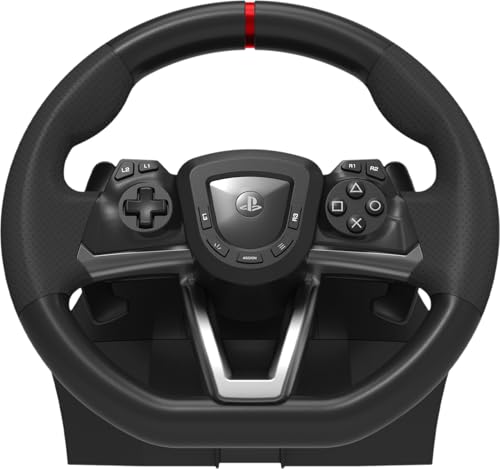
The HORI Racing Wheel Apex is a spring-loaded, non-force-feedback wheel that prioritizes affordability and console compatibility over simulation fidelity. Its 270-degree turn radius uses a spring-centering mechanism rather than a motor, meaning the wheel returns to center by tension, not by simulated road forces. This limitation makes it unsuitable for serious sim racing, but for casual arcade-style titles like Forza Horizon or Crew Motorfest, it delivers a more engaging experience than a standard gamepad.
The wheel is officially licensed by Sony and includes 23 buttons, a touchpad for PS5 navigation, and a full-size racing wheel design with a sturdy clamp system. The pedal unit is basic but functional, with spring-loaded accelerator and brake pedals. The HORI Device Manager app allows firmware updates and the creation of up to four custom profiles with adjustable output options. Setup is plug-and-play with no additional drivers required on console.
For the absolute entry-level budget, the HORI Apex works as an introduction to wheel-based racing. The spring-loaded mechanism is responsive after sensitivity adjustment, and the build quality is decent for the price. But the lack of force feedback means you lose all tactile information about traction, weight transfer, and curbing. Sim racers looking for a genuine step toward realism should save for a force feedback wheel. This is a controller substitute, not a sim racing tool.
Why it’s great
- Officially licensed for PlayStation consoles with full touchpad support.
- Easy plug-and-play setup with custom profile creation via companion app.
- Budget-friendly entry point for casual arcade racing on console.
Good to know
- No force feedback; spring-centering mechanism provides zero road simulation detail.
- 270-degree rotation is very fast, requiring sensitivity adjustment for realistic steering.
- Pedals are basic and lack the progressive resistance needed for trail braking.
FAQ
Do I need direct drive, or is a gear-driven wheel good enough?
Can I use an Xbox wheel on a PlayStation console?
What is the difference between belt-driven and gear-driven force feedback?
How many degrees of rotation do I really need for sim racing?
Are magnetic paddle shifters worth the extra cost?
Final Thoughts: The Verdict
For most users, the controller for racing games winner is the Fanatec GT DD Pro because its direct drive fidelity, PlayStation licensing, and Gran Turismo 7 integration make it the most capable console-compatible wheel on the market. If you want a PC-focused direct drive system with a higher torque ceiling, grab the MOZA R5 Bundle. And for Xbox users seeking a genuine direct drive upgrade without leaving the Microsoft ecosystem, nothing beats the MOZA R3 Bundle at its price point.

Mo Maruf
I created WellFizz to bridge the gap between vague wellness advice and actionable solutions. My mission is simple: to decode the research and give you practical tools you can actually use.
Beyond the data, I am a passionate traveler. I believe that stepping away from the screen to explore new environments is essential for mental clarity and physical vitality.