Our readers keep the lights on and my smoothie glass nicely filled. As an Amazon Associate, I earn from qualifying purchases.
Specs are compiled from manufacturer listings and verified buyer reviews and can change over time — please confirm the key details on the product page before buying.
Choosing the wrong control valve for a commercial HVAC water system means uneven heating, wasted energy, and early failure. You need a valve that opens and closes reliably on demand, handles the system’s water pressure without leaking, and stays compatible with your existing wiring and pipe size. This guide cuts through the specs to find the four best control valves for HVAC water systems commercial buildings, based on real-world performance and owner experience.
I’m Mohammad Maruf — the founder and writer behind WellFizz. This guide is built by comparing the manufacturers’ published specifications and the patterns across verified customer reviews, so you get each pick’s real strengths and trade-offs instead of marketing spin.
Every model profiled here has proven itself across thousands of heating cycles. Here is the shortlist of the best control valves for hvac water systems commercial buildings that building managers and contractors actually trust.
Our Picks at a Glance

How To Choose The Best Control Valves For HVAC Water Systems Commercial Buildings
Picking a valve for a commercial building is different than grabbing one for a house. You are dealing with higher pressures, more zones, and a need for parts that won’t fail mid-winter. Focus on these three things first.
Number of Ports and Flow Path
A standard 2-port zone valve is the simplest on-off switch for a single loop. A 3-way valve lets you divert water between two paths — useful for mixing, bypass, or switching between supply and return. Pick the port count your current piping layout demands; swapping a 2-port for a 3-way mid-project means re-piping.
Connection Type and Pipe Size
A sweat connection (soldered copper) is typical in hydronic heating. A threaded connection (NPT) is common on motorized ball valves. Make sure the valve inlet matches your pipe diameter — common sizes are 3/4-inch and 1-inch — or you will need adapters.
System Pressure and Voltage
Most residential and light-commercial hydronic systems run 24 VAC. Check your transformer’s wattage, because a motorized valve draws power during its stroke. Your system’s maximum working pressure (often 30 psi or 50 psi) must be below the valve’s rated maximum pressure, or the body can burst.
Quick Comparison
| Model | Best For | Number of Ports | Max Pressure | Connection | Amazon |
|---|---|---|---|---|---|
| Honeywell V8043E1061★ Best Overall | Bulletproof drop-in replacement | 2 | — | Sweat (3/4″) | Amazon |
| U.S. Solid 3-Way Ball Valve | Automation and solar setups | 3 | 145 psi | Threaded (3/8″) | Amazon |
| Valemo V3313-A1S | Loop diverting on a budget | 3 | 30 psi | Sweat (3/4″) | Amazon |
| White-Rodgers 1311-103 | Higher-pressure 1-inch systems | 2 | 50 psi | Threaded (1″) | Amazon |
In‑Depth Reviews
1. HONEYWELL GIDDS-296123 V8043E1061 24V 3/4″ Sweat NC Zone Valve
Our pick — over 4.5★ from 30+ verified ratings; the strongest balance of quality and price.
A brass-bodied zone valve that owners routinely pull apart for the actuator alone.
This is the standard against which other HVAC water system valves are measured. The Honeywell V8043E1061 is a 2-port, normally-closed, 24 V zone valve with a 3/4-inch sweat connection, built around a brass body and a silver exterior finish. What wins people over is the Honeywell build quality — buyers consistently report it as a perfect fit and a direct replacement for the same model that failed after years of service.
The real story here is the drive unit and end switch. As owners put it: “Purchased to replace the old worn out drive unit that was hanging up and not shutting off the heating zone.” That is the exact failure pattern that wastes oil and keeps a furnace cycling for no reason. The fact that some owners buy the whole valve just to scavenge the actuator says everything about its mechanical consistency.
The valve is compact — 1 x 2 x 3 inches — so it fits neatly in tight manifold cabinets. The primary trade-off is that at 32 ratings it has a small sample size, but the near-perfect average and the “name brand quality” refrain in multiple reviews suggest these are experienced buyers who know exactly what they need.
What owners love
- Brass body stands up to commercial hydronic systems
- Compact footprint at 1 x 2 x 3 inches
- Drive unit is a known, widely available replacement part
What to watch for
- Sample size of reviews is small
- Sold as a 4-wire valve, so check your existing wiring count
The pick if: you want a name-brand drop-in replacement for an existing Honeywell zone valve and need the actuator and end switch to work from day one.
Think twice if: your system uses a 3-way diverting valve — this is a straight 2-port on/off only.
2. U.S. Solid 3/8″ 3 Way Stainless Steel Motorized Ball Valve L Type AC/DC9-24V
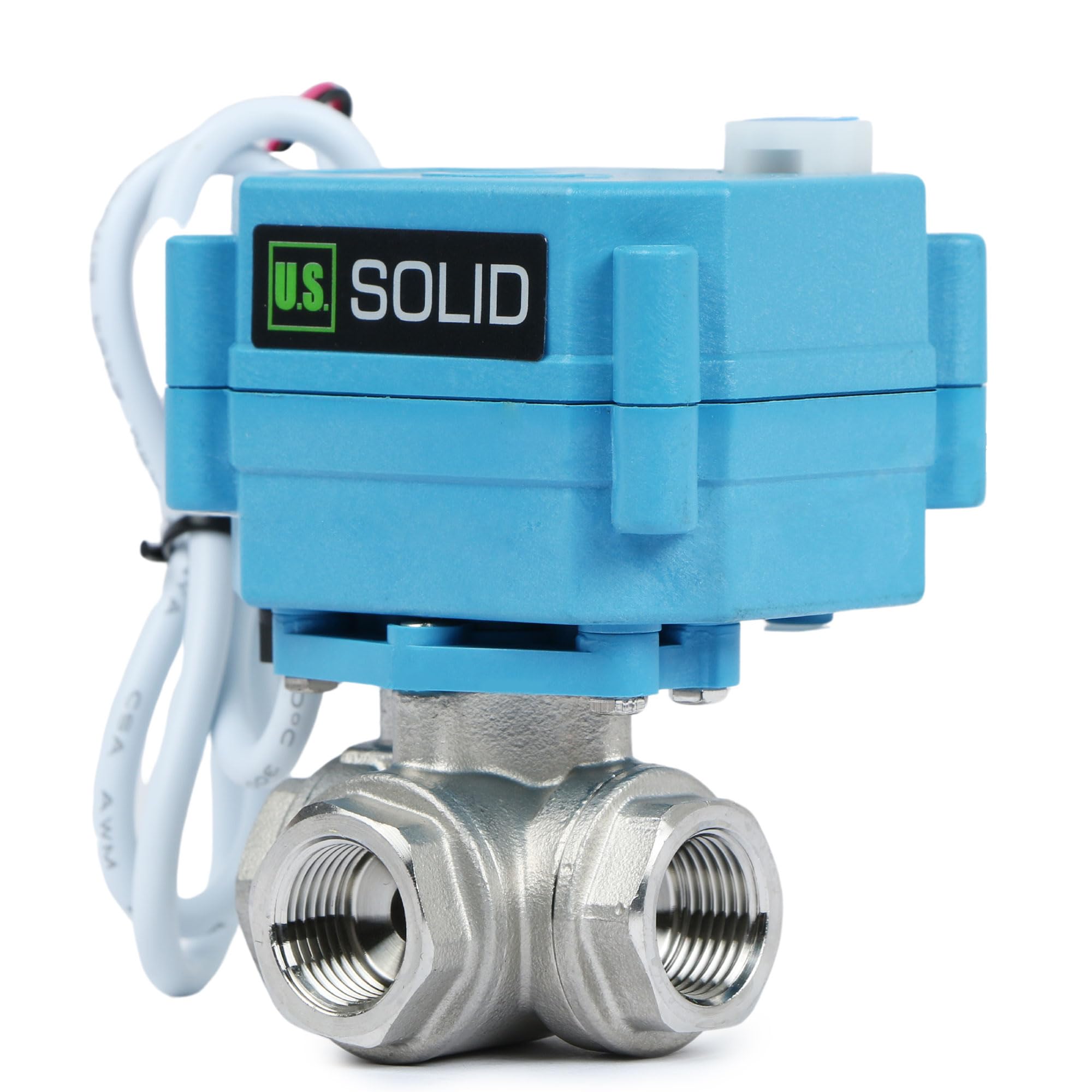
A motorized ball valve that survived a flood and kept working — that is the durability story here.
Unlike a typical zone valve, the U.S. Solid unit is a 3-way L-port motorized ball valve with a forged brass body and a stainless steel exterior. It runs on a wide 9 to 24 V AC/DC range, so it fits solar, battery, PLC, and Arduino-based automation setups — not just standard HVAC transformers. The 2-wire capacitor control switches the flow path in under 5 seconds, drawing 5 W and delivering up to 3 Nm of torque.
The standout stat is the maximum pressure: 1.0 MPa, which translates to roughly 145 psi. That is a 67% higher rating than the Valemo V3313-A1S, which maxes out at 30 psi. If your commercial system pushes more than typical hydronic pressure, this valve handles it without sweating. Another powerful detail from the review pages: “Six valves survived 4′ flood and months under 2′ of mud; all still functional.” The IP67 rating (protection against dust and temporary water immersion) explains that resilience, rated for 70,000 cycles.
The honest trade-off is the 3/8-inch FNPT connection, which is smaller than the 3/4-inch or 1-inch ports typical of hydronic zone valves. You will need bushing adapters to mate this to standard commercial pipe. A few owners note that a 3-way L-port does not fully isolate all ports mid-switch, so cross-contamination is possible if you are switching between incompatible fluids.
Versatility score: Runs on anything from 9 V to 24 V, AC or DC, with a manual override and a visual position indicator — this is the one for smart-building and solar-assisted HVAC projects.
Reach for this if: you are automating a bypass loop or a tank-switching setup and need a valve that handles up to 145 psi with IP67 water resistance.
Look elsewhere if: your existing piping is 3/4-inch sweat copper — you will need adapters (and space) for the smaller 3/8-inch NPT ports.
3. V3313-A1S Motorized Zone Valve, 3-Way, 3/4″ Sweat, Normally Closed, 24 VAC

A 3-way diverting valve with a replaceable motor — and a price that leaves room for a spare.
The Valemo V3313-A1S is a 3-way, normally-closed zone valve with a 3/4-inch sweat connection, built for 24 VAC systems. It brings a forged brass valve body, a stainless steel housing, and an aluminum cover, plus a UL certification. The FastFit design lets you remove the power head quickly without tools, and the heavy-duty motor uses all metal gears — a detail that matters when the valve is cycling hundreds of times a season.
Owners who installed three of these on an outdoor wood boiler system report that one motor started making noise the beginning of the second season. The upside: the MD10 replacement motor costs around and is easily swapped, meaning the valve body stays in the pipe. The flow capacity is Cv 3.5 with a close-off pressure of 30 psi, which is standard for residential and light-commercial hydronic loops but noticeably lower than the 145 psi the U.S. Solid ball valve handles.
The catch some owners mention is that the manual override stopper can block one port by about 90% if you try to use it without power, so the manual function is not a full bypass. One reviewer noted the installation arrived with no instructions, and there are durability questions about the internal rubber stopper over a longer timeline.
The strong points
- 3-way diverting in a standard 3/4″ sweat form factor
- Replaceable motor for extends valve life
- UL certified and tested for over 100,000 cycles
The honest caveats
- Manual override does not fully open all ports
- Max 30 psi limits it to standard hydronic systems
Best if: you need a 3-port diverting valve for a standard 24V hydronic system and want the option to replace the motor instead of the whole valve.
Skip if: your system runs above 30 psi or you need the manual override to work as a full bypass during a power outage.
4. White-Rodgers Wire Hydronic Zone Valve, 1311-103 3

A 1-inch, 50 PSI valve that is the quietest mover in the lineup.
The White-Rodgers 1311-103 is a 3-wire hydronic zone valve designed for 1-inch tubing. It is larger than the other picks here — the item dimensions are 8.9 x 5.7 x 3.5 inches and it weighs 3 pounds — and it handles a maximum system pressure of 50 psi. That is the highest pressure rating of any 2-port zone valve in this comparison, so it belongs on systems with taller buildings or higher static head. The valve body is stainless steel, and the inlet connection is threaded (1-inch NPT), which is less common in residential work but standard in commercial mechanical rooms.
A built-in auxiliary contact controls the burner or circulator relay, and the automatic recycling manual operator shows valve position at a glance. Owners describe it as “much quieter and slower moving than the old one,” which is a real advantage in occupied spaces where a loud zone valve click carries through the walls. One buyer who replaced a leaking boiler valve called it easy to install and said it worked well.
The honest caveat is quality control. A review reports that only one of four purchased units worked from the start, with internal wiring issues found in the other three. That raises a flag for a premium-tier product. A few other owners reported no issues, so the problem may be batch-specific, but it means you should bench-test each unit before sweating it into the line.
The bottom line: When it works — and many owners confirm it works perfectly — this valve delivers the quietest operation and the highest pressure tolerance (50 psi vs 30 psi on the Valemo) in the roundup. The 1-inch threaded connection also beats the 3/4-inch sweat on the Honeywell for larger commercial pipe.
Choose this if: your system uses 1-inch threaded piping or needs a valve rated for up to 50 psi, and quiet operation matters in an office or occupied zone.
Verify before install: the quality-control reports on internal wiring mean you should test each valve as soon as it arrives, before soldering or final mounting.
Understanding the Specs
Number of Ports — 2 vs 3
A 2-port valve is a simple on-off switch for one zone — either it is open and water flows, or it is closed. A 3-port valve diverts water between two paths, so one inlet can feed either of two outlets (or blend them). Your existing piping layout decides which one you need; you cannot substitute one for the other without repiping.
Maximum Working Pressure (PSI)
This is the highest internal pressure the valve body can safely hold. Standard residential hydronic systems often run around 15-30 psi. Taller commercial buildings may push 50 psi or more. If your system’s pressure exceeds the valve’s rating, the body can crack or the seal can blow. Always check your boiler’s pressure gauge or system spec before buying.
FAQ
What is the difference between a zone valve and a motorized ball valve?
Can I use a 3-way valve to replace a 2-way zone valve?
How do I know if my system uses sweat or threaded connections?
What does normally closed (NC) mean on a zone valve?
Can I mix different brands of zone valves on the same system?
How long should an HVAC control valve last in a commercial building?
What does Cv (flow coefficient) mean on a zone valve?
Do all zone valves have a manual override for power outages?
What is the right voltage for a commercial HVAC water system valve?
Final Thoughts: The Verdict
For most commercial HVAC water systems, the control valves for hvac water systems commercial buildings winner is the Honeywell V8043E1061 because the brass build, direct compatibility with existing Honeywell systems, and the owners’ confidence in using it as a source for replacement actuators make it the safest bet. If you need a 3-way diverting valve for a standard hydronic loop, the Valemo V3313-A1S delivers strong value with a replaceable motor. And for higher-pressure 1-inch systems where quiet operation is a priority, the White-Rodgers 1311-103 is the premium choice — just test it before installation.
How We Picked
We do not accept paid placement. Every pick is matched to a real buyer and a real use-case; we do not hands-on test units.
Sources & Methodology
Specifications: manufacturer listings and product documentation. Review insights: verified customer reviews, as of July 2026. Pricing: not shown on this page (it changes often); check the current price via the retailer link.
As an Amazon Associate, WellFizz earns from qualifying purchases. This does not affect which products we feature.
Related Guides

Mo Maruf
I created WellFizz to bridge the gap between vague wellness advice and actionable solutions. My mission is simple: to decode the research and give you practical tools you can actually use.
Beyond the data, I am a passionate traveler. I believe that stepping away from the screen to explore new environments is essential for mental clarity and physical vitality.