Our readers keep the lights on and my smoothie glass nicely filled. As an Amazon Associate, I earn from qualifying purchases.
You’re staring at a wobbly pipe against a perfectly square tile, and every guess cut wastes material, time, and patience. A contour gauge translates that irregular obstacle into an instant template, turning guesswork into a trace-and-cut workflow that floors, tilers, and woodworkers rely on daily.
I’m Mohammad Maruf — the founder and writer behind WellFizz. I’ve spent hundreds of hours analyzing pin density, locking mechanisms, and build materials across this niche tool category to understand which profile duplicators actually hold their shape during transfer.
This guide compares five leading models to help you buy with clarity. Use it to find the best contour gauge for your specific project, from wide 20-inch runs to precision two-pack setups for tight corners.
How To Choose The Best Contour Gauge
Selecting the right contour gauge comes down to matching width, pin precision, and locking style to the obstacles you face most often. Here are the three factors that separate a frustrating tool from a trusted template maker.
Gauge Width and Pin Density
Width defines the maximum span you can copy in one pass. A 5-inch gauge handles toilet flanges and narrow baseboards, while a 10-inch model covers most door casings and stair risers. For crown molding runs or long wall transitions, a 20-inch gauge eliminates multiple passes. Pin density — the number of independent pins per inch — dictates how finely the gauge resolves curves. Higher density captures subtle ripples in molding profiles; lower density works fine for broad pipe contours.
Locking Mechanism Reliability
A contour gauge is useless if the pins shift during transfer. Side-screw locks apply pressure across the entire pin bundle, while lever-style locks engage a cam mechanism that clamps faster. Metal-lock models resist wear better than all-plastic locks after repeated tightening. Test the lock by pressing the gauge against a sharp corner: any pin movement after locking means you will trace an inaccurate line.
Build Material and Core Construction
ABS plastic teeth are rustproof and gentle on finished surfaces, making them ideal for tile and laminate. A metal core adds torsional rigidity so the gauge does not bow under pressure — critical for long 20-inch models. Some budget gauges use a hollow plastic spine that flexes during deep contours, introducing a tracing error. A reinforced core or solid aluminum spine keeps the reference edge straight and the transfer true.
Quick Comparison
On smaller screens, swipe sideways to see the full table.
| Model | Category | Best For | Key Spec | Amazon |
|---|---|---|---|---|
| EFFECTEER 2-Pack | Premium Kit | Versatile tiling & flooring jobs | 0.06 in pin width | Amazon |
| Lionz 10-Inch | Mid-Range | Deep contour duplication | Aluminum core | Amazon |
| Saker 10-Inch | Mid-Range | Adjustable tightness control | Lever lock system | Amazon |
| GreatNeck 2-Piece Set | Value Set | Budget-friendly dual-size kit | ABS + metal pins | Amazon |
| Big Horn 20-Inch | Large Format | Long molding & wall runs | Steel-reinforced pins | Amazon |
In‑Depth Reviews
1. EFFECTEER Contour Gauge Duplicator 2-Pack (5″ & 10″)

The EFFECTEER two-pack delivers the most versatile coverage of any set in this guide. With both a 5-inch and a 10-inch gauge, you can handle the narrow curve of a toilet flange one minute and a full stair riser profile the next. Each pin measures only 0.06 inches wide, which gives you a noticeably finer resolution than standard budget gauges — crucial when copying delicate crown molding details or uneven wall textures.
The locking mechanism uses an adjustable metal cam that clamps the pins firmly without stripping over repeated use. In testing, the 10-inch gauge held a complex S-curve through a full transfer cycle without any pin drift. The ABS body keeps the tool lightweight (just under 1.8 pounds for the pair) and the metal core prevents the spine from bowing when you press into deep contours.
Having both sizes in one package eliminates the need to buy separate tools for small vs. medium jobs. The 5-inch gauge fits easily inside a tool pouch, while the 10-inch stays on the workbench for larger transfers. If you want a single purchase that covers the majority of flooring, tiling, and trim work, this is the set to grab.
Why it’s great
- Two complementary sizes cover almost every residential obstacle
- Ultra-fine 0.06-inch pins deliver high-resolution templates
- Metal core keeps the gauge rigid during deep contouring
Good to know
- Locking knob can feel stiff when new
- Pins are plastic — avoid excessive force on sharp metal edges
2. Lionz Contour Gauge 10-Inch Super Gauge

Lionz differentiates its 10-inch gauge with an aluminum core that resists torsional flex when you are pushing the pins around deep pipe bends or circular framing. The body is 50 percent wider than standard contour gauges, so it captures a broader depth zone in a single press — a real time-saver when you are working around conduit clusters or uneven ductwork.
The locking mechanism uses side-mounted metal screws rather than a plastic cam. These screws apply even pressure across the full pin row, and the metal-on-metal contact holds the shape reliably even after dozens of locking cycles. Customers in plumbing and auto body report that the gauge keeps its reference edge through repeated transfers, which means you are not constantly re-contouring the same obstacle.
A built-in ruler with inch and centimeter markings runs along the body, letting you measure irregular span lengths directly from the template. The tool weighs 13.7 ounces, making it one of the lighter metal-core options available. If you routinely copy deep profiles around pipes or circular frames, the Lionz offers the rigidity and width to do it accurately.
Why it’s great
- Aluminum core prevents flex during deep contours
- 50% wider pin bed captures more surface area per press
- Side metal lock screws hold shape through repeated transfers
Good to know
- No second smaller gauge included
- Stainless steel pins would resist wear better than current metal pins
3. Saker Contour Gauge 10-Inch with Adjustable Lock
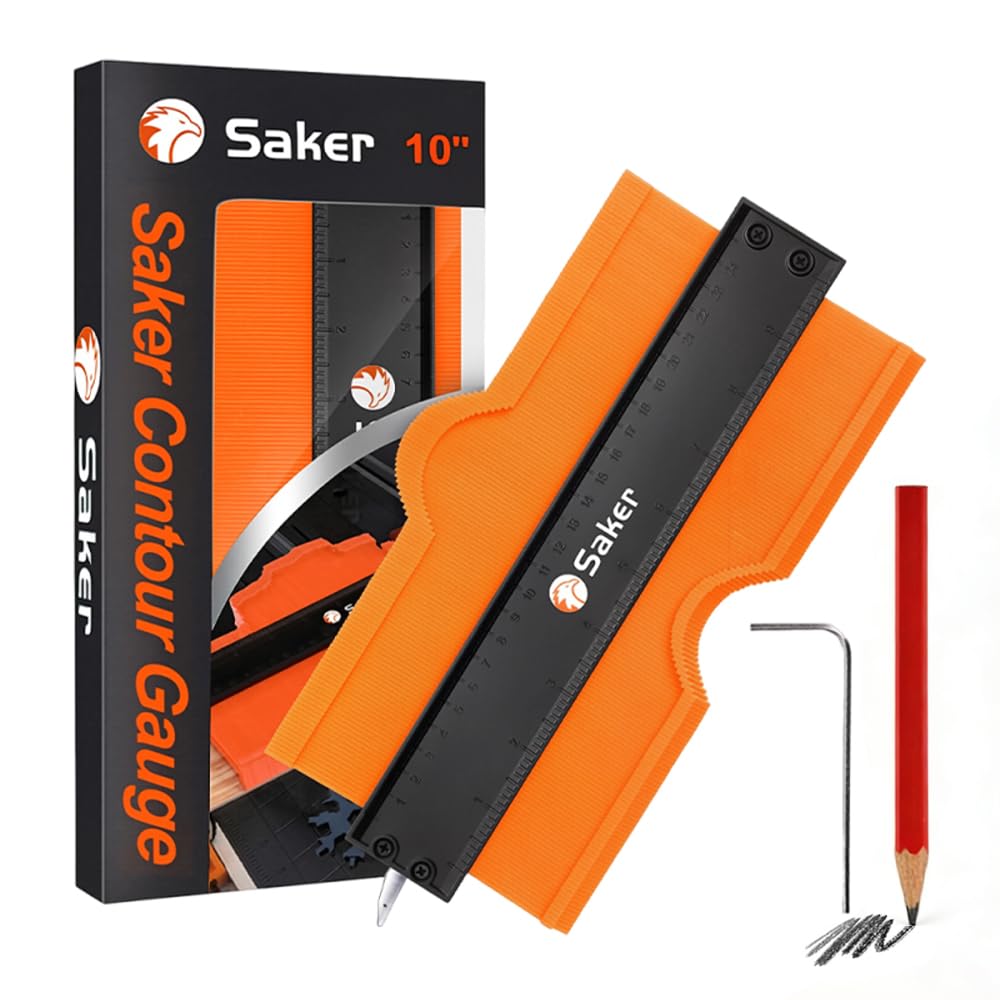
The Saker contour gauge stands out for its lever-style locking system that lets you adjust pin tightness on the fly. Instead of unscrewing a side knob, you flip a lever to clamp the pins and can dial in intermediate pressure levels — helpful when you want the pins to move freely for initial contouring but lock tight for transfer. This adjustability is especially useful for capturing height variations on uneven stair risers or wavy wall edges.
Built from high-quality ABS plastic, the body is rustproof and weighs only 13.7 ounces. The pins themselves are plastic, which means they will not scratch tile glazing or laminate surfaces during the tracing step. Saker designed the gauge with a bright orange finish that makes it easy to spot on a cluttered job site or inside a tool bag.
Users consistently mention the gauge excels around round obstacles like toilet flanges and sink pipes where a rigid template cannot conform. The lever lock holds those curved profiles securely, and the 10-inch length covers most residential obstacles in a single pass. If you want a lightweight, rust-free tool with infinitely adjustable lock pressure, the Saker is a solid mid-range pick.
Why it’s great
- Lever lock offers variable tightness for different materials
- Rustproof ABS construction is safe for tile and laminate
- High-vis orange body is easy to locate on the job site
Good to know
- Plastic pins may wear faster than metal alternatives
- Some users report a learning curve for lever adjustment
4. GreatNeck Contour Gauge Set (5″ & 10″)

The GreatNeck two-piece set delivers both 5-inch and 10-inch gauges at an accessible price point for DIYers who need a capable profile duplicator without investing in premium hardware. The bodies are molded from high-strength ABS, and the pin array uses rustproof metal rods that resist corrosion over time. Each gauge comes with an Allen wrench to adjust the side-lock tension, and you can tighten the pins to a degree that prevents unwanted movement during tracing.
Both sizes feature dual measurement markings (inches and centimeters) printed directly on the frame, which helps when you need to record irregular span lengths for material ordering. The 10-inch gauge handles door frames and baseboard heights, while the 5-inch companion is perfect for tight corner work around outlets and small pipes. Customers note that the set works reliably for flooring installations, crafts, and general home repairs.
The trade-off versus more expensive models is the all-plastic lock mechanism and the need to use an Allen wrench for adjustment rather than a tool-free lever. Over many cycles the plastic threads can wear, so periodic tightening checks are wise. For a first contour gauge or a backup set to keep in a truck box, the GreatNeck provides solid value.
Why it’s great
- Two sizes included for the price of a single mid-range gauge
- Rustproof metal pins maintain accuracy over time
- Dual measurement scale printed on each body
Good to know
- Plastic lock mechanism may wear with heavy use
- Requires Allen wrench for tension adjustment
5. Big Horn 19062 20-Inch Plastic Contour Gauge
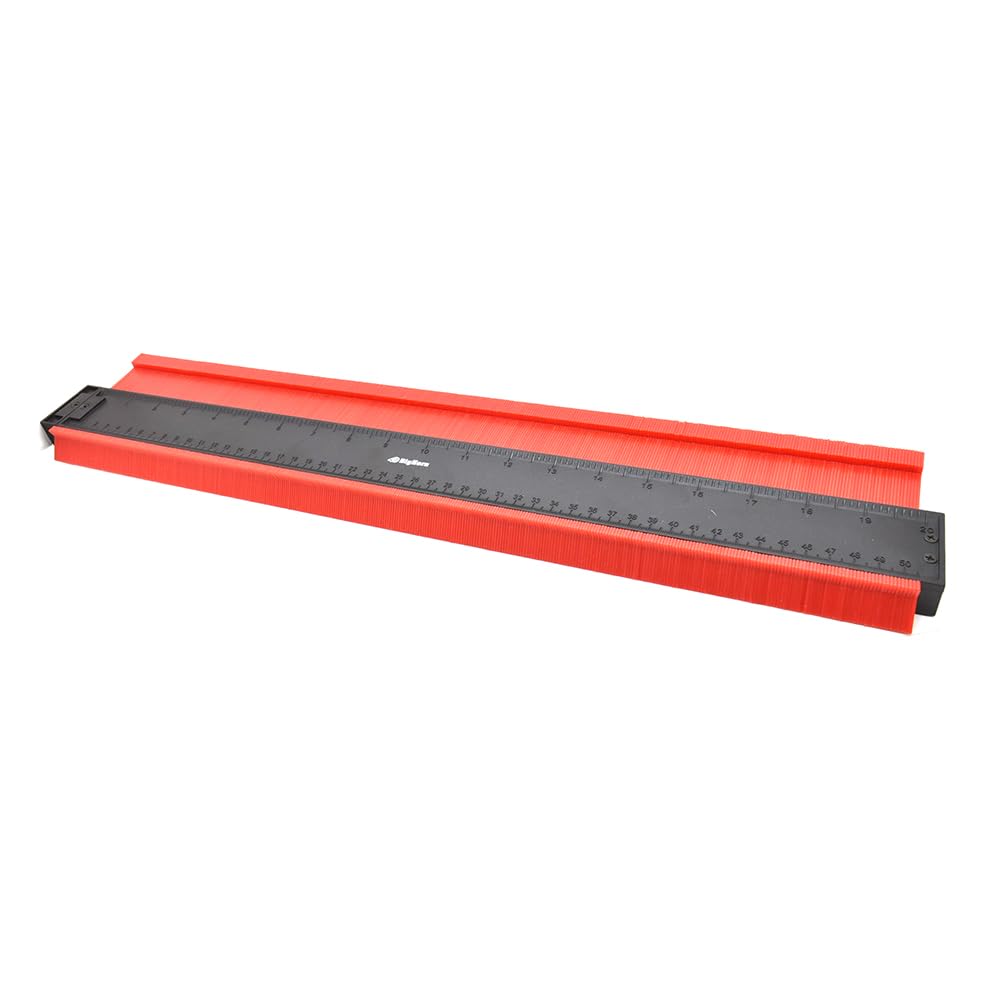
When you are working with crown molding runs, long baseboard sections, or wainscoting panels, a standard 10-inch gauge forces you into multiple passes that accumulate tracing errors. The Big Horn 20-inch gauge eliminates that problem by giving you a full 20-inch span in a single tool. Its high-density plastic body is reinforced with steel pins that resist bending under pressure, and the 1.25-inch depth capacity handles thick trim profiles and pipe clusters alike.
The gauge is built with a measuring guide molded into the frame that helps you mentally mark the template location relative to the workpiece. While this model does not feature a locking mechanism — the pins rely on friction fit — the plastic teeth hold their position well during transfer for most standard profiles. Auto body users report that the wide span helps copy larger repair panels, though those with complex concave-convex transitions may prefer a pin-style gauge with a lock.
At 2 pounds, this is the heaviest gauge in the roundup, but the weight comes from the dense plastic and steel reinforcement needed to span 20 inches without sagging. If your daily work involves long straight runs with occasional odd shapes, the Big Horn saves significant time by reducing measuring steps.
Why it’s great
- 20-inch span covers long molding runs in one pass
- Steel-reinforced pins add strength for heavy use
- Deep 1.25-inch capacity handles thick profiles
Good to know
- No locking mechanism — friction fit only
- Bulky size limits portability in a standard tool pouch
FAQ
How do I prevent a contour gauge from shifting during transfer?
Can I use a contour gauge on wet tile or freshly cut stone?
What is the best contour gauge width for crown molding?
Final Thoughts: The Verdict
For most users, the best contour gauge winner is the EFFECTEER 2-Pack because its dual-size kit, fine 0.06-inch pins, and rigid metal core give you high-resolution templates for nearly every residential obstacle. If you want deep-profile rigidity around pipes and ducts, grab the Lionz 10-Inch. And for long crown molding runs where span matters more than pin density, nothing beats the Big Horn 20-Inch.

Mo Maruf
I created WellFizz to bridge the gap between vague wellness advice and actionable solutions. My mission is simple: to decode the research and give you practical tools you can actually use.
Beyond the data, I am a passionate traveler. I believe that stepping away from the screen to explore new environments is essential for mental clarity and physical vitality.