Our readers keep the lights on and my smoothie glass nicely filled. As an Amazon Associate, I earn from qualifying purchases.
That shaky handheld footage from your phone is the single fastest way to lose a viewer before they even hear your first sentence. Whether you are filming a talking-head vlog, a mountain-bike descent, or a multi-camera live stream, the core gear decision comes down to one thing: stabilization path. Action cameras offer magnetic POV mounts and horizon lock. Gimbal cameras deliver motorized smoothness and subject tracking. Mirrorless systems provide interchangeable lenses with sensor-shift or optical stabilization. Each path forces a different trade-off between portability, image quality, and workflow complexity.
I’m Mohammad Maruf — the founder and writer behind WellFizz. I analyzed hundreds of verified reviews and compared sensor sizes, stabilization ratings, battery endurance, and kit completeness across the current content-camera landscape to pin down the gear that actually solves the specific pain points creators deal with daily.
This guide breaks down seven setups so you can match a capture system to your actual shooting style rather than buying into marketing hype. My goal is to help you identify the best content creator equipment for your specific workflow, whether that means a wearable action cam for sports or a cinema-line mirrorless for studio-grade production.
How To Choose The Best Content Creator Equipment
Selecting a camera for content creation is less about which brand you prefer and more about understanding the core mechanical and optical specifications that define your footage. Three specs dominate every decision: sensor size, stabilization type, and audio input flexibility. Ignore marketing buzzwords like “cinematic” and focus on these measurable traits.
Sensor Size and Its Real Impact
A 1-inch CMOS sensor like the one found in the DJI Osmo Pocket 3 captures approximately four times more light than the tiny 1/1.28″ sensor in a wearable action camera. That light advantage translates directly into cleaner footage at dusk, less noise in indoor settings, and smoother color grading in post. An APS-C sensor, as used in the Canon EOS R10 and Sony FX30, offers yet another step up in dynamic range — critical when you are shooting interview subjects against bright windows or mixed-lighting scenes. For social-media style content shot in good light, a 1-inch sensor is more than adequate. For narrative work or professional livestreaming, the larger APS-C format provides the latitude you need to correct exposure errors in editing.
Stabilization: Gimbal vs. Electronic vs. In-Body
Three distinct stabilization approaches exist in this lineup, and each serves a different shooting scenario. Mechanical gimbal stabilization, as implemented by the Osmo Pocket 3, physically moves the lens assembly to counteract shake — this produces the smoothest walking footage available in a pocketable form factor. Electronic image stabilization (EIS), used by action cameras like the Insta360 GO Ultra and DJI Osmo Action 6, crops into the sensor slightly to create a digital buffer zone for shake correction. In-body image stabilization (IBIS), found on the Sony FX30, shifts the sensor itself to compensate for hand movement. For high-movement scenarios like running or biking, the horizon-locking EIS of an action camera is actually better than IBIS. For controlled walking shots in a vlog, the mechanical gimbal wins. IBIS excels in static handheld shooting where subtle micro-shakes ruin the shot.
Audio Readiness and Kit Completeness
A stunning 4K image becomes unwatchable if the audio sounds like a tin can. The most practical investment you can make is choosing a kit that includes a usable external microphone. The Canon EOS R10 Content Creator Kit bundles a stereo microphone with a windscreen. The DJI Osmo Pocket 3 Creator Combo includes a DJI Mic 2 transmitter with a clip magnet. The Logitech Mevo Start 3-Pack relies on its built-in mics but allows a direct 3.5mm external mic connection. Before buying any camera body alone, check whether your budget allows for a separate wireless lavalier or shotgun mic — the difference in viewer retention is measurable and immediate.
Quick Comparison
On smaller screens, swipe sideways to see the full table.
| Model | Category | Best For | Key Spec | Amazon |
|---|---|---|---|---|
| Sony FX30 | Cinema Mirrorless | Professional narrative & studio content | APS-C, 14+ stops dynamic range | Amazon |
| Canon EOS R10 Creator Kit | Mirrorless Kit | Interchangeable-lens vlogging & photography | 24.2MP APS-C, 15fps mechanical | Amazon |
| DJI Osmo Pocket 3 Creator Combo | Gimbal Camera | Smooth walking vlogs & event coverage | 1-inch CMOS, 3-axis stabilization | Amazon |
| DJI Osmo Action 6 Bundle | Action Camera | High-motion sports & rugged outdoor use | 8K video, 360° HorizonSteady | Amazon |
| Sony ZV-1F Creator’s Kit | Compact Vlog Camera | Beginner-friendly talking-head & product showcases | 1-inch sensor, Product Showcase Setting | Amazon |
| Insta360 GO Ultra Creator Bundle | Wearable Action Cam | First-person POV & hands-free shooting | 53g body, magnetic mounts | Amazon |
| Logitech Mevo Start 3-Pack | Live Streaming Cam | Multi-camera streaming & events | 3-pack, 1080p, app-controlled | Amazon |
In‑Depth Reviews
1. Sony Cinema Line FX30

The Sony FX30 brings Cinema Line features to a Super 35 APS-C body at a price point that undercuts full-frame alternatives by a wide margin. With S-Cinetone color science, dual base ISO, and a 14+ stop dynamic range, this camera produces image quality that requires minimal grading straight out of the camera. The active cooling system prevents overheating during long recording sessions, a critical feature for podcasters and streamers who shoot for hours at a time.
Autofocus performance is Sony’s most advanced system, with 495 phase-detection points that lock onto subjects reliably even in challenging lighting. The body accepts full-frame FE and APS-C E-mount lenses, giving you access to the largest mirrorless lens ecosystem available. Dual SD card slots provide immediate backup for client work, and the full-size HDMI port makes external monitor connection reliable without flimsy adapters.
Battery life runs about 60-90 minutes of continuous 4K recording, which is below par for a camera in this class — you will need external USB-C power for all-day shoots. The menu system, while improved, still requires learning time to navigate quickly during a live production. For creators who demand true cinema features without stepping up to full-frame pricing, the FX30 is the most capable body in this guide.
Why it’s great
- S-Cinetone delivers broadcast-quality color out of camera
- Active cooling allows unlimited 4K recording without shutdown
- Dual card slots and full-size HDMI for professional workflows
Good to know
- Battery life is short for long-form content without external power
- Menu system is deep and requires deliberate setup
- No in-body image stabilization to match gimbal-level smoothness
2. DJI Osmo Pocket 3 Creator Combo
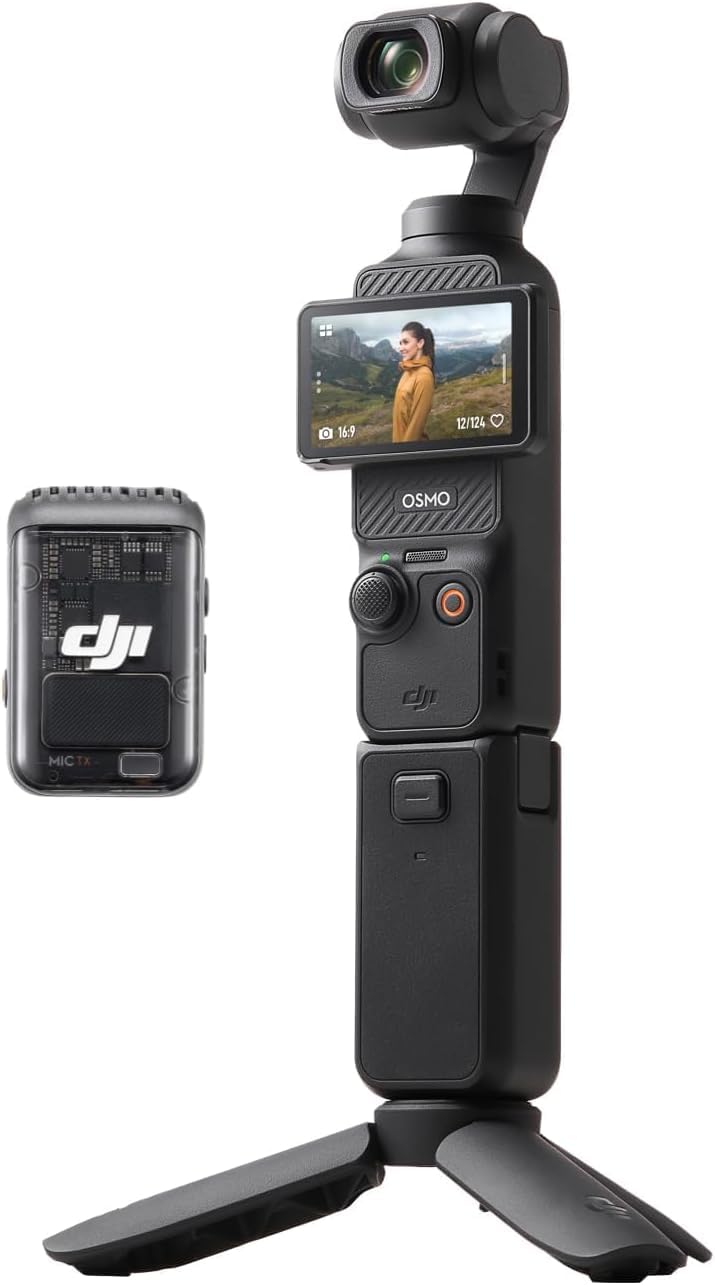
The Osmo Pocket 3 solves the problem of shaky vlog footage with a proper 3-axis mechanical gimbal housed in a body the size of a lipstick tube. The 1-inch CMOS sensor captures 4K video at 120fps, giving you the ability to slow down action sequences in post while maintaining sharpness. The rotatable 2-inch touchscreen allows instant switching between horizontal and vertical framing without rotating the entire camera — a crucial workflow shortcut for creators publishing to both YouTube and TikTok.
ActiveTrack 6.0 locks onto a subject and keeps them centered even during dynamic movement like dancing or fast walking. The included DJI Mic 2 transmitter clips magnetically to your shirt and pairs wirelessly with the camera, eliminating the need for a separate audio recorder or syncing in post. The battery handle extends run time to over two hours and serves as a physical counterweight for smoother panning.
The fixed wide-angle lens means you cannot zoom optically, and the digital zoom degrades image quality noticeably past 2x. Low-light performance is decent for a sensor this size, but it will not match an APS-C or full-frame body in dim interiors. For creators whose primary need is walking vlogs, event coverage, or on-the-go b-roll, this is the most immediately usable camera in this lineup.
Why it’s great
- 3-axis gimbal delivers gimbal-smooth footage without extra gear
- Rotatable screen for instant vertical content switching
- Creator Combo includes DJI Mic 2 for professional wireless audio
Good to know
- Fixed lens with no optical zoom capability
- Digital crop reduces quality at longer focal lengths
- Not weather-sealed for heavy rain or dust exposure
3. DJI Osmo Action 6 Bundle
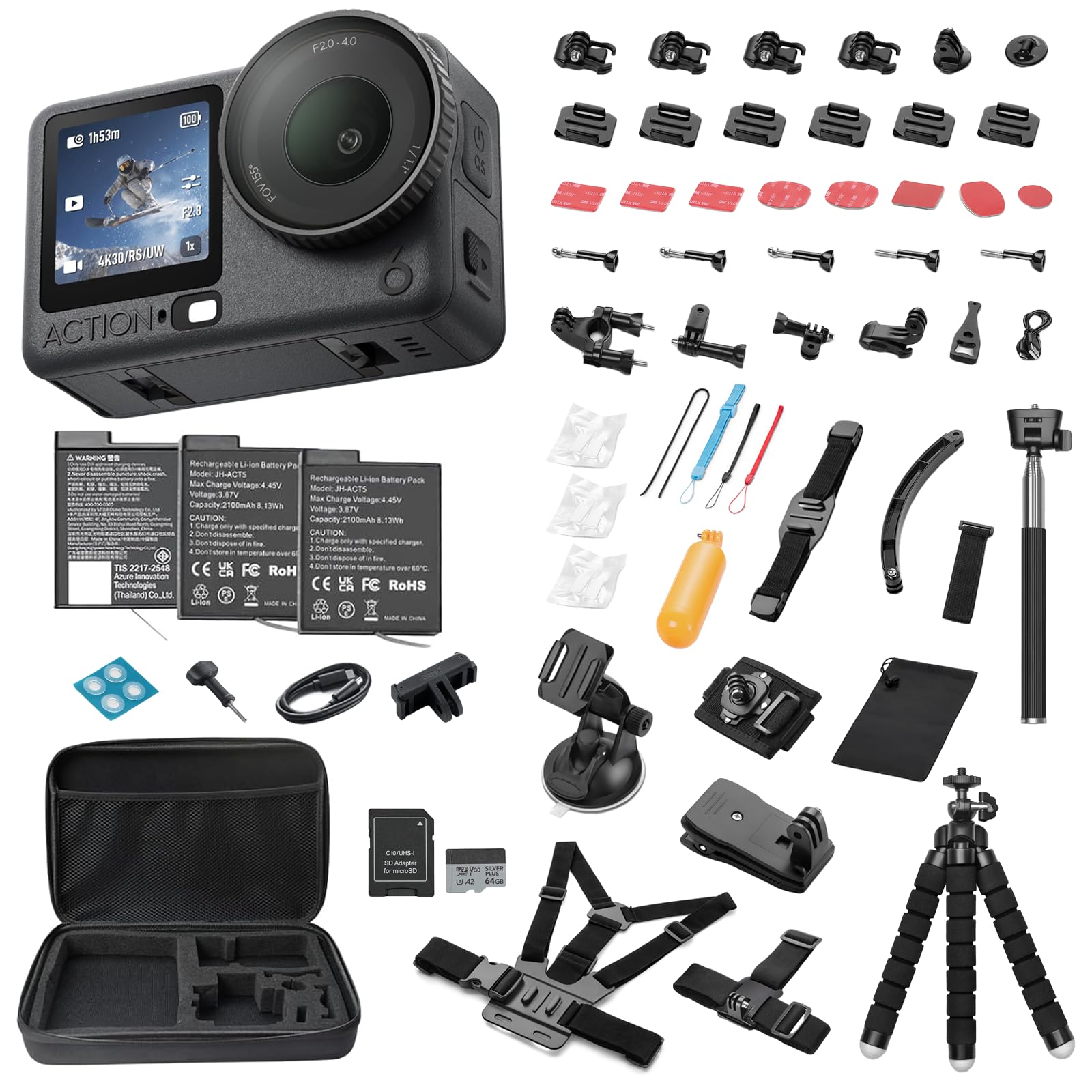
The Osmo Action 6 brings a variable aperture f/2.0 to f/4.0 lens and a 1/1.1-inch square sensor to the action camera space, allowing it to adapt exposure without ND filters. The headline feature is 360° HorizonSteady stabilization, which keeps the horizon perfectly level no matter how much you rotate the camera during a run or ride. This bundle includes three batteries, a 64GB microSD card, and a 58-piece accessory kit that covers helmet mounts, chest straps, and extension arms.
Built-in 50GB of storage provides a buffer when you forget your microSD card, and the wireless cloud upload feature automatically backs up footage when connected to Wi-Fi. The cold-resistant battery design maintains performance down to freezing temperatures, making it reliable for winter sports shoots. The front-facing color screen is large enough to frame yourself for vlogging without guessing.
The variable aperture system forces a trade-off — at f/4.0 the lens loses light fast in overcast conditions, so you need to manage exposure settings manually for consistent results. The image quality in 8K mode is detailed but the file sizes are massive, requiring fast storage and a capable editing computer. For action sports creators who prioritize stabilization and ruggedness over pure resolution, this is the most complete ready-to-shoot package available.
Why it’s great
- 360° HorizonSteady keeps level during spins and rolls
- Three batteries and 58-piece kit included
- Built-in 50GB storage and cloud auto-upload
Good to know
- 8K files demand very fast memory and editing hardware
- Variable aperture can limit low-light performance at f/4.0
- Heavier and bulkier than other action cameras
4. Canon EOS R10 Content Creator Kit
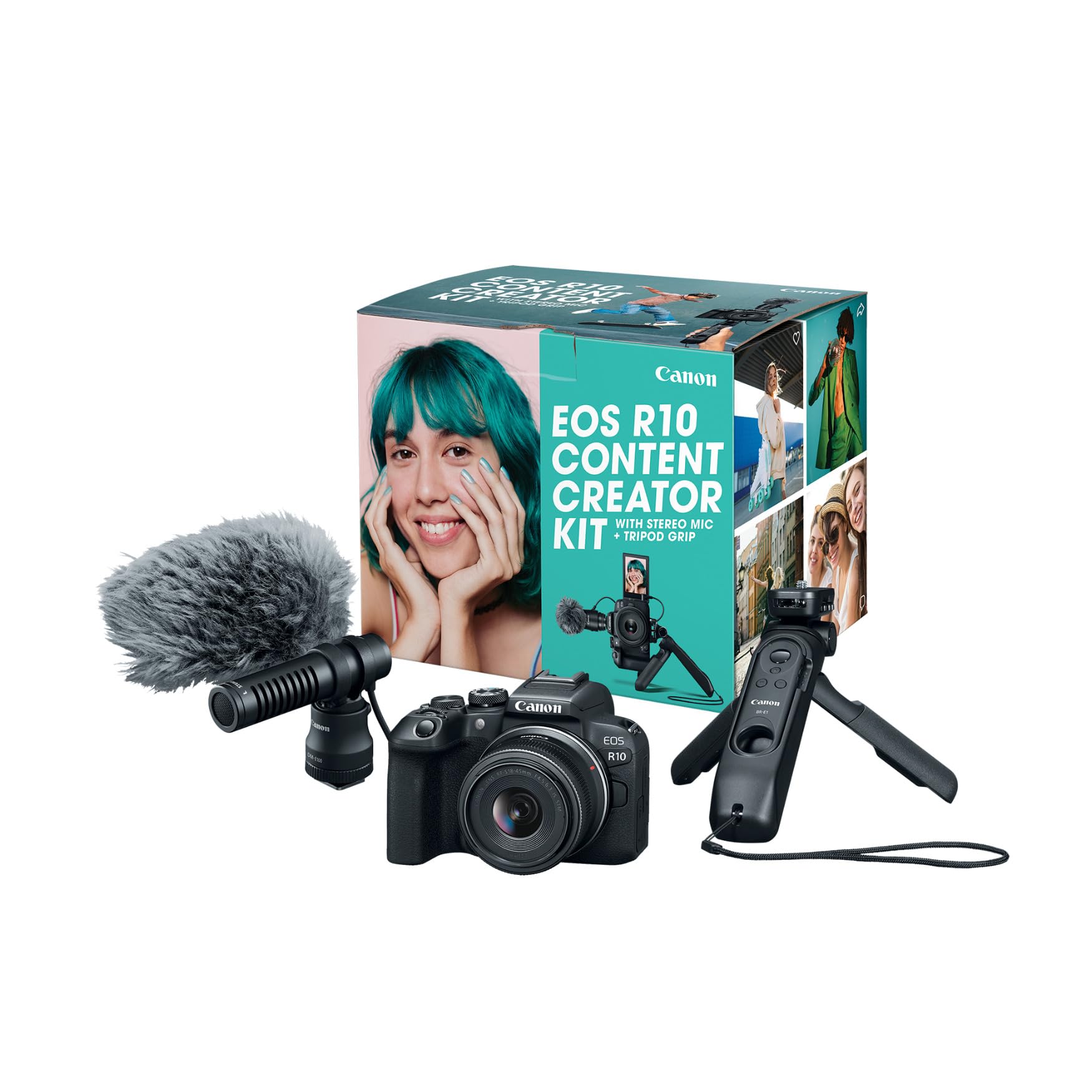
The EOS R10 Content Creator Kit is Canon’s most deliberate attempt to package a mirrorless system for the vlogging market. The 24.2-megapixel APS-C sensor paired with the DIGIC X processor delivers sharp 4K video and excellent stills, all within a body that weighs just over a pound with the kit lens attached. The included stereo microphone mounts to the hot shoe and connects via the multi-function shoe, providing immediate audio improvement over the internal mic without needing batteries or cables.
Autofocus is inherited from the EOS R3, with subject detection that tracks human eyes, animal eyes, and vehicle shapes reliably. The burst rate of 15fps mechanical or 30fps electronic shutter makes it useful for capturing fast action like sports or wildlife. The RF-S 18-45mm lens covers a useful wide-to-portrait range, though it is slow at f/6.3 on the telephoto end. The included tripod grip with wireless remote allows self-recording without a second person to operate the camera.
The kit lens is optically mediocre — expect soft corners and chromatic aberration in high-contrast scenes. You will want to budget for a faster prime lens like the RF 35mm f/1.8 for indoor shooting. The camera lacks in-body stabilization, so handheld footage requires a lens with IS or a tripod. For new creators who want to learn on a real interchangeable-lens system with professional features, this kit provides the most complete starting package.
Why it’s great
- Includes stereo microphone and tripod remote in the box
- Lightweight body with excellent subject-tracking autofocus
- High-speed shooting for action and burst photography
Good to know
- Kit lens is optically soft and slow at the long end
- No in-body stabilization for handheld video
- Battery life is average for mirrorless cameras
5. Sony ZV-1F Content Creator’s Kit

The ZV-1F is Sony’s dedicated vlogging camera designed around the specific needs of talking-head content and product demonstrations. The 1-inch sensor and wide-angle 20mm equivalent lens keep you and your background in focus with minimal distortion. The Product Showcase Setting automatically shifts focus to an object held close to the lens, then snaps back to your face when you lower it — a feature that saves significant editing time for review and unboxing channels.
This Creator’s Kit bundles a 128GB Extreme Pro memory card, a condenser microphone, a U-grip, and a tripod, so you have everything to start shooting immediately without additional purchases. Background Defocus activates with a single touch on the screen, creating a shallow depth-of-field effect that separates the subject from the background. The built-in directional microphone with a supplied windscreen captures usable audio in controlled environments, and the Active Mode stabilization smooths out walking shots to a reasonable degree.
The fixed lens limits your framing options entirely to wide-angle, which means no zoom for distant subjects or intimate close-ups beyond what digital cropping provides. Battery life is rated for about 40 minutes of continuous recording, so you will need to carry a power bank for extended shoots. The ZV-1F is specifically designed for a narrow use case — close-to-camera vlogging with occasional product work — and it excels at that function better than any other camera here.
Why it’s great
- Product Showcase Setting automates focus transitions for reviews
- Kit includes memory card, mic, tripod, and carry case
- Touch-to-defocus button creates instant shallow DOF
Good to know
- Fixed wide lens offers no optical zoom flexibility
- Continuous recording time under 45 minutes per battery
- Not ideal for cinematic or narrative shooting styles
6. Insta360 GO Ultra Creator Bundle
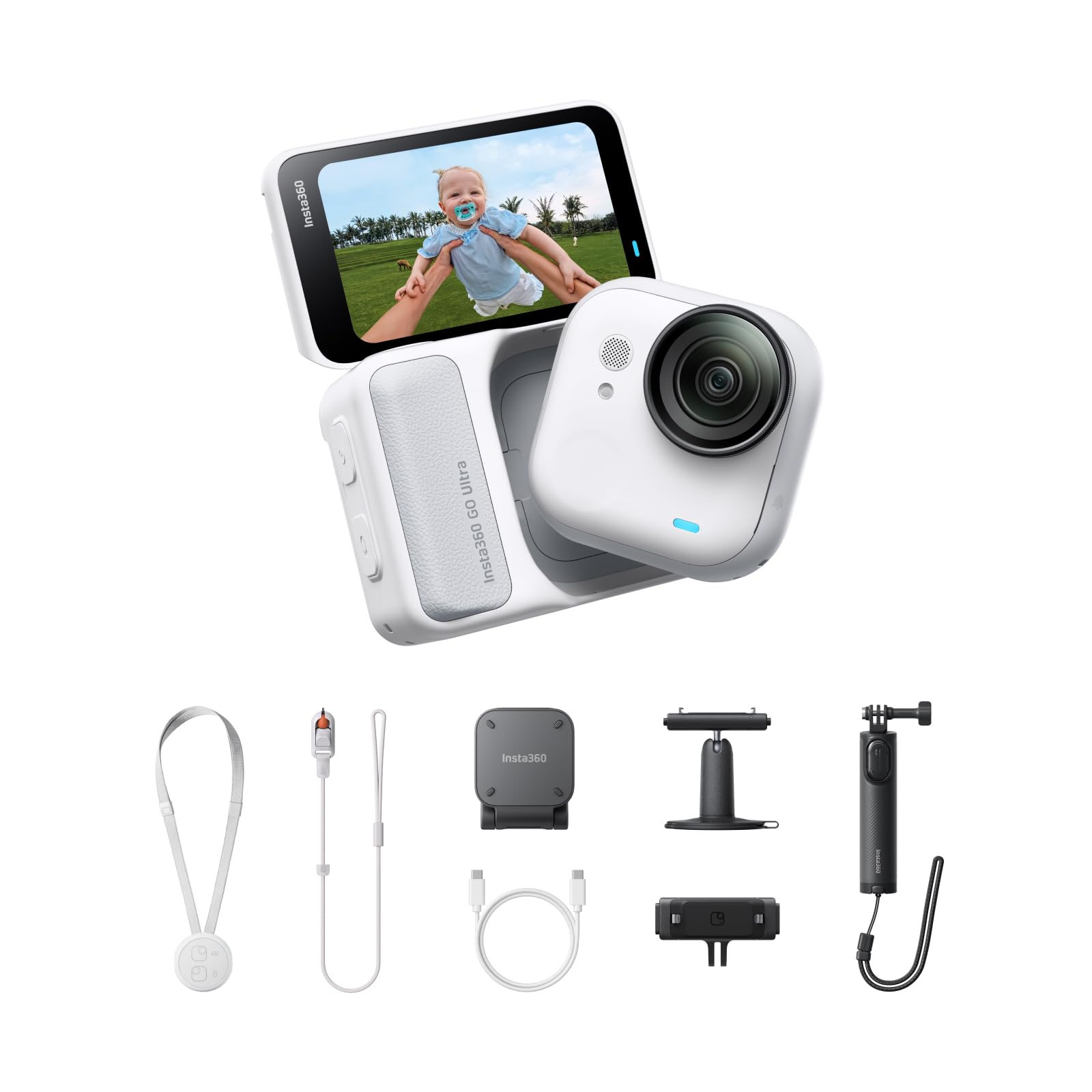
The Insta360 GO Ultra redefines what an action camera can be — a 53-gram body that attaches magnetically to clothing, hats, or any metal surface, delivering a true first-person perspective without a head strap. The 1/1.28-inch sensor and 5nm AI chip produce 4K footage at 60fps with Active HDR, and the three-level FlowState stabilization keeps the horizon locked during aggressive movement. The Action Pod extends total run time to 200 minutes and provides a flip-out screen for framing.
The magnetic mounting system includes a pendant worn around the neck, a clip for caps, and a quick-release safety cord, making it possible to capture angles that no handheld camera can reach. The camera is waterproof to 10 meters without a case, and with the included Dive Case the Action Pod reaches 60 meters. The AI auto-editing feature analyzes your footage and creates highlight reels with transitions and music — a time saver for creators who publish quick social clips rather than long-form narratives.
The 53-gram standalone module does not have a replaceable battery, limiting the main camera to about 70 minutes of continuous recording before needing the Action Pod’s battery. The Action Pod itself is only splashproof, not fully waterproof. For creators who need hands-free POV footage for cycling, running, or cooking tutorials, this camera delivers a perspective that no other device in this guide can replicate.
Why it’s great
- 53g magnetic body enables true hands-free POV capture
- 200 minute total battery life with Action Pod
- AI auto-editing creates shareable clips instantly
Good to know
- Standalone camera battery is non-replaceable
- Action Pod is splashproof but not fully waterproof
- Requires microSD card sold separately
7. Logitech for Creators Mevo Start 3-Pack

The Mevo Start 3-Pack solves one of the most persistent problems for live streamers — how to get multiple camera angles without running 50 feet of HDMI cable. Each unit streams wirelessly in 1080p HD over Wi-Fi, and the Mevo Multicam app controls all three simultaneously. The Auto-Director feature intelligently switches between cameras based on motion and speaker detection, producing a multi-angle broadcast that looks like a professional production without a dedicated video switcher.
Each camera has a built-in battery that lasts roughly 5-6 hours of continuous streaming, and they can run indefinitely when connected to a USB battery pack. A 3.5mm microphone input allows connection to an external lavalier or shotgun mic for improved audio quality. The cameras are small enough to mount on standard tripods, shelves, or gaffer-tape to a wall, making them adaptable to any venue. The NDI-compatible mode allows them to function as webcam sources for OBS Studio or Zoom calls.
Resolution is capped at 1080p, which is adequate for live streaming but noticeably softer than the 4K-and-up cameras in this guide. The fixed-focus lens requires subjects to stay within a narrow distance range, limiting cinematic flexibility. Auto-Director can make unexpected cuts if multiple people speak at the same time. For creators who run a weekly podcast, live-stream church services, or produce multi-camera product launches, this three-camera system delivers a production value far beyond its asking price.
Why it’s great
- Three synchronized cameras for multi-angle live streaming
- Auto-Director switches shots based on audio and movement
- Battery-powered for wireless setup anywhere
Good to know
- Fixed 1080p resolution, no 4K capability
- Requires Vimeo subscription for titling overlay feature
- Fixed focus limits creative depth-of-field control
FAQ
Do I need a gimbal if my camera has in-body stabilization?
Is 8K video necessary for content creation?
What is the most overlooked spec when buying a content creation camera?
Can I use an action camera as my primary vlogging camera?
What microphone should I pair with these cameras?
Final Thoughts: The Verdict
For most users, the best content creator equipment winner is the DJI Osmo Pocket 3 Creator Combo because it packages professional-level stabilization, a large sensor, and a high-quality wireless microphone into a portable kit that works immediately out of the box for both walking vlogs and static interviews. If you want interchangeable lenses and true cinematic color science for narrative or client work, grab the Sony FX30. And for multi-camera live streaming where you need three synchronized angles without a production switcher, nothing beats the Logitech Mevo Start 3-Pack.

Mo Maruf
I created WellFizz to bridge the gap between vague wellness advice and actionable solutions. My mission is simple: to decode the research and give you practical tools you can actually use.
Beyond the data, I am a passionate traveler. I believe that stepping away from the screen to explore new environments is essential for mental clarity and physical vitality.