Our readers keep the lights on and my smoothie glass nicely filled. As an Amazon Associate, I earn from qualifying purchases.
Tomato roots demand oxygen, consistent moisture, and room to sprawl — three conditions a standard clay pot simply cannot deliver. The difference between a bushy plant with a handful of fruits and a towering vine loaded with ripe tomatoes often comes down to the container’s ability to breathe, drain, and hold true to its stated volume.
I’m Mohammad Maruf — the founder and writer behind WellFizz. I’ve spent hundreds of hours cross-referencing fabric weights, stitch patterns, plastic gauge thicknesses, and real-world drainage performance to separate the containers that actually grow tomatoes from the ones that just look the part.
Whether you are planting determinate patio varieties or sprawling heirlooms that need five gallons of root zone per plant, choosing the right vessel changes everything. This guide evaluates the containers for growing tomatoes that hold up to full sun, repeated watering, and the weight of a mature plant without collapsing, cracking, or suffocating roots.
How To Choose The Best Containers For Growing Tomatoes
Tomatoes are heavy feeders with deep root systems, so the container material, size, and drainage setup determine whether your plants thrive or struggle. Matching the container to the tomato variety — determinate vs. indeterminate — is the first decision that dictates everything else.
Fabric Weight and Stitch Density
Fabric pots are measured in grams per square meter (GSM). A 300G bag works well for a single season, especially with tomatoes that have a shorter growing window. A 500G fabric is noticeably thicker, holds its shape longer, and resists UV damage across multiple summers. Reinforced stitching around the handles and side seams prevents blowouts when the soil is fully saturated.
True Capacity vs. Stated Size
Many grow bags and plastic pots overstate their internal volume. A container labeled 5 gallons might hold only 4 gallons of potting mix once filled and settled. For tomatoes, underestimating root space leads to stunted growth and reduced fruit yield. Checking the actual dimensions — diameter and height — gives a more reliable picture than the tag.
Quick Comparison
On smaller screens, swipe sideways to see the full table.
| Model | Category | Best For | Key Spec | Amazon |
|---|---|---|---|---|
| AC Infinity Square Fabric Pots | Premium Fabric | Maximum root aeration & structure | 500G fabric, 5.39 gal, square shape | Amazon |
| JERIA 10-Gallon 12-Pack | Large Fabric | Extra root space for indeterminates | 10 gal, 300G fabric, 12 plant labels | Amazon |
| Gardzen 300G 10-Pack | Mid-Range Fabric | Balanced value & multi-season use | 300G fabric, 5 gal, reinforced handles | Amazon |
| BN-LINK 5-Gallon 10-Pack | Budget Fabric | Starting a large garden on a budget | 300G fabric, 5 gal, serger stitching | Amazon |
| Gro Pro Premium Nursery Pot | Plastic Pot | Traditional rigid container needs | 5 gal, injection-molded plastic, grip lip | Amazon |
In‑Depth Reviews
1. AC Infinity Square Heavy Duty Fabric Pots 5-Pack

The AC Infinity fabric pot uses the thickest nonwoven material in this lineup — 500G — which gives it a rigid, felt-like feel that resists collapsing even when fully saturated. The square shape maximizes surface area for root respiration while fitting neatly on shelves or patios without wasted space between pots. True capacity comes in at 5.39 gallons, slightly larger than the standard 5-gallon rating, so your tomato roots get every cubic inch advertised.
Nylon reinforced handles are double-stitched into the fabric, and the side seams hold up season after season without fraying. The integrated fabric loops let you pass plant stakes or tomato cages directly through the pot wall, which keeps support hardware anchored without puncturing the root zone. Gardeners using these for indeterminate tomatoes report that the air-pruning effect produces a dense white root ball that fills the entire volume by mid-season.
Multiple reviewers noted that these bags feel noticeably more substantial than the 300G alternatives, and several mentioned that the square design makes an organized garden layout much easier. The clean gray color also stays looking presentable longer than black fabric, which fades unevenly in direct sun.
Why it’s great
- 500G fabric lasts multiple seasons without degradation
- Square shape prevents soil from pooling at the bottom
- Stake loops integrate with supports without damaging roots
Good to know
- Higher upfront cost per pot compared to thinner fabric alternatives
- Only available as a 5-pack, not individual units
2. JERIA 12-Pack 10 Gallon Grow Bags

The JERIA grow bags offer double the volume of a standard 5-gallon container at a price per pot that undercuts most premium options. At 10 gallons each, these are ideal for indeterminate tomato varieties that need deep, uninterrupted root runs to produce heavy fruit sets across a long season. The 300G nonwoven fabric is thick enough to hold its shape when filled and provides consistent drainage without waterlogging.
Built-in handles are reinforced with X-stitching and remained intact after two growing seasons of regular moving, according to multiple verified buyers. The 12-pack includes plant labels, which is a small but useful addition for gardeners managing several different tomato cultivars side by side. The bags measure 16 inches in diameter and 12 inches in height, giving each plant a wide footprint that reduces root circling.
Reviewers consistently praised the fabric’s durability against UV exposure and noted that the bags drained quickly even during heavy rain events. Several users who grew squash and zucchini in these pots said the extra soil capacity made a noticeable difference in plant vigor compared to 5-gallon containers. The polyester felt material is also washable and folds flat for winter storage.
Why it’s great
- 10-gallon capacity supports deep-rooted indeterminate tomatoes
- Reinforced stitching held up across two full seasons
- Includes 12 plant labels for organized garden management
Good to know
- 300G fabric is less rigid than premium 500G alternatives
- Large size can be heavy to move when fully saturated with soil
3. Gardzen 10-Pack 5 Gallon Grow Bags

Gardzen’s 5-gallon bags use a 300G thickened nonwoven fabric that strikes a solid balance between breathability and structural integrity. The material is BPA-free, which matters for food crops like tomatoes where chemical leaching is a real concern. Each bag measures 12.8 inches in diameter and 10 inches tall, providing enough soil volume for determinate tomato varieties and compact patio types.
The handles are reinforced with X-shaped cross-stitching rather than simple straight lines, which distributes the load of wet soil across a wider area and prevents the fabric from tearing at the attachment points. Air pruning is effective here — the fabric allows fine root hairs to die back at the wall surface, forcing the plant to branch and form a denser root system. This translates to more efficient nutrient uptake and better fruit production per plant.
Customers who used these bags for potatoes and radishes reported that the drainage prevented rot even during extended rainy periods. The fabric is washable and folds flat, making off-season storage simple. A handful of reviewers noted that the 5-gallon size runs slightly smaller than other brands’ 5-gallon bags, so measure your soil volume if exact capacity is critical for your tomato variety.
Why it’s great
- X-stitched handles resist tearing under full soil weight
- BPA-free fabric suitable for organic vegetable growing
- Excellent airflow prevents root rot in humid conditions
Good to know
- Actual capacity is closer to 4.5 gallons than 5
- 300G fabric may show wear after multiple seasons in full sun
4. BN-LINK 10-Pack 5 Gallon Grow Bags
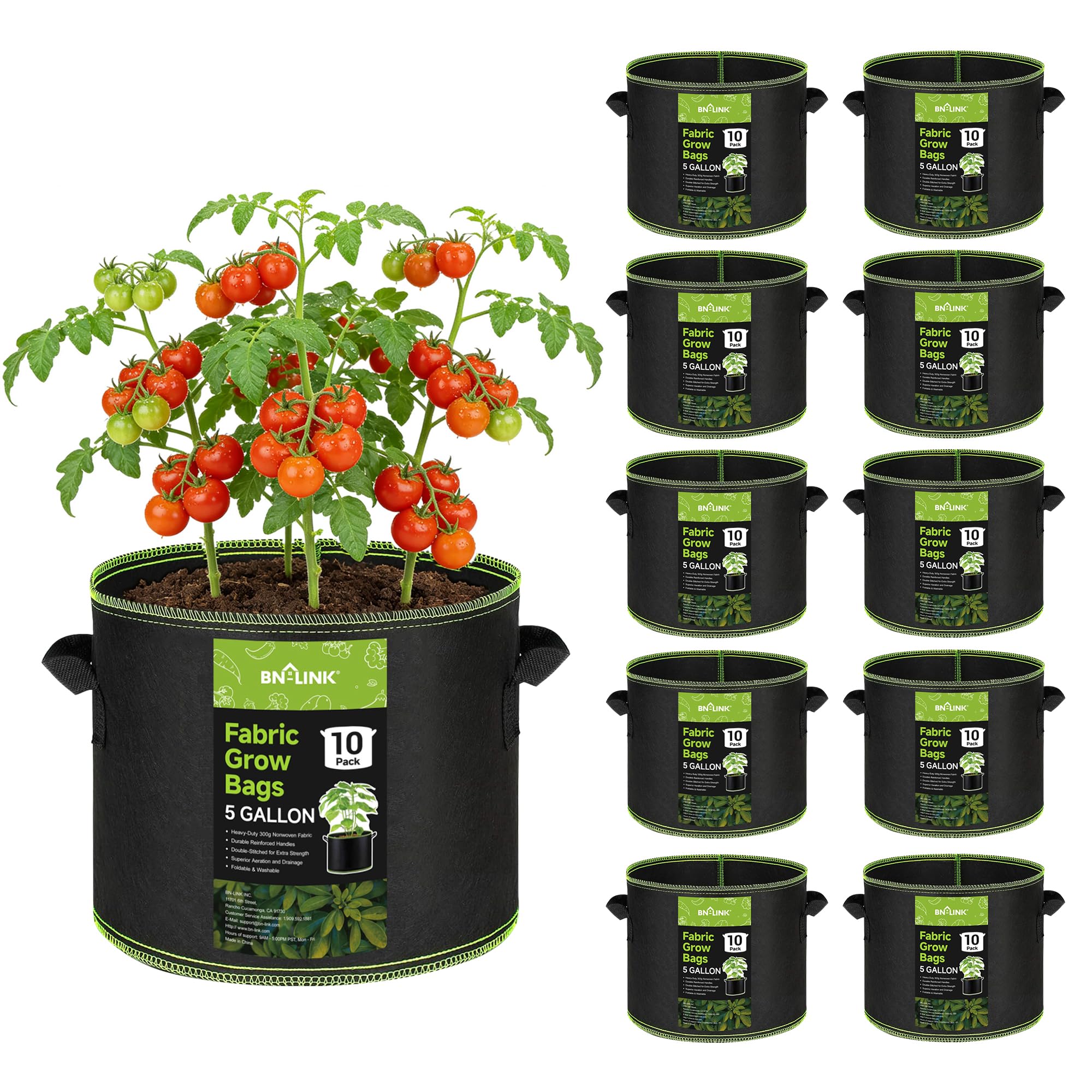
The BN-LINK grow bags provide the lowest per-unit cost in this roundup without cutting corners on fabric thickness. The 300G nonwoven material is comparable to the Gardzen bags and offers the same BPA-free, breathable construction that supports healthy tomato root development. The serger stitching around the edges and handles is tidy and consistent, and early reviews indicate that the bags hold up through at least one full growing season without seam failure.
These bags are best suited for gardeners who need high volume — the 10-pack lets you start a substantial tomato patch immediately. The fabric allows excess water to drain freely while retaining enough moisture between waterings, which reduces the frequency of irrigation on hot days. Handles are securely attached and held up during transport of fully loaded pots in multiple user reports.
Several buyers noted that the bags hold approximately 4 gallons of soil rather than the stated 5, so if you need exact capacity, plan to size up or adjust your planting density. The lightweight construction makes them easy to move around the patio or balcony, and the bags fold down to virtually no storage space in the off-season. A second-season user confirmed that the fabric showed no signs of disintegration after a year of outdoor exposure.
Why it’s great
- Excellent per-unit price for large-scale plantings
- Serger stitching provides reliable seam strength
- Foldable design stores flat between seasons
Good to know
- Actual capacity runs closer to 4 gallons than 5
- Not as rigid as premium fabric options
5. Gro Pro Premium Nursery Pot 5 Gallon

The Gro Pro nursery pot represents the rigid plastic container option for gardeners who prefer a traditional raised pot over fabric. It is injection-molded from thick, heavy-duty plastic that resists cracking under the weight of wet soil and a mature tomato plant. The 5-gallon capacity is genuine — it holds a full 1.5 cubic feet of potting mix without the volume compression that happens in fabric bags.
The grip lip around the top rim is a practical feature that makes lifting and carrying easier compared to pots with thin edges that dig into your fingers. Drainage holes are adequately sized and spaced to prevent water from pooling at the bottom, though the hard plastic surface does not provide the same air-pruning benefit that fabric offers. This pot is best for determinate tomato varieties or for gardeners who want to reuse the same containers year after year without worrying about UV degradation of fabric.
Some buyers mentioned that the pots arrived taped together with labels that are difficult to remove, leaving a sticky residue. The matte finish hides scuffs well, and the overall build quality justifies the investment if you prefer rigid containers. One reviewer warned that the pots can crack in transit if shipped in cold weather, so inspect them upon arrival.
Why it’s great
- True 5-gallon capacity without underfilling
- Grip lip makes moving heavy pots much easier
- Injection-molded plastic lasts many seasons without breakdown
Good to know
- No air-pruning benefit; roots can circle the interior
- Labels are difficult to remove and leave residue
FAQ
What size container do I need for a single tomato plant?
Should I use fabric pots or plastic nursery pots for tomatoes?
How many tomato plants can I put in a 10-gallon grow bag?
Final Thoughts: The Verdict
For most users, the containers for growing tomatoes winner is the AC Infinity Square Fabric Pots because the 500G fabric, true-to-size capacity, and integrated stake loops offer the best long-term structure and root health. If you want extra root space for indeterminate varieties, grab the JERIA 10-Gallon 12-Pack. And for a budget-friendly entry point that still provides good airflow and drainage, nothing beats the BN-LINK 10-Pack.

Mo Maruf
I created WellFizz to bridge the gap between vague wellness advice and actionable solutions. My mission is simple: to decode the research and give you practical tools you can actually use.
Beyond the data, I am a passionate traveler. I believe that stepping away from the screen to explore new environments is essential for mental clarity and physical vitality.