Our readers keep the lights on and my smoothie glass nicely filled. As an Amazon Associate, I earn from qualifying purchases.
A tool belt that digs into your hip, sags under the weight of a framing nailer, or forces you to fish for a tape measure in a collapsed pocket will cost you minutes of every hour and years off your lower back. The right construction tool belt turns your waist into a mobile workbench—each pouch springing open, every hammer loop grabbing securely, and the whole assembly staying planted through a full day of bending, climbing, and reaching.
I’m Mohammad Maruf — the founder and writer behind WellFizz. I’ve spent hundreds of hours analyzing leather grain weights, denier ratings, rivet patterns, and belt-tunnel dimensions so I can separate the rigs that hold up for a decade from the ones that unravel in a season.
This guide compares five rigs that actually earn their keep on real job sites. Whether you’re roofing in the rain, pulling wire in a crawlspace, or framing a subdivision, the right construction tool belt saves your body and your time.
How To Choose The Best Construction Tool Belt
The wrong tool belt turns every walk across a job site into a frustrating hunt. A good one makes every tool predictable. Here are the three specs that separate the winners from the wall hooks.
Leather Weight and Grain
Reversed top-grain leather (4-5 oz weight) resists punctures from nail heads and screw tips far better than corrected-grain or bonded split leather. Thicker leather holds its shape without steel stiffeners, which means the pockets stay open when you reach for a tool one-handed. If you work in wet concrete or heavy rain, look for oil-tanned leather that sheds moisture rather than wicking it into the fibers.
Pocket Architecture
Double-gusset pockets—fabric folded and stitched with a pleat on each side—create an opening that remains wide whether empty or full. Flat-pocket pouches collapse, forcing you to use two hands to retrieve a marking knife or a nail set. For electrical work, look for dedicated slots for screwdrivers and pliers; for framing, prioritize large-volume multi-tool pouches with separate chisel sleeves.
Load Support and Belt Width
A belt wider than 4 inches distributes the weight of a loaded rig across more of your hip and lower back. The tunnel should accommodate your existing belt width (2.25 to 2.75 inches is the standard window). For full-day wear or heavy loads, padded suspenders with metal carabiners shift the load to your shoulders, dramatically reducing lower-back fatigue.
Quick Comparison
On smaller screens, swipe sideways to see the full table.
| Model | Category | Best For | Key Spec | Amazon |
|---|---|---|---|---|
| DEWALT DWST540602 | Premium Fabric Rig | All-day comfort with heavy loads | 25 pockets, 1680 denier fabric | Amazon |
| Milwaukee 48-22-8120 | Premium Fabric Rig | Full-day wear, 53-inch waist fit | 24 pockets, padded belt | Amazon |
| LAUTUS Oil Tanned Leather | Full Leather Belt | Wet/outdoor work, concrete, roofing | 11 pockets, 28-46 fit, oil-tanned | Amazon |
| CLC Custom Leathercraft 179354 | Leather Pouch | Secondary bag or electrician, 10 pockets | 10 pockets, reversed top-grain | Amazon |
| Klein Tools 5125 | Canvas/Leather Pouch | Residential electrical, minimal carry | 5 pockets, canvas with leather | Amazon |
In‑Depth Reviews
1. DEWALT Professional Tool Belt Organizer With Suspenders and 25 Pockets (DWST540602)

The DEWALT rig uses 1680 denier fabric with a dirt-repellant tarpaulin layer and double stitching at every stress point—the same material grade used in heavy-duty tool bags that survive years on concrete floors. The 5.5-inch padded belt with a double-tongue roller buckle distributes the weight of a loaded framing kit across your entire hip, and the padded suspenders with metal carabiners shift a significant portion of that load to your shoulders.
The 25 pockets include wide-open structured pouches that stay upright even when empty, plus a yellow internal fabric that makes it easy to spot a bit driver or a nail set against dark backgrounds. Two hammer loops (one front, one back) and independent movable components let you customize the layout without buying separate pouches. The two sturdy carry handles make it easy to grab and go between the truck and the job site.
Outdoor framing or unfinished houses are this rig’s natural habitat—its size is a liability in tight attics or finished basements where every bulge scrapes a wall. The initial setup requires patience to position the pouches correctly, but after that adjustment, the system stays put through a full workday of bending and climbing.
Why it’s great
- Padded 5.5-inch belt and suspenders provide superior all-day comfort for heavy loads
- 25 wide-open structured pockets stay accessible without collapsing
- High-visibility yellow interior makes tool retrieval faster in low light
Good to know
- Bulky for tight spaces like attics or basements—best for open-framing jobs
- Initial setup is time-consuming with movable components needing adjustment
- 1680 denier fabric, while tough, is not as puncture-resistant as heavy leather
2. Milwaukee 48-22-8120 Contractor Work Belt with Suspension Rig
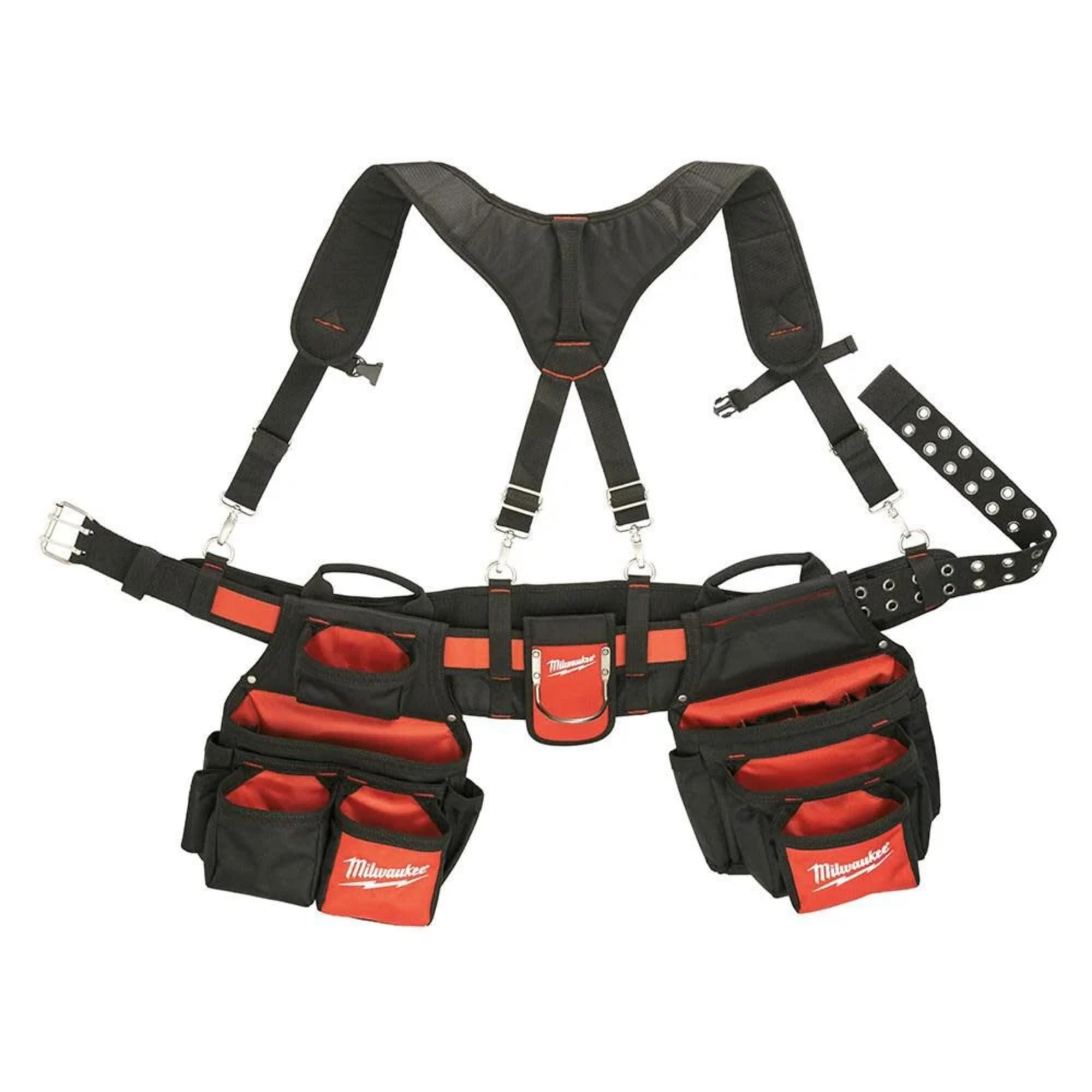
Milwaukee’s rig earned its reputation the hard way: users report pouches lasting six years of daily commercial use with only a single belt replacement needed over that span. The padded belt adjusts from a 30-inch to a massive 53-inch waist, making it one of the few premium rigs that accommodates both slim framers and bulkier winter-layered electricians.
The 24 pockets are laid out across modular pouches that attach via heavy-duty hook-and-loop strips. The system includes a padded suspension rig with carabiners, which effectively transfers load off the lower back and onto the shoulders—critical for an eight-hour day carrying six pounds of tools. The pouches are made from a durable blend that balances weight against tear resistance, keeping the total rig lighter than a comparably-sized leather setup.
A notable complaint centers on the Velcro attachment: when the pouches are fully loaded with heavy tools, they can drift or detach if the hook-and-loop interface wears down. Replacing the belt itself is straightforward and relatively inexpensive. Some users also wish the hammer loop was side-mounted rather than positioned on the back, where it interferes with leaning back against a wall or ladder.
Why it’s great
- Proven six-year lifespan under daily commercial use with modular repairability
- Adjustable from 30 to 53 inches, fitting nearly any body type with layered clothing
- Padded suspension system relieves lower back strain significantly
Good to know
- Hook-and-loop pouch attachment can loosen over time under heavy loads
- Hammer loop is positioned on the back, not the side, limiting leaning comfort
- Replacement belt sold separately adds long-term cost
3. LAUTUS Oil Tanned Leather Tool Belt

The LAUTUS belt uses oil-tanned full-grain leather that actively repels moisture rather than absorbing it—a critical advantage for roofers who work in rain, concrete finishers who kneel in slurry, or anyone who sets their belt down on wet subfloors. The leather is noticeably thick and stiff out of the box, requiring a break-in period of several days before the pouches shape themselves to your tools.
Eleven pockets cover the essentials: large multi-tool pouches, a dedicated tape measure slot, smaller pockets for nail sets and pencils, and a hammer loop. The belt accommodates waist sizes from 28 to 46 inches, with a sturdy buckle that holds position even when the pouches are loaded with a full framing kit. Users who have worn this belt through a season of roofing report that the leather has held its shape without tearing or stretching out at the rivet points.
The main drawback is the rivet finishing: several buyers received belts with sharp rivet edges that can snag jeans or scratch surfaces. A quick pass with a file or a hammer tap resolves the issue, but it’s an extra step that shouldn’t be necessary. The belt also runs about a size small—if you’re between sizes, sizing up ensures a comfortable fit over tool pouches or winter layers.
Why it’s great
- Oil-tanned full-grain leather excels in wet environments—roofing, concrete, rain
- Thick leather holds its shape without stiffeners after break-in
- Affordable for a genuine heavy-duty leather rig with 11 pockets
Good to know
- Rivets may arrive with sharp edges that need manual dressing
- Stiff leather requires a break-in period of several days
- Sizing runs slightly small—order up one size if between measurements
4. CLC Custom Leathercraft 179354 Carpenter’s Nail and Tool Bag
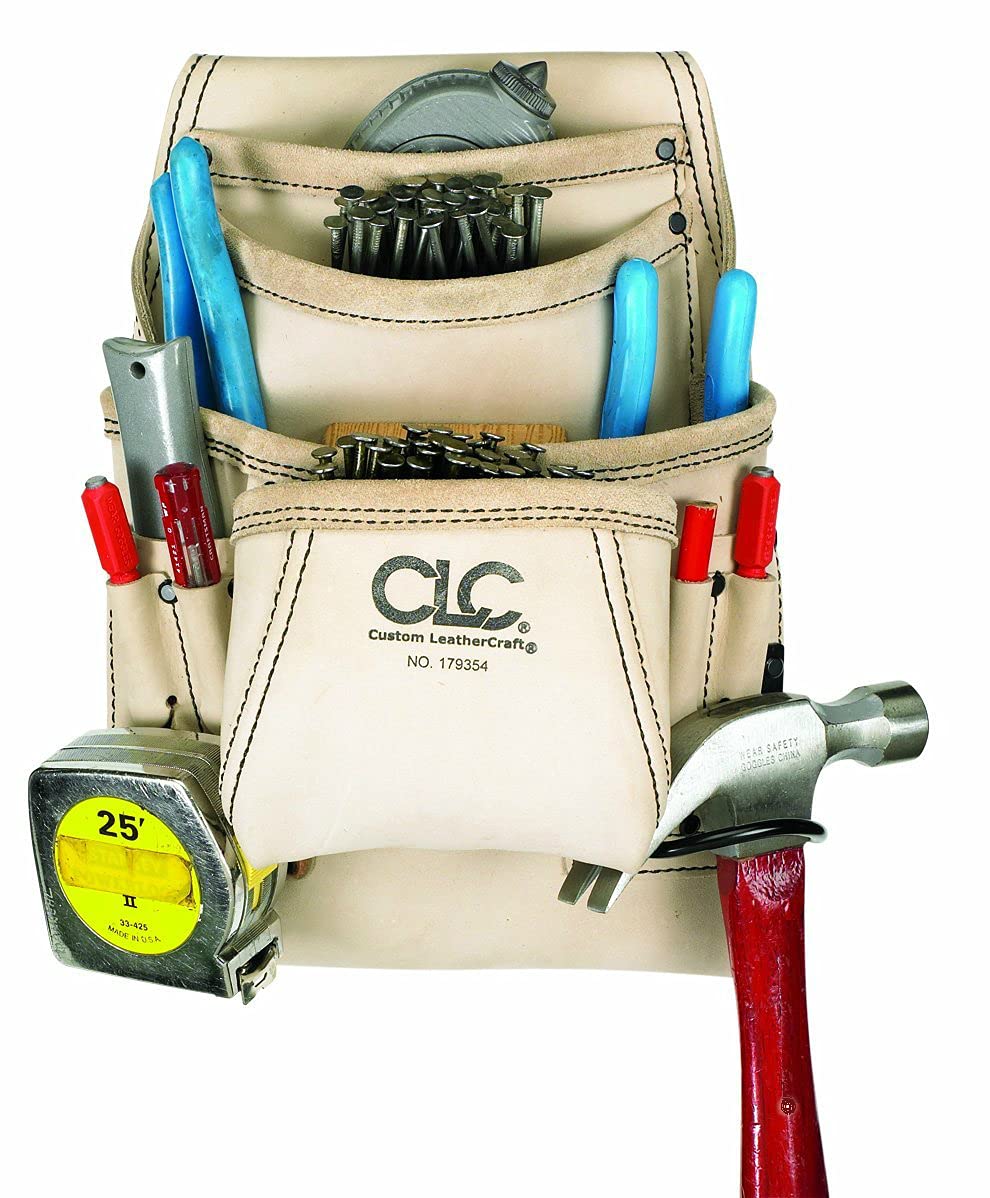
The CLC pouch uses reversed top-grain leather—the outside is the flesh side, which is less prone to scuffing and shows wear more slowly than traditional smooth-grain leather. Double gussets on the front pockets keep them springing open wide for one-handed retrieval, a feature that matters when you’re balancing on a ladder with the other hand occupied. The steel hammer loop and metal tape measure clip are riveted through the leather, not just stitched, which eliminates the failure point that kills most pouches within a year.
With 10 pockets, this pouch works best as a secondary bag for electricians carrying material, or as a primary pouch for carpenters who prefer to keep their load light. The two main pockets are large enough for a speed square and a chalk line, while the six smaller pockets sort nail sets, pencils, and pliers without losing anything. It fits belts up to 2.75 inches wide, which covers most standard tool belts.
Quality control varies between units: some buyers received pouches with misplaced rivets or a thin spot in the leather from an erroneous cut. The leather is thick and stiff—good for longevity, but the bag won’t feel broken in for several weeks. Users who got a defect-free unit report five years of daily 8-10 hour wear with no torn pockets or failed stitching, making this a strong value if you inspect the unit on arrival.
Why it’s great
- Double-gusset pockets stay open for one-handed tool retrieval on ladders
- Reversed top-grain leather resists scuffing better than smooth-grain alternatives
- Riveted steel hammer loop and tape clip eliminate common early failure points
Good to know
- Quality control on rivet placement and leather thickness is inconsistent
- Stiff leather takes weeks to fully break in
- Not a full rig—pouch only, requires a separate belt
5. Klein Tools 5125 Canvas and Leather 5-Pocket Tool Pouch

The Klein 5125 combines rugged #4 canvas with a leather back and belt tunnel, creating a pouch that is lighter than a full-leather bag but just as durable in daily electrical work. Two large canvas pockets hold linesman pliers and a bundle of screwdrivers, while three smaller leather pockets organize strippers, a voltage tester, and a folding knife. The chain tape thong keeps a measuring tape tethered to the pouch.
Electricians consistently report this pouch lasting over a decade of residential and light commercial use—the canvas eventually develops a hole from a screwdriver tip, but the leather back and riveted construction hold the structure together. The belt tunnel fits a 2.25-inch belt, which is standard for most electrician’s tool belts. The pouch is deliberately compact; it does not bulge or scrape against walls in tight panel boxes or crawlspaces.
The limited capacity is the main trade-off. This pouch is designed for a minimal carry—four screwdrivers, pliers, strippers, and a tester—not for a full framing kit or a multi-trade loadout. If you carry more than six tools, this bag will feel cramped, and overpacking the small leather pockets can cause the canvas to tear at the seam within months. It is a specialist tool for electricians who know exactly what they need on their waist.
Why it’s great
- Proven 10+ year lifespan in residential and light commercial electrical work
- Lightweight canvas/leather hybrid avoids the hip-digging weight of full-leather pouches
- Compact profile stays out of the way in crawlspaces, attics, and panel boxes
Good to know
- Only 5 pockets—inadequate for framers or anyone carrying more than a basic electrical kit
- Canvas can tear at small pocket seams if overloaded with bits or heavy hardware
- Fits belts up to 2.25 inches only—not compatible with wider framing belts
FAQ
What is the standard belt width for a construction tool belt?
Can I use a leather tool belt in wet conditions?
How many pockets do I actually need?
Are suspenders necessary for a tool belt?
Final Thoughts: The Verdict
For most users, the construction tool belt winner is the DEWALT DWST540602 because the combination of 1680 denier fabric, padded suspenders, and 25 structured pockets delivers all-day comfort and organization without the break-in period of leather. If you work in the rain or on concrete and want leather that lasts, grab the LAUTUS Oil Tanned Leather belt. And for a compact, decade-proven electrician’s pouch, nothing beats the Klein Tools 5125.

Mo Maruf
I created WellFizz to bridge the gap between vague wellness advice and actionable solutions. My mission is simple: to decode the research and give you practical tools you can actually use.
Beyond the data, I am a passionate traveler. I believe that stepping away from the screen to explore new environments is essential for mental clarity and physical vitality.