Our readers keep the lights on and my smoothie glass nicely filled. As an Amazon Associate, I earn from qualifying purchases.
Protecting your hearing on a construction site isn’t just about wearing something over your ears—it’s about choosing a seal that actually holds against the constant assault of saws, compactors, and hammer drills. A poor fit doesn’t just mean discomfort; it means dangerous gaps that let damaging noise through, making the earmuffs essentially useless. The difference between a good and bad day on the job often comes down to the clamping force, the cushion density, and the overall attenuation rating of the gear strapped to your head.
I’m Mohammad Maruf — the founder and writer behind WellFizz. My analysis digs into the measurable sound reduction data, real-user fit reports, and material durability specs to separate the gear that genuinely works from the gear that just looks the part.
After evaluating dozens of units based on real-world seal integrity and attenuation claims, I’ve narrowed the field to the most effective options for heavy-duty noise environments. This guide covers the best construction earmuffs for protecting your hearing without compromising on all-day comfort or job-site practicality.
How To Choose The Best Construction Earmuffs
Selecting the right hearing protection for construction work requires balancing the level of noise reduction with the need for comfort during long shifts and compatibility with other safety gear like hard hats. The most expensive pair won’t help if it doesn’t stay sealed on your head all day.
Attenuation Ratings (NRR vs SNR)
The Noise Reduction Rating (NRR) is the US standard, while the Single Number Rating (SNR) is used internationally. A higher number indicates more potential sound reduction, but real-world performance is always lower. For construction environments with impact tools and heavy machinery, look for models with an NRR of at least 24 dB or an SNR of 30 dB or higher for passive muffs.
Comfort and Clamping Force
Earmuffs that clamp too tightly cause headaches and ear fatigue after a few hours, leading workers to remove them in noisy zones. Conversely, a loose seal lets in damaging noise. The ideal headband applies consistent, moderate pressure with thick, well-cushioned ear pads. The overall weight of the unit, often between 7 and 14 ounces, also heavily influences long-term wearability.
Hard Hat Compatibility
If your job site requires a hard hat, standard over-the-head earmuffs will be awkward or impossible to wear. Look for cap-mounted models that attach directly to the hard hat’s side slots, allowing the ear cups to be rotated up and out of the way when not in use. Low-profile ear cups are also a major advantage in tight spaces.
Quick Comparison
On smaller screens, swipe sideways to see the full table.
| Model | Category | Best For | Key Spec | Amazon |
|---|---|---|---|---|
| ProCase Extra Large SNR 37dB | Over-the-Head | Maximum passive noise reduction | SNR 37dB / NRR 30dB | Amazon |
| ClearArmor 31.5 dB SNR | Over-the-Head | Lightweight compact travel | 31.5 dB SNR / 9.5 oz | Amazon |
| 3M PELTOR X2P3E | Hard Hat Mount | Universal hard hat attachment | NRR 24 dB / Cap-Mount | Amazon |
| PROHEAR Electronic | Electronic | Communication in loud zones | NRR 23 dB / 0.6 lbs | Amazon |
| Dewalt DPG62-C | Over-the-Head | Versatile budget protection | Sturdy Build / Yellow Shell | Amazon |
In‑Depth Reviews
1. ProCase Extra Large SNR 37dB

The ProCase sets a new passive ceiling with an SNR rating of 37 dB and an NRR of 30 dB, making it the highest-rated unit in this roundup for raw sound blocking. The extra-large design is not marketing fluff—the headband extends significantly to accommodate larger head shapes and even fits comfortably over a baseball cap, a major advantage for outdoor site work.
User feedback consistently highlights the thick, imitation leather ear cushions as a key differentiator. They create a dense, airtight seal that effectively eliminates the low-frequency hum of heavy equipment like table saws and lawn mowers, while the soft foam pads reduce the pressure that typically causes fatigue during extended use. The build quality feels robust for the price tier.
The trade-off is size: these earmuffs are notably wide and don’t fold down as compactly as some alternatives. They also don’t stop high-pitched ring noises as effectively as lower-frequency sounds, though this is a characteristic of most passive muffs. For sheer decibel reduction without spending premium money, this is a powerhouse.
Why it’s great
- Highest SNR 37dB rating in this group for maximum passive protection
- Extra-large fit with padded cushions for all-day comfort
- Excellent low-frequency noise cancellation
Good to know
- Bulky ear cups may interfere with tight spaces or rifle cheek weld
- Does not fold as compactly as some competitors
2. ClearArmor 31.5 dB SNR

The ClearArmor model strikes a smart balance by delivering an effective SNR of 31.5 dB (often measured by users as closer to 34 dB in real-world conditions) while staying remarkably lightweight at just 9.5 ounces. The compact folding mechanism is a highlight here, collapsing into a small enough footprint to toss in a tool bag or backpack without hassle.
Real-world testing against high-decibel equipment like a Vita-Mix blender or a miter saw shows it holds its seal effectively, outperforming some competitors with higher printed ratings simply because the ear cushions conform and seal better against the side of the head. The headband is adjustable but runs slightly snug for larger heads—some users with hat sizes over 7 5/8 found it uncomfortable for all-day wear.
Where this pair shines is short-term, high-intensity noise. For tasks like cutting tile, running a jackhammer, or shooting at a range, the seal is tight and the noise floor drops noticeably. It’s an excellent value pick that punches above its weight class in real-world attenuation, as long as your head shape fits the comfort profile.
Why it’s great
- Real-world noise reduction often exceeds its rated specs
- Lightweight 9.5 oz build with easy folding storage
- Good seal integrity for intermittent loud noise
Good to know
- Snug fit may be uncomfortable for larger head sizes during long shifts
- Ear cups are bulky and can interfere with precision shooting posture
3. 3M PELTOR X2P3E

When your job site mandates a hard hat, the 3M PELTOR X2P3E is the definitive solution. It uses a universal mounting attachment that clicks securely into the side slots of most standard hard hats, including popular models from brands like Petzl. This keeps the earmuffs out of your way when you don’t need them—just pivot them up—and locked over your ears when noise ramps up.
With an NRR of 24 dB, it’s designed for low-to-moderate level industrial noise rather than extreme blast environments. Users report it effectively tames the roar of chainsaws, chippers, and diesel engines while still allowing for normal conversation, a safety plus on active sites. The stainless steel band resists bending and provides consistent pressure over time, which prevents the seal from degrading as the material ages.
Build quality is robust, but the plastic ear cup attachment points can snap if the muffs are handled roughly or dropped repeatedly. The cushions and foam liners are replaceable via the HYX2 hygiene kit, extending the unit’s life significantly. For anyone who wears a hard hat all day, this is the most practical and job-site-friendly choice.
Why it’s great
- Universal hard hat mount fits most helmet slots securely
- Folds up when not in use to save space on the helmet
- Durable stainless steel headband resists warping
Good to know
- Plastic attachment points can break under rough handling
- NRR 24 dB is suited for moderate noise, not extreme impact
4. PROHEAR Electronic NRR 23dB
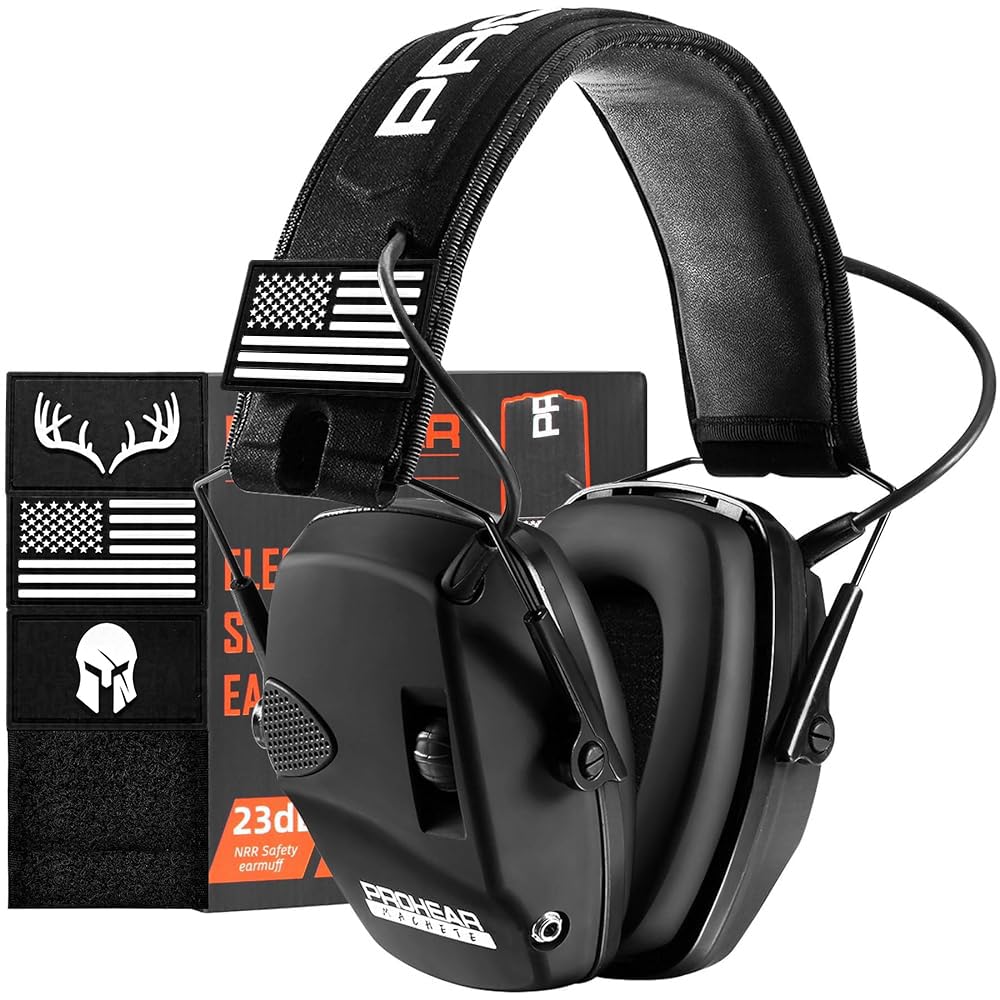
For construction environments where communication is critical—like coordinating with a spotter on a crane or giving instructions to a ground crew—the PROHEAR electronic earmuffs bring a major advantage. The active circuitry amplifies low-level ambient sounds like speech up to four times while suppressing harmful impulse noise over 140 dB within 0.01 seconds.
Weighing just 0.6 pounds, this is one of the lightest fully-featured electronic muffs on the market, significantly reducing neck fatigue during a full day on the site. The slim, low-profile ear cups allow for better clearance when working in tight spaces alongside hard hats. The IPX4 water and dust resistance is a practical benefit for outdoor construction work in all conditions.
The NRR of 23 dB is lower than the passive muffs on this list, making it a better fit for moderate to high noise rather than extreme continuous impact. Some users report a faint high-pitched tone from the electronics in very quiet moments, which is not harmful but can be slightly irritating. The auxiliary audio port is a useful bonus for adding a radio or phone connection for music or calls.
Why it’s great
- Amplifies speech for clear communication in noisy environments
- Ultra-lightweight 0.6 lb design for all-day comfort
- IPX4 weather-resistant build for outdoor sites
Good to know
- NRR 23 dB is lower than passive alternatives for extreme noise
- Occasional faint electronic hum reported by some users
5. Dewalt DPG62-C Interceptor

The Dewalt DPG62-C is a well-rounded passive earmuff that covers all the basics without gimmicks. It features a notably adjustable headband that works well for smaller head sizes and women, solving a fit issue that many standard earmuffs overlook. The bright yellow color adds a secondary safety element by increasing worker visibility on site.
Sound reduction is solid for general construction tasks like mowing, using a backpack blower, or operating power tools. The ear cushions are comfortable for extended wear, though some users with larger heads found the clamping force increased over time, leading to soreness around the ears. The build quality is typical Dewalt—sturdy but not overbuilt, with a headband that slides down for compact storage.
It lacks the extreme attenuation of the higher-rated muffs, making it best suited for environments where noise is consistent but not punishing. The simple construction and reliable fit make it a solid entry-level or backup pair to keep in the truck. For the price, it delivers dependable protection and good adjustability that fits a wider range of users than most competitors.
Why it’s great
- Very adjustable headband accommodates smaller heads well
- Bright yellow color enhances on-site visibility
- Comfortable cushions for medium-duration wear
Good to know
- Can cause sore ears for larger heads during extended use
- Not the highest noise reduction rating in its class
FAQ
Can I wear construction earmuffs with a hard hat?
What is the difference between passive and electronic earmuffs?
How often should I replace the ear cushions on my earmuffs?
Final Thoughts: The Verdict
For most users, the best construction earmuffs winner is the ProCase Extra Large SNR 37dB because it delivers the highest passive noise reduction in this lineup with a comfortable, oversized fit that works for long shifts. If you need hard hat compatibility for a regulated job site, grab the 3M PELTOR X2P3E. And for job sites where you need to hear your crew while protecting your ears, nothing beats the PROHEAR Electronic Earmuffs.

Mo Maruf
I created WellFizz to bridge the gap between vague wellness advice and actionable solutions. My mission is simple: to decode the research and give you practical tools you can actually use.
Beyond the data, I am a passionate traveler. I believe that stepping away from the screen to explore new environments is essential for mental clarity and physical vitality.