Our readers keep the lights on and my smoothie glass nicely filled. As an Amazon Associate, I earn from qualifying purchases.
The jump from a standard LED panel to a modern OLED or Mini-LED TV is the single most dramatic upgrade you can make in your living room. You stop noticing backlight bleed, motion blur during fast cuts, and the washed-out blacks that make dark scenes look cloudy. Instead, you get pixel-level contrast, vibrant color volume, and fluid motion that makes everything from sports to cinematic dialog feel immediate.
I’m Mohammad Maruf — the founder and writer behind WellFizz. I’ve spent hundreds of hours analyzing panel technologies, refresh rate standards, and real-world processor performance to build this guide around what actually matters when you buy a connected TV.
Whether you prioritize deep blacks for movie nights, tear-free gaming at high frame rates, or a smart platform that organizes your streaming apps without lag, this guide to the best connected tv will help you match the right panel type and processor to your daily viewing habits.
How To Choose The Best Connected TV
The best connected TV for your home depends on three core pillars: panel technology, processor and refresh rate capability, and the smart platform that powers your daily streaming. Ignoring any one of these leads to buyer’s remorse, whether it’s washed-out blacks during a dark movie scene or a sluggish interface that makes app switching feel like a chore.
Panel Technology: OLED, Mini-LED, or QLED
OLED panels use self-lit pixels that turn off completely for absolute black and infinite contrast. This makes them the gold standard for dark-room movie viewing but they can struggle with peak brightness in sun-drenched rooms. Mini-LED technology uses thousands of tiny backlights behind an LCD panel to achieve deep blacks with much higher brightness, making it ideal for bright living rooms and HDR highlights. QLED, often found on mid-range sets, uses a quantum dot layer to boost color volume and vibrancy but still relies on a traditional LED backlight, so black levels will not match OLED or premium Mini-LED models.
Refresh Rate, HDMI 2.1, and Gaming Features
A 120Hz or 144Hz native refresh rate eliminates motion blur during sports, action movies, and fast-paced gaming. HDMI 2.1 inputs enable Variable Refresh Rate (VRR), Auto Low Latency Mode (ALLM), and 4K at high frame rates, which are essential for PS5, Xbox Series X, and PC gamers. If you only watch cable TV and streaming, a 60Hz panel may suffice, but the extra headroom ensures your TV stays smooth for years as content standards evolve.
Smart Platform and Ecosystem
Your TV’s operating system determines how quickly you find content, receive updates, and integrate with smart home devices. webOS on LG offers a clean, fast interface with excellent remote control. Google TV on Sony and TCL provides deep Google Assistant integration and personalized recommendations. Fire TV on Panasonic ties into Alexa and Amazon services. Roku TV delivers the simplest, most ad-light experience with consistent app availability. Choose the platform that matches the devices you already own.
Quick Comparison
On smaller screens, swipe sideways to see the full table.
| Model | Category | Best For | Key Spec | Amazon |
|---|---|---|---|---|
| LG G5 OLED evo | Premium | Ultimate HDR & Bright Room Viewing | OLED evo, 2000+ nits peak brightness | Amazon |
| Sony BRAVIA 7 Mini-LED | Premium | Upscaling & PS5 Gaming | XR Processor, XR Backlight Master Drive | Amazon |
| Sony BRAVIA XR8B OLED | Premium | Cinematic Black Levels | XR OLED Motion, 8M self-lit pixels | Amazon |
| Panasonic Z8 OLED | Premium | Large 77″ OLED Value | 144Hz, HCX Pro AI MKII Processor | Amazon |
| Hisense U7 Mini-LED | Mid-Range | High Brightness Gaming & Sports | Native 165Hz, 3000 nits peak | Amazon |
| Samsung S90F OLED | Mid-Range | Vibrant QD-OLED Colors | NQ4 AI Gen3, 144Hz Motion Xcelerator | Amazon |
| TCL T7 QLED | Mid-Range | Budget 4K Gaming with 120Hz | 120Hz-144Hz VRR, Motion Rate 480 | Amazon |
| Roku Plus Series Mini-LED | Mid-Range | Simple Interface & Free Streaming | Mini-LED, Dolby Vision, Roku OS | Amazon |
| Samsung Q8F QLED | Entry-Level | Compact 32″ 4K Bedroom TV | Quantum Dot, 100% Color Volume | Amazon |
In‑Depth Reviews
1. LG G5 OLED evo

The LG G5 OLED evo sets the benchmark for what a premium connected TV should deliver. Its Brightness Booster Max technology pushes each self-lit pixel to over 2000 nits peak brightness, which is a major leap for OLED and makes HDR highlights in bright rooms genuinely impactful. The UL Discomfort Glare Free certification means you can watch dark scenes with the curtains open without fighting reflections — a pain point that has traditionally pushed buyers toward Mini-LED.
Gamers benefit from four full HDMI 2.1 inputs, a 0.1ms response time, and native 120Hz with NVIDIA G-Sync and AMD FreeSync Premium support. The α11 AI Processor Gen2 handles AI Super Upscaling of lower-resolution content, so older YouTube clips and live broadcasts look cleaner without introducing artificial sharpness artifacts. The One Wall Design leaves virtually no gap when mounted, and the included wall bracket saves you the extra purchase cost that many competitors force.
The webOS platform remains one of the most responsive and well-supported smart TV interfaces, with over 350 free LG Channels included. The remote lacks backlit buttons, which is a minor ergonomic frustration in dark rooms, and the 165Hz mode requires a manual toggle in the hidden Game Dashboard menu. For buyers who want the absolute best image quality bar none — perfect blacks, vivid colors, and high brightness in one package — this is the clear frontrunner.
Why it’s great
- Over 2000 nits peak brightness for glare-free HDR in bright rooms
- Four HDMI 2.1 inputs with 0.1ms response and 120Hz gaming
- Slim One Wall Design with included wall bracket
Good to know
- Remote lacks backlit buttons, making night use inconvenient
- 165Hz mode hidden behind a manual menu toggle
- Gamma flicker noticeable when frame rate drops suddenly
2. Sony BRAVIA 7 Mini-LED

If you frequently watch older HD broadcasts, streaming content with variable bitrates, or any source below native 4K, the Sony BRAVIA 7 Mini-LED is the best connected TV for you. Sony’s XR Processor and XR Backlight Master Drive control thousands of Mini-LED zones with incredible precision, delivering bright, detailed HDR without the blooming that plagues many Mini-LED competitors. The XR Triluminos Pro technology reproduces billions of real-world colors, making nature documentaries and animated films look punchy and natural.
The BRAVIA 7 is built for PlayStation 5 owners. Exclusive features like Auto HDR Tone Mapping and Auto Genre Picture Mode automatically optimize picture settings when the console is connected, and the Game Menu consolidates all gaming picture settings in one place. The Acoustic Multi-Audio system fires sound from actuators behind the screen, creating the illusion that dialogue is coming directly from the characters’ mouths. This reduces the need for a dedicated center channel in smaller rooms.
Studio-calibrated modes for Netflix, Prime Video, and Sony Pictures Core guarantee that streaming content matches the creator’s intent. The included Sony Pictures Core app gives you five credits to redeem 4K UHD movies and a 12-month subscription to hundreds of classics. One drawback is the narrow optimal viewing angle of roughly 30 degrees — colors wash out when you sit off-center. Also, the anti-reflective coating is less effective than the higher-end BRAVIA 9, so direct sunlight may cause noticeable reflections at certain angles.
Why it’s great
- Superb upscaling of HD and low-bitrate content via XR Processor
- PS5 exclusive features: Auto HDR Tone Mapping and Game Menu
- Acoustic Multi-Audio for immersive dialogue placement
Good to know
- Narrow viewing angle (~30 degrees) before color shift occurs
- Reflective screen in direct sunlight; less effective than B9 model
- Noticeable blooming on high-contrast subtitles in dark scenes
3. Sony BRAVIA XR8B OLED

The Sony BRAVIA XR8B OLED is the purest cinematic experience in this lineup. Over 8 million self-lit pixels turn off completely to produce absolute black, and the XR OLED Motion system inserts frames intelligently to keep fast-moving action blur-free without the soap opera effect that cheaper motion interpolation creates. The XR Processor analyzes each scene in real time to boost color, contrast, and clarity, and the studio-calibrated modes for Netflix and Prime Video ensure streaming matches the filmmaker’s intent out of the box.
PS5 integration is seamless. The TV automatically detects the console and applies Auto HDR Tone Mapping, and the controller can power on the TV natively. Two HDMI ports support 4K at 120Hz with VRR, which covers the vast majority of console gaming needs. The front-firing screen speaker — Acoustic Surface Audio+ — vibrates the panel to produce sound that feels like it emanates from the center of the image, creating a remarkably coherent audio-visual experience without a soundbar.
Viewing angles are excellent thanks to OLED’s natural wide-angle performance, and the anti-reflective coating handles moderate room light well. The main compromises are peak brightness — OLED cannot match Mini-LED or the LG G5’s brightness levels — so bright rooms with direct sunlight will cause some detail loss in highlights. The remote is minimalistic and lacks a dedicated backlight, which some users find frustrating for dark-room operation. For dedicated movie enthusiasts who prioritize contrast ratio above all else, this is the pick.
Why it’s great
- Perfect black levels with over 8 million self-lit OLED pixels
- Acoustic Surface Audio+ for screen-centric sound imaging
- PS5 auto-detection and native 4K 120Hz with VRR
Good to know
- Lower peak brightness struggles in very bright rooms with direct light
- Only two HDMI 2.1 ports at 4K 120Hz
- Minimalist remote without backlight is inconvenient in dark rooms
4. Panasonic Z8 OLED
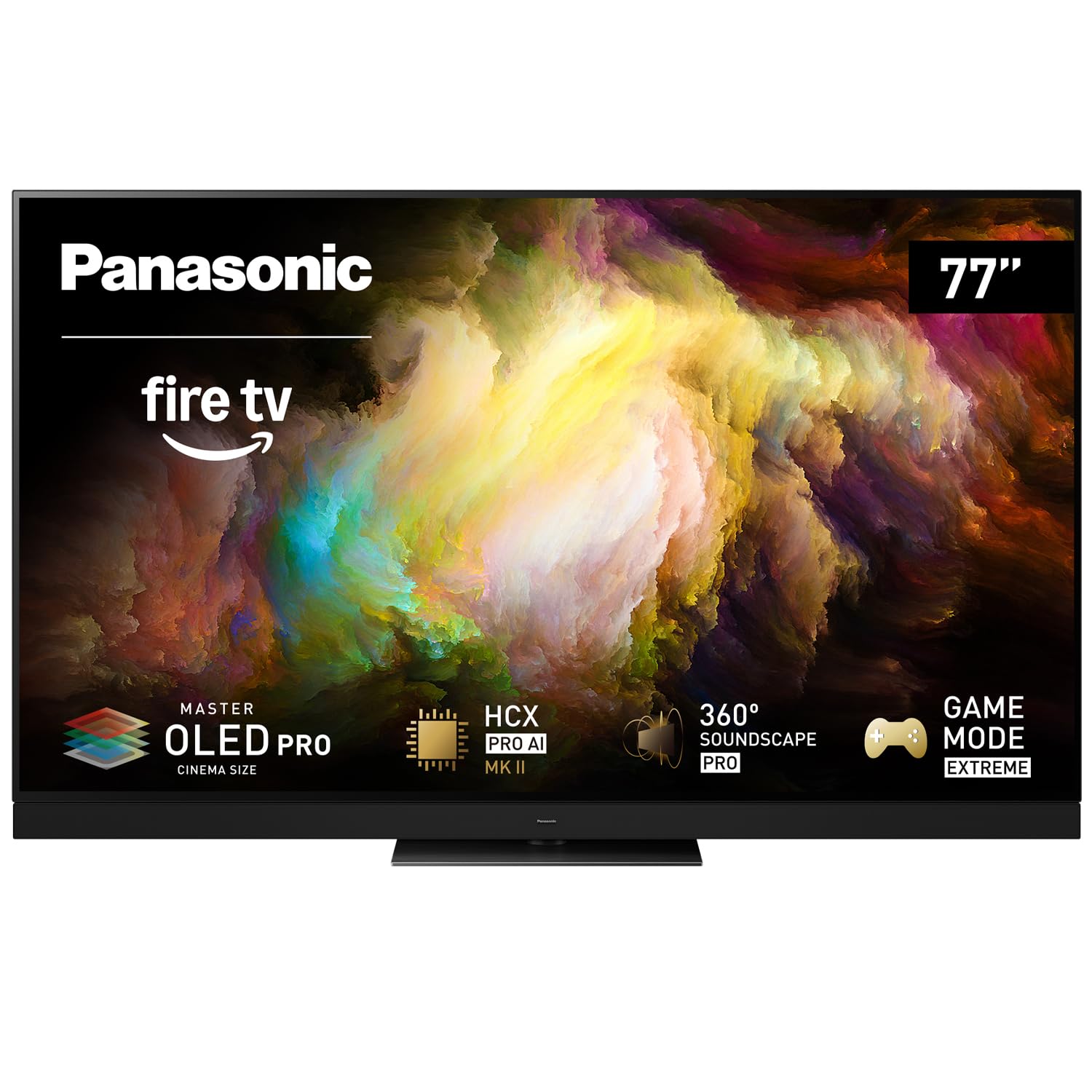
The Panasonic Z8 Series delivers 77 inches of OLED for a remarkably accessible price point, making it the best connected TV for buyers who want a truly large cinematic screen without stepping up to the flagship LG or Sony price brackets. The Master OLED PRO panel uses micro-lens-array technology to boost brightness beyond standard OLEDs, and the HCX Pro AI Processor MKII handles scene-by-scene optimization with excellent color accuracy out of Filmmaker Mode. Dolby Vision IQ and HDR10+ Adaptive both adjust to ambient room lighting, which keeps shadow detail visible even when daylight shifts during a long movie.
Gaming specs are competitive: a native 144Hz refresh rate, HDMI 2.1 with VRR, AMD FreeSync Premium, and NVIDIA G-SYNC support. The 360 Soundscape Pro audio system tuned by Technics uses a front-array, upward-firing, and side-firing speaker configuration to create a wide soundstage with Dolby Atmos height effects. The Game Control Board gives you quick access to refresh rate and VRR status, and two gaming sound modes (RPG and FPS) tailor the audio profile to the genre.
The Fire TV built-in platform provides hands-free Alexa support and integrates well with Amazon Prime and Fire TV devices, but it is less customizable than webOS or Google TV. The TV is extremely heavy — roughly 80 to 100 pounds — requiring at least two people and a sturdy wall mount for installation. The built-in media player has limited codec support, so you may need an external streaming device for niche file formats. For the price per inch of OLED real estate, this set is hard to beat.
Why it’s great
- Exceptional value for a 77-inch OLED with micro-lens-array tech
- Native 144Hz refresh rate with both FreeSync and G-SYNC support
- 360 Soundscape Pro delivers wide, immersive audio without add-ons
Good to know
- Very heavy (~80-100 lbs); requires two-person installation
- Fire OS is less customizable than webOS or Google TV
- Built-in media player lacks codec support for some file formats
5. Hisense U7 Mini-LED
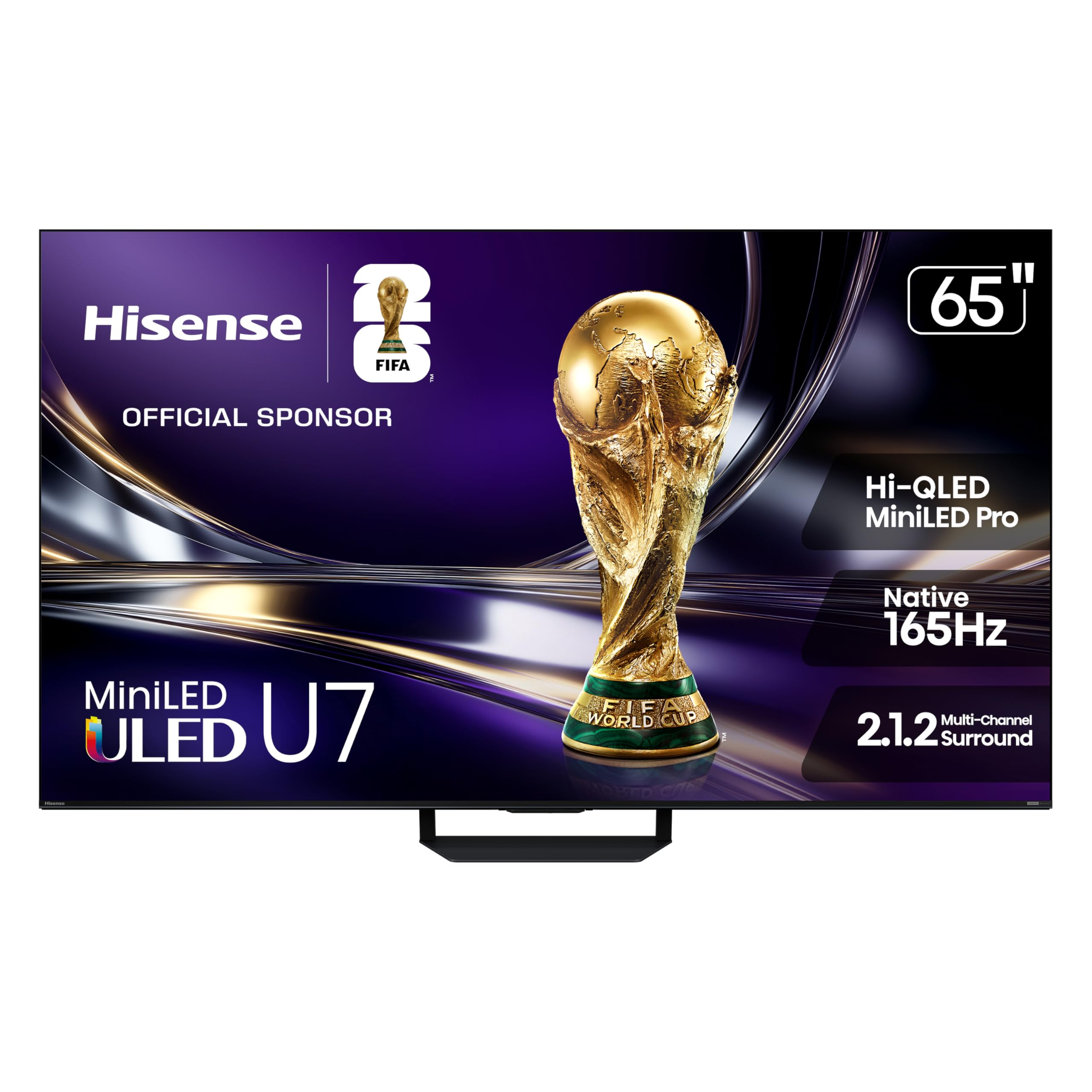
The Hisense U7 Mini-LED is built for buyers who watch TV in a living room with large windows, overhead lights, or afternoon sun. Its Hi-QLED MiniLED Pro backlight, with up to 3000 local dimming zones and a peak brightness of 3000 nits, delivers punchy HDR highlights that cut through ambient light without washing out. The anti-reflection and glare-free layer uses an advanced dual-screen treatment that preserves black levels significantly better than standard single-layer designs, so you don’t lose detail in dark scenes during the day.
The native 165Hz refresh rate is the highest in this list, and combined with VRR up to 330Hz, it makes motion in fast sports and competitive gaming exceptionally smooth. The Hi-View AI Engine Pro analyzes each scene in real time to adjust color, contrast, and detail, and the panel is Pantone Validated for color accuracy. Google TV integration is solid, with Chromecast built-in and hands-free voice control via Google Assistant. The 2.1.2 channel speaker system has upward-firing drivers for Dolby Atmos height effects, which outperforms most mid-range TV audio.
The Google TV interface can occasionally feel cluttered with promoted content, and some users report minor input lag when the AI processing is enabled in non-game modes. The built-in smart platform is responsive overall but lacks the long-term software update track record of LG or Sony. For buyers who need a TV that performs equally well in bright day and dark night conditions without a blackout curtain setup, this is the most capable option at its tier.
Why it’s great
- 3000 nits peak brightness with anti-glare for bright room use
- Native 165Hz with VRR 330 for ultra-smooth gaming motion
- Pantone Validated color accuracy and 3000 local dimming zones
Good to know
- Google TV interface can feel cluttered with promoted content
- AI processing can introduce minor input lag outside Game Mode
- Long-term software update support less assured than Sony or LG
6. Samsung S90F OLED

The Samsung S90F uses QD-OLED technology, combining quantum dot color volume with self-lit pixels to produce brighter, more saturated colors than standard OLED panels while maintaining perfect blacks. The NQ4 AI Gen3 processor, powered by 128 neural networks, upscales lower-resolution content to near-4K quality and analyzes each scene to boost brightness dynamically. The result is an image that feels more vibrant and punchy in SDR and HDR alike, without the color volume ceiling that traditional OLEDs hit on bright highlights.
Motion Xcelerator supports up to 144Hz VRR gaming, and the Samsung Gaming Hub aggregates cloud gaming services like Xbox Game Pass and GeForce Now directly on the TV without needing a console. The AI processor also includes a motion smoothing mode specifically for sports that reduces blur on fast-moving balls and player movements. Samsung’s Tizen smart platform provides access to 2700+ free channels through Samsung TV Plus, and Alexa is built-in for hands-free voice control.
The S90F is best suited for a controlled lighting environment — it is not as bright as the Hisense U7 or LG G5, and direct sunlight can wash out some highlight details. The anti-reflective coating is delicate and can be damaged by aggressive cleaning, so use a microfiber cloth only. The solar-powered remote is an eco-friendly touch, but its charging cell is located on the bottom, making it less effective when stored in a dark cabinet. For vivid color lovers who value saturation and contrast equally, this is a strong mid-range premium pick.
Why it’s great
- QD-OLED delivers brighter, more saturated colors than standard OLED
- 144Hz VRR and Samsung Gaming Hub for cloud gaming
- 128-neural-network AI processor for excellent 4K upscaling
Good to know
- Delicate anti-reflective coating; can be scratched by rough cleaning
- Not as bright as premium Mini-LED models in sunlit rooms
- Solar remote charging cell on bottom is ineffective in dark cabinets
7. TCL T7 QLED

The TCL T7 Series is the best connected TV for budget-conscious gamers who want high refresh rates without stepping up to premium Mini-LED or OLED pricing. The 120Hz panel supports up to 144Hz VRR for compatible titles, and the Motion Rate 480 with MEMC frame insertion keeps fast-paced action blur-free. The QLED quantum dot layer covers nearly the entire DCI-P3 color space, so colors are rich and vibrant even at this entry-level price point — something that previously required spending significantly more.
Google TV provides a unified interface that aggregates movies and shows from your subscribed apps, and built-in Chromecast and Apple AirPlay 2 make mobile casting effortless. The TCL AIPQ Pro Processor handles real-time optimization of color, contrast, and clarity, and the four HDMI inputs include one with eARC for connecting a soundbar. The bezel-less design makes the panel look larger than its physical dimensions, and the included voice remote works with Alexa, Google Assistant, and Apple HomeKit.
The built-in speakers are adequate for casual viewing but lack the bass and clarity needed for immersive movie nights — a soundbar is a worthwhile partner. The panel uses Direct LED backlighting, so black levels are not as deep as Mini-LED or OLED, and there is some light bleed in letterbox bars during dark scenes. If you game frequently on PS5 or PC and want a 120Hz+ experience without sacrificing color accuracy, this is the most efficient route.
Why it’s great
- 120Hz native panel with 144Hz VRR for smooth gaming on a budget
- QLED quantum dot color covers nearly entire DCI-P3 space
- Bezel-less design and four HDMI inputs including eARC
Good to know
- Built-in speakers lack bass and clarity; soundbar recommended
- Direct LED backlight means weaker black levels vs Mini-LED
- Some light bleed noticeable in letterbox bars during dark scenes
8. Roku Plus Series Mini-LED
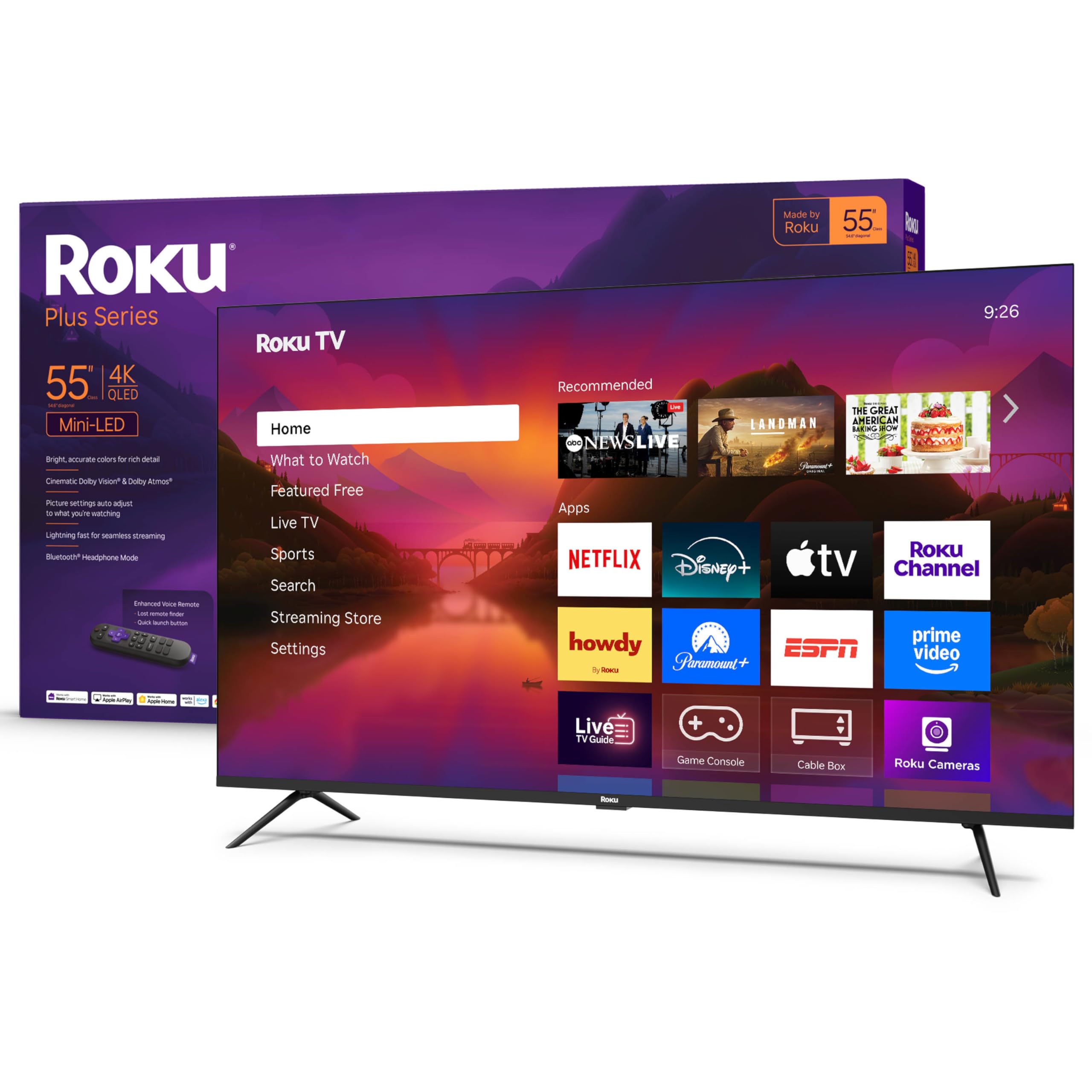
The Roku Plus Series delivers Mini-LED backlighting with Dolby Vision and QLED color at a mid-range price, and it pairs that hardware with the best smart TV interface for simplicity-focused buyers. Mini-LED backlighting improves contrast noticeably over standard LED, and the QLED layer produces vibrant, punchy colors in both SDR and HDR. The AI-powered Roku Smart Picture Max cleans up incoming TV signals and optimizes color and sharpness per scene, which is especially useful for lower-bitrate cable or antenna broadcasts.
The Roku OS is the defining feature here. It boots quickly, loads apps instantly thanks to the Plus Series’ upgraded Wi-Fi, and presents content without the promoted clutter found on Google TV or Fire TV. The Enhanced Voice Remote includes a lost remote finder, personal app shortcuts, and voice search across thousands of apps. Dolby Atmos support via the built-in subwoofer gives the audio more depth than most mid-range competitors, and Bluetooth Headphone Mode lets you listen privately without waking the house.
The Plus Series lacks the deep black performance of premium Mini-LED sets with many local dimming zones, and the USB port has a quirk where connected bias lights remain powered for roughly 10 minutes after the TV turns off. The Roku OS offers limited calibration settings compared to Sony or LG, so video enthusiasts may find the picture tuning options basic. For anyone who prioritizes a fast, ad-light interface and reliable app support over granular picture settings, this is an excellent match.
Why it’s great
- Roku OS is fast, simple, and clutter-free for easy daily use
- Mini-LED with QLED and Dolby Vision for vibrant, high-contrast HDR
- Built-in subwoofer and Bluetooth Headphone Mode for versatile audio
Good to know
- Limited local dimming zones; black levels not as deep as premium Mini-LED
- USB port keeps bias lights powered for ~10 min after TV off
- Basic calibration settings may frustrate advanced video tweakers
9. Samsung Q8F QLED

The Samsung Q8F is the best connected TV for secondary rooms — a bedroom, home office, or kitchen — where space is tight but you still want 4K resolution and smart streaming. The 32-inch QLED panel uses Quantum Dot technology to deliver 100% color volume, so even at this small size, HDR content looks punchy and colorful rather than washed out. The AirSlim design keeps the profile low against the wall, and the Q4 AI Processor handles 4K upscaling of HD sources effectively for the size class.
Samsung Vision AI optimizes both picture and sound per content type, and the Game Mode supports up to 4K at 144Hz for VRR gaming, which is unusually high for a 32-inch set. Samsung TV Plus provides over 2700 free channels without any subscription, making this a solid option for cord-cutters who want live news, sports, and movies in a small space. Alexa is built-in for hands-free control, and Bluetooth 5.3 keeps wireless peripherals like headphones connected reliably.
At this screen size, the 4K resolution is less visually distinguishable from 1080p at normal viewing distances compared to larger screens, so the primary value is in the color volume and smart features rather than raw pixel density. The remote is overly sensitive, with some users reporting accidental channel changes when it rests on a couch cushion. For a compact, feature-rich connected TV that doesn’t sacrifice picture quality for size, this is the top pick.
Why it’s great
- 100% color volume QLED for punchy HDR in a compact 32-inch frame
- 4K 144Hz VRR gaming support, rare at this size
- AirSlim design for flush wall mounting in tight spaces
Good to know
- 4K resolution benefits are marginal at 32 inches from typical distance
- Remote is overly sensitive, causing accidental channel changes
- Built-in speakers lack the power for immersive room-filling audio
FAQ
Is OLED or Mini-LED better for a bright living room?
Do I need HDMI 2.1 for regular streaming and cable TV?
Final Thoughts: The Verdict
For most users, the best connected tv winner is the LG G5 OLED evo because it combines perfect black levels with over 2000 nits of brightness, making it versatile for both dark movie nights and bright living rooms. If you want the absolute best upscaling for older content and deep PlayStation 5 integration, grab the Sony BRAVIA 7 Mini-LED. And for a budget-friendly gaming setup with high refresh rates and vibrant QLED color, nothing beats the TCL T7 QLED.

Mo Maruf
I created WellFizz to bridge the gap between vague wellness advice and actionable solutions. My mission is simple: to decode the research and give you practical tools you can actually use.
Beyond the data, I am a passionate traveler. I believe that stepping away from the screen to explore new environments is essential for mental clarity and physical vitality.