You want a water heater that gives you endless hot water without a giant tank. The trick is picking one that handles your whole household—multiple showers, the dishwasher, and laundry all running at once—without tripping breakers, freezing, or burning through gas money.
I’m Mohammad Maruf — the co-founder and writer behind WellFizz. This guide is built by comparing the manufacturers’ published specifications and the patterns across verified customer reviews, so you get each pick’s real strengths and trade-offs instead of marketing spin.
This guide breaks down the twelve best options for a condensing tankless water heater, covering efficiency ratings, flow rates, and the real-world quirks that only actual owners discover.
How To Choose The Best Condensing Tankless Water Heater
Picking a condensing unit means you get better energy efficiency than standard tankless models, because they trap heat from exhaust gases that would otherwise go up the vent. But not every model fits every home. You need to match three things: your home’s peak hot water demand, the available gas supply, and your space constraints.
Match the Flow Rate to Your Household Size
The flow rate, measured in GPM (gallons per minute), tells you how much hot water the unit can deliver at once. A single shower requires about 1.5–2 GPM, while running a shower and a dishwasher might need 3–4 GPM. For a family of four, look for a unit that delivers at least 6–8 GPM at a 45°F temperature rise (the amount the heater warms the incoming water). Going too low means you’ll get cold water when the kitchen sink and shower run simultaneously.
Check the Uniform Energy Factor (UEF)
UEF is a standardized measure of how efficiently a heater converts fuel into hot water. A higher number means lower operating costs. Most condensing units score between 0.91 and 0.98, which is markedly better than non-condensing models that often hover around 0.80. A 0.98 UEF unit can save you roughly 15–20% annually on gas compared to a standard tank heater, according to Energy Star data.
Gas Supply and Venting Requirements Are Not Optional
Many condensing tankless water heaters need a 3/4-inch gas line (not the 1/2-inch line older homes have), and they all require dedicated venting with schedule 40 PVC pipe. You cannot tie into an existing metal flue. If your home’s gas meter is undersized, you may need an upgrade. Skip this step and you risk poor performance, error codes, or unsafe operation.
Quick Comparison
On smaller screens, swipe sideways to see the full table.
| Model | Category | Best For | Key Spec | Amazon |
|---|---|---|---|---|
| Noritz NRC66DVNG | Best Overall | Balanced efficiency & size | 6.6 GPM, 38 lbs | Amazon |
| Rinnai RX199iN | Premium Pick | High flow for large families | 11.1 GPM, UEF .98 | Amazon |
| ThermoMate RTC68iN | Top Performer | Massive flow & energy savings | 9.38 GPM, 0.91 UEF | Amazon |
| Rinnai RXP199iN | Best Value | Built-in recirculation pump | 11.1 GPM, 58 lbs | Amazon |
| EZ Tankless Ultra HE | Compact Pick | Small spaces & supplemental use | 3.4 GPM, 6.5″ deep | Amazon |
| Noritz NRC71DVNG | Mid-Range | Solid upgrade from NRC66 | 7.1 GPM, 41 lbs | Amazon |
| Takagi T-H3S-DV-N | Top Performer | High capacity at 8 GPM | 8 GPM, 22.5″ H | Amazon |
| Takagi T-H3J-DV-N | Mid-Range | Compact 6.6 GPM option | 6.6 GPM, 58 lbs | Amazon |
| Rinnai RU160iP | Premium Pick | Propane-powered high flow | 9 GPM, 72.5 lbs | Amazon |
| Rheem RTGH-RH11DVLN | Premium Pick | Built-in recirculation & 11 GPM | 11 GPM, 0.94 UEF | Amazon |
| Rheem RTGH-84DVLN-2 | Mid-Range | 8.4 GPM for medium homes | 8.4 GPM, 77.9 lbs | Amazon |
| Noritz NRC66DVLP | Compact Pick | Propane, compact size | 6.6 GPM, 38 lbs | Amazon |
In‑Depth Reviews
1. Noritz NRC66DVNG Indoor Condensing Direct Tankless Hot Water Heater

The 6.6 GPM output in a 13.8-inch-wide frame makes the Noritz NRC66DVNG the top pick for a family of four who wants endless hot water without expensive gas-line or meter upgrades, since it runs on 120,000 BTUs and typically fits a standard 1/2-inch gas line.
Buyers report “10-20% lower gas usage after 6 months” because the unit condenses exhaust heat instead of venting it outside, and it vents with standard schedule 40 PVC pipe to simplify installation. At 38 pounds, one person can hang it on a wall bracket.
The catch is the “cold-water sandwich”—a brief slug of cold water between hot-water uses—which is common across all tankless units, but the long-term gas savings and the 12-year parts warranty make this the most balanced pick for a primary residence.
Why it’s great
- Proven 10-20% gas savings reported by owners
- Compact 13.8″ width conserves space
- Uses standard PVC venting
Good to know
- Expect a brief cold water delay between uses
- Buy from a reliable seller to avoid shipping issues
2. Rinnai RX199iN Condensing Smart Sense Tankless Water Heater

The Rinnai RX199iN blows past the Noritz on raw capacity—at 11.1 GPM it can handle seven fixtures at once compared to the Noritz’s 6.6 GPM, making it the stronger choice for a family of five or a home with two full bathrooms. Its UEF rating (Uniform Energy Factor, a government efficiency score) of 0.98 is as high as residential units get, meaning it wastes almost no gas—only 2% of the energy it consumes goes up the vent.
Owners with three-bedroom homes report running multiple showers without any temperature or pressure drop, and they note the unit is quiet enough to install near living areas. The Smart Sense gas control lets it switch between natural gas and propane without a conversion kit, which is rare in this category. That flexibility is a big plus if you might change fuel sources later.
The upfront cost is higher, and professional installation is strongly recommended (Rinnai requires it for warranty validity). But if your household routinely runs two showers plus the dishwasher at the same time, this model’s capacity justifies the premium. skip it if your home’s gas line is only 1/2 inch; you will need a 3/4-inch line for it to work at full power. Choose the Rinnai RX199iN over the top pick if you need the highest possible simultaneous fixture count and can accommodate a 3/4-inch gas line.
Where it shines
- Industry-leading 0.98 UEF for maximum efficiency
- Runs 7 fixtures at once with 11.1 GPM
- Converts between gas types without a kit
Worth noting
- Requires professional install for warranty
- WiFi module sold separately
3. ThermoMate RTC68iN Condensing Tankless Water Heater
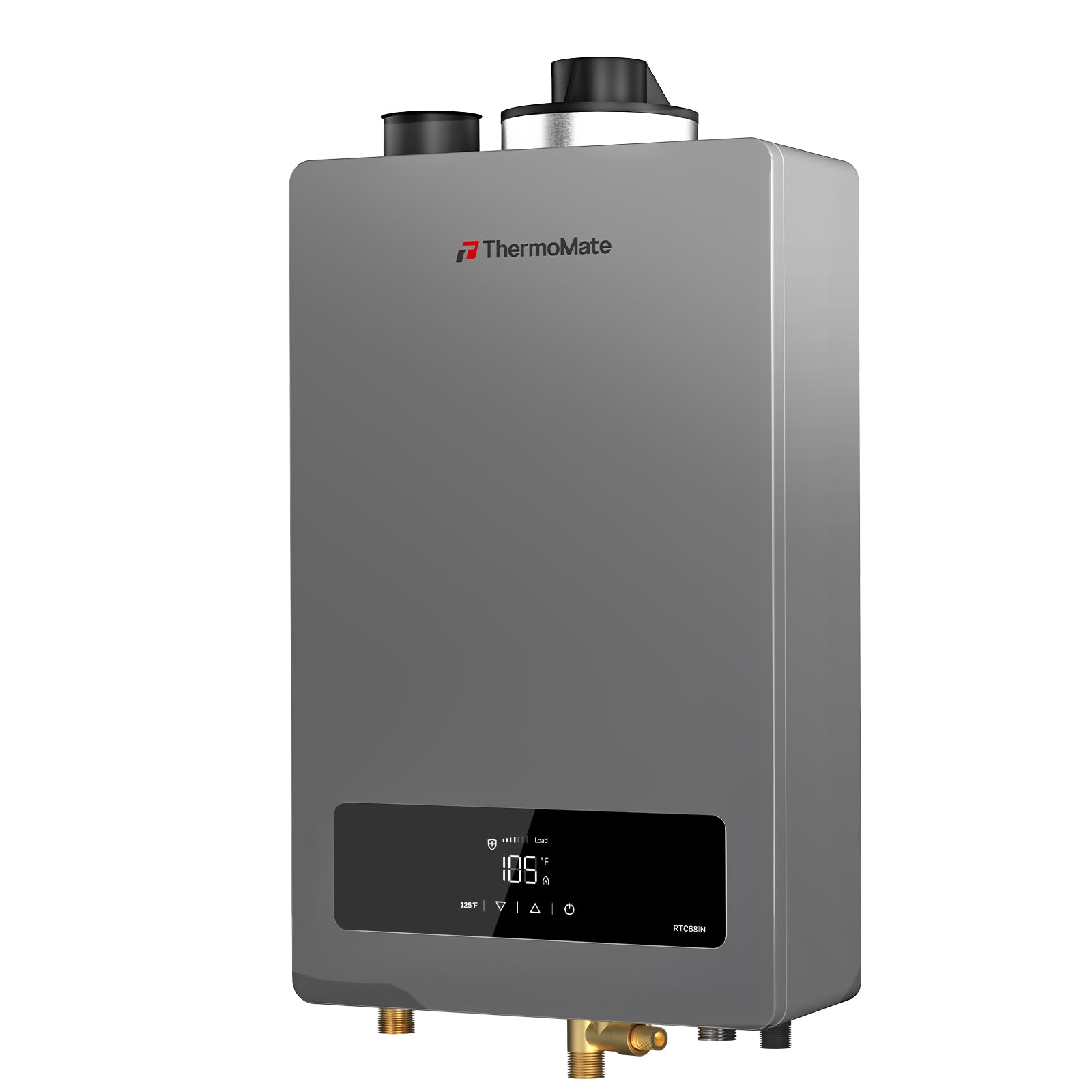
If you live in a warmer climate where groundwater temperatures stay above 62°F, the ThermoMate RTC68iN becomes the most powerful option in this lineup because it can deliver up to 9.38 GPM—enough for three showers running at 105°F simultaneously. Its dual heat exchange system (a stainless steel condensing exchanger paired with an oxygen-free copper exchanger) captures waste heat that traditional models lose, contributing to the 0.91 UEF rating.
Buyers confirm “instant hot water for multiple points” and praise the “constant warm water” even in cabins and small homes. The sealed combustion design keeps operational noise noticeably lower than older tankless units. At 163,000 BTUs, it also has enough heating muscle for homes in colder zones, though its flow rate drops proportionally as incoming water gets colder—a reality for any tankless unit.
The important fine print: as a condensing unit, it produces mildly acidic condensate that must be discharged into a drain with a neutralizer kit (sold separately). Plan for that during installation to avoid pipe corrosion. This unit is a top performer for warmer areas; pass on it if your groundwater dips below 50°F in winter, as the GPM will drop significantly. At 9.38 GPM with a 0.91 UEF, it delivers the highest flow in this guide for warm-climate homes.
What stands out
- Massive 9.38 GPM at warmer inlet temps
- Dual heat exchanger boosts efficiency to 0.91 UEF
- Sealed combustion for quiet operation
The trade-offs
- Requires a condensate neutralizer (not included)
- Flow rate drops in colder inlet water
4. Rinnai RXP199iN Smart Sense Condensing Tankless Water Heater
The single number that matters most in this category is flow rate, and the RXP199iN delivers 11.1 GPM at 199,000 BTUs—matching the RX199iN on both heating power and hot water output.
The built-in recirculation pump with Smart-Circ technology sets the RXP199iN apart by learning your household’s peak usage times and pre-heating the water in the pipes, so you do not stand at the faucet waiting 30 to 90 seconds for hot water. The downside is that some owners mention the recirculation pump is “louder than expected,” and the pump settings only offer economy or comfort modes rather than fine-tuning. The unit weighs 58 pounds and measures 19 inches wide by 31 inches tall—slightly larger than the Noritz.
If you are willing to accept a bit of pump noise in exchange for near-instant hot water at every tap, the RXP199iN delivers convenience that most competing units cannot match without an external pump add-on. it’s not for you if noise sensitivity is a concern in your living space; the RX199iN is quieter but lacks the built-in pump—making the RXP199iN a strong price-to-value pick for households that prioritize instant hot water over absolute silence.
The upsides
- Built-in recirculation pump for instant hot water
- Smart-Circ learns your usage patterns
- High 11.1 GPM flow rate
Keep in mind
- Recirculation pump is audible when running
- Limited pump adjustment settings
5. EZ Ultra HE Natural Gas Indoor Condensing Tankless Water Heater

At this lower price you get a tankless water heater that is just 6.5 inches deep—a 3.6x size reduction versus the 23.7-inch-deep ThermoMate—making it mountable in a shallow utility closet or even under a sink. The trade-off is a 3.4 GPM flow rate, the lowest here, sufficient for roughly one shower plus one sink.
Buyers confirm it “saves /month on water heating” and note the compact size is ideal for guest bathrooms, kitchen remodels, or as a dedicated booster for a distant fixture. The unit uses standard 2-inch schedule 40 PVC for venting, includes a back-draft prevention device, and draws only 1 watt of standby power.
The honest limit is that a family expecting to run two showers simultaneously will be disappointed. This is a specialized tool for supplemental use—think a workshop sink or a guest bath—not a whole-home solution for a large household. Compare it to the Noritz NRC66DVNG if you need a whole-home unit in a similar footprint but with higher flow. It is perfect for the budget buyer who needs a compact, low-cost booster for a single remote fixture rather than a whole-house system.
Why we’d pick it
- Ultra-compact 6.5-inch depth
- Reported /month savings on water heating
- 1W standby power use
A few caveats
- 3.4 GPM limits simultaneous use
- Best for supplemental or single-fixture use
6. Takagi T-H3S-DV-N Condensing High Efficiency Natural Gas Indoor Tankless Water Heater

This Takagi is perfect for a family of four that occasionally runs two showers at once, offering a middle-ground 8 GPM flow rate between compact and high-volume models. At 17.75 inches wide, it is 29% larger than the Noritz NRC66DVNG’s 13.8 inches, so measure your space carefully before buying.
Customers note setting it at 120°F with no issues and note the unit is “quiet” during operation. It meets the strict 2012 SCAQMD Rule 1146.2 for ultra-low NOx emissions, which matters if you live in California or other areas with air quality regulations. The computerized safety features include freeze protection and flame-out shutdown.
One owner warns that the unit requires biannual cleaning to prevent scale buildup, and the gas line must be 3/4 inch (not 1/2). Factor in those maintenance costs and pipe upgrades when budgeting for this model. Just be aware that its ongoing maintenance demands are higher than some competitors.
Strong points
- 8 GPM handles two showers comfortably
- Ultra-low NOx compliant for strict regions
- Quiet operation per owner feedback
Before you buy
- Requires biannual descaling maintenance
- Needs 3/4-inch gas line
7. Noritz NRC71DVNG Indoor Condensing Direct Vent Tankless Water Heater
The NRC71DVNG sits at a mid-range price point among condensing tankless water heaters, offering a modest flow increase over the NRC66DVNG for a relatively small premium, making it a value-focused step up for homes that need just a bit more capacity without jumping to a higher-tier model.
Buyers who replaced older units say installation was straightforward: one reviewer noted they “basically unplugged old one and plugged in new one.” The compact space-saving design is ideal for replacing a tank heater in the same footprint. The unit uses schedule 40 PVC for venting and meets low-NOx standards.
The potential risk is customer service. One owner reported a unit failure after eight months and ongoing issues with Noritz’s warranty support. For peace of mind, ensure you register the warranty and work with a certified installer. The one clear reason to choose it is the extra 0.5 GPM over the NRC66DVNG, which can mean the difference between a comfortable shower and a sudden cold blast when someone turns on the kitchen sink.
What we like
- 7.1 GPM adds extra headroom over 6.6 GPM models
- Lightweight at 41 lbs for DIY wall mounting
- Uses standard PVC venting
The downsides
- Warranty support issues reported by some owners
- Requires professional installation for best results
8. Takagi T-H3J-DV-N Condensing High Efficiency Natural Gas Indoor Tankless Water Heater

The T-H3J-DV-N delivers the same 6.6 GPM flow rate as the Noritz NRC66DVNG but in a taller, narrower package (17″W x 13″H at the base, though the full height is substantial). It is heavier at 58 pounds compared to the Noritz’s 38, which makes wall mounting a two-person job.
Long-term reviewers point out these units last 15 years without problems, and one buyer mentioned “set at 120 F supplies the hot water we need” with consistent performance. The computerized safety features and ultra-low NOx compliance are the same as the larger Takagi T-H3S model. Expect hot water almost instantly upon opening the tap.
However, some shoppers say it can take longer to heat water than an old tank heater if the gas line is undersized. Verify your gas line is at least 3/4 inch before purchase. For buyers who want Takagi’s long-term reliability but need a lighter unit, the Noritz NRC66DVNG is a better bet at 38 pounds. This is the pick for buyers who prioritize proven 15-year longevity over a lighter install.
Why it’s great
- Proven 15-year lifespan from repeat buyers
- Ultra-low NOx compliant
- Consistent 120°F output
Good to know
- Heavier than comparable models at 58 lbs
- May require gas line upgrade to 3/4 inch
9. Rinnai RU160iP Condensing Tankless Hot Water Heater, Propane

The Rinnai RU160iP is one of the few high-flow condensing units available in propane, and at 9 GPM it can handle up to six appliances at once—matching the top pick’s flow rate but requiring propane instead of natural gas. It is also the heaviest unit on this list at 72.5 pounds, so plan for a reinforced mounting bracket and a second pair of hands during installation.
Its Circ-Logic feature allows pairing with an external recirculation pump to reduce water waste, and the 0.98 UEF rating matches the top-tier Rinnai models for efficiency. Owners confirm it “saved a bundle on hot water” during warmer months and runs well on a 1/2-inch propane line even though the spec calls for 3/4 inch.
At 33.86 inches tall, it is the tallest unit here, so check your ceiling clearance. For propane-heavy households (off-grid homes, cabins, or areas without natural gas), this is the premium pick. Choose this over the top pick if you need a high-flow condensing tankless water heater that runs on propane rather than natural gas.
Where it shines
- 9 GPM propane model for off-grid homes
- 0.98 UEF for maximum fuel savings
- Circ-Logic supports external recirculation
Worth noting
- Very heavy at 72.5 lbs
- Tall 33.86-inch height may limit placement
10. Rheem Prestige Condensing Tankless Gas Indoor Natural Gas Water Heater RTGH-RH11DVLN

If your household demands 11 GPM and you want a tankless water heater with a built-in recirculation pump and smart learning that pre-heats water for your peak usage times, the Rheem Prestige RTGH-RH11DVLN packs those features into a 199,000 BTU unit that matches the top Rinnai models on raw flow. Its UEF of 0.94 is respectable but slightly behind the Rinnai RX199iN’s 0.98, meaning it wastes about 6% of its gas instead of 2%.
The warranty is aggressive: 25 years on the heat exchanger for residential use, 5 years on parts, and 1 year on labor. Water and gas leak detection sensors automatically shut the unit down and display error codes, adding a layer of safety.
However, the buyer feedback is mixed. Multiple buyers report failures within 2-5 years, including cracked heat exchangers and constant error codes. Customer service complaints are common. If you gamble on this unit, make sure your installer is local and responsive, because you may need them. Compared to the Rinnai RXP199iN, the Rheem offers similar features but with more reliability risk.
What stands out
- 11 GPM with built-in recirculation pump
- 25-year heat exchanger warranty
- Auto-Learn schedules pre-heating for peak use
The trade-offs
- Mixed reliability reports from long-term owners
- Customer service response is slow per reviews
11. Rheem Prestige Condensing Tankless Indoor Natural Gas Water Heater, RTGH-84DVLN-2

The single number that matters most in this category is flow rate, and the RTGH-84DVLN-2 delivers 8.4 GPM at a mid-range price point, offering a solid upgrade from the 6.6 GPM units without jumping to the premium tier. Weighing 77.9 pounds, it is the second-heaviest unit on this list, so installation will require a proper wall anchor and at least two people.
Buyers in 1,000-square-foot homes report it never runs out of hot water for long showers, and the unit is “very quiet” once running. At just 9.8 inches wide by 18.5 inches high, it fits in tighter spaces than the larger Rheem 11 GPM model. The water and gas leak detection safety feature is standard.
Packaging complaints appear in reviews—some units arrive with cosmetic damage—so inspect the box immediately upon delivery. Also, the condensation drain line can freeze in single-digit weather, so insulate it in cold climates. For the price, the Noritz NRC66DVNG offers better long-term reliability with a simpler design, unless you need the extra 1.8 GPM that the Rheem provides.
The upsides
- 8.4 GPM in a compact 9.8″ wide chassis
- Very quiet operation per owners
- Leak detection safety sensors
Keep in mind
- Heavy at 77.9 lbs—two-person install
- Packaging damage reported during shipping
12. Noritz NRC66DVLP Indoor Condensing Direct Tankless Hot Water Heater, Liquid Propane
What you actually get at this lower price is the propane version of the Noritz NRC66DVNG, delivering the same 6.6 GPM flow rate in the same compact 14-inch width. At 38 pounds, it is one of the lightest units on this list, making it a practical choice for rural homes, cabins, or properties where natural gas is not available.
Owners confirm easy DIY installation, though a separate shut-off valve purchase is required. The unit vents with standard schedule 40 PVC, which is simpler and cheaper than stainless steel venting. The 12-year heat exchanger warranty, 5-year parts warranty, and 1-year labor warranty are competitive.
Be cautious: one buyer bought this unit thinking it could convert to natural gas, but it is LP-only. If you need natural gas, choose the NRC66DVNG. Also, in cold climates, installing a backflow preventer is recommended to stop cold air from freezing the top coils. For propane users, this is the most straightforward path to the same balanced performance as the top-rated natural gas Noritz, making it the exact budget buyer it is perfect for.
Why we’d pick it
- Lightweight 38 lb propane unit
- Standard PVC venting keeps install costs down
- Good warranty coverage
A few caveats
- LP-only—cannot be converted to natural gas
- May need backflow preventer in freezing climates
Understanding the Specs
UEF — Uniform Energy Factor
This is the government-standard rating for how efficiently a water heater turns fuel into hot water. A UEF of 0.98 (the highest among these picks) means the unit wastes only 2% of the energy it consumes—almost all the gas goes into heating your water. Compare that to a standard tank heater at 0.60–0.70, and the savings become clear over a year. Every 0.05 increase in UEF typically cuts your gas bill by about 5%.
GPM — Gallons Per Minute
GPM tells you how much hot water the unit can deliver at a specific temperature rise (usually measured at a 45°F or 35°F increase). A 1.5 GPM shower head uses 1.5 gallons of hot water per minute. If you want to run two showers plus the dishwasher, you need roughly 5-6 GPM. Bigger is not always better—oversizing wastes gas because the unit cycles on and off for small draws, reducing efficiency.
Condensing vs. Non-Condensing
Condensing units capture heat from exhaust gases that would otherwise go out the vent. This gives them UEF ratings above 0.90, while non-condensing models typically score 0.80–0.85. One limitation is that condensing models produce acidic water (condensate) that must be drained and neutralized. Non-condensing models are simpler and cheaper upfront, but you pay more in gas over time.
Temperature Rise
This is the amount your heater can warm the incoming groundwater. If your ground water is 50°F and you want 120°F showers, you need a 70°F temperature rise. Higher flow rates drop as the required temperature rise goes up. In northern climates with colder groundwater, you may need a larger unit to maintain the same GPM output as someone in the South with 70°F incoming water.
FAQ
Can a condensing tankless water heater replace my existing tank heater without new venting?
Do I need a condensate neutralizer and why?
How often does a condensing tankless water heater need maintenance?
Does a condensing tankless water heater work during a power outage?
What is the ‘cold water sandwich’ effect with tankless heaters?
Final Thoughts: The Verdict
For the majority of shoppers, the condensing tankless water heater winner is the Noritz NRC66DVNG because it balances a solid 6.6 GPM flow rate, compact 13.8-inch width, and proven gas savings at a mid-range price. If you want the highest efficiency and enough flow to run seven fixtures at once, grab the Rinnai RX199iN. And for a whole-home unit with a built-in recirculation pump that delivers near-instant hot water, the Rinnai RXP199iN is the feature-rich choice.

Mo Maruf
I created WellFizz to bridge the gap between vague wellness advice and actionable solutions. My mission is simple: to decode the research and give you practical tools you can actually use.
Beyond the data, I am a passionate traveler. I believe that stepping away from the screen to explore new environments is essential for mental clarity and physical vitality.