Our readers keep the lights on and my smoothie glass nicely filled. As an Amazon Associate, I earn from qualifying purchases.
Specs are compiled from manufacturer listings and verified buyer reviews and can change over time — please confirm the key details on the product page before buying.
The difference between a muddy conference call and a voice that cuts through a mix often depends on the metal capsule sitting on your desk. Every condenser USB microphone promises “studio quality,” but the real gap shows up in how it handles your actual room, your voice, and the background hum you cannot silence.
I’m Mohammad Maruf — the founder and writer behind WellFizz. This guide is built by comparing the manufacturers’ published specifications and the patterns across verified customer reviews, so you get each pick’s real strengths and trade-offs instead of marketing spin.
You will learn what separates a good recording from a great one, which polar pattern suits a noisy gaming setup versus a quiet podcast booth, and how to match a microphone to your exact workflow without overpaying for features you will never use. That is the goal of this guide to the best condenser usb microphone.
Our Picks at a Glance

How To Choose The Best Condenser USB Microphone
Understanding a few key specs and design choices will help you zero in on the right mic for your setup without wasting money. Here is what to look for.
Pick the right polar pattern for your room
The polar pattern determines which direction the microphone hears sound from. Most condenser USB mics use a cardioid pattern, which picks up sound from the front and rejects noise from the sides and rear. This is ideal if you are in a noisy room with a computer fan, a clicking keyboard, or outside traffic. A handful of mics offer multiple patterns — omni (hears everything around), bidirectional (front and back only), and stereo — which are useful if you plan to record interviews or multiple instruments around one mic.
Sample rate and bit depth matter for editing, not just listening
A higher sample rate (measured in kHz, like 96 kHz) and a higher bit depth (24-bit is standard) give you more headroom when you edit the audio later. You can stretch, pitch-shift, or apply heavy noise reduction without introducing artifacts. For pure speech and live streaming, the standard 44.1 kHz at 16-bit is still fine, but if you are recording music or plan to do lots of post-processing, look for the higher numbers. The difference between 44.1 kHz and 96 kHz is about how much detail is captured, not a guarantee that your voice will sound “better” in a raw recording.
Onboard controls versus software dependency
Some microphones rely entirely on a companion app for adjusting EQ, compression, and noise gating, while others give you physical dials for gain, volume, and a mute button right on the body. If you want to change settings without clicking through a window in the middle of a stream, physical controls are a big advantage. On the other hand, software-based mics often have more powerful effects because the processing happens on your computer.
Quick Comparison
| Model | Best For | Polar Pattern | Sample Rate (Max) | Monitor Jack | Amazon |
|---|---|---|---|---|---|
| Elgato Wave:3 MK.2★ Best Overall | Streamers & content creators | Cardioid | 96 kHz | Yes | Amazon |
| Razer Seiren V2 XBudget Champion | Budget gamers & dictation | Supercardioid | — | Yes | Amazon |
| beyerdynamic FOX | Musicians on a budget | Cardioid | 96 kHz | Yes | Amazon |
| Razer Seiren V3 Chroma | RGB-heavy gaming setups | Supercardioid | — | No | Amazon |
| Logitech Blue Yeti | Multi-source recording | Cardioid, Omni, Bidirectional, Stereo | — | Yes | Amazon |
| Sennheiser Profile | Plug-and-play simplicity | Cardioid | — | Yes | Amazon |
| Audio-Technica AT2020USB-X | Critical home studio recording | Cardioid | 96 kHz | Yes | Amazon |
In‑Depth Reviews
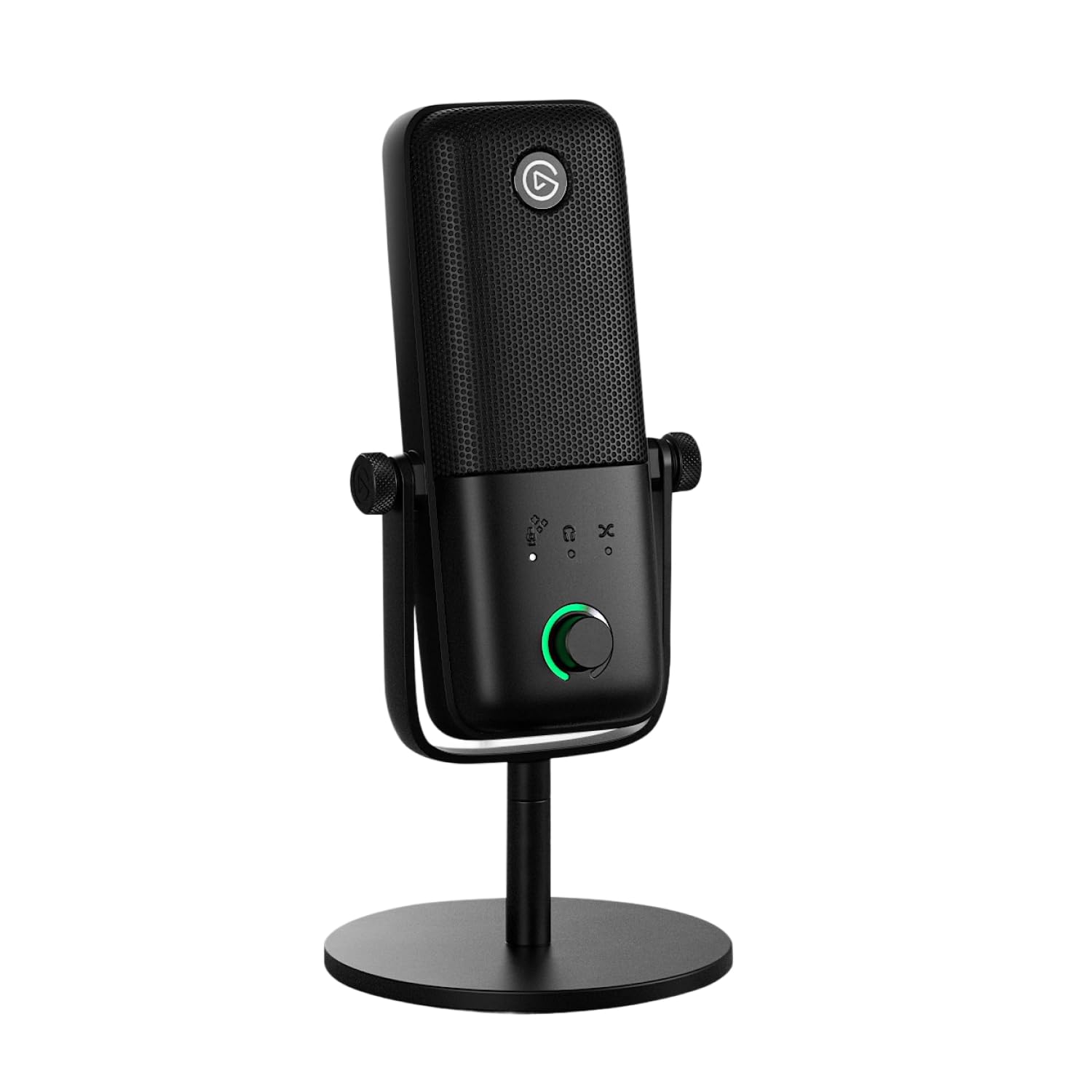
1. Elgato Wave:3 MK.2 USB Condenser Microphone
Our pick — over 4.5★ from 10,000+ verified ratings; the strongest balance of quality and price.
The studio-stream hybrid that keeps your voice clean even when the energy peaks.
This is the microphone that convinced countless streamers to ditch the headset. At its core is a premium condenser capsule that delivers focused, studio-quality vocals through a cardioid pattern, so your voice takes the spotlight while keyboard clatter and room echo fade into the background. The real headline here is the multi-stage Clipguard 2.0 protection system — this is an intelligent anti-distortion setup that makes clipping virtually impossible, even when you get loud during a heated moment. Pair that with the Auto Gain feature, which sets your levels in seconds and removes the guesswork from calibrating audio.
The onboard Wave FX Processor unifies DSP effects and VST plugins in one signal chain, meaning you can use the built-in voice enhancer, compressor, and EQ without needing a separate software interface. The multifunction dial and tap-to-mute sit right at your fingertips, and the real-time LED feedback plus an integrated headphone jack let you monitor your levels at a glance. While the microphone works well initially, some buyers report it stopped working after 2 months of use, so keep that warranty info handy. Still, its width of positive feedback — quality alone earns the most praise by a wide margin — makes it the crowd favorite for a reason.
One note on fit: the mic stands 8.4 inches tall, so be prepared for it to sit above your monitor’s bezel. It also requires the Wave Link app for full feature access, which may not appeal to those who want zero software dependency. Compared to the beyerdynamic FOX, this Elgato covers a narrower frequency range (20 kHz versus 96 kHz), but it outmuscles the FOX on features like on-demand noise removal and integrated effects that matter more for live streaming than raw recording bandwidth.
What wins people over
- Clipguard 2.0 makes harsh distortion basically a non-issue during loud moments
- Wave Link app gives you pro-level mixing and VST support for free
- USB-C connection and compact, sturdy build feel genuinely premium
The honest trade-offs
- Reports of failure after a few months, so check the return policy
- Tall chassis can block your monitor unless you use a boom arm
- Full feature set demands the Wave Link software, not truly standalone
Your best bet if: you are a streamer or podcaster who wants advanced onboard effects and a nearly fail-safe anti-distortion system.
Look elsewhere if: you prefer a truly no-software, plug-and-play mic or need a wider frequency range for critical music recording.
2. Razer Seiren V2 X USB Condenser Microphone
A tiny powerhouse that punches way above its weight for gamers and Mac dictation users.
Do not let the low price fool you — this is a 25mm condenser microphone with impressive sensitivity that captures voices with a high degree of accuracy, especially at higher frequencies. The supercardioid pickup pattern is noticeably tighter than standard cardioid, designed specifically to suppress noise from the back and sides, so your keyboard clicks and mouse clacks stay out of the mix. There is also a built-in shock absorber that dampens vibrations from accidental desk bumps, which is a rare find at this level. If you use a Mac, this mic is a standout choice — it works without any software for dictation and is noted as excellent for picking up whispers from 18 inches away.
The integrated digital limiter is programmed to automatically prevent clipping and peaking, so you never have to babysit your levels mid-game. Physical gain control and a mute button live on the body, plus a headphone jack for zero-latency monitoring of your own voice. A few owners mention it is definitely a directional mic, so speak directly into the top for optimal performance. The build is plastic but lightweight, and some streamers find a pop filter helpful if a fan is running in the background. Reliability is the most-discussed aspect after sound quality, and it gets positive marks there too.
The trade-off is audible noise rated at 78 Decibels (S/N ratio), which is on the lower side compared to the 105 Decibels of the beyerdynamic FOX. This means the recorded signal carries a bit more self-noise at high gain settings, so keep the mic close to your mouth and the gain moderate. The frequency response stops at 20 kHz, which is fine for speech but not ideal for capturing high-frequency instrument detail.
Smart for the cost: A rugged, feature-rich mic that beats the sound of any headset mic two tiers above its price. The supercardioid pattern is a genuine advantage in a noisy room.
The one catch: Plastic build and a modest audible noise floor mean you need to stay close and avoid cranking the gain too high.
Reach for this if… you want a reliable, compact gaming or dictation mic that works without software and rejects side noise well.
Think twice if… you are recording music at a distance or need a build that feels like a premium desk ornament.
3. beyerdynamic FOX USB Condenser Microphone

German engineering at 96 kHz that musicians love — once you get a good unit.
If your priority is raw recording fidelity on a budget, this is the mic that delivers 24-bit, 96 kHz studio-grade quality straight into your computer. That frequency response is 96 kHz versus the 20 kHz cap on the Elgato Wave:3 MK.2, which means the FOX preserves significantly more detail in the high-frequency range — ideal if you are recording acoustic guitar, cymbals, or voice with a lot of sibilant detail. The large diaphragm condenser capsule handles loud instruments without flinching, and the headphone output offers zero-latency monitoring, so you hear your own voice or instrument in real time with no delay. There is also a gain switch for blending with loud sources and a mute button on the body.
The catch is consistency. The first unit some owners received was defective — quiet and hissy — while the replacement performed excellently, sounding clean at 30 inches on high gain or 10 inches on low gain. A few units develop buzzing within weeks, and the bright always-on power LED that flashes when muted can be a nuisance in a dark streaming space. Notably, the FOX is incompatible with USB-C 3.0 ports; it requires a USB 2.0 connection to function correctly. Quality is the top positive aspect that owners praise, but the sound quality and build quality are marked as mixed in the broader consensus, and noise level draws the most negative attention. The audible noise figure is 105 Decibels — that is a 35% higher (better) signal-to-noise ratio than the Razer Seiren V2 X’s 78 Decibels, meaning the actual recording is cleaner and less prone to that underlying hiss. When the unit is good, it is very good.
The dimensions are 7.3 x 2.1 x 4.1 inches — that is a footprint of 7.3 x 2.1 x 4.1 inches versus the Elgato’s 3.9 x 3.9 x 8.4 inches, so the FOX takes up more desk surface despite being shorter. The stand is solid, but the overall build can feel a bit plasticky.
For the recording purist: class-leading sample rate and a clean signal path when the unit works right. The audible noise floor is genuinely low for this price bracket.
The honest reality: A notable quality-control lottery — a defective unit on arrival is not rare, and USB-C 3.0 incompatibility is a real annoyance for modern laptop users.
Best if: you are a musician or podcaster who records at 96 kHz and is willing to test the unit immediately and return if defective.
skip it if: you need guaranteed plug-and-play reliability from the start or use only USB-C 3.0 ports on a thin laptop.
4. Razer Seiren V3 Chroma RGB USB Microphone

A supercardioid mic that syncs with your game, with a tap-to-mute sensor that feels futuristic.
If your streaming or gaming setup revolves around visual flair, this mic brings lighting that reacts not just to Chroma-integrated titles but to stream events like emotes, alerts, and more. Under the colors sits a supercardioid condenser mic that captures more voice detail than a standard cardioid, supported by a tighter pickup pattern that suppresses room noise such as typing or mouse clicks. The multi-function tap-to-mute sensor on top lets you prevent audio mishaps with a single tap; you can map its double and triple tap commands to adjust lighting or toggle the digital gain limiter. A built-in shock absorber handles accidental vibrations, and the dynamic lighting warns you when audio levels are peaking — a clever visual safeguard.
The plug-and-play design works from the start with Discord, OBS Studio, and XSplit without any software, though you will want Razer Synapse for advanced customization like setting studio-level sample and bit rates or managing stream volume mixes. Some owners mention it has an excellent vocal clarity with background suppression that rivals more expensive mics, and the all-metal build feels sturdier than the Seiren V2 X. However, reliability gets mixed feedback — some units work perfectly while others fail within a period of use, so it is not a set-and-forget pick for long-term confidence. There is no headphone jack for direct monitoring, which is a notable absence for a mid-range mic. At 0.9 pounds, it is light and easy to mount on a boom arm, but users note a pop filter is advisable for best results.
Compared to the Elgato Wave:3 MK.2, the V3 Chroma gives you the RGB spectacle and a more aggressive supercardioid pattern, but loses the onboard DSP effects and proper latency monitoring through a headphone jack — you must monitor through your PC instead.
The visual advantage
- Game and stream reactive lighting adds genuine immersion to a gaming setup
- Supercardioid pattern offers excellent noise rejection for a noisy room
- Tap-to-mute sensor with customizable double/triple tap commands is genuinely handy
Where it falls short
- No headphone monitor jack means you cannot hear yourself in real time without software
- Mixed reliability feedback — some customers note failure over time
- Full customization depends on Razer Synapse software, not fully standalone
Reach for this if… RGB integration and a tactile mute sensor are high priorities in your streaming setup, and you strictly monitor through your PC.
Look elsewhere if… direct headphone monitoring is a must-have for your workflow or you need a rock-solid long-term reliability guarantee.
5. Logitech Creators Blue Yeti USB Microphone

The legend of the USB mic world — versatile enough for solo podcasters and roundtable interviews alike.
Its custom three-capsule array is the defining feature that separates it from almost everything else here: four pickup patterns (cardioid, omni, bidirectional, and stereo) let you switch from a solo voice track to a multi-person interview or a room mic with the flick of a dial. That kind of flexibility means you can record a podcast with two people around one mic in bidirectional mode, then switch to cardioid for a solo commentary track — something that would normally require multiple microphones. The onboard audio controls, including headphone volume, pattern selection, instant mute, and mic gain, put every level of the recording process at your fingertips without touching a mouse. The Blue VO!CE software adds broadcast-quality effects, advanced modulation, and HD audio samples for those who want to polish their tone further.
Build quality is a strong point — the metal enclosure and adjustable desktop stand feel like a piece of pro gear. It is not portable by any stretch, but it looks the part of a serious creative tool. The frequency response is rated at 20 Hz to 20 kHz, which covers the full range of human hearing and is typical for speech and most vocal work. Where the Yeti stands tall is in its sheer community trust — it is a reliable, easy-to-use USB mic that works beautifully for conference calls, podcasting, and voice-over work. Sound quality is crisp and studio-grade. The main trade-off is that this is a large, heavy microphone that takes up significant desk real estate, and its sensitivity means it will pick up room noise and rustling if not positioned carefully. Unlike the Elgato Wave:3 MK.2, the Yeti has no onboard DSP effects like compression or EQ built into the hardware, so you rely on the Blue VO!CE software or your own post-processing chain.
Compared to the Sennheiser Profile, the Yeti offers the massive advantage of multiple polar patterns but is bulkier and heavier on the desk. For a solo podcaster who only needs cardioid, the Profile is more elegant; for a creator who records different scenarios from a single mic, the Yeti remains class-leading.
The versatility king: Four polar patterns in one mic is a genuine advantage if you do interviews, record room ambience, or collaborate with others. The metal build inspires confidence.
The practical limit: It is physically large and sensitive, so you need a clean room and some desk space. Onboard effects are software-dependent, not embedded in the mic itself.
Best for: creators who need a single microphone that can handle solo streams, two-person podcasts, and field recording without buying a second mic.
pass on it if: desk space is tight, you prefer a lightweight small form factor, or you want hardware DSP effects built directly into the mic.
6. Sennheiser Profile USB Cardioid Condenser Microphone

A no-software, all-metal mic that delivers natural warmth the moment you plug it in.
Sennheiser built the Profile for the person who does not want to wrestle with drivers, apps, or menus. It is a plug-and-play cardioid condenser microphone with a premium, German-engineered capsule inside a metal housing. You connect it via USB-C, twist the dial for gain, and the sound is immediately natural and warm, accentuating the body and presence of the human voice. There is no software ecosystem to install — the headphone jack delivers zero-latency monitoring for your voice, the mute button changes color when active, and you can blend desktop audio with voice chat volume using the onboard mix control. Quality and sound quality are the two aspects owners praise most, and the positive feedback around functionality — 28 mentions — reflects how easy it is to get a professional result.
The table stand is compact and functional, but most owners eventually recommend a mic arm to get the capsule closer to their mouth. At 717 grams, it has a solid, dense feel without being a desk hog. A few owners experienced recognition issues on Windows 11, but Sennheiser support helped identify a mislabeled Windows setting as the cause. The cardioid pattern is fixed, so you cannot switch to omni for interviews — this is a dedicated solo-sound microphone. That makes it easier to use and simpler to position than the multi-pattern Blue Yeti, but also less flexible for group recording. Compared to the Elgato Wave:3 MK.2, the Profile lacks DSP effects and a multi-stage anti-clip system, but it wins on pure simplicity and that warm Sennheiser tonality that many describe as the best USB mic they have used.
There is no published sample rate in the spec sheet beyond the base USB standard, but for broadcast speech and streaming, the sound quality is widely reported as professional-grade. The trade-off is straightforward: you trade away effects and software mixing for a flawless out-of-box experience that will not burden you with updates or configuration.
Simplicity perfected: No software, no driver installations, no apps — just a premium metal mic that sounds excellent the instant you plug it in. The controls are right on the body.
The one limitation: Fixed cardioid pattern and no built-in effects mean it is strictly a solo-use mic — not for interviews or sound design.
Reach for this if… you want a premium, plug-and-play mic with zero software clutter and excellent natural vocal warmth.
Think twice if… you need multiple polar patterns or hardware-based effects like compression or de-essing built directly into the microphone.
7. Audio-Technica AT2020USB-X Cardioid Condenser USB Microphone

The XLR classic now speaks USB — 96 kHz resolution with the studio lineage you trust.
Audio-Technica’s AT2020 is arguably the most famous entry-level studio condenser in the world, and the USB-X version brings that same smooth, extended frequency response to a plug-and-play format. The high-resolution AD converter operates at 24-bit / 96 kHz sampling rate for extremely clear, natural sound reproduction — the same raw recording quality as the beyerdynamic FOX but with a much longer track record of reliability. The cardioid pickup pattern minimizes background noise effectively, and the built-in headphone jack lets you monitor your audio directly from the microphone in real time. A soft-touch capacitive mute button on the body silently mutes the audio, and the two-state LED indicator ring lights blue when powered and red when muted — a simple but effective visual cue.
The included custom desk stand is solid and heavy, and the package contains a USB-C to USB-A cable with a USB-A to USB-C adapter for maximum compatibility. The audible noise is rated at 80 Decibels (S/N ratio), which is a middle ground between the Razer Seiren V2 X’s 78 Decibels and the beyerdynamic FOX’s 105 Decibels — clean enough for serious recordings but not class-leading. The mic is quite sensitive, so it picks up faint sounds like a furnace vent or room rustles, and the light stays on even when the computer is off. Some reviewers point out it can handle a loud electric guitar without loss, making it versatile beyond just voice. Compared to the Elgato Wave:3 MK.2, the AT2020USB-X lacks DSP effects and the Clipguard 2.0 protection system, meaning you cannot correct distortion after the fact — you must set your levels carefully. But for pure, transparent audio fidelity, this is the choice for critical home studio work.
At 600 Ohms impedance, it is a high-impedance microphone, which means it needs a clean USB power source; some users found it requires a powered USB hub when used with an iPad. The frequency response is rated at 20 Hz, covering the low end well but the high-frequency extension beyond that is not explicitly published.
The studio heritage
- 96 kHz / 24-bit conversion delivers genuinely pro-level recording detail
- Solid metal and stainless steel build feels like a permanent piece of gear
- Capacitive mute button is silent and responsive, no mechanical click
The honest limits
- High sensitivity picks up room noise easily — best in a quiet treated space
- No onboard effects or auto-leveling; you manage gain and post-processing yourself
- LED stays lit even when computer is off, which annoys some owners
Best for: musicians, voiceover artists, and podcasters who want a trusted studio standard with 96 kHz capability and do not mind doing their own level and noise management.
Not ideal for: noisy gaming rooms or streamers who prefer automatic clipping protection and software-driven effects built into the mic.
Understanding the Specs
Polar Patterns
The polar pattern describes the direction the microphone hears sound from. A cardioid pattern picks up sound from a heart-shaped area in front of the mic while rejecting noise from the sides and back — this is the most common pattern for solo speech and streaming. Supercardioid is even tighter, offering better side rejection but also catching a small amount of rear sound, which can be an issue if you have a noisy monitor behind the mic. Omni picks up sound from all directions equally, great for capturing room ambience or group conversation. Bidirectional picks up sound from the front and back only, ideal for two-person interviews facing each other with the mic between them. Stereo uses two capsules to create a wide left-right image, which is useful for recording acoustic instruments or ambient soundscapes.
Sample Rate & Bit Depth
Sample rate (measured in kHz) determines how many times per second the microphone measures the sound wave. 44.1 kHz is CD-quality and sufficient for most speech and streaming. 96 kHz captures more high-frequency detail, which gives you more headroom when editing or applying effects later. Bit depth (16-bit vs 24-bit) determines the dynamic range — 24-bit offers about 48 dB more headroom, which means you can record at a lower level and still have room to boost the volume in post without introducing noise. For most streamers and podcasters, 44.1 kHz / 16-bit is perfectly fine. For music recording or intensive post-production, aim for 96 kHz / 24-bit. Note that higher sample rates produce larger files and require more from your computer’s processor.
FAQ
What is the difference between condenser and dynamic microphones?
Does a condenser USB microphone require phantom power?
Will a condenser USB microphone work with my gaming console?
How far should I sit from a condenser USB microphone?
What is a pop filter and do I need one?
Can I use a condenser USB microphone with a boom arm?
What does a mute button on a microphone do?
Why does my condenser USB microphone pick up background noise?
Is a higher sample rate always better?
Can I use two USB microphones at the same time?
Final Thoughts: The Verdict
For most streamers, podcasters, and content creators, the Elgato Wave:3 MK.2 is the most complete package because it pairs a premium condenser capsule with an intelligent anti-distortion system and powerful Wave Link software for mixing and effects — all in a compact, sturdy build. If you want a truly no-fuss, plug-and-play experience with rich German-engineered vocal warmth, grab the Sennheiser Profile. And for critical music recording on a budget where 96 kHz fidelity matters more than onboard effects, the Audio-Technica AT2020USB-X or the beyerdynamic FOX are the ones to reach for.
How We Picked
We do not accept paid placement. Every pick is matched to a real buyer and a real use-case; we do not hands-on test units.
Sources & Methodology
Specifications: manufacturer listings and product documentation. Review insights: verified customer reviews, as of July 2026. Pricing: not shown on this page (it changes often); check the current price via the retailer link.
As an Amazon Associate, WellFizz earns from qualifying purchases. This does not affect which products we feature.
Related Guides

Mo Maruf
I created WellFizz to bridge the gap between vague wellness advice and actionable solutions. My mission is simple: to decode the research and give you practical tools you can actually use.
Beyond the data, I am a passionate traveler. I believe that stepping away from the screen to explore new environments is essential for mental clarity and physical vitality.