Our readers keep the lights on and my smoothie glass nicely filled. As an Amazon Associate, I earn from qualifying purchases.
The difference between a muddy, distant recording and a professional, intimate vocal track often comes down to one decision: the microphone capsule that captures it. A condenser microphone’s sensitive diaphragm translates air movement into electrical signals with far greater detail than dynamic alternatives, but that sensitivity cuts both ways—revealing every plosive, every room reflection, and every instance of electronic self-noise the preamp generates.
I’m Mohammad Maruf — the founder and writer behind WellFizz. I’ve spent hundreds of hours analyzing frequency response curves, self-noise ratings, polarization schematics, and polar pattern consistency across dozens of studio-grade and USB condenser models to separate genuine engineering progress from marketing claims in this saturated category.
This guide covers seven contenders spanning entry-level USB mics to premium large-diaphragm XLR capsules. What matters is the right combination of capsule size, self-noise floor, and connectivity for your specific space and workflow when selecting the best condenser microphone.
How To Choose The Best Condenser Microphone
Condenser mics are defined by their electrically polarized diaphragm and backplate, which require external power (48V phantom power for XLR models or bus power for USB models). The critical trade-off is sensitivity versus self-noise: a larger diaphragm captures more low-end detail but also introduces more thermal noise. For home studios and untreated rooms, prioritizing a low self-noise floor (under 10 dBA) gives you cleaner takes without aggressive noise gating.
Connectivity: USB vs. XLR
USB condenser mics include an analog-to-digital converter (ADC) and preamp inside the body, making them fully self-contained. XLR condensers require an external audio interface with phantom power. USB simplifies setup and portability, while XLR offers higher headroom, lower latency, and the ability to swap preamps or upgrade your signal chain later. The decision comes down to whether your future includes a dedicated interface or you want one-cable convenience right now.
Capsule Size and Polar Pattern
Large-diaphragm condensers (typically 1-inch or larger) deliver a warmer, fuller sound and higher sensitivity, making them ideal for vocals and acoustic instruments. Small-diaphragm condensers provide a flatter, more transient-accurate response preferred for drum overheads and classical recording. Most all-purpose vocal condensers use a cardioid polar pattern, which rejects sound from the rear and sides. Mics with multiple switchable patterns (cardioid, omnidirectional, bidirectional) let you adapt to different recording scenarios, from solo podcasting to two-person interviews.
Self-Noise and SPL Handling
Self-noise is the electronic hiss the mic produces even in silence, measured in dBA. Lower is better: studio-grade condensers sit between 4 and 10 dBA, while budget models often exceed 20 dBA. For quiet sources like voiceover or fingerpicked guitar, every dBA matters. Conversely, SPL (sound pressure level) handling, measured in decibels, determines how loud a source the mic can capture before distorting. A high-SPL rating (130 dB or above) is important for drum close-mic’ing or loud vocalists. Balancing these two specs ensures you neither hear electronic noise on quiet passages nor clip on peaks.
Quick Comparison
On smaller screens, swipe sideways to see the full table.
| Model | Category | Best For | Key Spec | Amazon |
|---|---|---|---|---|
| RØDE NT1 Signature Series | XLR Studio | Professional Vocal Recording | 4 dBA Self-Noise | Amazon |
| LEWITT LCT440PURE | XLR Studio | Versatile Studio & Home Recording | 7 dBA Self-Noise | Amazon |
| Audio-Technica AT4040 | XLR Studio | High-SPL Instrument & Vocal Sources | Transformerless Circuit | Amazon |
| SENNHEISER Profile | USB Streaming | Software-Free Live Streaming | 60 dBA Noise Floor (Max) | Amazon |
| Audio-Technica AT2020USB-X | USB Studio | Plug-and-Play Home Recording | 24-Bit / 96 kHz ADC | Amazon |
| Logitech Blue Yeti | Multi-Pattern USB | Versatile Podcasting & Gaming | 4 Pickup Patterns | Amazon |
| Audio Technica AT2020 (XLR Bundle) | Entry-Level XLR | Beginning XLR Setup | 20 Hz – 20 kHz Range | Amazon |
In‑Depth Reviews
1. RØDE NT1 Signature Series

RØDE achieves a self-noise of just 4 dBA with the NT1 Signature Series, making it the quietest studio condenser in this roundup. The HF6 1-inch true condenser capsule delivers a smooth frequency response with a slight presence lift around 8 kHz that adds clarity without harshness, ideal for capturing vocal nuance and acoustic guitar detail in untreated rooms where noise floor matters most.
The package includes the SM6 shock mount, a high-quality pop filter, and a 6-meter XLR cable — accessories that would cost significant extra with competing mics. The all-metal construction and Australian precision engineering feel substantial, and the 10-year warranty underlines RØDE’s confidence in long-term reliability.
This mic requires 48V phantom power and an audio interface with sufficient gain (at least 60 dB recommended) to drive its 4 dBA floor cleanly. Avoid this if you need USB connectivity or plan to record in highly reflective rooms without acoustic treatment, as the exceptional sensitivity will pick up every room flaw.
Why it’s great
- World-class 4 dBA self-noise captures quiet sources without hiss
- Complete studio bundle with professional shock mount and pop filter
- 10-year warranty signals exceptional build quality
Good to know
- XLR-only; needs phantom power and audio interface
- Extreme sensitivity reveals untreated room acoustics
2. LEWITT LCT440PURE

The LEWITT LCT440PURE centers on a 1-inch true condenser capsule that delivers a warm, detailed character with excellent off-axis rejection. Its cardioid polar pattern attenuates rear-arriving sound by more than 25 dB, making it a strong choice for home studios where noise from computer fans or room reflections can bleed into open mics.
Self-noise measures 7 dBA — exceptionally low for a mic at this level — and the SPL handling of 140 dB means you can close-mic a guitar cabinet or drum kit without audible distortion. The included magnetic pop filter and shock mount reduce setup friction, and the zinc die-cast body feels built to survive years of studio use.
Some users note that the shock mount restricts full 360-degree rotation, which may limit positioning flexibility on some boom arms. The mic is also XLR-only, requiring an interface with clean gain. For vocalists and podcasters who want a noticeable step-up from entry-level condensers without jumping to territory, this is a compelling middle ground.
Why it’s great
- Low 7 dBA self-noise and 140 dB SPL handling
- Excellent off-axis rejection minimizes room bleed
- Includes magnetic pop filter and shock mount
Good to know
- Shock mount limits full 360-degree rotation
- XLR-only; requires external interface and phantom power
3. Audio-Technica AT4040

Audio-Technica’s AT4040 uses an externally polarized large diaphragm with transformerless circuitry, a design that virtually eliminates low-frequency distortion and preserves transient detail. The precision-machined nickel-plated brass baffle stabilizes the element, resulting in consistent performance even when handling high SPL sources like grand pianos or brass instruments — which is where this mic truly separates itself from the AT2020 and AT2030 series.
The included AT8449 shock mount fits standard 5/8-inch threaded stands, and a protective carrying case adds travel safety. With response extending to 20 kHz and a dynamic range wide enough to handle peaks without clipping, the AT4040 operates comfortably in both critical studio tracking and live sound applications.
At this price point, the AT4040 competes with mics that include built-in pad switches or high-pass filters, so the lack of on-board attenuation and roll-off may be a limitation in some setups. Sibilance can be noticeable on certain voices without careful de-essing, but the overall clarity and headroom justify its reputation as a reliable all-rounder.
Why it’s great
- Transformerless design eliminates low-frequency distortion
- Nickel-plated brass baffle ensures stable, consistent response
- Excellent SPL handling for piano, drums, and loud vocals
Good to know
- No built-in pad or high-pass filter
- Can exhibit sibilance on bright voices without de-essing
4. SENNHEISER Profile

Sennheiser’s Profile sidesteps the reliance on proprietary software that plagues many USB microphones. The cardioid condenser capsule delivers a natural, warm vocal tone right out of the box, with physical dials for gain, mix, and headphone volume giving you tactile control without any driver installation. The mute button includes a visual indicator, and the headphone jack offers zero-latency monitoring.
The metal housing and German-engineered capsule provide durability, while the USB-C connection (with included 1.2 m cable) works across Windows, macOS, and Linux without special drivers. The table stand is compact but functional; many users ultimately mount the Profile on a boom arm for better placement.
The low-profile stand can be limiting on a cluttered desk, and the self-noise ceiling of 60 dBA is higher than XLR studio condensers — though still acceptable for live streaming, video calls, and podcasting where the host is close to the mic. If you refuse to install another piece of bloated audio software, this is the cleanest USB path.
Why it’s great
- No software required; universal USB-C plug-and-play
- Physical controls for gain, mix, and headphone volume
- Zero-latency monitoring through built-in headphone jack
Good to know
- Table stand is low-profile; boom arm recommended for ergonomics
- Self-noise is higher than dedicated XLR studio condensers
5. Audio-Technica AT2020USB-X

The AT2020USB-X retains the cardioid capsule design from Audio-Technica’s popular AT2020 line, but upgrades the internal ADC to support 24-bit depth at 96 kHz sampling rate — delivering significantly better transient resolution and lower noise than the standard 16-bit/48 kHz converters found in most entry-level USB mics. The result is a noticeably cleaner, more detailed capture of vocals and acoustic instruments.
A soft-touch capacitive mute button on the body lets you silence the mic instantly without handling noise, while the two-state LED ring glows blue when active and red when muted. The custom desk stand and included USB-C to USB-A cable (plus USB-A to USB-C adapter) make this fully cross-platform compatible, including with some Android tablets that support USB audio.
The mic is extremely sensitive — a sign of quality, but a liability in noisy environments. Several users report picking up furnace vents, PC fans, and other ambient sounds. The cardioid pattern helps, but in an untreated room, you may still need noise-gate software. The lack of an internal pop filter means plosives can be prominent without an external add-on.
Why it’s great
- High-resolution 24-bit/96 kHz ADC for cleaner digital capture
- Soft-touch mute with clear LED status indicator
- Works with PC, Mac, and compatible Android devices
Good to know
- Very sensitive; picks up ambient noise in untreated rooms
- No internal pop filter; plosives can be an issue
6. Logitech Blue Yeti

The Blue Yeti’s defining feature is its triple-capsule array, which enables four switchable polar patterns: cardioid, omnidirectional, bidirectional, and stereo. This flexibility allows one mic to handle solo podcasting (cardioid), two-person interviews (bidirectional), conference calls (omnidirectional), and acoustic instrument recording (stereo) — replacing multiple microphones in a single USB device.
Onboard controls include a mute button, headphone volume dial, microphone gain knob, and dedicated pattern selector. The included adjustable desktop stand is stable and allows tilting, reducing the need for an immediate boom arm purchase for many users. Blue VO!CE software adds compression, EQ, and effects processing for streamers who want polished audio without post-production.
The Yeti’s self-noise is higher than the XLR options on this list, and the built-in stand is surface-sensitive — vibrations from desk movements or typing can transmit through the base. In shared or noisy rooms, the omnidirectional and bidirectional patterns will capture significant background chatter. The mic is also noticeably larger and heavier, requiring more desk space than slim profile mics.
Why it’s great
- Four pickup patterns cover multiple recording scenarios with one mic
- Full physical controls for gain, mute, pattern selection, and volume
- Blue VO!CE software offers effects without external hardware
Good to know
- Desk stand transmits vibration noise; boom arm helps
- Higher self-noise than dedicated XLR studio condensers
7. Audio Technica AT2020 (XLR Bundle)
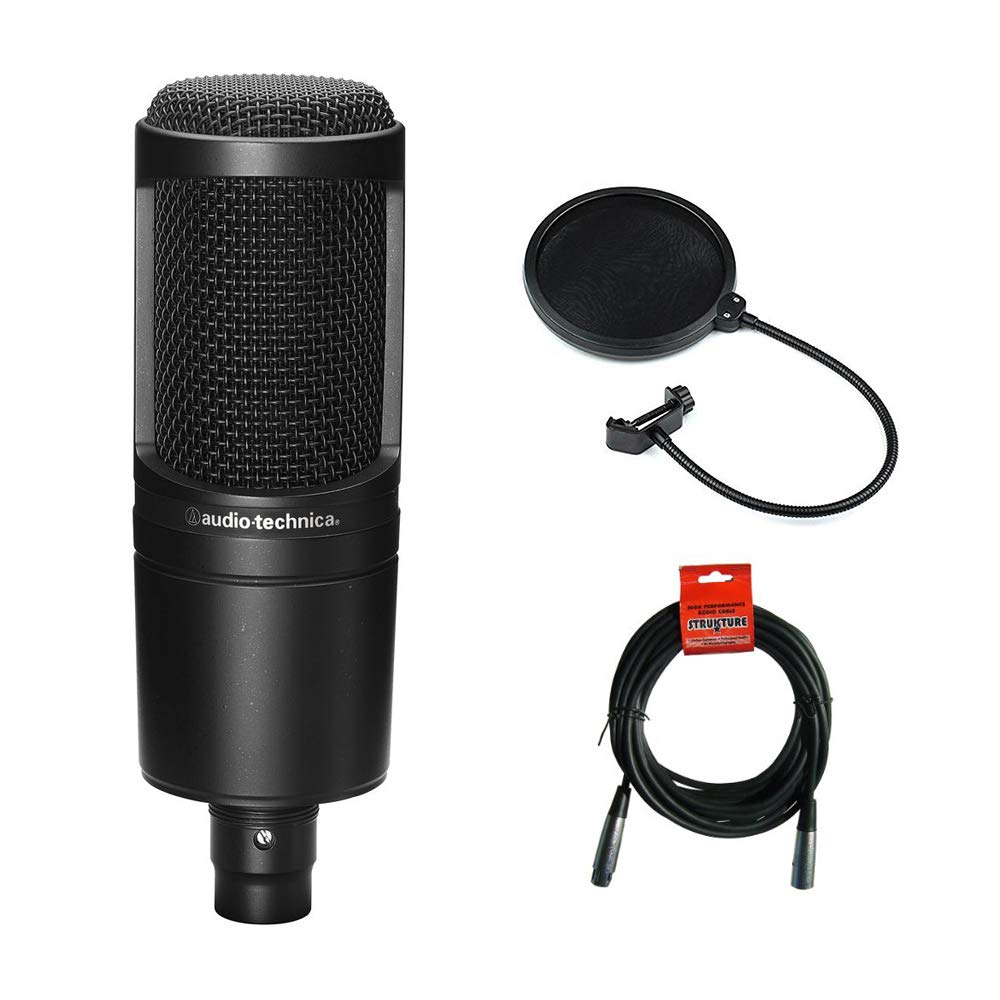
This bundle packages Audio-Technica’s entry-level XLR condenser with a pop filter and a 20-foot balanced XLR cable at a price that undercuts buying the components separately. The AT2020’s low-mass diaphragm provides excellent transient response and a frequency range that covers the full audible spectrum, making it a capable starting point for vocal and speech recording.
The included pop filter is a necessary addition — the AT2020’s unprotected capsule picks up plosives aggressively without it. The 20-foot XLR cable offers generous positioning flexibility, letting you place the mic on a boom arm away from the interface. The metal housing feels solid for the price tier, holding up well in home studio environments.
This is strictly an XLR mic; you will need an audio interface with phantom power to use it. The self-noise is higher than premium condensers, and the cardioid pattern’s rear rejection is adequate but not exceptional — background noise from room reflections can still reach the capsule. If you already own an interface and want the cheapest path into a real XLR condenser, this bundle delivers.
Why it’s great
- Affordable entry into XLR condenser recording
- Bundle includes pop filter and 20-foot XLR cable
- Solid metal construction for the price point
Good to know
- Requires audio interface with 48V phantom power
- Self-noise is higher than mid-range and premium options
FAQ
Can I plug a condenser microphone directly into my computer?
What polar pattern should I choose for solo podcasting?
Why does my condenser mic pick up so much background noise?
Final Thoughts: The Verdict
For most users, the best condenser microphone winner is the RØDE NT1 Signature Series because its 4 dBA self-noise floor is effectively silent for home studio use, the included shock mount and pop filter eliminate hidden costs, and the 10-year warranty removes long-term risk. If you want a USB mic that doesn’t force you into proprietary software, grab the SENNHEISER Profile. And for the highest value XLR upgrade path from entry-level, nothing beats the LEWITT LCT440PURE.

Mo Maruf
I created WellFizz to bridge the gap between vague wellness advice and actionable solutions. My mission is simple: to decode the research and give you practical tools you can actually use.
Beyond the data, I am a passionate traveler. I believe that stepping away from the screen to explore new environments is essential for mental clarity and physical vitality.