Our readers keep the lights on and my smoothie glass nicely filled. As an Amazon Associate, I earn from qualifying purchases.
Specs are compiled from manufacturer listings and verified buyer reviews and can change over time — please confirm the key details on the product page before buying.
Finding the right condenser microphone under can feel like deciphering a secret code of specs and buzzwords. You want that rich, studio-quality sound for your voice, but you don’t want to blow your budget on something that sounds thin or picks up every single echo in your room. This guide cuts through all that by comparing seven top contenders on the specs that actually matter for your voice.
I’m Mohammad Maruf — the founder and writer behind WellFizz. This guide is built by comparing the manufacturers’ published specifications and the patterns across verified customer reviews, so you get each pick’s real strengths and trade-offs instead of marketing spin.
You want a condenser mic under 500 that captures your voice clearly while staying affordable. Here is what each model does best so you can pick the right one for your home studio or streaming rig without wasting time or money.
Quick Picks
- Warm Audio WA47jr Large Diaphragm Condenser Mic, Black — Best Overall
- Audio-Technica AT4040 Cardioid Condenser Microphone — Premium Pick
- Audio-Technica AT2050 Multi Pattern Condenser Mic — Best Value
- Aston Microphones Origin Large Diaphragm Cardioid Condenser Microphone — Top Performer
- Blue Blackout Spark SL XLR Condenser Microphone — Best for Streaming
- LEWITT LCT 240 Pro Large Diaphragm Condenser Mic — Great for Untreated Rooms
- Audio Technica AT2020 Condenser Studio Microphone Bundle with Pop Filter and XLR Cable — Budget Champion
How To Choose The Best Condenser Mic Under 500
Picking a condenser microphone is less about “loudness” and more about how much detail the mic can capture from your voice. The key is matching the mic’s technical specs to the kind of space you are recording in and the sound profile you prefer.
Pickup Pattern: The Room Matters More Than You Think
The pickup pattern determines where the microphone hears sound from. A cardioid pattern (heart-shaped) picks up sound from the front and rejects noise from the sides and rear, making it the standard for untreated rooms. Multi-pattern mics let you switch between cardioid, omni-directional (hears everything), and figure-8 (hears front and back), which is a major advantage if you plan to record multiple instruments or two people face-to-face.
Self-Noise and Frequency Response: The Clarity Specs
Self-noise, measured in decibels (dB), is the tiny hum the mic makes on its own. A lower number means a quieter mic and a cleaner recording, especially for quiet vocals or acoustic guitar. Frequency response (measured in Hz) tells you the range of pitches the mic can capture — a wider range usually means more detail in the highs (sibilance, air) and authority in the lows.
Build and Mounting: Does It Fit Your Stand?
Condenser microphones need an XLR connection and 48V phantom power from your audio interface. They come in different weights, from under 1 pound to over 3.5 pounds. A heavier mic might need a sturdier boom arm or a separate shock mount to prevent vibrations from your desk getting into the recording.
Quick Comparison
| Model | Best For | Pickup Pattern | Audible Noise | Item Weight | Amazon |
|---|---|---|---|---|---|
| Warm Audio WA47jr | Vintage Vibe + Multi-Pattern | 3 Polar Patterns | — | 3.59 Pounds | Amazon |
| Audio-Technica AT4040 | Low-Noise Studio Clarity | Cardioid | — | — | Amazon |
| Audio-Technica AT2050 | Multi-Pattern Versatility | Omni / Cardioid / Figure-8 | — | — | Amazon |
| Aston Microphones Origin | Rugged Build + Warm Sound | Cardioid | — | 1.25 Pounds | Amazon |
| Blue Blackout Spark SL | Vocals and Streaming | Cardioid | 16.4 Decibels | 11.52 Ounces | Amazon |
| LEWITT LCT 240 Pro | Compact Home Studio | Cardioid | 20 Decibels | 1.5 Pounds | Amazon |
| Audio-Technica AT2020 Bundle | Budget Starter Pack | Cardioid | 20 Decibels | — | Amazon |
In‑Depth Reviews
1. Warm Audio WA47jr Large Diaphragm Condenser Mic, Black
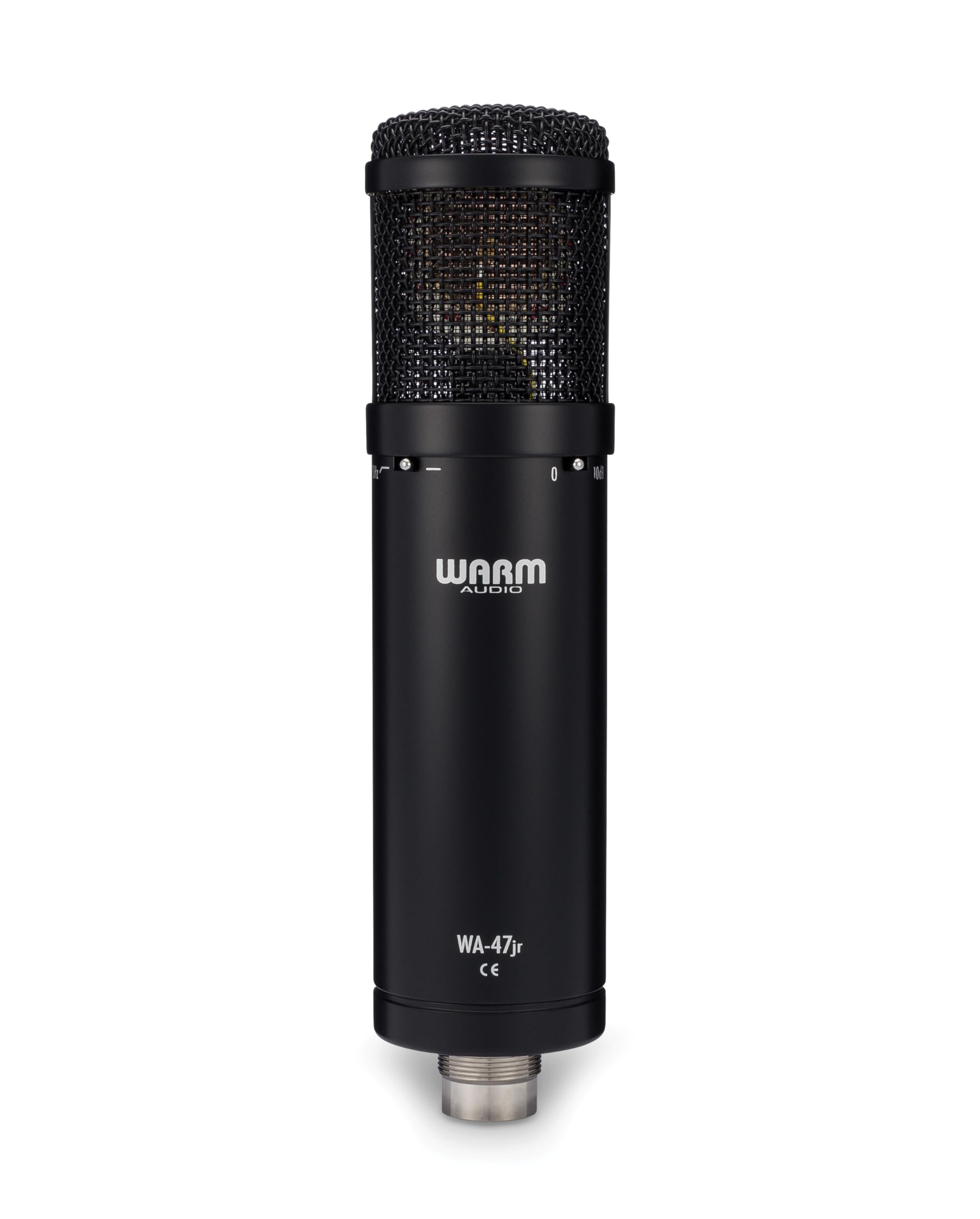
The premium vintage-voiced workhorse that gives you three polar patterns for serious studio growth.
The Warm Audio WA47jr gives you that classic ’47 tube-mic character in a modern, transformerless FET (a type of transistor circuit that delivers clean gain) package. It uses a custom K47-style capsule (the component that captures sound) reproduction, designed with the same hole pattern and frequency response as the vintage design, so you get that sought-after smooth top end and warm low-mid presence without the sky-high price tag. It offers 3 polar patterns to choose from, letting you switch between cardioid (standard), omni, and figure-8 for different recording scenarios.
This mic is designed for pro studio, home studio, live, and broadcast applications, making it incredibly versatile. The major trade-off is its weight — at 3.59 pounds, it is noticeably heavier than the Aston Origin’s 1.25 pounds, which means you need a sturdy, high-quality boom arm or its included shock mount to hold it securely. Reviewers on Amazon highlight its rich, vintage-inspired sound that sits well in a mix, though some note it is on the heavier side for standard mic stands.
Unlike the Blue Blackout Spark SL, which is a fixed-cardioid mic, the WA47jr gives you the pattern flexibility of the AT2050 but with that distinct, sought-after warm character. This is the pick for the buyer who wants a real step up in sonic character — that vintage vibe that is hard to dial in with EQ.
Vintage character: Custom K47-style capsule delivers a smooth, warm sound that excels on vocals and acoustic instruments.
The practical catch: At 3.59 pounds, it requires a serious mic stand or boom arm — not for a lightweight desk arm.
Grab this if: You want a multi-pattern mic with a signature vintage tone and plan to use it with a professional studio stand.
Pick a lighter option if: You use a budget boom arm or need to mount it on a lightweight desk stand without risk of drooping.
2. Audio-Technica AT4040 Cardioid Condenser Microphone

The transparent, ultra-clean cardioid that handles loud sources without a hint of distortion.
The Audio-Technica AT4040 is an externally polarized true condenser design (meaning it requires 48V phantom power and uses an external charge to capture sound accurately). Its transformerless circuitry virtually eliminates low-frequency distortion and provides superior handling of high-speed transients — ideal for capturing the attack of a guitar pick or the crisp detail of a sibilant vocal. It delivers exceptionally low noise and a wide dynamic range and high-SPL (Sound Pressure Level) capability for greatest versatility, so you can record a loud amp without the garbled crackle.
Buyers report this mic is a strong, clean, and quiet performer even with loud and complex sound from a large grand piano, noting it handles complex overtones and bass without distortion unlike the AT2035. A precision-machined, nickel-plated brass acoustic element baffle provides enhanced stability, and it includes the AT8449 shock mount for 5/8-27 threaded stands. The notable trade-off based on specs is that its self-noise specification is not shown here, while the Blue Blackout Spark SL is listed at 16.4 Decibels, so buyers who prioritize very quiet vocal recording should compare the published noise specs before deciding.
The AT4040 also lacks the multi-pattern switching of the AT2050, but it offers arguably cleaner electronics and better handling of high-volume sources for that pristine studio capture.
Clean and quiet: Transformerless design and high-SPL capability make it a top choice for loud instruments and vocals.
One spec to note: The self-noise is higher than other premium options, so it’s best for louder sources or well-treated rooms.
Reach for this if: You need a mic you can push hard on a snare drum or a loud vocalist and still get a clean, undistorted track.
Look elsewhere if: Your main priority is recording quiet, intimate vocals in an untreated space where low self-noise is critical.
3. Audio-Technica AT2050 Multi Pattern Condenser Mic

The bargain multi-pattern mic that brings pro versatility to a home studio budget.
The Audio-Technica AT2050 is a multi-pattern condenser mic that offers three switchable polar patterns: omni (hears equally from all directions), cardioid (rejects rear and side noise), and figure-of-eight (rejects side noise). This means you can use it for a single vocalist, a two-person interview, or capturing room ambiance for an instrument, all with the same mic. It also includes a switchable 80 Hz high-pass filter (which cuts low rumble from traffic or HVAC) and a 10 dB pad (which prevents distortion from very loud sources).
Owners mention that it delivers crisp, clear vocals with different frequencies and works beautifully with Apogee Duet 2 interfaces. Customers note it is incredibly powerful for vocal performance recordings, but also use it for business calls and conversations due to its excellent clarity. The large diaphragm delivers a smooth, natural sound with low noise. It comes with a shock mount and a protective pouch, making it a complete package for the price. While it doesn’t have the low self-noise of the Blue Blackout Spark SL’s 16.4 dB, its pattern flexibility is a massive advantage over that fixed-cardioid mic.
When compared directly to the more expensive Warm Audio WA47jr, the AT2050 uses a different sonic approach — it is cleaner and more neutral, whereas the WA47jr aims for a specific vintage character. For someone wanting to experiment with recording techniques (mid-side stereo, duel vocalists), the AT2050 is the smarter, more flexible buy.
Versatile patterns: Switch between omni, cardioid, and figure-8 opens up a world of recording techniques without buying extra mics.
Built-in controls: The 80 Hz high-pass filter and 10 dB pad give you room to cut noise and handle loud sources.
Best for: The adventurous home recordist who wants to learn different mic techniques — omni for ambience, figure-8 for duets.
skip it if: You only ever record one voice in the same spot — the extra pattern features will go unused.
4. Aston Microphones Origin Large Diaphragm Cardioid Condenser Microphone

The brutally rugged British mic that packs an integrated pop filter and a surprisingly warm character.
The Aston Microphones Origin features a chassis made from 2 millimeter solid stainless steel that is laser cut and etched, making it incredibly tough — perfect for a busy home studio or a tour bag. It also has a built-in pop filter using stainless steel mesh knit technology, which saves you the hassle of buying an external pop filter and keeps plosive pops out of your recordings. The large diaphragm cardioid capsule is voiced for a “warm, crisp sound with low self-noise,” which works beautifully for vocals, voice-overs, and acoustic guitar.
Buyers highlight its effective cardioid pattern that rejects background noise well, and its ability to handle gain for subtle vocal nuances without added hiss. At 1.25 pounds versus the Warm Audio WA47jr’s 3.59 pounds, it is easier to mount on a budget boom arm. However, reviewers point out that finding an off-brand shock mount is difficult and it lacks deep bass response compared to some rivals, though this can be fixed with a little post-processing.
One reviewer noted they performed well enough in a final mix over a more expensive Soyuz O17 microphone. While the Audio-Technica AT2050 gives you multi-pattern switching, the Aston Origin focuses all its engineering on delivering one winning cardioid sound in a tank-proof package.
Tank-tough build: 2mm stainless steel chassis and a built-in pop filter make this a low-maintenance workhorse for any environment.
Compact and light: At only 1.25 pounds, it is significantly easier to mount than heavier mics like the WA47jr.
Grab this if: You want a fuss-free, durable mic that sounds warm right from the start and doesn’t need extra gear like a pop filter.
Look elsewhere if: You need multi-pattern switching or deep sub-bass response for kick drums or floor toms.
5. Blue Blackout Spark SL XLR Condenser Microphone

The low-noise, high-clarity vocal mic with a legendary Blue sound for streaming and voiceovers.
The Blue Blackout Spark SL delivers that famous Blue broadcast vocal sound, known for being crisp and ideal for voiceovers, streaming, and gaming. It uses custom Blue condenser capsule with Class-A JFET electronics (a high-quality amplifier circuit that provides a rich, detailed sound) to provide studio quality sound with rich harmonic audio. It has a precise cardioid pattern to help isolate your voice from background noise like keyboard clicks.
A standout spec here is its low audible noise — it is listed at 16.4 Decibels, while the LEWITT LCT 240 Pro and Audio-Technica AT2020 are each listed at 20 Decibels. This means your recordings will have less inherent hum, giving you a cleaner signal to work with, especially for quiet vocal passages. It also includes a 100Hz high-pass filter (cuts low rumble) and a -20dB pad (which prevents distortion from loud audio), making it versatile enough for a variety of sources. At only 11.52 ounces, it is very lightweight and easy to mount.
Buyers consistently mention that it offers superior value for the price point and is excellent for low/mid-toned voices, delivering a warm radio-announcer sound with presence when paired with a high-quality preamp like the GOXLR Mini. The included wooden storage box and custom shock mount add to its premium feel.
Incredibly quiet: With self-noise at 16.4 Decibels, this is among the most silent mics on the list — great for quiet vocals.
Legendary Blue sound: The Class-A JFET electronics give that rich, broadcast-quality tone that streamers and podcasters love.
Best for: Streamers, podcasters, and voice actors who need a broadcast-ready sound with a very low noise floor.
Keep in mind: The cardioid-only pattern means it is less versatile for stereo recording techniques compared to multi-pattern mics.
6. LEWITT LCT 240 Pro Large Diaphragm Condenser Mic

The compact problem-solver that gives you studio detail while reducing the annoying boominess of close miking.
The LEWITT LCT 240 Pro is an extremely versatile cardioid condenser microphone designed for modern home studios. It features a high-performance condenser capsule that enables clean, modern, and detailed recordings, with a special boost for airy frequencies to add sparkle to your vocals. Its most practical feature is its reduced proximity effect (the bass boost that happens when you get very close to a mic) — this means your voice stays clear and natural even when you are close to the capsule, without that muddy, boomy low-end.
Shoppers say that it has a very low noise floor (zero audible at normal levels) and that no external booster is needed, making it ideal for untreated home studios. They also mention a slight 2kHz harshness compared to an RE320 but note it is half the price, making the trade-off well worth it. The mic is compact and light at just 1.5 pounds, fitting easily on any boom arm. Its stainless steel enclosure adds to its durability.
When compared to the Audio-Technica AT2020, the LCT 240 Pro offers a more modern, detailed sound that is less likely to get muddy up close. If you are recording in a room without sound treatment, its reduced proximity effect is a real asset that saves you from having to EQ out unwanted boominess later.
Reduced proximity effect: This keeps your voice clear and natural when you are close-miking, reducing the muddy bass that plagues many condensers.
Compact form: At 1.5 pounds, it is easy to position and fits on budget boom arms without sagging.
Grab this if: You record in a bedroom or untreated space and need a mic that minimizes messy low-end buildup from close positioning.
Look elsewhere if: You need multi-pattern capabilities or a mic with a very deep, sub-bass response for instruments like kick drums.
7. Audio Technica AT2020 Condenser Studio Microphone Bundle with Pop Filter and XLR Cable
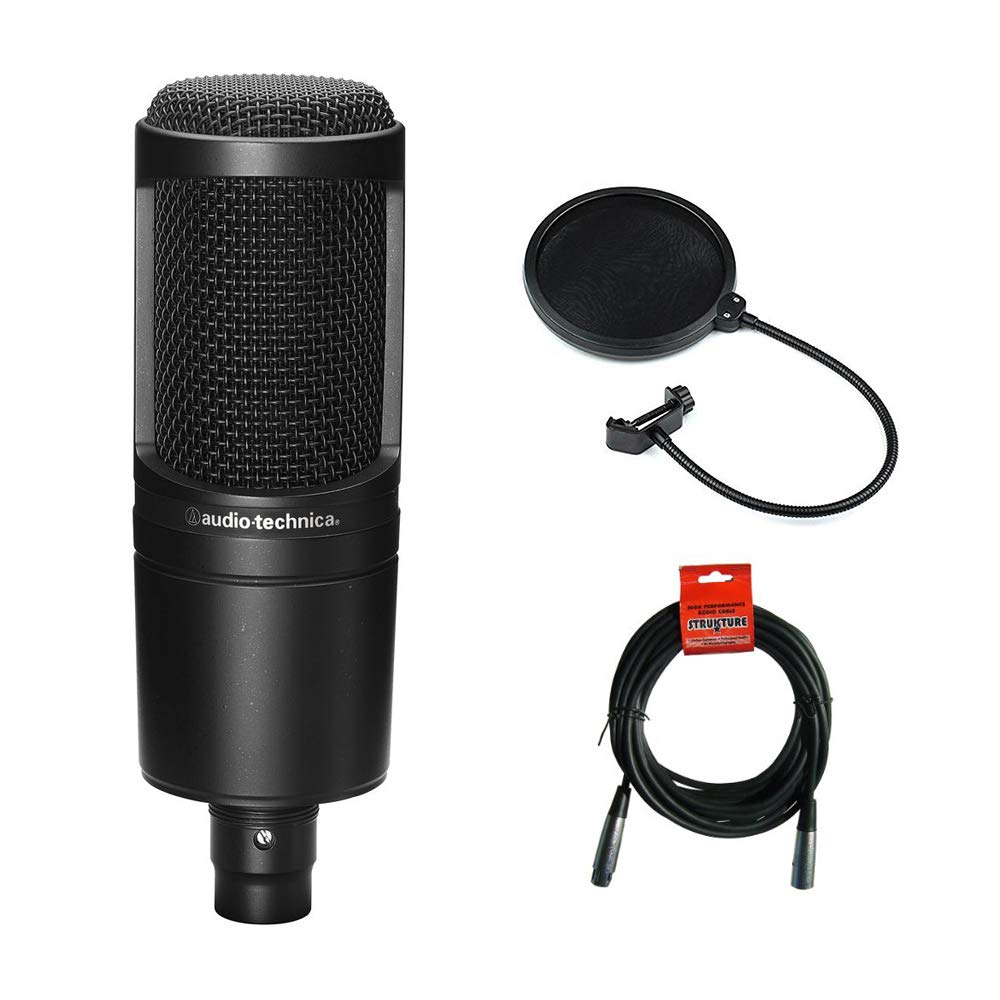
The classic entry-level XLR mic that proves you don’t need to spend a fortune for a clean, reliable recording.
The Audio-Technica AT2020 is the standard by which many budget condensers are judged, and this bundle makes it even easier to start by including a pop filter and a 20 ft. Balanced XLR cable. This means you are ready to plug into your audio interface (which provides the required 48V phantom power) from the start. It offers a frequency range from 20 Hz to 20 kHz, an impedance of 100 Ohms, and self-noise is rated at 20 Decibels — very usable for the price.
While the AT2020 is a cardioid-only mic, it is remarkably consistent and durable. It does not have the multi-pattern versatility of the AT2050, its bigger sibling, nor its more advanced electronics, but it gets the job done for anyone starting out in podcasting, streaming, or home recording. The metal or plastic enclosure keeps the weight down and the cost low. Remember, this is an XLR mic and requires a preamp with phantom power, so a USB interface is needed.
This bundle is perfect for the beginner who wants a proven, reliable entry point into XLR recording. The Blue Blackout Spark SL is listed at 16.4 dB self-noise, while the AT2020 bundle is listed at 20 dB, making the AT2020 bundle a strong no-frills value option for getting started.
Starter bundle: Includes a pop filter and a 20 ft. XLR cable — you just need to add an audio interface with phantom power.
Industry standard: This is the most recommended entry-level XLR mic for good reason — it is clean, reliable, and consistent.
Best for: The first-time XLR buyer who wants to dip a toe into professional recording without any financial risk.
Upgrade if: You already have a decent interface and want a more feature-rich mic with lower self-noise or multi-pattern capability.
Understanding the Specs
Audible Noise (Self-Noise)
This is the low hum the microphone itself produces when it is on but nothing is happening. You see it measured in decibels (dB). A lower number is better — it means the electronics inside are quiet, leaving you more room between your vocal performance and the floor of noise. For recording quiet, intimate vocals or acoustic instruments, look for a mic around 16-20 dB. For louder sources like drums or guitar amps, self-noise matters less because the stronger source signal masks more of the mic’s own noise.
Polar Pattern
This describes which direction the mic hears sound from. A cardioid pattern hears what is in front and rejects noise from the sides and rear — this is the safest choice for a typical home studio setup where you want to minimize room echo. Multi-pattern mics let you switch between cardioid, omni (hears everything, 360 degrees), and figure-8 (hears front and back). Omni is great for capturing room sound or a choir, while figure-8 is perfect for duet interviews or mid-side stereo recording.
Frequency Response
Measured in Hz (Hertz), this tells you the range of pitches the mic can capture. The standard for a good vocal mic is about 20 Hz (lowest bass) to 20,000 Hz (highest sibilance and air). A wider or flatter response usually means the mic will capture more detail and sound more natural, but a mic that deliberately boosts certain frequencies (like the LEWITT LCT 240 Pro’s boost for airy frequencies) can give your voice more presence without needing EQ.
Built-in Controls (Pad & Filter)
Many good mics have two switches on the body. A high-pass filter (or HPF) cuts low rumbling sounds like traffic noise, room rumble, or breath pops — useful for cleaning up your signal at the source. A pad (like -10 dB or -20 dB) reduces the mic’s sensitivity, preventing your audio interface from clipping when you record a loud source like a guitar amp or shouting vocals. Having these on the mic body saves you from having to fix those issues in post-processing.
FAQ
Do I need an audio interface for these condenser mics?
What does 48V phantom power mean?
How do I know if a mic will fit my boom arm or stand?
What is the difference between cardioid and multi-pattern?
Can I use a condenser mic for recording a guitar amp?
How important is self-noise?
Will a condenser mic pick up my keyboard clicks?
What is the difference between a dynamic and a condenser mic?
How long will a quality condenser mic last?
Can I use an XLR to USB adapter instead of an interface?
Final Thoughts: The Verdict
For most buyers, the best condenser mic under 500 is the Warm Audio WA47jr because it delivers professional-grade, vintage-style sound with three polar patterns at a price that beats the competition. If you want an ultra-clean workhorse for loud sources and tricky live sound, grab the Audio-Technica AT4040. And for the budget-conscious beginner who wants a proven, reliable start in XLR recording, the Audio-Technica AT2020 Bundle is the smartest investment on the list.
How We Picked
We do not accept paid placement. Every pick is matched to a real buyer and a real use-case; we do not hands-on test units.
Sources & Methodology
Specifications: manufacturer listings and product documentation. Review insights: verified customer reviews, as of July 2026. Pricing: not shown on this page (it changes often); check the current price via the retailer link.
As an Amazon Associate, WellFizz earns from qualifying purchases. This does not affect which products we feature.

Mo Maruf
I created WellFizz to bridge the gap between vague wellness advice and actionable solutions. My mission is simple: to decode the research and give you practical tools you can actually use.
Beyond the data, I am a passionate traveler. I believe that stepping away from the screen to explore new environments is essential for mental clarity and physical vitality.