Our readers keep the lights on and my smoothie glass nicely filled. As an Amazon Associate, I earn from qualifying purchases.
If water soaks into your driveway, patio, or brick wall, your concrete is slowly breaking down. Freeze-thaw cycles (repeated freezing and melting that cracks surfaces), deicing salts, and moisture will crack, flake, and stain your concrete. The right sealer stops all that. Your first big choice: a penetrating sealer that soaks into the concrete and disappears, or a film-forming sealer that sits on top and leaves a glossy finish. This guide uses the manufacturers’ published specs and patterns from verified customer reviews to give you each pick’s real strengths and trade-offs.
I’m Mohammad Maruf — the co-founder and writer behind WellFizz. This guide is built by comparing the manufacturers’ published specifications and the patterns across verified customer reviews, so you get each pick’s real strengths and trade-offs instead of marketing spin.
How To Choose The Best Concrete Water Sealer
Your first decision is the chemical type and the finish you want. Get those right for your surface, and the rest is just application details.
Penetrating vs. Film-Forming Sealers
A penetrating sealer (like silane or siloxane) soaks into the concrete pores and bonds chemically — it creates an invisible water-repellent barrier. It does not change the look or feel of the surface: no shine, no color change, no slippery film. Use it on driveways, walkways, and anywhere you want the natural concrete appearance and slip resistance. A film-forming sealer (like acrylic) sits on top of the concrete as a physical coating. It can be low-gloss or high-gloss and dramatically darkens and enriches the color — what buyers call a “wet look.” You want this for decorative stamped concrete, pool decks, and patios where a rich, glossy finish matters. The catch: it can wear off under heavy traffic and may need recoating every 1-2 years.
Coverage and Project Size
Sealers come by the gallon and the quart. A gallon of penetrating sealer typically covers 100-400 square feet per coat, depending on how porous your concrete is. A gallon of acrylic sealer covers about 175-225 square feet per coat. Measure your area and plan for two coats on most jobs. For large projects, a 5-gallon pail is often more economical than buying multiple single gallons.
VOC Regulations in Your State
VOC stands for Volatile Organic Compounds — chemicals that evaporate into the air as the sealer dries and cause strong odors. Different states have different rules. Solvent-based sealers (like the Armor models) have high VOC content and may be restricted in California and other strict-rule states. Water-based sealers (like the Black Diamond Stoneworks and BEEST options) have much lower VOCs and are legal everywhere. Check the product listing to make sure the formulation ships to your state before ordering.
Quick Comparison
On smaller screens, swipe sideways to see the full table.
| Model | Category | Best For | Key Spec | Amazon |
|---|---|---|---|---|
| BEEST CS-9500 | Penetrating | Invisible protection on driveways & walkways | 9 lbs (4.1x heavier than Black Diamond) | Amazon |
| MasonryDefender | Penetrating | Large brick & stone projects | 128 fl oz (4x more than Black Diamond) | Amazon |
| Armor AR350 | Film-forming | Wet look on stamped concrete & patios | 9 x 9 x 12 inches (2.2x larger than BEEST) | Amazon |
| Black Diamond Stoneworks | Penetrating | Small projects & targeted spot sealing | 32 fl oz | Amazon |
| Armor AR500 | Film-forming | Large surfaces needing a high-gloss showroom finish | 5 gallons | Amazon |
In‑Depth Reviews
1. BEEST CS-9500 Concrete Sealer
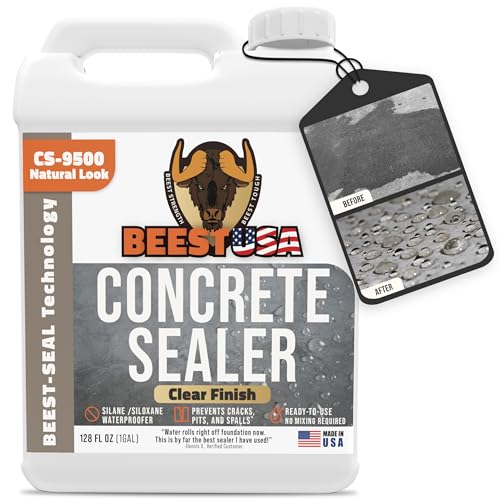
The BEEST CS-9500 is the top pick because it is a contractor-grade formula at 9 pounds per gallon — 4.1x heavier than the Black Diamond Stoneworks quart (2.2 pounds) — for anyone who wants invisible waterproofing with no shine, no color change, and no slippery film. It creates a hydrophobic barrier inside the pores so water beads up and rolls off, and one reviewer noted applying “4 thin coats on stamped concrete patio and walkway” with excellent beading results. The CS-9500 lasts up to 5 years on horizontal surfaces and up to 10 years on vertical surfaces, and because it uses low-VOC BEEST-SEAL technology, there is almost no odor, with one reviewer noting the sealer stayed in a pump sprayer for two weeks without clogging or thickening.
A few buyers noted it slightly darkened the concrete — not what “natural finish” usually promises. If that matters to you, test it on a small hidden area first.
The clear winner for anyone who wants invisible waterproofing without the heavy solvent smell.
Why it’s great
- Deep-penetrating silane/siloxane formula — does not alter the look or feel of your concrete
- DOT approved for freeze-thaw protection on driveways and roads
- Low odor and low VOC — safe to use around plants and pets
Good to know
- Some users reported a slight darkening effect on certain concrete types
- Must apply on a completely dry surface and avoid ponding for best results
2. MasonryDefender All Purpose Brick Stone & Concrete Sealer

Compared to the top pick’s quart (32 fl oz), the MasonryDefender delivers a full gallon (128 fl oz) — four times the volume for covering large brick walls, long stone walkways, or big patios without buying multiple bottles. Like the BEEST, it dries clear with no film or shine. Buyers report it “stopped water seepage from stone porch post into basement” and praise the easy spray-on application with a standard garden sprayer. One reviewer posted photo evidence showing water beading on the treated area while the untreated side stays wet and dark.
The downside: this sealer adds no gloss or color enhancement. A few users noted the long-term durability was unproven after just a few months.
Choose this over the BEEST if your project is primarily brick or cultured stone rather than plain concrete, and you need the larger volume to finish the job in one go — you get more liquid for your money than any other penetrating sealer here.
Where it shines
- Full gallon (128 fl oz) covers large brick and stone surfaces without needing a second bottle
- Quick-drying formula — easy to apply with a garden sprayer
- Proven water-stopping performance in real basements and porch posts
Worth noting
- No color enhancement or glossy finish — purely invisible protection
- Must shake the container very well to prevent clumps from clogging your spray nozzle
3. Armor AR350 Low Gloss Wet Look Concrete Sealer

If you want your concrete pavers to look permanently wet — deep, rich, almost black with moisture — the Armor AR350 is built for that. It is a solvent-based acrylic sealer that forms a thin, durable film on the surface and dramatically darkens the concrete. One reviewer described it as transforming gray slate into a “black wet look” that made the entire pool area pop. Unlike the penetrating BEEST and MasonryDefender, this one is a film-forming sealer, so it sits on top of the concrete rather than soaking in.
The AR350 lays down a low-gloss (not high-shine) finish that resists UV yellowing, road salts, and foot traffic. It covers 175-225 square feet per gallon and needs a 24-hour dry time between coats. Reviewers consistently report that two coats deliver a smooth, waterproof finish that beads water beautifully. The bottle measures 9 x 9 x 12 inches — a chunky can that is 2.2x the dimensions of the BEEST’s container. The strong point is the 700 VOC (Volatile Organic Compounds) solvent base, which means a powerful chemical smell — buyers strongly recommend a respirator. If you live in a state with strict VOC rules, check that the 700 VOC formulation ships to your address, or look for the 350 VOC or 50 VOC versions of the same product.
That 700 VOC rating is the highest solvent punch in this guide, delivering the deepest wet-look darkening you can get from a can.
What stands out
- Delivers a rich, dramatic color enhancement — makes concrete look like it is permanently wet
- Self-priming formula makes recoating simple: just clean, dry, and roll on a new coat
- Long-lasting protection against UV rays, road salts, and foot traffic
The trade-offs
- Strong solvent odor requires a respirator — not a product for enclosed or poorly ventilated spaces
- Film-forming sealer may wear off under heavy vehicle traffic faster than a penetrating sealer
4. Black Diamond Stoneworks Concrete Sealer – Penetrating Water Repellent
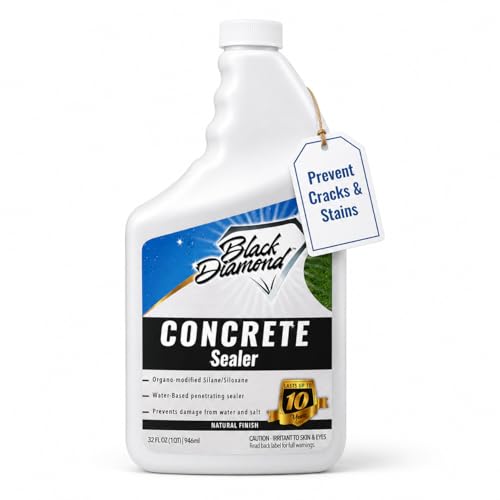
The single number that matters most in this category is size: at 32 fluid ounces (one quart) and weighing just 2.2 pounds, this is the smallest sealer in the lineup — 4.1x lighter than the 9-pound BEEST gallon. If your job is a single birdbath, a ceramic planter, a small patch of brick, or a handful of pavers, a full gallon would sit unused on your shelf for years. That is where the Black Diamond Stoneworks fits: a tiny, targeted solution for small projects that still deserve real protection.
It is a water-based, penetrating siloxane (a penetrating chemical that bonds inside the concrete) formula with low odor and simple cleanup with soap and water. One buyer mentioned “I have seen it repel water!” after using it on a birdbath. Another applied two coats to a ceramic planter to protect it from freezing winters. The sealer dries clear and leaves the surface looking exactly as it did before — just waterproof.
The trade-off: the cost per ounce is higher than buying a gallon. If your concrete area is bigger than about 50 square feet, the quart will run out before you finish the second coat, and you will need to buy another. For the small-project buyer who wants a reliable, easy-to-use penetrating sealer without the commitment of a full gallon, this is the right pick — not the BEEST, not the MasonryDefender — offering a price-to-value read that favors precision over volume.
The upsides
- Small quart size is ideal for planters, birdbaths, grout lines, and spot treatments
- Low-odor, non-toxic water-based formula — safe around pets and plants
- Easy brush application and simple soap-and-water cleanup
Keep in mind
- Very thin consistency — buyers warn it is easy to over-pour if you are not careful
- Price per ounce is higher than buying a gallon; not economical for medium-to-large surfaces
5. Armor AR500 High Gloss Wet Look Concrete Sealer 5 Gallon

The Armor AR500 is the high-gloss sibling of the AR350 above, and it comes in a 5-gallon pail that weighs 42 pounds — the heavyweight of the lineup. If you are sealing a large paver patio (one reviewer covered 900 square feet of Unilock pavers), a big driveway, or a commercial walkway, this 5-gallon pail saves you from needing four separate gallon cans and gives you consistent chemistry across the entire job. This is the one to buy if the AR350’s low-gloss finish is not glossy enough for you.
The AR500 creates a glossy, wet-look finish that dramatically deepens and enriches concrete colors. One buyer describes the result as “stunning high-gloss finish — professional results if applied correctly.” The formula is solvent-based (700 VOC), self-priming, and resists UV yellowing, road salts, and abrasion. A gallon covers up to 225 square feet per coat, so the 5-gallon pail handles up to about 1,125 square feet with a single coat or just over 550 square feet with two coats. The strong fumes require a respirator and full ventilation. Drips can form a film in a pool, so one reviewer recommends turning off the filter and using a net. Recoating is needed every 1-2 years under foot traffic.
A premium choice for the serious DIYer or contractor who wants the best-looking gloss on a large surface.
Why we’d pick it
- 5-gallon pail gives you one consistent batch chemistry for large commercial or residential projects
- High-gloss wet look delivers the most dramatic color enhancement of any sealer in this guide
- Self-priming and easy to maintain — just clean and recoat when the shine begins to fade
A few caveats
- Strong solvent odor — a respirator is essential and outdoor application is strongly recommended
- Coverage can be lower than expected; some buyers needed two coats on very porous surfaces
Understanding the Specs
Silane vs. Siloxane vs. Acrylic
Silane and siloxane are both penetrating sealers. They are tiny molecules (silane is smaller) that soak into concrete pores and chemically bond with the surface, repelling water from the inside out. Siloxane is a slightly larger molecule that stays closer to the surface but still penetrates. Acrylic sealers, by contrast, form a plastic film on top of the concrete. That film can be low-gloss, satin, or high-gloss. Acrylic gives you color enhancement and a wet look, but it can yellow, scuff under traffic, and needs recoating more frequently — every 1-2 years instead of every 3-5.
VOC Content and Why It Matters
VOC stands for Volatile Organic Compounds — chemicals that evaporate into the air as the sealer dries. High-VOC products (like the 700 VOC Armor sealers) smell stronger and are regulated in states like California. Low-VOC and water-based formulas (like Black Diamond Stoneworks and BEEST) have far less odor and are legal everywhere. If you are sealing an indoor surface (like a garage floor) or working in a tight space, choose a low-VOC product. For outdoor driveways with good airflow, high-VOC is not a problem — just wear the right respirator.
FAQ
How long does a concrete sealer last?
Can I apply a wet-look sealer over an existing penetrating sealer?
Do I need to seal new concrete right away?
Final Thoughts: The Verdict
If you want one dependable pick, the best concrete water sealer is the BEEST CS-9500 because it gives you invisible, deep-penetrating protection against water and road salts without any odor or slippery film. If you want the dramatic wet-look finish that darkens your concrete and makes the colors pop, grab the Armor AR350 — its 700 VOC solvent base gives the deepest color change in this guide. And for a large brick or stone project where you need maximum value per gallon, the MasonryDefender gives you 128 fluid ounces — 4x the liquid of the Black Diamond quart — for one consistent price.

Mo Maruf
I created WellFizz to bridge the gap between vague wellness advice and actionable solutions. My mission is simple: to decode the research and give you practical tools you can actually use.
Beyond the data, I am a passionate traveler. I believe that stepping away from the screen to explore new environments is essential for mental clarity and physical vitality.