Our readers keep the lights on and my smoothie glass nicely filled. As an Amazon Associate, I earn from qualifying purchases.
Specs are compiled from manufacturer listings and verified buyer reviews and can change over time — please confirm the key details on the product page before buying.
If you are painting a concrete wall, the biggest question is straightforward: will this paint stop moisture from seeping through, or are you just adding color to a problem? Concrete is porous — it soaks up water like a sponge — so the right paint has to do two jobs at once: give you a great looking finish and block the water trying to push through from the other side. This guide sticks to three paints purpose-built for concrete and masonry, separating the ones that merely decorate from the ones that seal.
I’m Mohammad Maruf — the founder and writer behind WellFizz. This guide is built by comparing the manufacturers’ published specifications and the patterns across verified customer reviews, so you get each pick’s real strengths and trade-offs instead of marketing spin.
The three paints below are the only ones to consider if you are serious about getting the job done right the first time, and they represent the entire range of what a quality concrete wall paint can actually offer, from high-pressure waterproofing to durable stain finishes that bond to the surface instead of just sitting on top.
Quick Picks
How To Choose The Best Concrete Wall Paint
Concrete wall paint is not one-size-fits-all. You need to match the paint to the surface condition, the moisture level, and whether the wall is indoors or outdoors. The three specs that really separate a good paint from a waste of money are waterproofing ability, coverage rate, and the finish type.
Hydrostatic Pressure & Waterproofing
A paint that says “waterproof” on the can is only useful if it comes with a real number — a hydrostatic pressure rating. That rating tells you how much water weight the paint film can hold back. If your basement wall has water pushing against it from wet soil outside, you need paint rated to withstand at least 10 to 12 PSI (pounds per square inch). Without this number, you are just coloring the damp, not stopping the leak.
Coverage Per Gallon
Coverage in this category varies wildly — from as little as 75 square feet per gallon for a thick waterproof coating, to as much as 400 square feet per gallon for a stain or an all-in-one exterior paint. A lower coverage number is not a bad thing: it usually means a thicker, more protective layer. Always measure your wall area before buying, and budget for a second coat since bare concrete will drink the first coat.
Finish: Satin vs. Low Sheen
The sheen level affects both look and function. A satin finish reflects a bit more light, making it easier to clean and more moisture-resistant on the surface. A low sheen or flat finish hides surface imperfections better but is more porous to dirt. For interior basement walls, a satin or semi-gloss is usually the smarter choice because it wipes down easier and resists mildew growth better than a flat finish.
Quick Comparison
| Model | Best For | Coverage | Finish | Waterproof | Amazon |
|---|---|---|---|---|---|
| Glidden Total Exterior Paint & Primer | Exterior concrete & masonry | Up to 400 sq. ft. | Satin | No | Amazon |
| INSL-X WaterBlock Acrylic Masonry Waterproofer | Basement waterproofing | 75 to 125 sq. ft. | Semi-Gloss | Yes (12 PSI) | Amazon |
| INSL-X TuffCrete Acrylic Concrete Stain | Stained concrete finish | 300 – 400 sq. ft. | Low Sheen | No (stain) | Amazon |
In‑Depth Reviews
1. INSL-X WaterBlock Acrylic Masonry Waterproofer Paint, White, 1 Gallon

The only pick here built to physically hold back groundwater against your basement wall.
This paint is the heavyweight in the lineup — quite literally, at 11.05 pounds per gallon versus the TuffCrete stain at 9.86 pounds per gallon. That extra weight comes from the thick acrylic body, which delivers a waterproofing layer rated to withstand up to 12 PSI of hydrostatic pressure. That is not marketing fluff: it means this coating can resist the force of water pushing in from saturated soil outside, a capability the Glidden exterior paint simply does not claim.
Buyers report a real-world result that matches the spec. One reviewer noted: “No more water leaking in, and we have had a few good long heavy rains since the second coat and everything is dry.” The trade-off is coverage — you only get 75 to 125 square feet per gallon, versus the Glidden’s up to 400 sq. ft. The paint is fast-drying and has high alkali resistance (up to pH-13), so it holds up against the chemical conditions common on fresh concrete and cinder block. Apply it only when the temperature is between 50 °F and 90 °F for proper cure.
What seals the deal
- Genuine 12 PSI hydrostatic pressure rating — one of the few concrete paints with a real number behind its waterproof claim.
- High alkali resistance (up to pH-13) means it bonds to fresh, uncured masonry without the paint peeling off later.
- Comes with a can opener and stir stick included, so you do not need to buy extra tools to start.
One trade-off to know
- Low coverage rate (75 to 125 sq. ft. per gallon) means a medium basement wall will need at least two gallons for two coats.
Reach for this if: you have a basement or foundation wall with active moisture intrusion and you want a paint that carries a real pressure rating, not just a label.
Know before you buy: the white color is practical for a waterproofing coat, but you will need to top-coat it if you want a color other than white — the 75-125 sq. ft. coverage also means you should measure your wall carefully before ordering.
2. INSL-X TuffCrete Waterborne Acrylic Concrete Stain Paint, Desert Sand, 1 Gallon

A concrete stain that bonds deep into the surface rather than just coating the top.
Unlike the WaterBlock above, this product is a stain, not a waterproof sealer — it soaks into the concrete pores instead of forming a thick film on top. The chemistry is different: it is a waterborne acrylic that you can apply in one coat for a translucent stain look, or two coats for a solid, opaque finish that owners mention looks like a painted surface but breathes like a stain. One buyer mentioned: “Have to apply 2 coats as 1st gets sucked into the concrete which is what you want.” This absorption is exactly what gives the finish durability against scrubbing and detergents.
The coverage is generous at 300 to 400 square feet per gallon, similar to the Glidden, but unlike the Glidden this product is self-priming and self-sealing — a major time saver since there is no separate primer step. It is designed for both vertical and horizontal masonry surfaces (concrete, stucco, brick), and the low sheen finish hides surface imperfections much better than a glossy paint would. At 9.86 pounds per gallon, it is lighter than the WaterBlock because the acrylic formulation is not loaded with the same level of waterproofing solids, which makes sense for a stain that needs to penetrate rather than sit on top.
Stain that lasts: Resists fading, oils, grease, and cleaning detergents — the “non-fade” spec (listed in the product’s additional features) means the color holds up in direct sun better than a standard paint with a thin color layer.
Best suited for: interior stained concrete floors, patios, walkways, or any horizontal concrete surface where you want the color to live inside the slab rather than peel off the surface.
Not for waterproofing: this stain does not carry a hydrostatic pressure rating and should not be used below grade on a basement wall that sees water pressure — that job belongs to the WaterBlock above.
3. Glidden Total Exterior Paint & Primer All-in-One, Fudge/Brown, Satin, 1 Gallon
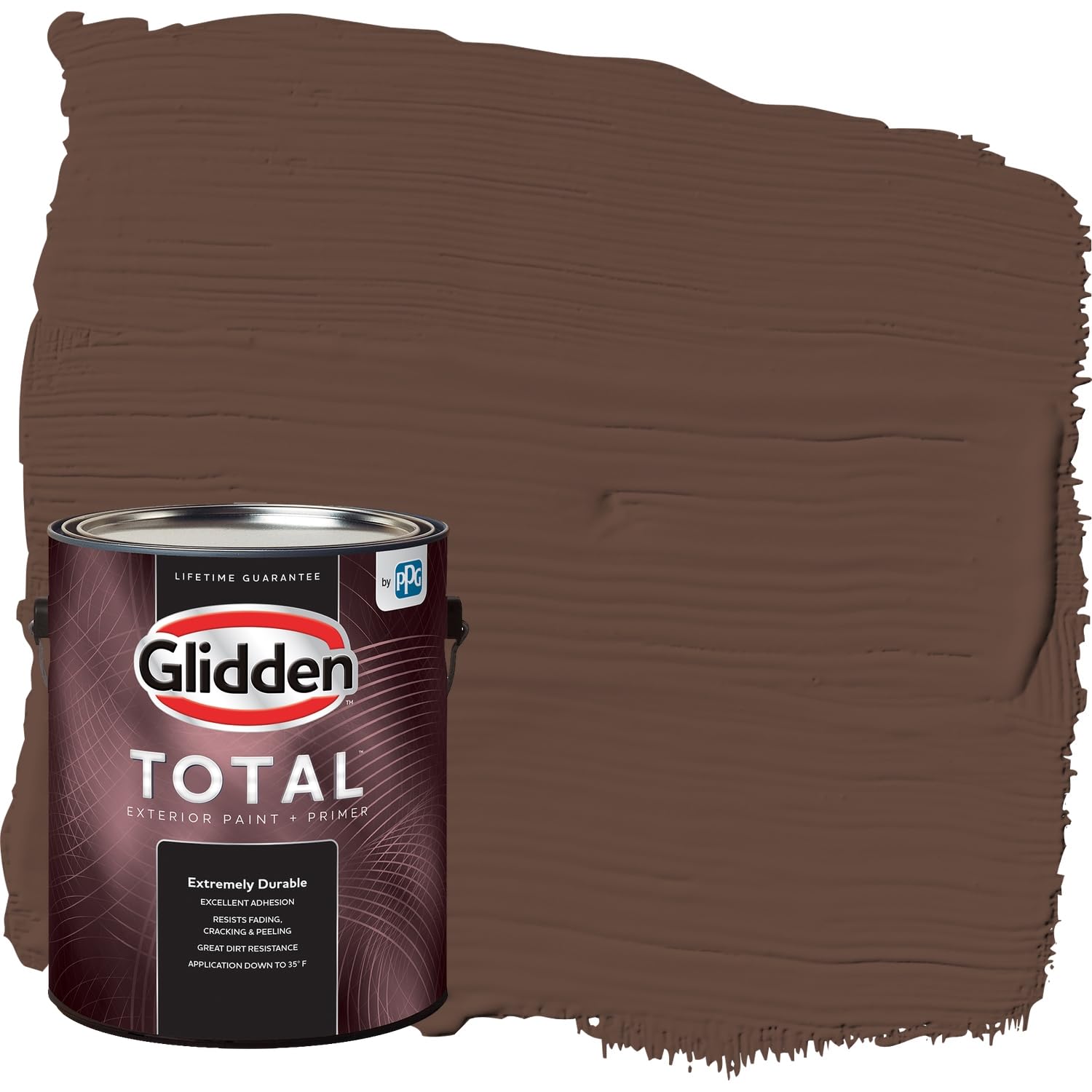
The economical exterior paint that covers a huge area but does not claim to stop moisture.
This Glidden is the highest-coverage option in the group at up to 400 square feet per gallon, which makes it the obvious choice if you are painting a large exterior concrete wall, a brick facade, or a masonry shed. It is a paint-and-primer all-in-one with a satin finish — that satin sheen offers better dirt resistance and cleanability than a flat paint. Customers note genuine satisfaction: one review called it “excellent 1-coat semigloss paint, sprays well, strong finish, great color.” The full cure time is 4 hours, meaning you can recoat or expose it to light weather the same day.
The catch is that it is not a waterproofing product — the product data explicitly lists “Is Waterproof: False.” Unlike the INSL-X WaterBlock, this paint will not stop hydrostatic pressure from pushing moisture through a basement wall. It is designed for proper outdoor exposure where the wall itself is already dry and the paint’s job is color and weather resistance, not water blocking. The product works on wood, brick, masonry, concrete, weathered aluminum, and primed metal, so it is the most versatile surface match in this list if you need one paint for mixed materials. Application is possible down to 35 degrees Fahrenheit, extending your painting season into cooler months.
Why it wins for value
- Highest coverage at 400 sq. ft. per gallon — you can paint a large wall with just one or two cans, unlike the WaterBlock where you might need three.
- Works down to 35 °F, so spring and fall painting is possible without waiting for a heat wave.
- Paint and primer in one, plus a stir stick included — grab a bucket and go.
Where it falls short
- Not waterproof and has no hydrostatic pressure rating — completely wrong for basement walls or below-grade concrete that sees moisture.
Buy this for: a budget-friendly exterior refresh on concrete walls, brick, or masonry where the wall is already dry and you just want great coverage at the lowest cost per square foot.
skip it if: there is any sign of moisture, efflorescence (white chalky deposits), or dampness on the concrete — those walls need a waterproof coating like the INSL-X WaterBlock instead.
Understanding the Specs
Hydrostatic Pressure
If a paint says it can withstand a certain PSI (pounds per square inch) of hydrostatic pressure, that is the number that tells you exactly how much water weight the coating can block. The INSL-X WaterBlock is rated at 12 PSI — that is enough to hold back a column of water about 27 feet tall pushing against the back of the wall. If no PSI number is listed, the paint is not designed to stop actual water intrusion; it is just a decorative coating.
Coverage Per Gallon (sq. ft.)
For concrete paint, lower coverage usually means a thicker, more protective layer. A product that covers 75-125 sq. ft. per gallon (like the WaterBlock) is building up a film thick enough to bridge hairline cracks and resist pressure. A paint that covers 400 sq. ft. per gallon (like the Glidden) is thinner and better suited to dry surfaces that only need color. Always assume you need two coats on bare concrete regardless of the product — the first coat will soak into the porous surface.
FAQ
Can I use regular exterior paint on a concrete basement wall?
How many coats of concrete stain do I actually need?
What does 12 PSI hydrostatic pressure mean in real life?
Is concrete stain waterproof like regular concrete paint?
Can I paint over old concrete paint on a wall?
What temperature range is safe to apply concrete paint?
How do I calculate how many gallons I need for my wall?
Why does concrete stain cost more per gallon than regular paint?
Final Thoughts: The Verdict
For the majority of shoppers, the best concrete wall paint winner is the INSL-X WaterBlock because it is the only product here with a genuine 12 PSI hydrostatic pressure rating that actually blocks water intrusion. If you want a stained concrete floor or patio color that bonds deep into the slab rather than coating the top, grab the INSL-X TuffCrete. And for a budget-friendly exterior refresh on a dry wall where coverage per dollar matters most, the standout is the Glidden Total Exterior Paint & Primer.
How We Picked
We do not accept paid placement. Every pick is matched to a real buyer and a real use-case; we do not hands-on test units.
Sources & Methodology
Specifications: manufacturer listings and product documentation. Review insights: verified customer reviews, as of July 2026. Pricing: not shown on this page (it changes often); check the current price via the retailer link.
As an Amazon Associate, WellFizz earns from qualifying purchases. This does not affect which products we feature.

Mo Maruf
I created WellFizz to bridge the gap between vague wellness advice and actionable solutions. My mission is simple: to decode the research and give you practical tools you can actually use.
Beyond the data, I am a passionate traveler. I believe that stepping away from the screen to explore new environments is essential for mental clarity and physical vitality.