Our readers keep the lights on and my smoothie glass nicely filled. As an Amazon Associate, I earn from qualifying purchases.
Picking the wrong concrete sealer means a faded driveway, peeling film on your patio, or wasted weekend effort. The real question isn’t which one is the most expensive — it’s which formula (water-based acrylic, solvent-based acrylic, or penetrating silane/siloxane) matches your surface and your goal, whether that’s a glossy wet look or invisible waterproofing that leaves the stone looking natural.
I’m Mohammad Maruf — the co-founder and writer behind WellFizz. This guide is built by comparing the manufacturers’ published specifications and the patterns across verified customer reviews, so you get each pick’s real strengths and trade-offs instead of marketing spin.
Whether you want a high-gloss shine for your stamped concrete driveway or a breathable sealer that keeps your brick patio safe from winter freeze-thaw cycles, the right concrete sealer is defined by its active chemistry, coverage rate, and real-world durability as reported by homeowners who have already put it to the test.
How To Choose The Best Concrete Sealer
Your concrete is porous — it absorbs water, oil, and de-icing salts that cause cracking and staining. A sealer creates a barrier. The three main types are acrylic (film-forming), penetrating silane/siloxane (water-repellent), and epoxy/polyurethane (heavy-duty, usually for garages). Your choice depends on whether you want to change the color and gloss of the concrete or keep its natural look.
Acrylic Sealers: For Color Enhancement and a Wet Look
Acrylic sealers sit on top of the concrete, forming a thin plastic film. They darken the surface dramatically, giving you that “wet look” that makes paver colors pop. They come in water-based (low odor, easy clean-up) and solvent-based (tougher, more durable, stronger smell) formulations. Solvent-based acrylics like the Armor AR350 tend to last longer and resist yellowing better than water-based versions, but they require a respirator during application. Most acrylics need recoating every 1 to 3 years depending on sun exposure and traffic.
Penetrating Sealers: For Invisible Protection
Penetrating sealers (silanes and siloxanes) chemically react inside the concrete pores to repel water from within — they do not change the look or feel of the surface at all. They are breathable, meaning trapped moisture can escape, which prevents freeze-thaw damage. These are the right choice for natural stone, brick, and exposed aggregate where you want to stop water and salt damage without adding shine. They typically last 3 to 10 years, depending on the quality of the formula and the porosity of the concrete. The Siloxa-Tek 8500 is a premium example in this category.
Coverage Rate and Number of Coats
Every manufacturer lists a coverage rate in square feet per gallon. Acrylic sealers usually cover 150 to 400 square feet per gallon per coat. Most acrylics require two thin coats for even coverage and durability. Penetrating sealers often require two “wet-on-wet” coats — you apply the second coat while the first is still wet to ensure deep saturation. A gallon of concentrate like Lithi-Tek 9500 makes 5 gallons of ready-to-use sealer, covering up to 1,000 square feet per coat, which is significantly more economical for large projects than single-gallon jugs.
VOC Regulations: What You Can Buy Depends on Where You Live
VOC (Volatile Organic Compounds) limits vary by state. California and several other states have strict caps (often 50 or 100 grams per liter for solvent-based sealers). Most major brands like Foundation Armor offer multiple VOC formulations — for example, a 700 VOC version for unrestricted states and a 50 VOC version for regulated states. Always check the VOC rating before purchasing, or you may receive a product you legally cannot apply in your area.
Quick Comparison
On smaller screens, swipe sideways to see the full table.
| Model | Category | Best For | Key Spec | Amazon |
|---|---|---|---|---|
| Armor AR350 | Acrylic, Solvent | Low-gloss wet look on pavers | 175–225 sq. ft/gal coverage | Amazon |
| DOMINATOR LG+ | Acrylic, Water-based | Low-odor, fast-dry large paver projects | 250–400 sq. ft/gal coverage | Amazon |
| MasonryDefender | Silane/Siloxane | Invisible waterproofing for brick and stone | 90–150 sq. ft/gal coverage | Amazon |
| Lithi-Tek 9500 | Penetrating, Concentrate | Densifying and waterproofing old driveways | Up to 1,000 sq. ft/gal (mixed) | Amazon |
| Armor AR500 | Acrylic, Solvent | High-gloss wet look on stamped concrete | 175–225 sq. ft/gal coverage | Amazon |
| Siloxa-Tek 8500 | Silane/Siloxane, Concentrate | Long-term salt and water protection | Up to 250 sq. ft/gal (mixed) | Amazon |
| Armor WL550 | Acrylic, Solvent | Matte wet look on natural stone | Ready to use, no mixing required | Amazon |
In‑Depth Reviews
1. Armor AR350 Low Gloss Wet Look Concrete Sealer

175–225 square feet per gallon coverage with a low-gloss wet look makes the Armor AR350 the top pick for homeowners who want dramatic color enhancement on exterior driveways, walkways, or patios without the blinding shine of a high-gloss sealer.
Coverage sits at 175–225 square feet per gallon, which buyers report is accurate when applied in two thin coats. Owners mention that a 48-hour cure time delivers the final finish, and the water beading effect becomes visible almost immediately. It is self-priming, so you do not need a separate primer coat, and it is available in three VOC formulations (700, 350, and 50) to stay legal in any state. Customers note that after two coats the finish looks fantastic and water beads perfectly.
The catch is the strong chemical odor — this is a solvent-based sealer, and multiple reviewers warn that a good respirator (not just a dust mask) is essential during application. If you are sealing a small area near windows or doors, the fumes can be overwhelming for about an hour. For the confidence of a professional-grade finish that lasts years on driveways and garage floors, the AR350 earns its spot as the top recommendation. skip it if you are sealing near living spaces or have respiratory sensitivity — the DOMINATOR LG+ is a better choice there.
Why it’s great
- Dramatic color enhancement with a low-gloss wet look
- Self-priming and easy to apply with a sprayer or roller
- Long-lasting protection against UV, road salts, and abrasion
Good to know
- Strong solvent fumes require a respirator
- Bubbling can occur if applied in direct heat
2. DOMINATOR LG+ Clear Acrylic Sealer
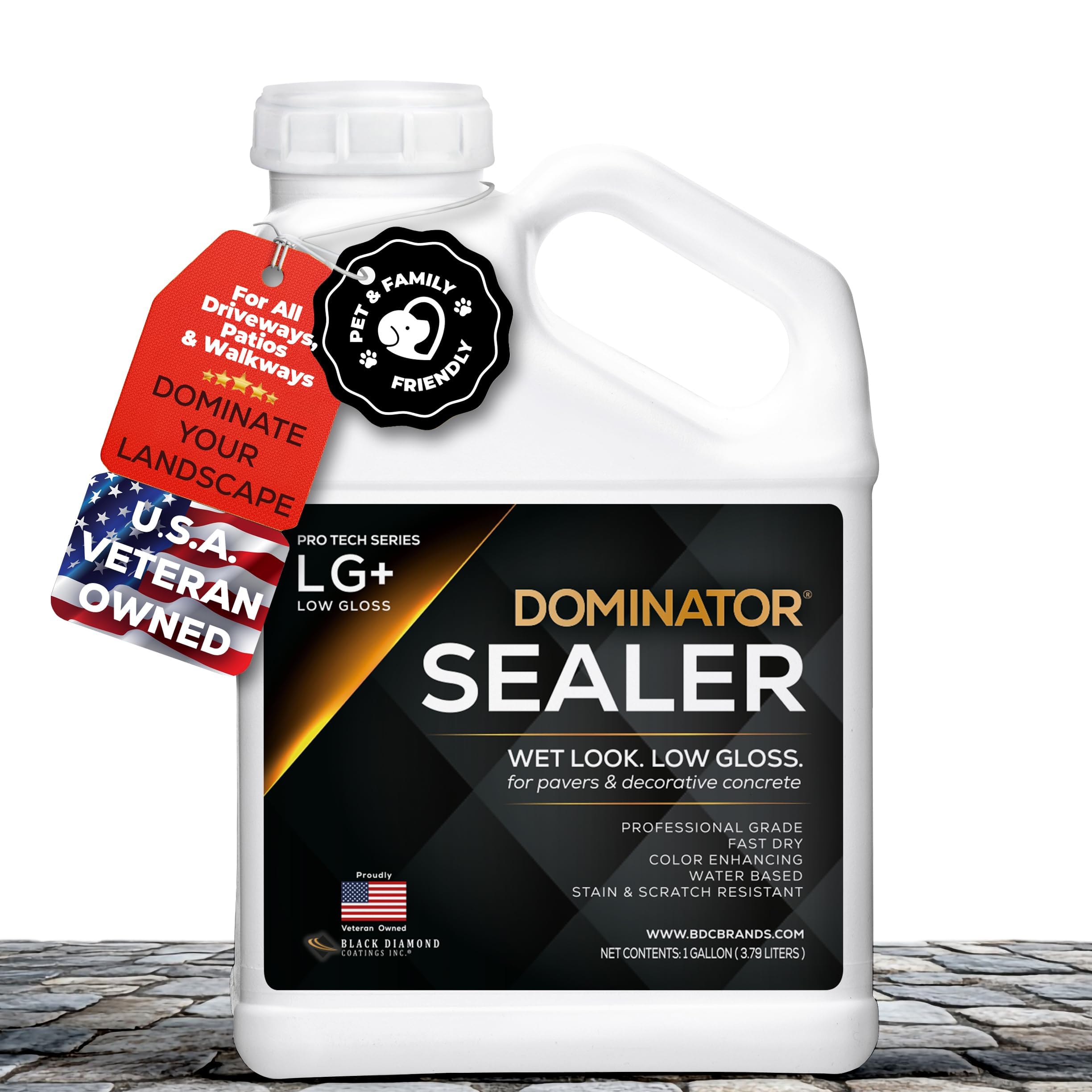
The DOMINATOR LG+ is the strongest alternative to the Armor AR350 if odor and dry time matter more to you than maximum longevity. Where the AR350 is solvent-based and stinky, the DOMINATOR is water-based with low VOCs and no harsh odor, making it a much more pleasant weekend project. But it loses on coverage versatility — the AR350 covers 225 sq ft per gallon, while the DOMINATOR stretches to 250–400 sq ft per gallon, per coat, meaning you get more square footage out of each can.
Reviewers point out applying two coats to 1,500 square feet of brick pavers with a garden sprayer in under an hour, and the fast dry time means you can do both coats in a single day. The finish is a wet look with a low gloss sheen that makes paver colors pop without looking like a high-gloss plastic coating. It protects against oil stains and weather, lasting 2–4 years before needing a recoat, according to the manufacturer.
If you are sealing a large area near your house or in a neighborhood where chemical fumes would be a problem for neighbors or pets, the DOMINATOR LG+ is the smarter choice than the AR350. Just know that it is a film-forming acrylic (it sits on top of the surface), so you need to keep pavers clean before application — one reviewer noted that sand lines can hold dirt that washes off, which is normal for this type of finish. This one works best for large paver projects where speed and low odor are priorities, not for natural stone or clay surfaces, which the manufacturer says it is not intended for.
Where it shines
- Water-based formula with low odor and low VOCs
- Fast dry time allows two-coat application in one day
- High coverage rate of 250–400 sq ft per gallon
Worth noting
- Not intended for stone or clay surfaces
- Rain shortly after application can cause temporary white spots
3. MasonryDefender All Purpose Brick Stone & Concrete Sealer

Imagine you have a stone porch post that drips water into your basement every time it rains, or a brick walkway that darkens and grows moss every winter — you need a sealer that stops water at the source without leaving a shiny film. The MasonryDefender is a penetrating silane/siloxane sealer that soaks into porous masonry and chemically reacts to repel water from inside the material, leaving the surface looking exactly as it did before.
Shoppers say that it effectively stopped water seepage from a stone porch post into a basement after a simple spray application. The coverage rate is 90–150 square feet per gallon, which is lower than acrylics because penetrating sealers need to saturate deep into the pores. Buyers report that it dries quickly and is easy to apply with a garden sprayer, but it lacks any shine or color enhancement — you get zero visual change. One buyer confirmed it works by showing picture evidence of water beading on brick after application.
This is the sealer to choose if your priority is invisible waterproofing and breathability (trapped moisture can escape, preventing freeze-thaw cracking) rather than a cosmetic upgrade. Its standout spec is the 320 fluid ounce container (2.5 gallons), giving you a generous volume for covering large masonry walls or multiple brick planter boxes.
What stands out
- Penetrating formula preserves the natural look of brick and stone
- Creates a waterproof barrier that stops water seepage
- Easy spray-on application with a garden sprayer
The trade-offs
- No color enhancement or gloss — surface looks unchanged
- Requires thorough shaking before use to avoid clumping
4. Lithi-Tek 9500 Ultra Concentrate Penetrating Concrete Sealer
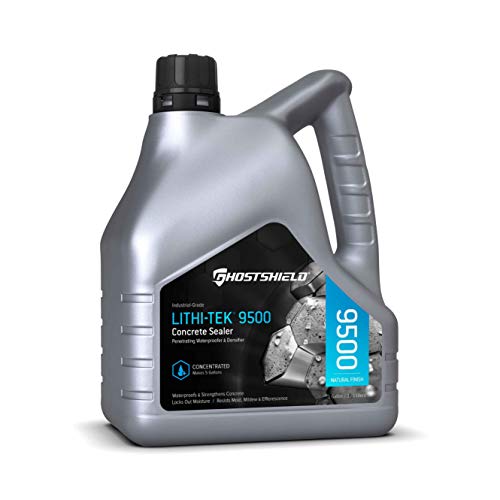
The single number that matters most in this category is coverage per gallon, and the Lithi-Tek 9500 Ultra Concentrate Penetrating Concrete Sealer scores at up to 1,000 square feet per coat — one gallon of this ultra-concentrate mixes with 4 gallons of water to create 5 gallons of ready-to-use sealer, covering roughly 10 times the area per jug of a standard ready-to-use acrylic sealer, making it the most economical pick for large driveways and garage floors.
The downside is that this is a penetrating sealer, meaning it densifies the concrete and creates a hydrophobic (water-repelling) barrier inside the pores. It does not change the color or add any gloss — your concrete looks exactly the same, just more resistant to water, efflorescence (white powdery stains), and surface abrasion. Owners mention that it strengthens concrete by up to 50% and works well on old aggregate driveways, but requires thorough surface cleaning and a dry day with temperatures around 70°F.
If you have a large expanse of plain concrete — a 1,500-square-foot driveway, a basement floor, or a garage slab — and you want maximum protection without changing its industrial look, the Lithi-Tek 9500 delivers the best cost-per-square-foot value in this lineup. It also prevents hydrostatic pressure and moisture vapor transmission, so it is a smart choice for basement walls and floors where moisture intrusion is a concern. The price-to-value line here is simple: you pay more upfront for the concentrate, but each application covers far more square footage than any single-gallon acrylic.
The upsides
- Ultra-concentrate makes 5 gallons, covering up to 1,000 sq ft
- Densifies concrete, increasing abrasion resistance
- Prevents efflorescence and reduces water vapor intrusion
Keep in mind
- No color enhancement or visual change
- Requires clean, dry surface and 70°F temperature for best results
5. Armor AR500 High Gloss Wet Look Concrete Sealer

What you actually get at this lower price is the same solvent-based acrylic chemistry as the AR350, but formulated for a high-gloss finish instead of low-gloss — it produces the kind of mirror-like wet look that makes 15-year-old stamped concrete look freshly poured. Coverage remains 175–225 square feet per gallon, and the 5-gallon pail gives you enough for a substantial project. Customers note stunning results on stamped concrete and Unilock brand pavers, noting that two coats produce vibrant colors and excellent water beading.
The AR500 is self-priming, UV-resistant to delay yellowing, and available in multiple VOC formulations. One buyer mentioned that after a failed cheap sealer, the AR500 gave their patio a beautiful wet look that the big-box store products could not match. The honest catch is that high-gloss shows every imperfection — drips, streaks, and uneven coverage are more visible than with a low-gloss sealer like the AR350.
Reviewers warn that drips in a pool can form a floating film that needs to be netted out. And at 42 pounds for the 5-gallon pail, it is heavy to move around. For a driveway or patio where you want that glossy “wow factor” that lasts, the AR500 is the premium choice, but it requires careful application technique — the exact budget buyer it is perfect for is the homeowner who prioritizes dramatic, glossy appearance over application ease and is willing to invest the extra effort in meticulous technique.
Why we’d pick it
- High-gloss wet look dramatically enhances color
- Long-lasting, non-yellowing, UV-resistant finish
- Self-priming and easy to maintain with a single recoat
A few caveats
- High gloss shows imperfections and drips clearly
- Drips in pools can create floating film that requires cleanup
6. Siloxa-Tek 8500 Ultra Concentrate Penetrating Concrete Sealer

If you live in a cold climate where de-icing salts are spread on driveways and sidewalks every winter, or if you have a saltwater pool deck, the Siloxa-Tek 8500 is purpose-built for you. It is a Department of Transportation (DOT) approved penetrating sealer that resists chloride and salt damage — the kind of chemical attack that causes concrete to spall (flake off), pit, and crack over repeated freeze-thaw cycles.
This concentrate makes 5 gallons of sealer from 1 gallon of formula, covering up to 250 square feet per gallon per coat. The active particles are smaller than standard siloxanes, so they penetrate deeper into the concrete for longer-lasting protection. Reviewers point out that water beads like glass on treated concrete and that the effect lasts multiple years — one reviewer has been using it every three years on a saltwater pool deck and says water still beads up after a couple of seasons. It dries completely invisible and is breathable, so it will never peel or delaminate.
The honest limit is cost — this is the most expensive concentrate on the list, and when you factor in the full mixed volume, it is still a significant upfront investment. But for any surface exposed to de-icing salts (driveways in snow states, walkways near roads), the Siloxa-Tek 8500 offers unmatched chemical protection that cheaper sealers cannot match. Choose this if you want a “set it and forget it” solution that lasts 5-plus years between applications.
Strong points
- DOT approved for resisting de-icing salt and chloride damage
- Concentrate makes 5 gallons for extended coverage
- Invisible, breathable finish — never peels or delaminates
Before you buy
- High upfront cost compared to non-concentrate sealers
- Coverage varies significantly based on concrete porosity
7. Armor WL550 Deep Penetrating Solvent-Based Matte Wet Look Sealer

The Armor WL550 sits at a moderate price point among the seven picks, offering better value than the premium AR500 but costing more than basic penetrating sealers; it fills a specific niche that most acrylic sealers ignore by giving natural stone and masonry a wet look without the high-gloss shine. It sits between the penetrating sealers (which add no visual change) and the glossy AR500 (which can look plastic on flagstone). This is the pick for flagstone patios, bluestone walkways, slate paths, and brick walls where you want color enhancement and a slight darkening but absolutely no slippery film.
It is solvent-based and chemically reacts below the surface to form a water repellent barrier, which means it reduces water absorption without leaving a glossy topcoat. Shoppers say that it makes flagstone look non-dusty and enhances the natural color, and water beads up on the surface. One reviewer used 6 gallons on a 900-square-foot flagstone and mortar walkway with a pump sprayer, reporting good coverage with no second coat needed. Another verified that it reduces mold and algae growth in a humid Florida climate.
Choose the WL550 over the AR350 or DOMINATOR if you are working with natural stone (slate, bluestone, flagstone) where a slick shiny film would be dangerous underfoot when wet, or where you want to preserve the natural texture. The 5-gallon pail is ready to use out of the can with no mixing, and at 44 pounds it is a substantial bucket, but the coverage is generous enough for large walkways and patios. A caution, though: buyers report the wet look can fade after about 6 months depending on sun exposure, so plan for maintenance, which is the one clear reason to choose it: you want a non-slip wet-look finish for natural stone that no other sealer in this guide provides.
What we like
- Matte wet look that enhances natural stone without a glossy film
- Penetrates below the surface to form a water repellent barrier
- Reduces mold and algae growth in humid climates
The downsides
- Wet look can fade after 6 months depending on exposure
- Sprayer nozzle can clog if not cleaned thoroughly after use
Understanding the Specs
Film-Forming vs. Penetrating
Film-forming sealers (acrylics like the Armor AR350 and DOMINATOR LG+) sit on top of the concrete and create a protective plastic layer. They darken and enhance the color, giving a “wet look,” but they can peel, scuff, or yellow over time. Penetrating sealers (like Lithi-Tek 9500 and Siloxa-Tek 8500) soak into the concrete pores and chemically bond to repel water from within. They do not change the color or texture, but they never peel because there is no film to peel. For driveways that experience vehicle traffic, penetrating sealers are often preferred because tire marks do not scuff the surface.
VOC Regulations
VOC (Volatile Organic Compounds) are chemicals that evaporate into the air as the sealer dries. Many states, especially California, have strict VOC limits that determine which sealer formulas you can legally buy and apply. Solvent-based acrylics often come in 700 VOC (for unrestricted states), 350 VOC, and 50 VOC formulations. Water-based acrylics and silane/siloxane sealers naturally have lower VOCs. Always check the VOC rating of the product you are ordering — buying a higher-VOC sealer in a regulated state can result in shipping delays or legal issues.
Coverage Rate and Surface Porosity
Coverage is listed as square feet per gallon, but the actual number depends heavily on how porous your concrete is. New, smooth concrete absorbs less sealer, giving you closer to the maximum listed coverage. Old, rough, or broom-finished concrete (which has a textured surface) is more porous and can absorb significantly more sealer, reducing your effective coverage. For penetrating sealers, you may need two “wet-on-wet” coats — apply the second coat while the first is still wet — to ensure the concrete is fully saturated. Always buy 10–20% more sealer than you think you need for porous surfaces.
DOT Approval and Salt Resistance
DOT (Department of Transportation) approval means a sealer has been tested to resist damage from de-icing salts and chlorides, which are the primary cause of concrete spalling (surface flaking) and cracking in cold climates. You can find this spec listed on the product page for penetrating sealers like the Siloxa-Tek 8500. If you live in a winter state where salt trucks pass your driveway, DOT approval is a meaningful indicator that the sealer will last longer than a standard acrylic under salt exposure.
FAQ
Can I apply a concrete sealer in cold weather?
How long does a concrete sealer last before I need to reapply?
Water-based vs. solvent-based acrylic sealer — which one should I choose?
What is the difference between a high-gloss and a low-gloss concrete sealer?
Can I use a concrete sealer on indoor surfaces like a garage floor?
Final Thoughts: The Verdict
For most people, the concrete sealer that makes the most sense is the Armor AR350 because it provides a professional-grade low-gloss wet look with long-lasting protection that works on driveways, patios, and pavers, and it comes in multiple VOC formulations to ship anywhere. If you want a fast-drying, low-odor option for a large paver project, grab the DOMINATOR LG+. And if your concrete or brick simply needs invisible waterproofing — no color change, just protection — the concentrated Lithi-Tek 9500 gives you the most coverage per dollar for large areas.

Mo Maruf
I created WellFizz to bridge the gap between vague wellness advice and actionable solutions. My mission is simple: to decode the research and give you practical tools you can actually use.
Beyond the data, I am a passionate traveler. I believe that stepping away from the screen to explore new environments is essential for mental clarity and physical vitality.